Thursday, 28 May 2026

When Cities Burn: Could the Los Angeles fires happen here?

 Excerpt: 

"In January 2025, in the middle of the Northern Hemisphere’s winter, Los Angeles was overrun by a firestorm that killed 31 people, destroyed more than 16,000 structures, and left one of the world’s best-resourced firefighting teams overwhelmed.

This prompted an immediate, and unsettling question for many Australians: could something like this happen here?

Our new analysis brings together the latest science, climate trends and fire behaviour research to provide the answer.
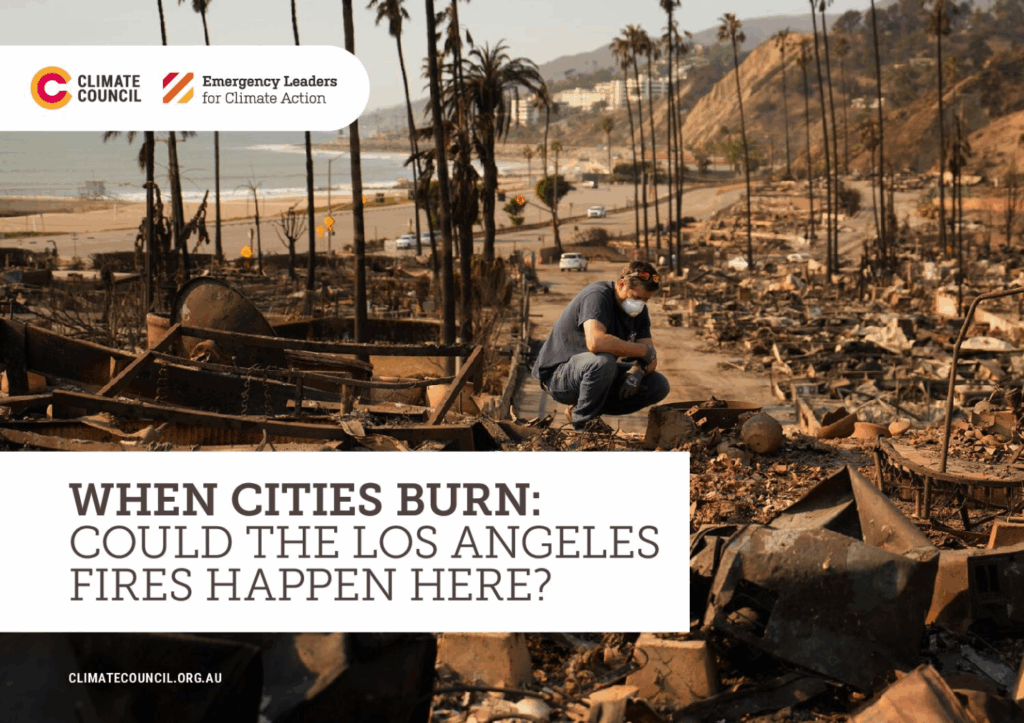
The uncomfortable truth is that many of the factors that led to the LA disaster are already present in Australia — and getting worse. Climate pollution from burning coal, oil and gas is supercharging heat, drying out landscapes, lengthening fire seasons and fuelling more extreme fire weather across fire-prone regions.

Australians have already experienced fires with the same hallmarks of the LA fires: drought- parched forests, strong winds, low humidity, explosive fire behaviour, and unstoppable fire fronts that fire agencies, no matter how well-resourced, struggle to respond to. 

In 2003, it happened in Canberra. In 2009, Black Saturday hit Victoria. Tasmania and the NSW Blue Mountains were ablaze in 2013. Then, the national megafires of 2019-20: the Black Summer bushfires; the most destructive and widespread in Australia on record.

What Australia has not yet experienced — but is increasingly at risk of — is what Los Angeles endured: a major fire hitting a major city. 

Our latest analysis explains that millions more Australians now live on the expanding outskirts of our capital cities and major regional centres, where homes adjoin highly flammable bush and grasslands. 

These at-risk communities — from the Dandenong Ranges in Victoria, Perth Hills, Adelaide Hills, the Blue Mountains, Sydney suburbs, NSW Central Coast, Hobart’s suburbs and Canberra’s western edge — are already some of the most fire-exposed urban areas in the world. 

In this report, we outline how climate change played an instrumental role in supercharging the main factors that underpinned the Californian catastrophe, and compare those conditions across Australia’s capital cities. We also explain why firefighters are increasingly facing fires they cannot stop; and what must be done to protect Australian lives, homes and communities as extreme fire weather intensifies.

We still have a choice on just how dangerous future fire conditions become. Now is the time to reduce climate pollution further and faster, to adapt our cities, and prepare our fire services and communities for a future increasingly at risk of devastating bushfires.

Key findings

1. The shocking 2025 wildfires that ripped through Los Angeles neighbourhoods in the middle of winter were supercharged by climate pollution.

  • Climate pollution from the burning of coal, oil and gas shaped the dangerous and extreme weather conditions that drove these fires: record dryness; non arrival of the typical annual wet season; and hurricane-like winds gusting up to 160 kmh.
  • Climate pollution has all but erased traditional fire seasons and turned them into an all-year-round threat. The January 2025 fires hit in the middle of winter, well outside of the traditional fire season from June to November.
  • LA experienced climate whiplash: a rapid switch between two very wet years that resulted in extreme fire fuel loads, followed by very dry conditions ideal for fires.
  • Around the world, climate pollution is driving worsening fire conditions: 43% of the 200 most damaging fires have occurred in just the past decade.

2. Many Australian cities share dangerous characteristics that made the LA fires so destructive, and many of our worst bushfires have also exhibited unstoppable fire behaviour.

  • Like California, many parts of Australia have a hot and dry climate. Research shows between 2000 and 2023 the intensity and frequency of the worst fires in southern Australia and western North America rose sharply under more extreme weather conditions.
  • Australia has suffered through fires with the same characteristics as LA: extremely strong winds, drought conditions, high fuel loads and unstoppable fire behaviour. During Black Saturday 2009 in Victoria, the fire danger index exceeded 200 (with 100 the upper limit of recognised fire danger rating up until 2009).
  • Fire-generated thunderstorms, or pyroconvective events, were relatively rare with 60 such events recorded in Australia in the 40 years up to 2018. During Black Summer, there were at least 45 fire- generated thunderstorms.
  • Our analysis shows that the outskirts of Sydney, Melbourne, Canberra, Adelaide, Perth and Hobart share characteristics that made the LA fires so destructive.

3. Just like in LA, more people than ever are living in harm’s way on the fast-growing urban fringes of Australian cities.

  • In LA, hurricane-like Santa Ana winds (up to 160 km/h) created a firestorm that fed on tinder dry brush, then houses. From 1990-2020, 45% of all new homes in California were built where suburbs meet flammable terrain.
  • Over the past 20 years, outer suburban populations have exploded in Australia, too: More than doubling in Melbourne and Perth, up 36% in Adelaide, 33% in Hobart and 24% in Sydney.
  • More than 6.9 million Australians now live where suburbs meet the bush — the zones most exposed to deadly fires. Had the Black Summer bushfires directly impacted the edges of our cities or major regional centres – such as Sydney, Newcastle, Wollongong, the NSW Central Coast, the Dandenong ranges, the Adelaide Hills, the Perth Hills or Hobart – then property losses on the scale of LA could have occurred.
  • Many of the LA homes that burnt were built before fire resilient building standards were introduced there in 2008. Up to 90% of Australian homes in high-risk fire zones were also built before modern bushfire standards existed — making ignition due to ember attack and house-to-house fire spread far more likely.
  • Research shows that, globally, 10% of all fires result in 78% of all fatalities. Most of these occur in suburbs built where bush or grassland meets cities.

4. Climate pollution is turbo-charging Australian fire conditions, and it’s making fires more frequent, costly, intense – and less predictable.

  • Since 2020 insurance premiums have increased by 78% to 138% for homes in bushfire-prone Local Government Areas within Sydney, Melbourne and Perth.
  • The cost of the 2019/20 Black Summer bushfires to our economy was estimated at $10 billion. It is a matter of when – not if – we’ll experience another fire on this scale, or worse, as dangerous fire weather conditions driven by climate pollution make this a near certainty.
  • From 1979 to 2019 fire seasons across Australia grew by an additional 27 days – a 20% increase over the 40-year period.
  • Southern Australia is experiencing long-term declines in cool-season rainfall at the same time as spring and summer become hotter and drier: setting the stage for earlier, more intense and widespread fires like the 2003 Canberra fires and 2009 Black Saturday bushfires.
  • Fire behaviour at night is becoming more extreme and robbing firefighters of a tool they’ve used for centuries: attacking fires and backburning during milder night conditions to bring large fires under control.
  • The world’s first large-scale fire-generated tornado – and the fastest rate of spread for a forest fire –  was recorded in Canberra, in January 2003.

5. Climate-fuelled fires are increasingly exceeding the limits of modern firefighting. Investment in community preparation and urgent cuts to climate pollution are both critical to saving Australian lives and communities.

  • There is no way to safely or effectively fight pyroconvective events, like those experienced in Canberra 2003, Black Saturday 2009, and the Black Summer bushfires. Aircraft must be grounded, and efforts to protect properties temporarily abandoned.
  • Modelling shows that 3°C of global warming would result in catastrophic fire danger zones three times bigger than experienced on Black Saturday in 2009 (810,000 km2) with temperatures as high as 48°C in Victoria, NSW, and South Australia.
  • Fires on this scale are considered beyond the limits of any fire service to control. Los Angeles is one of the best-resourced firefighting jurisdictions in the world, but was still overwhelmed: extreme winds grounded aircraft, simultaneous fires limited assistance, and there was sudden loss of water pressure.
  • Australia is facing more days of extreme fire weather and larger, more damaging fires under worsening fire weather caused by climate pollution. We must:
    • Cut climate pollution from coal, oil and gas more swiftly and deeply if we’re to avoid even worse.
    • Invest heavily in disaster preparation and community resilience at all levels of government so we’re as prepared as possible  for the worsening fire risks we already face.
    •  As a priority, increase emergency service and land management capacity at the urban fringe of our cities and major regional centres so growing populations are better protected for what’s to come." Climate Council


At least 11 dead as Europe bakes in unprecedented heatwave

 Excerpt: 

"In short:

London has recorded a maximum temperature of 35 degrees Celsius on Tuesday, breaking the record for the hottest day in May on record.

Europe is sweltering through an unusually early heatwave that scientists say are becoming more frequent and occurring at abnormal times due to climate change.

At least 11 people have died in Britain and France, mostly due to drownings as people seek relief. 

Sunday, 19 April 2026

Excerpt: "Despite Trump Actions, the Most Dangerous Climate Argument Today Isn’t Denial — It’s Delay"

on


Despite the growing awareness that climate change is real, as evidenced by communities facing floods like this one in North Carolina’s Outer Banks, the politics of climate action remain stuck. Credit: National Park Service

Under Donald Trump’s renewed push to expand fossil fuel production — including plans to ramp up oil and gas drilling and roll back climate regulations — climate politics in the United States is entering a new phase. Although Trump’s climate agenda is very much aligned with outright denial, it has become less central in mainstream climate action debate. Instead, opposition to policies such as carbon pricing, emissions standards, and fossil fuel phaseouts remains strong.

At the same time, the impacts of climate change are becoming harder to ignore. When the devastating wildfires tore through Los Angeles in January 2025, causing over $60 billion in destruction, millions of Americans glimpsed what climate change looks like up close. Across the country — as in many parts of the world — the signs are multiplying: insurers abandoning coastal areas, deadly heatwaves breaking records, and entire communities facing floods or drought. Understandably, the proportion of Americans who believe global warming is happening has increased over time, rising from about 57 percent in 2010 to over 70 percent in recent years, according to the Yale Climate Opinion Map of 2024.

Yet, despite this growing awareness, the politics of climate action remain stuck.

The old strategy of obstructionists — denying climate change outright — has largely lost credibility among scientists and the public at large. The scientific consensus on human-caused climate change is overwhelming, and its impacts are increasingly visible. But the departure of denial has not meant the arrival of decisive action. 

Instead, something more subtle has taken its place: climate delay.

Scholars have increasingly warned about this shift. In 2020, William Lamb and colleagues identified a set of arguments that acknowledge climate change but still justify postponing meaningful action. These “discourses of climate delay” include familiar claims that action would hurt the economy, that technology will solve the problem later, or that responsibility lies with someone else.

Building on this framework, we conducted a nationwide survey of more than 1,500 Americans in 2024 to examine how widespread these narratives have become among the public — and how they might shape support for climate policy. Our findings show that large segments of the U.S. public hold beliefs that align with these narratives.

And they are everywhere: in political speeches, cable news debates, and everyday conversations.

Listen closely to climate debates today, and you’ll hear them constantly:

Yes, climate change is real — but why should we act if China doesn’t?

Yes, it’s real — but regulations will hurt ordinary people.

Yes, it’s real — but technology will solve it eventually.

These arguments sound reasonable. Many contain a kernel of truth. But together they add up to the same conclusion: not now.

Our research suggests that some of these narratives are particularly powerful in undermining support for climate policy. And it is not necessarily the most widespread ones that are most problematic.

The most influential narrative is what is often called “whataboutism,” which only about a third of our respondents subscribed to. This argument shifts responsibility for climate change elsewhere — usually toward other nations — while downplaying one’s own emissions. Americans hear it constantly: Why should the United States cut emissions if China is building coal plants? Unless other countries act, why should we?

In our survey, people who agreed with this line of argument were significantly less likely to support climate policies or demand government action. 

It’s an argument that resonates politically because it taps into familiar themes of fairness and national competition. But it also misunderstands the nature of global cooperation. If every country waits for someone else to act first, no one moves.

‘No Sticks, Just Carrots’

Another powerful narrative insists that climate policy must rely only on voluntary action — what can be described as “no sticks, just carrots.” Subsidies for clean energy? Fine. But regulations, bans, or carbon taxes? Off the table.

This framing is politically convenient because it allows leaders to appear supportive of climate goals while avoiding the policies most likely to reduce emissions. But it also undermines support for the kinds of measures that actually work — from carbon pricing and emissions standards to restrictions on fossil fuels.

A third potent narrative exploits genuine concerns about fairness. Many people worry that climate policies will raise energy prices or hurt working-class communities. These concerns are understandable and occasionally real, as badly designed policies can indeed impose unfair costs — underscoring the importance of ensuring that the transition away from fossil fuels is fair and equitable.

But when these concerns are used to block climate action entirely or strategically deployed to obstruct it, then they become another form of delay. In our study, framing climate policy primarily as a threat to social justice significantly reduced support for government climate action.

Under Donald Trump’s first term, climate denial was still common. Today, it has been re-energized at the political level — with figures in the current administration engaging with climate denial networks and rolling back environmental protections. At the same time, familiar delay tactics remain central: acknowledging climate change while shifting responsibility to others or downplaying the need for urgent action. The result is not a replacement of denial with delay, but a more dangerous combination of the two — one that risks further entrenching resistance to meaningful climate policy. This helps explain why, even as most Americans now accept that climate change is real, many remain uncertain or divided over the policies needed to address it."


Tuesday, 7 April 2026

Trump’s Budget Proposes Massive Cuts for Climate and Environmental Programs: Inside Climate News excerpt


The budgets of the EPA, NOAA and FEMA would all be slashed, as would incentives for renewable energy.

President Trump’s annual budget request to Congress continues his administration’s defunding of climate change programs, environmental protection and renewable energy, slashing the budgets of the Environmental Protection Agency, the National Oceanic and Atmospheric Administration and the Federal Emergency Management Agency. 

 Demonstrators march during a “Hands off the EPA” rally outside the agency’s offices in Ann Arbor, Mich., on April 22, 2025. Credit: Jeff Kowalsky/AFP via Getty Images


The spending plan for fiscal 2027 “builds on the President’s vision by continuing to constrain non-defense spending,” wrote Russell Vought, director of the Office of Management and Budget, in a foreword to the 92-page document, which includes an historic, $1.5 trillion defense budget, an increase of 44 percent.

EPA spending would be cut in half under Trump’s proposal, released Friday, and grants from the agency would be slashed by $1 billion. Congress rejected a similar budget request from the president last year. 

An Inside Climate News analysis of federal workforce data released by the Office of Personnel Management shows that EPA lost more than 4,000 employees in the first year of Trump’s second term, reducing its workforce to 12,849, its lowest level since the 1980s. The 24 percent reduction was more than double the rate of losses across the entire federal government.


“This EPA budget proposal leaves families sicker, not safer,” said Michelle Roos, a former EPA project manager and current executive director of the Environmental Protection Network, an organization of former EPA employees. “This is part of the Trump administration’s dangerous and far-reaching plan to let polluters decide which toxic chemicals to dump in our drinking water, which harmful pollution to pump into the air we breathe, and which pesticides are put on the food we eat.”

Trump’s proposed budget would also cut $449 million from renewable energy funding and re-propose canceling $15 billion in renewable energy infrastructure funding under the 2021 Bipartisan Infrastructure Law, which Trump has called part of a “Green New Scam.” 

“The U.S. Government will no longer subsidize intermittent energy forms that destabilize the grid or Green New Scam projects,” Trump’s budget proposal said. “Instead, the Budget pushes an aggressive America First agenda that would combat foreign influence through robust domestic critical material supply chains, as well as revitalize the Nation’s Strategic Petroleum Reserve.” 

To date, the Trump administration has moved to discontinue tax credits and other incentives provided under Biden’s Inflation Reduction Act for renewable energy and electric vehicles and has taken aggressive action to halt three offshore wind programs under construction off the U.S. coast in the Atlantic Ocean.

Most recently, the Trump administration has offered France’s Total Energy $928 million to forfeit leases on wind farms off the East Coast if the company reinvests those funds in U.S. oil and gas projects. 

Meanwhile, since Trump began bombing Iran on Feb. 28 and, in retaliation, Iran closed the Strait of Hormuz, through which 20 percent of the world’s oil and gas is shipped, gasoline prices in the U.S. have increased by more than $1 at the pump across the country, an increase of 35 percent in just over a month. 

Beyond the EPA cuts, Trump’s budget plan includes cuts of $1.6 billion for the National Oceanic and Atmospheric Administration, which it said has “consistently funded efforts to radicalize students against markets.” The budget also cut $1.3 billion from Federal Emergency Management Agency grants, and $1 billion from Environmental Protection Agency grants and $1 billion from the National Institute of Standards and Technology, which, the document said, “has long funded awards for the development of curricula that advance a radical climate agenda.” It also proposes eliminating the $4 billion Low Income Home Energy Assistance Program.

The National Energy Assistance Directors Association said eliminating the low-income home energy assistance program “would deepen the nation’s energy affordability crisis and leave millions of vulnerable households without the assistance they need.” 

In a statement on Friday, the Center on Budget and Policy Priorities said Trump’s proposal, which cuts roughly $100 billion from non-defense discretionary spending, “isn’t a serious plan” and “isn’t worthy of the American people.” The Committee for a Responsible Federal Budget said the president’s proposal was “missing any significant plan for how to address the major drivers of our spending and deficit growth.” The conservative Cato Institute said that “Trump’s budget falls short on the spending programs driving the federal debt.” 

The American Public Health Association said that Trump’s proposal “threatens all aspects of the public’s health” and “should be dead on arrival.” The Sierra Club said Trump’s budget “fails to adequately fund the agencies and programs tasked with protecting our clean air and drinking water.”

A spokesperson for the Ocean Conservancy told the website Seafood Source, “Slashing NOAA’s budget would weaken weather forecasting, disrupt fisheries management and stall ocean research—putting American lives, livelihoods, and global scientific leadership at risk.”

https://insideclimatenews.org/news/06042026/trump-budget-proposes-epa-noaa-fema-cuts/ 

Wednesday, 1 April 2026

Excerpt: Canada’s Oil Industry Is Trying to Cash in on Iran War Canadian politicians and pundits are leveraging Trump’s war with Iran to expand fossil fuel infrastructure."

 Analysis By Mitch Anderson on Mar 19, 2026


"Prime Minister Mark Carney and Equinox CEO Anders Opedal meeting to discuss the proposed Bay Du Nord project. Credit: Mark Carney/Facebook"

"Never let a good crisis go to waste. That seems to be the strategy of fossil fuel interests trying to leverage the oil-related conflict in the Persian Gulf to lock in another chapter of oil extraction.

Alberta Premier Danielle Smith flagged the unfolding war as a rationale to fast track bitumen export infrastructure, telling a Calgary news conference, “We’re here to help..Part of the way in which we can help is, of course, with expansions to the West Coast pipelines”. Prime Minister Mark Carney was quick to promote the proposed offshore oil Bay du Nord development in Newfoundland as, “a very attractive project” that will produce “very low carbon oil”.

Pro-extraction talking points were similarly trotted out four years ago when Russia invaded Ukraine, causing European allies to restrict Russian energy imports and inflating prices.

This is the Shock Doctrine in action, where oil-related interests exploit crises like armed conflict to catalyze ever more extraction. Canadian author Naomi Klein coined the term for her 2008 book of the same title on “the rise of disaster capitalism”.

Oil producers outside the Gulf region now reap windfall profits while publicly trying to curb their enthusiasm. “The idea that the industry profits from war and death is not one a VP of public relations wants to promote,” Mark Jones, political science fellow at Rice University’s Baker Institute, said to Politico. Canadian oil investors are likewise licking their chops, calling the Iran conflict a “massive opportunity” for oil companies here.

While fossil fuel producers might rake in short-term profits from war-related price instability, consumers instead are demanding a more ethical, sustainable and secure supply of energy.

Electric vehicle sales just eclipsed gas cars in Europe, with EV purchases jumping a whopping 50 percent over the same time last year. The EU also saw renewable power generation overtake fossil fuels for the first time in 2025, a milestone rooted in the last energy security shock when  Russia marched on Kyiv. For decades, carbon-based energy was essentially the only option for rapidly developing economies in Asia. China drove global oil demand for over twenty years, which only peaked in 2024. That energy security calculus flipped in the last few years with wind, solar, and batteries already outcompeting fossil fuels on cost, without the added risk of catastrophic supply disruptions now unfolding in the Persian Gulf.


Canada’s potential LNG customers are the countries most affected by Trump’s latest war. To understand how insecure fossil fuel supply lines can be, consider that Iran struck the world’s largest LNG facility in Qatar with a $30,000 drone, shutting down production for one-fifth of the global supply. Qatar declared a force majeure, meaning it washed its hands of legal contracts to supply countries like India and Pakistan with LNG, which rely on Qatar for 50 percent and 99 percent of their supply respectively.

Pakistan in particular has seen this predicament before. Global gas prices spiked after the Ukraine invasion, causing a European energy panic. Pakistan’s LNG supply contracts were promptly ignored by international brokers who re-routed their shipments to Europe at a massive profit. Pakistan has since pivoted heavily toward renewables and the latest supply crisis will only accelerate that transition.

The current war could be seen as Asia’s Ukraine moment. Yet unlike Europe in 2022, nations like India now have alternatives to unstable energy in the form of increasingly affordable renewables. Solar and batteries already beat fossil fuels on levelized costs of operation, and they will also soon be cheaper even on capital costs.

That means a new solar installation coupled with energy storage will cost less than building a coal or LNG plant, with no ongoing fuel costs or risks of supply disruptions. This approaching tipping point will further propel the global move to renewables.

This war will not last forever (hopefully) and perhaps in the coming months energy shipments will return to something approaching normal. The question for Canada and our potential export customers is whether we should double-down on fossil fuel infrastructure, further destabilizing geopolitics and our climate. Experts tracking the rapidly accelerating energy transition have the opposite view.

“Do you want to invest in an industry that’s dying, where you can maybe get a couple of windfalls? This is not a sustainable growth market for jobs, for the economy,” Ember energy analyst Daan Walter told the National Observer.

This ugly war and the speeding energy transition present Canadians with a stark choice: which side of history do we want to be on?" DeSmog


Excerpt:" The War on Wind Continues The burn, baby, burn compulsion persists amid a fossil fuel crisis"

Mar 25, 2026

 
 https://paulkrugman.substack.com/p/the-war-on-wind-continues


 Electricity generation in Texas. Source: Energy Information Agency

We are now in a global fossil fuel crisis. With oil and liquefied natural gas from the Persian Gulf unable to reach international markets due to Iran’s blockade of the Strait of Hormuz, hydrocarbon prices have been soaring around the world and widespread shortages are emerging. Anyone who thought that the U.S. would be insulated from this dire picture thanks to its large domestic oil production has had a rude awakening: the average retail price of gasoline has risen more than $1 per gallon over the past month, while the price of diesel is up $1.60.

But the Trump administration hasn’t allowed these short-run distractions to divert it from its long-run goals: It remains deeply committed to killing renewable energy, especially wind power, and increasing America’s reliance on fossil fuels.

True, some of the administration’s attacks on wind power have failed: Its efforts to throttle offshore wind development by ordering developers to stop work on projects that are already underway have repeatedly been overruled by the courts. But the administration is continuing to block development of onshore wind and solar power by freezing the issuance of federal permits.

And on Monday the Interior Department unveiled a new tactic in its war on wind: It announced that it will pay TotalEnergies, a French energy giant, almost $1 billion to not produce energy — specifically to abandon its plans to build two large wind farms off the East Coast.

To understand the Trump administration’s motives in its campaign to kill renewable energy, one must realize that this campaign is both economically self-destructive and, despite the best efforts of the fossil fuel industry, deeply unpopular.

Fifteen years ago wind and solar power were still relatively marginal energy sources, which those hostile to their development could portray as unproven and uneconomic. Today they are major contributors to energy supply in many nations — and in some U.S. states. Perhaps most notably, as the chart at the top of this post shows, renewables — mostly wind, but with a growing role for solar — now account for more than a third of electricity generation in Texas, America’s largest producer of electricity and not exactly a state run by environmental extremists.

Even more impressively, renewables have dominated the growth in Texas’s electricity generation in recent years:......"  Read more at the link above.


Excerpt: "Why War Is One Of The World’s Biggest Climate Threats" Forbes


"By Nils Rokke,

Contributor.

I write about the global energy transition and net-zero emissions.


"As war rages on in Ukraine, Gaza, Sudan, and Congo, the world’s attention is understandably focused on human suffering and destruction. But a quieter, longer-lasting war is also being waged—one against nature, biodiversity, and the global climate.

War is among the most destructive forces on Earth, and not just for the people caught in its path.

While humanitarian impacts dominate headlines, the environmental costs are immense and largely ignored.

Armed conflicts unleash unprecedented levels of greenhouse gas emissions and pollution from the fossil-fueled tanks, jets, and warships to the vast industrial complexes that churn out ammunition, drones, and military vehicles. This is not to be ridiculed as we are talking about a strong driver for conflicts, global warming and biodiversity attrition.

PROMOTED

Every stage of war, from preparation and production to combat and eventual reconstruction, leaves an indelible carbon footprint on the planet.

The Climate Cost Of Military Action

Recent research has found that global militaries are responsible for nearly 5.5% of total global greenhouse gas emissions—a staggering figure that puts military emissions on par with the global cement industry. If it were a country, it would be the fourth biggest emitter in the world.

Military emissions are more than 2 times greater than those from global civil aviation. Although military spending accounts for about 2% of global GDP, its emissions intensity is roughly three times higher than the global economic average, making it one of the dirtiest and least regulated sectors in terms of climate impact.

Yet unlike most other major sectors, military emissions often remain invisible, exempt from many international reporting obligations and largely absent from climate negotiations.

The Cost Of The Ukraine Conflict

The ongoing war in Ukraine offers a stark example of how devastating the environmental impact of war can be.

According to a recent report from the Initiative on Greenhouse Gas Accounting of War, emissions attributable to the war in Ukraine have reached an estimated 230 million tons of CO₂ equivalent over the first three years—more than the combined annual emissions of all five Nordic countries.

These emissions stem from burning oil depots, exploded gas pipelines, and widespread damage to energy infrastructure. The destruction of electrical transformers and power stations releases specialized gases such as sulfur hexafluoride, or SF₆, a substance used for its insulating properties in high-voltage equipment...." ....Forbes