
USNEWS.COM

La Corte Internacional de Justicia emitió la Opinión Consultiva OC-32-2025, que reconoce el cambio climático como un riesgo existencial causado por …
The International Court of Justice issued the Consultative Opinion OC-32-2025, which recognizes the climatic change as an existential risk caused by …
International Court of Justice imposes legal responsibility in countries that do not allow measures to slow down the climate change.
"Science journalist Adam Becker speaks with DeSmog about how Silicon Valley tech billionaires have invented new forms of greenwashing and climate denial in their quest for ever-more fantastic technology.

In the wildest dreams of tech billionaires, humans colonize the solar system on giant space stations, dodge mortality by uploading their brains into computers, and solve climate change in a single swoop of god-like AI-generated genius.

It’s a hubris that has led Big Tech companies, which until recently were seen as corporate climate leaders with ambitious clean energy goals, to run full-tilt towards oil and gas — powering the rapid expansion of their monstrously energy-hungry AI data centers with natural gas, and holding court with Trump energy officials who deny climate science while championing American fossil fuel “energy dominance.”
To all of this, Adam Becker, an astrophysicist and science journalist, basically says – Um. No.
Becker’s book, More Everything Forever: AI Overlords, Space Empires, and Silicon Valley’s Crusade to Control the Fate of Humanity,
exposes how tech billionaires’ sci-fi inspired fantasies about
ever-more technology making everything, endlessly, better are basically,
well — terrible. These billionaires’ promises, in Becker’s careful
accounting, veer from what he says is “wildly implausible” to
“profoundly immoral” – and ultimately paves the way for a descent into
oligarchy.
They’re also, in Becker’s view, emerging as the root
of a new, Silicon Valley-styled “insidious form of climate denial” –
replete with its own set of what he calls greenwashing tactics.
DeSmog reporter Rei Takver spoke with Becker about what he thinks
drives this new kind of climate denialism, and its consequences.
This interview has been condensed and edited for concision and clarity.
Rei Takver: You’ve said that writing More Everything Forever started after uncovering that evangelical Christian tech billionaire and Palantir founder Peter Thiel
was funding a science magazine, Inference: International Review of
Science, that was publishing not only creationism, but full-on climate
science contrarianism. Why did Thiel’s climate denial take you over the edge?
Adam Becker:
People take Silicon Valley’s ideas about science and technology very
seriously, as though the leaders of the tech industry actually know
anything about science or tech. It’s an understandable mistake to make,
but it’s a mistake. When I started thinking about what I already knew
about that, I realized that there was this through-line in Silicon
Valley of climate denial of a kind, usually not the outright climate
denial that you find in that Thiel-funded magazine,
but a more insidious form of climate denial that minimizes climate
change as a problem and says, “Oh, this is something that we can solve
later, once we’ve built an [artificial intelligence] god, or gone to
space.”
Rei Takver: When I see the phrase “more everything forever,” it conjures visions of endless power — more oil, more gas, more nuclear, forever. You’ve written about how many of these tech billionaires, such as OpenAI CEO Sam Altman, love dreaming about tapping into endless sources of infinite energy — often alongside the Trump administration. Why do you think Altman, and a wide selection of other tech leaders are aligning with the Trump administration’s aggressively fossil-fuel dominant AI energy policy?
Adam Becker: Let
me answer your question with a segue. Nuclear fusion is one of these
false promises of the tech industry, right? There’s a company, Helion,
saying that they’re going to get a nuclear fusion power plant online at
commercially competitive rates by 2028. I’m a physicist. That’s delusional.
More realistically, we’re talking 40 years, and even that is probably
optimistic — 2028 is not going to happen. Guess who’s the single largest
investor in Helion and chairman of the board? It is Sam Altman. In an
interview in January he was asked, what’s the best way to combat climate
change? And he said,
oh, we need to loosen up permitting for nuclear fusion plants,
something that doesn’t exist and will not exist for probably decades.
Rei Takver: I wonder if Altman knows that himself. He’s written
in his personal blog that “the 22nd century is going to be the century
of atomic energy,” but also that he’s “unsure” how we’ll power the 21st
century. Well, it does seem like he has some idea, since OpenAI is firing up gas turbines to run data centers already.
Adam Becker: I think it’s important to take a careful look at the world view here. Altman hired
a Trump natural gas dude [to lead OpenAI’s global energy strategy]
because he wants to build out as much AI infrastructure as possible, and
he wants to get people to give him as much money as they can — before
either the AI bubble pops or they succeed in building an AI god, which
is not going to happen.
Rei Takver: Hasn’t
Altman even said he believes AGI, artificial general intelligence, a
supercomputer that in theory would match or exceed the intelligence of a
human being, is going to solve climate change when it’s invented?
Adam Becker: Yeah, he said back in 2023 that climate change isn’t going to be that big a deal for a super intelligent AGI, because we can just ask it for three wishes to solve global warming. That’s not a viable plan. That’s not even a concept of a plan. The thing about these insane, futuristic visions that Altman and other tech billionaires are trying to sell the rest of us on is that it allows them to justify any action that they possibly want to take. As in, sure, we can just burn as many fossil fuels as we want right now, because the AGI is going to solve it for us.
Eric Schmidt, former CEO of Google, billionaire venture capitalist, and CEO of a space company [Relativity Space], said a little over a year ago now that“we’re
not going to hit the climate goals anyway because we’re not organized
to do it,” so we need to just burn as much energy as possible, get into
AGI now, so the AI will solve climate change for us. That’s a better
climate plan.
Solar and renewables are cheaper than they’ve ever been, and more reliable
than they’ve ever been, but sure, buddy, we’re not going to meet our
climate goals, even if we try. Whatever. I’m sure that the solution is
to have people invest in the companies in your venture capitalist
portfolio, which, by the way, includes another one of these boondoggle
fusion companies.
Rei Takver: Microsoft and its founder Bill Gates have also been backtracking on climate issues recently. Last year, Microsoft announced publicly that its own climate targets had been a “moonshot,” and Bill Gates recently argued that AI will do more to solve climate change than worsen it.
Adam Becker: The idea that tech will save us, and is
the only thing that will save us, and will solve every single problem,
is something that you see over and over again in the tech industry. It
is the idea that, his time, we found the thing that’s going to save the
world, the World Wide Web! Oh, no. no, no. What’s going to save people
is social media — look at the Arab Spring! Oh, no, no. What’s going to
save the world is AI! No. What’s going to save the world is AI data
centers in space!
Rei Takver: Speaking of data centers in space, Jeff Bezos
is a huge fan, and also a huge fan of expansive space colonization that
would see trillions of humans across the solar system. What is going on
with this?
Adam Becker: Bezos said recently
that he “doesn’t see how anybody can be discouraged who is alive right
now” because “in the next couple of decades, there will be millions of
people living in space.” No, that’s definitely not happening. You are
wrong. The only reason you could actually say that with a straight face
was you just don’t believe anything that anyone with expertise tells you
about the world, or don’t bother to seek it out in the first place
before you make statements.
Rei Takver: And
part of the reason that Bezos says we need these space colonies is
because he thinks there’s just not enough energy on Earth.
Adam Becker: Bezos
is right about the fact that if our energy usage growth continues at
the current rate, in a few hundred years we will not be able to keep
growing our energy usage, because we’ll be using all the energy that the
sun delivers to Earth in the form of sunlight. He’s right about that,
too. The problem is, first of all, we’re not even going to get close to
that. There’s all sorts of reasons why our energy usage is going to have
to stop growing way before that point. Even if it doesn’t stop before
that point, the waste heat from thermodynamic limits would boil the
oceans.
The other way Bezos goes wrong is that after he says “Earth is the best planet,”
he then says, so therefore, since we have to go into space to keep
growth going, we need to build giant artificial space stations, and then
we can have Earth as a kind of like planetary preserve.
Rei Takver: Which doesn’t have any congruence with the fact that his company just sponsored a
summit where a bunch of fossil fuel companies came together with Trump
energy officials to fantasize about building out more carbon belching,
everything in the name of building out AI infrastructure.
Adam Becker: Yup. We get more, everything, forever.
Rei Takver: Elon Musk is also really into space colonies — in his case, on Mars. Musk says humans need to be multi-planetary because we need a backup, and weirdly, he seems to talk more about asteroids hitting the Earth than climate change. Why do you think that is?
Adam Becker: I’m going to quote [astronomer] Lucianne Walcowicz
on this. They speculate, and I think they’re probably right, that an
asteroid hitting Earth is something that a billionaire can’t be culpable
for, right? Billionaires are not complicit in the fact that
planet-killing asteroids exist, right? That’s just a fact about the
solar system. Of course, it’s also true that if one of those asteroids
hit here, it would still be nicer to be on Earth than it would be on
Mars. And it’s also true that Mars gets hit with more asteroids than the
Earth does.
Musk talks about terraforming Mars … if we have the
technology to terraform Mars, why not just use that technology to solve
climate change here on Earth? If such technology existed, it would
absolutely be easier to use it here to fix climate change, because
stopping climate change and getting the climate back into a good state
that is compatible with advanced human civilization is so much easier
than terraforming Mars. And yet, we have not shown ourselves capable of
getting climate change under control. Mars is just a terrible idea as a
backup for humanity for so many reasons. Even the idea of a backup for
humanity is inherently problematic.
Rei Takver:
Totally. In going after a “backup” planet, Musk is not just abdicating
responsibility about climate change in a hypothetical future, he’s
abdicating responsibility for the climate, and humanity, here and now.
Adam Becker: Oh yeah, I mean, look at the un-permitted natural gas plants that Musk is using to power an xAI data center in Tennessee. These tech billionaires are using these futuristic visions of their technologies to justify
continuing extractive practices and continuing to accumulate power and
wealth that’s always going to be at the expense of lots of other people.
And I don’t think that they’re acting in their own enlightened self
interest, right? What good is your money if civilization collapses due
to a climate crisis?
Rei Takver: How much would you say we should be thinking of these tech bro fantasies and these tech bros as explicitly anti-climate?
Adam Becker: That’s exactly what they are. They do
not care about the climate because they don’t see it as a problem, which
is a form of climate denial, right? They think, we’ll fix it in post,
basically, right? That’s essentially Sam Altman’s answer about climate
change is: “Oh, yeah, we’ll get to AI and then we can fix everything
else with that.” That’s not going to happen. And they just don’t think
that anything else is as important as these futuristic fantasies that
they have about AI in space and, you know, having more everything
forever. Even the nuclear fusion stuff, where they say, “Oh yeah, this
is green energy.” It’s not going to happen. And so what it is, is
essentially a form of greenwashing, by using false promises of a
futuristic green energy technology that is not going to arrive in time,
if ever, as an excuse to temporarily use fossil fuels as transition to
this technology that will never come, instead of just using the
abundant, cheap green energy technology that we have now.
Adam Becker’s More Everything Forever can be purchased in the U.S., UK, and Canada." DeSmog
Excerpt:
"In January 2025, in the middle of the Northern Hemisphere’s winter, Los Angeles was overrun by a firestorm that killed 31 people, destroyed more than 16,000 structures, and left one of the world’s best-resourced firefighting teams overwhelmed.
This prompted an immediate, and unsettling question for many Australians: could something like this happen here?
Our new analysis brings together the latest science, climate trends and fire behaviour research to provide the answer.
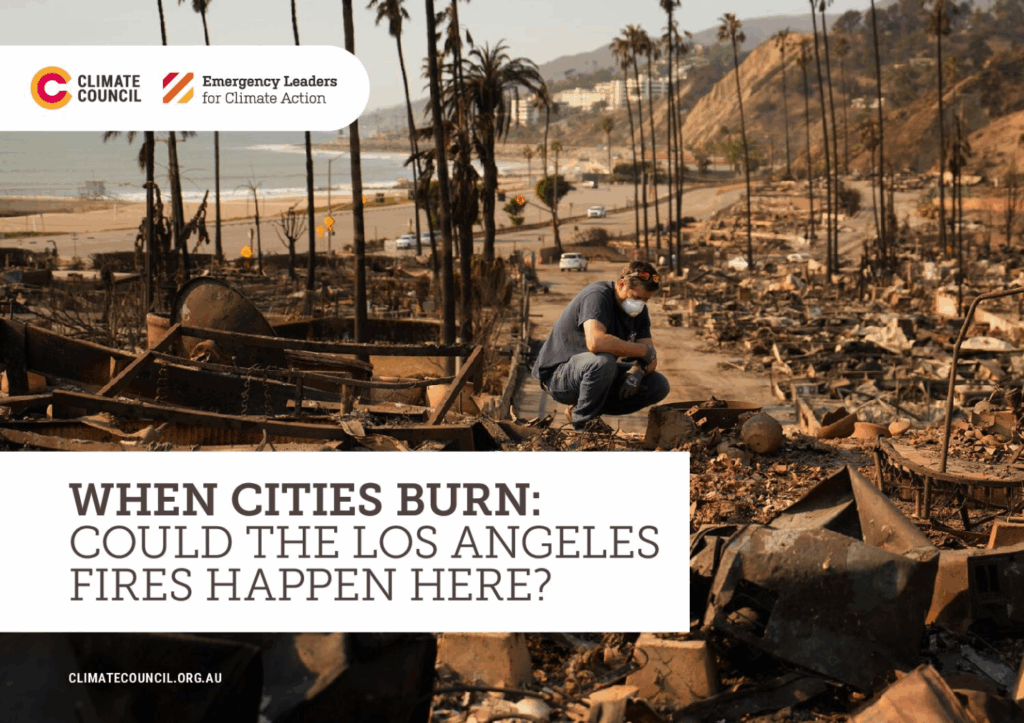
The uncomfortable truth is that many of the factors that led to the LA disaster are already present in Australia — and getting worse. Climate pollution from burning coal, oil and gas is supercharging heat, drying out landscapes, lengthening fire seasons and fuelling more extreme fire weather across fire-prone regions.
Australians have already experienced fires with the same hallmarks of the LA fires: drought- parched forests, strong winds, low humidity, explosive fire behaviour, and unstoppable fire fronts that fire agencies, no matter how well-resourced, struggle to respond to.
In 2003, it happened in Canberra. In 2009, Black Saturday hit Victoria. Tasmania and the NSW Blue Mountains were ablaze in 2013. Then, the national megafires of 2019-20: the Black Summer bushfires; the most destructive and widespread in Australia on record.
What Australia has not yet experienced — but is increasingly at risk of — is what Los Angeles endured: a major fire hitting a major city.
Our latest analysis explains that millions more Australians now live on the expanding outskirts of our capital cities and major regional centres, where homes adjoin highly flammable bush and grasslands.
These at-risk communities — from the Dandenong Ranges in Victoria, Perth Hills, Adelaide Hills, the Blue Mountains, Sydney suburbs, NSW Central Coast, Hobart’s suburbs and Canberra’s western edge — are already some of the most fire-exposed urban areas in the world.
In this report, we outline how climate change played an instrumental role in supercharging the main factors that underpinned the Californian catastrophe, and compare those conditions across Australia’s capital cities. We also explain why firefighters are increasingly facing fires they cannot stop; and what must be done to protect Australian lives, homes and communities as extreme fire weather intensifies.
We still have a choice on just how dangerous future fire conditions become. Now is the time to reduce climate pollution further and faster, to adapt our cities, and prepare our fire services and communities for a future increasingly at risk of devastating bushfires.
Excerpt:
London has recorded a maximum temperature of 35 degrees Celsius on Tuesday, breaking the record for the hottest day in May on record.
Europe is sweltering through an unusually early heatwave that scientists say are becoming more frequent and occurring at abnormal times due to climate change.
At least 11 people have died in Britain and France, mostly due to drownings as people seek relief.
Heat records have tumbled across Europe for the second straight day as an unprecedentedly early heatwave continues to bake the continent, with some fatalities reported.
In London, temperatures topped 35 degrees Celsius in the mid-afternoon, officially making Tuesday the hottest day in May since records began.
This broke the previous record, set only a day prior on Monday, when the British capital sweltered under 33.5C temperatures.
London also recorded a rare "tropical night" on Monday evening, defined as one in which the temperature does not fall below 20C." ABC News

Temperatures in London topped 35 degrees Celsius on Tuesday afternoon, local time. (AP: Kin Cheung)

Despite the growing awareness that climate change is real, as evidenced
by communities facing floods like this one in North Carolina’s Outer
Banks, the politics of climate action remain stuck. Credit: National
Park Service
Under Donald Trump’s renewed push to expand fossil fuel production —
including plans to ramp up oil and gas drilling and roll back climate
regulations — climate politics in the United States is entering a new
phase. Although Trump’s climate agenda is very much aligned with
outright denial, it has become less central in mainstream climate action
debate. Instead, opposition to policies such as carbon pricing,
emissions standards, and fossil fuel phaseouts remains strong.
At
the same time, the impacts of climate change are becoming harder to
ignore. When the devastating wildfires tore through Los Angeles in
January 2025, causing over $60 billion in destruction, millions of
Americans glimpsed what climate change looks like up close. Across the
country — as in many parts of the world — the signs are multiplying:
insurers abandoning coastal areas, deadly heatwaves breaking records,
and entire communities facing floods or drought. Understandably, the
proportion of Americans who believe global warming is happening has
increased over time, rising from about 57 percent in 2010 to over 70 percent in recent years, according to the Yale Climate Opinion Map of 2024.
Yet, despite this growing awareness, the politics of climate action remain stuck.
The old strategy of obstructionists — denying climate change outright — has largely lost credibility among scientists and the public at large. The scientific consensus on human-caused climate change is overwhelming, and its impacts are increasingly visible. But the departure of denial has not meant the arrival of decisive action.
Instead, something more subtle has taken its place: climate delay.
Scholars have increasingly warned about this shift. In 2020, William Lamb and colleagues identified a set of arguments that acknowledge climate change but still justify postponing meaningful action. These “discourses of climate delay” include familiar claims that action would hurt the economy, that technology will solve the problem later, or that responsibility lies with someone else.
Building on this framework, we conducted a nationwide survey of more than 1,500 Americans in 2024 to examine how widespread these narratives have become among the public — and how they might shape support for climate policy. Our findings show that large segments of the U.S. public hold beliefs that align with these narratives.
And they are everywhere: in political speeches, cable news debates, and everyday conversations.
Listen closely to climate debates today, and you’ll hear them constantly:
Yes, climate change is real — but why should we act if China doesn’t?
Yes, it’s real — but regulations will hurt ordinary people.
Yes, it’s real — but technology will solve it eventually.
These arguments sound reasonable. Many contain a kernel of truth. But together they add up to the same conclusion: not now.
Our research suggests that some of these narratives are particularly powerful in undermining support for climate policy. And it is not necessarily the most widespread ones that are most problematic.
The most influential narrative is what is often called “whataboutism,” which only about a third of our respondents subscribed to. This argument shifts responsibility for climate change elsewhere — usually toward other nations — while downplaying one’s own emissions. Americans hear it constantly: Why should the United States cut emissions if China is building coal plants? Unless other countries act, why should we?
In our survey, people who agreed with this line of argument were significantly less likely to support climate policies or demand government action.
It’s an argument that resonates politically because it taps into familiar themes of fairness and national competition. But it also misunderstands the nature of global cooperation. If every country waits for someone else to act first, no one moves.
Another powerful narrative insists that climate policy must rely only on voluntary action — what can be described as “no sticks, just carrots.” Subsidies for clean energy? Fine. But regulations, bans, or carbon taxes? Off the table.
This framing is politically convenient because it allows leaders to appear supportive of climate goals while avoiding the policies most likely to reduce emissions. But it also undermines support for the kinds of measures that actually work — from carbon pricing and emissions standards to restrictions on fossil fuels.
A third potent narrative exploits genuine concerns about fairness. Many people worry that climate policies will raise energy prices or hurt working-class communities. These concerns are understandable and occasionally real, as badly designed policies can indeed impose unfair costs — underscoring the importance of ensuring that the transition away from fossil fuels is fair and equitable.
But when these concerns are used to block climate action entirely or strategically deployed to obstruct it, then they become another form of delay. In our study, framing climate policy primarily as a threat to social justice significantly reduced support for government climate action.
Under Donald Trump’s first term, climate denial was still common. Today, it has been re-energized at the political level — with figures in the current administration engaging with climate denial networks and rolling back environmental protections. At the same time, familiar delay tactics remain central: acknowledging climate change while shifting responsibility to others or downplaying the need for urgent action. The result is not a replacement of denial with delay, but a more dangerous combination of the two — one that risks further entrenching resistance to meaningful climate policy. This helps explain why, even as most Americans now accept that climate change is real, many remain uncertain or divided over the policies needed to address it."
President Trump’s annual budget request to Congress continues his administration’s defunding of climate change programs, environmental protection and renewable energy, slashing the budgets of the Environmental Protection Agency, the National Oceanic and Atmospheric Administration and the Federal Emergency Management Agency.

The spending plan for fiscal 2027 “builds on the President’s vision by continuing to constrain non-defense spending,” wrote Russell Vought, director of the Office of Management and Budget, in a foreword to the 92-page document, which includes an historic, $1.5 trillion defense budget, an increase of 44 percent.
EPA spending would be cut in half under Trump’s proposal, released Friday, and grants from the agency would be slashed by $1 billion. Congress rejected a similar budget request from the president last year.
An Inside Climate News analysis of federal workforce data released by the Office of Personnel Management shows that EPA lost more than 4,000 employees in the first year of Trump’s second term, reducing its workforce to 12,849, its lowest level since the 1980s. The 24 percent reduction was more than double the rate of losses across the entire federal government.
“This EPA budget proposal leaves families sicker, not safer,” said Michelle Roos, a former EPA project manager and current executive director of the Environmental Protection Network, an organization of former EPA employees. “This is part of the Trump administration’s dangerous and far-reaching plan to let polluters decide which toxic chemicals to dump in our drinking water, which harmful pollution to pump into the air we breathe, and which pesticides are put on the food we eat.”
Trump’s proposed budget would also cut $449 million from renewable energy funding and re-propose canceling $15 billion in renewable energy infrastructure funding under the 2021 Bipartisan Infrastructure Law, which Trump has called part of a “Green New Scam.”
“The U.S. Government will no longer subsidize intermittent energy forms that destabilize the grid or Green New Scam projects,” Trump’s budget proposal said. “Instead, the Budget pushes an aggressive America First agenda that would combat foreign influence through robust domestic critical material supply chains, as well as revitalize the Nation’s Strategic Petroleum Reserve.”
To date, the Trump administration has moved to discontinue tax credits and other incentives provided under Biden’s Inflation Reduction Act for renewable energy and electric vehicles and has taken aggressive action to halt three offshore wind programs under construction off the U.S. coast in the Atlantic Ocean.
Most recently, the Trump administration has offered France’s Total Energy $928 million to forfeit leases on wind farms off the East Coast if the company reinvests those funds in U.S. oil and gas projects.
Meanwhile, since Trump began bombing Iran on Feb. 28 and, in retaliation, Iran closed the Strait of Hormuz, through which 20 percent of the world’s oil and gas is shipped, gasoline prices in the U.S. have increased by more than $1 at the pump across the country, an increase of 35 percent in just over a month.
Beyond the EPA cuts, Trump’s budget plan includes cuts of $1.6 billion for the National Oceanic and Atmospheric Administration, which it said has “consistently funded efforts to radicalize students against markets.” The budget also cut $1.3 billion from Federal Emergency Management Agency grants, and $1 billion from Environmental Protection Agency grants and $1 billion from the National Institute of Standards and Technology, which, the document said, “has long funded awards for the development of curricula that advance a radical climate agenda.” It also proposes eliminating the $4 billion Low Income Home Energy Assistance Program.
The National Energy Assistance Directors Association said eliminating the low-income home energy assistance program “would deepen the nation’s energy affordability crisis and leave millions of vulnerable households without the assistance they need.”
In a statement on Friday, the Center on Budget and Policy Priorities said Trump’s proposal, which cuts roughly $100 billion from non-defense discretionary spending, “isn’t a serious plan” and “isn’t worthy of the American people.” The Committee for a Responsible Federal Budget said the president’s proposal was “missing any significant plan for how to address the major drivers of our spending and deficit growth.” The conservative Cato Institute said that “Trump’s budget falls short on the spending programs driving the federal debt.”
The American Public Health Association said that Trump’s proposal “threatens all aspects of the public’s health” and “should be dead on arrival.” The Sierra Club said Trump’s budget “fails to adequately fund the agencies and programs tasked with protecting our clean air and drinking water.”
A spokesperson for the Ocean Conservancy told the website Seafood Source, “Slashing NOAA’s budget would weaken weather forecasting, disrupt fisheries management and stall ocean research—putting American lives, livelihoods, and global scientific leadership at risk.”
https://insideclimatenews.org/news/06042026/trump-budget-proposes-epa-noaa-fema-cuts/
