Showing posts with label #USA. Show all posts

Wednesday, 2 July 2025

Amid Brutal Heat Wave, Officials Stress Health Risks of Hot Nights


Excerpt : "Much of the United States is baking amid an unusually severe June heat wave, with more than 150 million people under some sort of heat advisory. The unrelenting heat wave started in the Mountain West over the weekend and has since descended upon the Midwestern and Eastern U.S., where high humidity is making temperatures topping 100 degrees Fahrenheit feel even hotter. 

Even at night, people can’t escape the unforgiving heat, which poses a particularly high health risk. 

The level and duration of the heat is rare for this time of year “with little to no overnight relief, and affects anyone without effective cooling and/or adequate hydration,” the National Weather Service said in an advisory Monday morning.

During a heat wave, it is crucial for people to cool down at night to reduce their core body temperature and reduce the physiological burden put on them during long, sizzling days. But a growing body of research shows that hot nights are becoming more common with climate change—and not just during a heat wave. "  By Kiley Price, From Inside Climate News

Friday, 17 June 2022

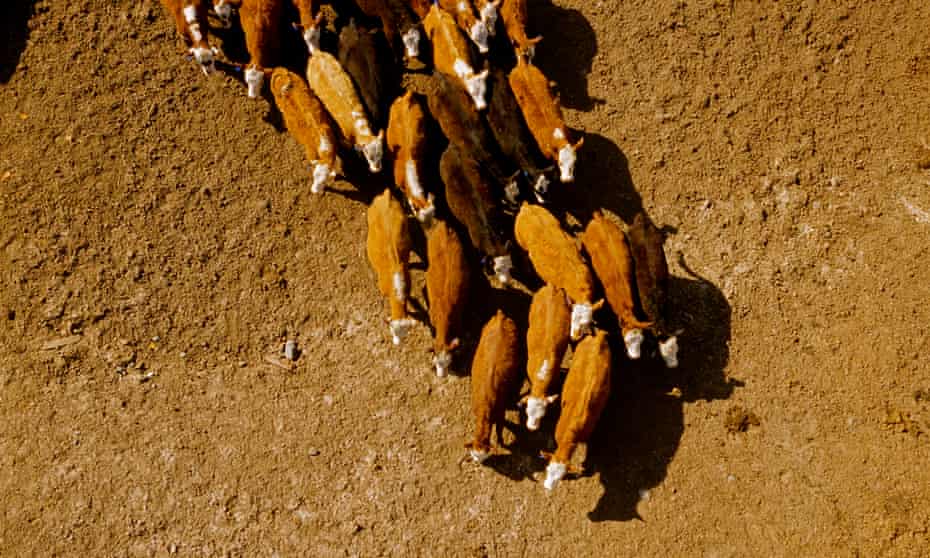
The Guardian: Thousands of cattle dead due to heatwave in Kansas

 Extreme heat is predicted for large parts of the US including Kansas, which is one of the country’s top three beef producers

beef cattle at a feedlot
‘What is clear is that the livestock heat stress issue will become increasingly challenging,’ said one expert. Photograph: Richard Hamilton Smith/Design Pics/Getty Images/Design Pics RF
Fri 17 Jun 2022 03.47 AEST Last modified on Fri 17 Jun 2022 03.49 AEST 
 

This week, the National Weather Services (NWS) predicted extreme heat on parts of the Gulf coast and spreading to the Great Lakes in the midwest, with more than 100 million Americans advised to stay inside to fight the heat.

Read the article

https://www.theguardian.com/us-news/2022/jun/16/cattle-deaths-kansas-heat-wave-climate?CMP=share_btn_fb&fbclid=IwAR3GbaIHDiODyItHmnpEjfmT1Pn02Hyb2FiK4GLmpd3xFRtUoX35jpTRGjM

Sunday, 15 November 2020

Politicians Try to Rally Support for Coal Despite Economics and Biden Presidential Win (excerpt): DeSmog

Sen. Mitt Romney

"The election results are a stark reminder of just how divided the country remains on many issues. However, in the days since the results were announced November 7, two senators from both parties are finding common ground in a familiar space: opposition to the Green New Deal and support for a dying coal industry.

Both Sen. Mitt Romney (R-UT) and Sen. Joe Manchin (D-WV) immediately took to CNN and Fox News in the days after the election was called to try and rally support for the fossil fuel industry in the wake of Joe Biden's election as president a success which brings with it the promise of strong climate action.

But their comments also come on the heels of yet another coal plant closure in the U.S. and as the world's largest coal producer, Peabody Energy, warns of going bankrupt for the second time in five years.

Romney told CNN on November 8 that “I want to make sure that we conservatives keep on fighting to make sure we don't have a Green New Deal, we don't get rid of gas and coal.”


Pic from this blog

Meanwhile, Manchin went on Fox News on November 9 to alsocriticize the Green New Deal, saying, “That’s not who we are as a Democratic Party.” 

We’re going to use fossil in its cleanest fashion,” he added. Manchin's unwavering support for the coal industry is well documented and unsurprising as he ran a coal company prior to being elected to the Senate.

Manchin in his comments also echoed Romney’s call to not get rid of gas and coal, telling Fox News, “You have to have energy independence in this country. You can’t eliminate certain things.”


Read complete Politicians Try to Rally Support for Coal Despite Economics and Biden Presidential Win

in DeSmog by Justin Mikulka • Thursday, November 12, 2020. Read time: 10 mins


Related:  What is the Climate 21 Project?


Saturday, 14 November 2020

What is the Climate 21 Project?


The Climate 21 Project taps the expertise of more than 150 experts with high-level government experience, including nine former cabinet appointees, to deliver actionable advice for a rapid-start, whole-of-government climate response coordinated by the White House and accountable to the President.

The memos below contain the Climate 21 Project’s recommendations for 11 White House offices, federal departments, and federal agencies, as well as cross-cutting recommendations on personnel and hiring.

Importantly, the Climate 21 Project is not offering a policy agenda. Rather, the memos below contain

 recommendations that can help the President hit the ground running

 and build the capacity of his administration to tackle the climate crisis quickly with the existing tools at hand.

The recommendations are focused in scope on areas where the contributors have the most expertise. An all-of-government mobilization on climate change will require important work by additional federal departments and agencies that were not examined by the Climate 21 Project.

Go to https://climate21.org/

"A team of former Obama administration officials and experts have created a 300-page blueprint laying out a holistic approach to the climate while avoiding some of the pitfalls that hampered President Barack Obama, who shared some of the same goals but was unable to enact all of them. Dubbed the Climate 21 Project, it took a year and a half to develop and was delivered recently to Biden’s transition team. The document outlines how the incoming administration could restructure aspects of the government to move faster on global warming." Washington Post

Related: The 40 Things Biden Should Do First on Climate Change (excerpt): Bloomberg Green

Friday, 13 November 2020

The 40 Things Biden Should Do First on Climate Change (excerpt): Bloomberg Green


Randolph Bell
Randolph Bell, Director for Global Energy Security, Atlantic Council

Take care of fugitive methane emissions.

“Failing to fully address methane leakage is increasingly a risk for the climate and for the U.S. economy. Methane makes up at least 10 percent of U.S. greenhouse gas emissions—recent analysis suggests far more—and is at least 25% more potent at trapping heat than carbon dioxide. With natural gas projected to play an important role in the global energy system even under aggressive decarbonization scenarios by providing low-carbon power in the developing world and feedstock for hydrogen production (with carbon capture and storage), addressing methane is crucial for meeting climate goals.”

“The U.S.’s methane problem has the attention of major oil & gas producers, who decried the Trump Administration’s August reversal of an Obama-era rule on methane. Engie’s decision last month, under pressure from the French government, to delay its $7 billion deal with U.S. LNG company NextDecade because of U.S. methane emissions underscores the risks to the U.S. economy.”

“President-elect Biden can immediately direct the EPA to initiate a new rulemaking process to ensure that industry monitors and addresses leaks in new equipment, as Obama’s rule did. Biden can also be more ambitious and address leaks in older equipment, an effort that was not completed under Obama.” —As told to Akshat Rathi


Thursday, 5 November 2020

State Backers of Anti-Protest Bills Received Campaign Funding from Oil and Gas Industry, Report Finds (excerpt): DeSmog

 "Politicians responsible for drafting laws criminalizing pipeline protests in Louisiana, West Virginia, and Minnesota did so after receiving significant funding from the fossil fuel industry, according to a new report by the Institute for Policy Studies, a progressive think tank based in Washington, D.C.

The major pipelines studied in the report disproportionately impact historically disenfranchised communities who, in turn find themselves potentially targeted by the protest criminalization measures, often framed as efforts to protect “critical infrastructure,” the report details.

Under the premise of protecting infrastructure projects,” the Institute wrote, “these laws mandate harsh charges and penalties for exercising constitutional rights to freely assemble and to protest.”

Marathon Petroleum, one of three large fossil fuel companies the report names as driving state-level efforts to criminalize pipeline protests, is also facing new allegations of electoral wrong-doing in the form of a Federal Election Commission complaint alleging that the company made over $1 million in contributions to Republican super PACs that are barred by rules preventing federal contractors from providing that sort of funding."

...................

“Micheal Hennigan and the oil corporations lobbying for these bills are obviously trying to criminalize dissent, not protect public health,” said Jesse Coleman, a senior researcher with Documented, a watchdog group. “Look at what has actually caused pipeline explosions, leaks, and other problems — it's not the oil industry critics.”

“These projects are dangerous by design,” Coleman added, “and trying to shift the focus to boogeymen protesters is a cheap trick to avoid scrutiny.”

Go to original DeSmog article by Sharon Kelly 


Related: Polling Shows Growing Climate Concern Among Americans. But Outsized Influence of Deniers Remains a Roadblock (excerpt): DeSmog


also


Meet the Money Behind The Climate Denial Movement (excerpt): Smithsonian Mag

Sunday, 1 November 2020

The Trump administration is burying dozens of studies detailing the promise of renewable energy, impeding a transition away from fossil fuels (excerpt): Grist

 ‘It just goes into a black hole’ 

Vote for my future climate

The Trump administration is burying dozens of studies detailing the promise of renewable energy, impeding a transition away from fossil fuels

on Oct 26, 2020

"But what went unsaid at the grip-and-grin was that one of those high-ranking officials, Dan Simmons of the U.S. Department of Energy doesn’t appear to fully support renewables. In fact, he has presided over his agency’s systematic squelching of dozens of government studies detailing its promise.

One pivotal research project, for example, quantifies hydropower’s unique potential to enhance solar and wind energy, storing up power in the form of water held back behind dams for moments when the wind isn’t blowing and the sun isn’t shining. By the time of the Hoover Dam ceremony, Simmons’ office at the Energy Department had been sitting on that particular study for more than a year.


In all, the department has blocked reports for more than 40 clean energy studies. The department has replaced them with mere presentations, buried them in scientific journals that are not accessible to the public, or left them paralyzed within the agency, according to emails and documents obtained by InvestigateWest, as well as interviews with more than a dozen current and former employees at the Department of Energy, or DOE, and its national labs.

Bottling up and slow-walking studies is already harming efforts to fight climate change, according to clean energy experts and others, because Energy Department reports drive investment decisions. Entrepreneurs worry that the agency’s practices under the current White House will ultimately hurt growth prospects for U.S.-developed technology."

Go to complete Grist story


 Related: Polling Shows Growing Climate Concern Among Americans. But Outsized Influence of Deniers Remains a Roadblock (excerpt): DeSmog


Monday, 19 October 2020

Amy Coney Barrett says she’s “not a scientist” and has no “firm views” on the topic of climate change: (excerpts) LAT and NYT

Wikipedia pic from 2018 Amy Coney Barrett
Amy Coney Barrett, the president’s Supreme Court nominee, was asked about climate change during Senate confirmation hearings. She responded that she’s “not a scientist” and has no “firm views” on the topic. The Supreme Court could play a big role in determining whether the federal government is able to mount a serious response to the climate crisis; as Marianne Lavelle wrote recently for InsideClimate News, activists are worried the court’s landmark 2007 climate ruling could be in danger.


Go to LA Times story

"But with Senator Kamala Harris of California, the Democratic

Photo from Alliance for Justice

candidate for vice president, Judge Barrett, the daughter of an oil executive, went further. She described the settled science of climate change as still in dispute, compared to Ms. Harris’s other examples, including whether smoking causes cancer and the coronavirus is infectious.

“Do you believe that climate change is happening and threatening the air we breathe and the water that we drink?” Ms. Harris asked.

Judge Barrett responded, “You asked me uncontroversial questions, like Covid-19 being infectious or if smoking causes cancer” to solicit “an opinion from me on a very contentious matter of public debate,” climate change.

“I will not do that,” Judge Barrett concluded. “I will not express a view on a matter of public policy, especially one that is politically controversial.”

Go to New York Times story 


Related:  Anxiety Mounts Abroad About Climate Leadership and the Volatile U.S. Election (excerpts): InsideClimate News


Friday, 16 October 2020

Florida Sees Signals of a Climate-Driven Housing Crisis (excerpt): NYT

"Home sales in areas most vulnerable to sea-level rise began falling around 2013, researchers found. Now, prices are following a similar downward path."

In Florida, home sales in areas at high risk from sea-level rise

have fallen compared to areas at low risk.


"The idea that climate change will eventually ruin the value of coastal homes is neither new nor particularly controversial. In 2016, the then-chief economist for the federal mortgage giant Freddie Mac warned that rising seas “appear likely to destroy billions of dollars in property and to displace millions of people.” By 2045, more than 300,000 existing coastal homes will be at risk of flooding regularly, the Union of Concerned Scientists concluded in 2018.

The question that has occupied researchers is how soon, and how quickly, people will respond to that risk by demanding price discounts or fleeing the market. Previous research has begun to tackle that question, showing that climate change, far from being a distant threat, is already starting to hurt real estate values."


Credit...Rose Marie Cromwell for The New York Times

"Then, starting in 2013, something started to change. While sales in safer areas kept climbing, sales in vulnerable ones began to fall. By 2018, the last year for which Dr. Keys and Mr. Mulder obtained data, sales in vulnerable areas trailed safer areas by 16 percent to 20 percent.

A few things happened around that time that might have made prospective home buyers more worried about climate risk, Dr. Keys said. An international report the previous year highlighted the risks of extreme weather events. After that report came out, Google searches in Florida for “sea level rise” spiked.

And people from the Northeast, who account for a significant portion of Florida home buyers, had just lived through Hurricane Sandy, which damaged some 650,000 homes and caused 8.5 million people to lose power, some for months."


Go to NYT original full length story 


Related: I’m an American Climate Emigrant (excerpts): Sierra


Wednesday, 14 October 2020

I’m an American Climate Emigrant (excerpts): Sierra

 "My family moved northward for many reasons—climate chaos was among them

We were only a few hours’ drive north of the California-Oregon border when I began to feel the pangs of survivor’s guilt. It was mid-August, and the news from back home was no good. We had busted out of the San Francisco Bay Area just as the heat wave began to sizzle California, and as we drove north through wine country, the temperature gauge in our car said it was 108 degrees outside. Days later, a freak electric storm swung across the state, sparking hundreds of fires. Some of our favorite places were burning: the forested mountains around Santa Cruz and the oak woodlands west of Davis, where we had spent many summer afternoons lounging on the banks of Putah Creek. Smoke was already beginning to choke our friends and former neighbors. “You got out just in time,” a buddy texted. “California is imploding.”

The Oregon coast felt, at that time, like a whole new world. As we threaded our way up Highway 1, the sky was cool and gray, and by evening a thick fog had turned into a spitting rain. The smoke and fires might as well have been on another planet. The rain was a relief, but I couldn’t shake a certain shame. I felt bad about our good fortune, about leaving our community behind to suffer.

I had lived in California for more than 20 years, and my family’s long-planned departure was supposed to be an adventure of sorts, an opportunity to start a new life for ourselves in the Pacific Northwest. For months, we had been looking forward to the move with a mix of trepidation and excitement, the swirl of emotions common to any emigrant: nostalgia for the life we had built, spiked with the thrill of surprising horizons. But now, as grim news piled up in our newsfeeds, the move had taken on a sour taste.

We weren’t merely heading toward a new home in another state. With a disaster unfolding behind us, we were fleeing."

Go to the Sierra article 


climate change refugees,climate refugees,#California,#USA,climate fires,floods,tidal flooding,

Tuesday, 6 October 2020

Anxiety Mounts Abroad About Climate Leadership and the Volatile U.S. Election (excerpts): InsideClimate News

"VIENNA, Austria—Whenever artist Michael Aschauer returns home after an extended stay in the United States, people here pepper him with questions about the direction America is heading. 

With gallows humor typical of the city, they often ask, "Will it fall apart slowly, or very fast?" he said, adding that Vienna has plenty of experience with how rising and falling empires can destabilize global systems.

Aschauer is married to an American and keenly watches climate and energy politics on both sides of the Atlantic while trying to imagine a post-carbon future. In an informal social media art project, he documents gas stations that have been abandoned or converted to other uses. 

He said it's hard to imagine that Americans would re-elect the

incumbent president, but that it can't be ruled out, either, given the current volatility of U.S. politics. "The outcome will have profound consequences for the future of Earth's climate," he added.

Carbon budgets detailed in recent climate reports show that four more years of pro-fossil fuel policies in the U.S. would make it much harder for the world to reach the Paris climate agreement goal of preventing catastrophic global warming, he said. On the other hand, Biden's decarbonization plan would accelerate demand for renewable energy in the world's biggest consumer economy and speed the global shift to a zero-carbon economy. "

.................

"Debate Debacle

But it's not all fear and loathing—people here say they feel a cultural, social and economic affinity with the U.S. And the interest is even more intense this year, after extensive international media coverage of the escalating cycle of police violence and destructive protests, as well as wildfires, hurricanes, the botched pandemic response and potential election chaos all painted a picture of a country in turmoil. 

Last week's presidential debate reinforced global concerns about the direction of the U.S., said Reimund Schwarze, an environmental economist with the Helmholtz Centre for Environmental Research in Germany. Trump's recent statements questioning the legitimacy of the election process raise the specter of widespread unrest, he said."   "

................................

"  "From what I see in the Democratic Party, there is a lot of movement, a lot of mobilization from the other side." Even with time running short for meaningful climate action, he said, there is a hopeful scenario that a generational shift in politics in the U.S. could upend the political landscape for many years to come, leading to fundamental changes in U.S. policy. 

All over the world, people are waiting in suspense to see if Nov. 3 marks the start of that shift.

"I don't want to put any pressure on anyone," Austrian ecologist Sarah Höfler posted on Twitter recently, "but the American election will, in my opinion, decide whether humanity has still a chance in the #ClimateCrisis. It is as simple as that."  "


Go to complete story by Bob Berwyn in InsideClimate News


Related: America's year of fire and tempests means climate crisis just got very real (excerpt): Guardian

 Pics from this blog


Trump,Biden,#climateaction,voters,#USA,European Union,#jailclimatecriminals, 

Sunday, 27 September 2020

Wildfires Explained: The YEARS Project video

  Maya Lilly—who has lived through several California wildfires that threatened her home—explains the science behind wildfires. How is climate change responsible for making wildfires worse? Global warming produces more heat and more fuel—two ingredients that necessary for fires. Watch more #ClimateFacts: https://theyearsproject.com/watch/cli...


Related:A season of climate-fueled disasters (excerpt): NYT

Saturday, 19 September 2020

European Thinktanks Repeating ‘Well-worn’ US Climate Denial Tropes (excerpt): DeSmog

Organisations promoting climate science denial and anti-environmentalism in Europe share the same rhetoric, narratives and right-wing links as their US counterparts, new research has found.
 

The paper published in the journal Climatic Change examines publications from eight of the most prominent contrarian thinktanks in six EU countries over 24 years from 1994 to 2018, and argues the organisations enjoy a “remarkable” level of political influence for their size.

These include the UK-based Global Warming Policy Foundation (GWPF), the Institute of Economic Affairs (IEA) and the Centre for Policy Studies (CPS), as well as the German Europäisches Institut für Klima und Energie (EIKE), the Austrian Economics Centre (AEC), Institut Économique Molinari (IEM) in France, Instituto Juan de Mariana (IJM) in Spain and the Liberales Institut (LI) in Switzerland.

The researchers found an increase in environmentally-focused activity

From DeSmog
by these organisations in Europe after 2007 and again between 2015 and 2018.

The publications echoed the arguments put forward by US thinktanks, with a fifth denying climate science outright. Of those which accepted that the planet is warming, many downplayed the role of people in causing it, were sceptical about policies to tackle the problem, or argued that climate change was actually a good thing.

As well as openly contesting climate science, many of the critiques were aimed at environmental campaigners, politicians or journalists.

Well-worn climate change counter-frames” spread by US thinktanks are being “consistently circulated” by European organisations, too, the research concludes.

Go to complete DeSmog article By Isabella Kaminski • Thursday, September 17, 2020


Related: How Climate Migration Will Reshape America Millions will be displaced. Where will they go? (excerpt) : NYT Magazine

Thursday, 17 September 2020

Body count: How climate change is killing us: Paddy Manning's Book


"True stories of loss and courage from people at the frontlines of Australia's worst climate-fuelled disasters - bushfire, heatwaves, flash-floods, disease outbreaks and now the latest in a new age of pandemics. 


What are the health risks of climate change, why weren't we warned and what are Australian governments doing about it?"
"Suddenly, when the country caught fire, people realised what the government has not: that climate change is killing us.

But climate deaths didn’t start in 2019. Medical officers have been warning of a health emergency as temperatures rise for years, and for at least a decade Australians have been dying from the plagues of climate change – from heat, flood, disease, smoke. And now, pandemic.

In this detailed, considered, compassionate book, Paddy Manning paints us the big picture. He revisits some headline events which might have faded in our memory – the Brisbane Floods of 2011; Melbourne’s thunderstorm asthma fatalities of 2016 – and brings to our attention less well-publicised killers: the soil-borne diseases that amplify after a flood; the fact that heat itself has killed more people than all other catastrophes put together. In each case, he has interviewed scientists to explore the link to climate change and asks how – indeed, whether – we can better prepare ourselves in the future.

Most importantly, Manning has spoken to survivors and the families of victims, creating a monument to those we have already lost. Donna Rice and her 13-year-old son Jordan. Alison Tenner. The Buchanan family. These are stories of humans at their most vulnerable, and also often at their best. In extremis, people often act to save their loved ones above themselves. As Body Count shows, we are now all in extremis, and it is time to act.

 
#climate crisis, #climateemergency, #Australia, #California, Oregon, #climatefires, #USA, smoke, infectious diseases, #foodsecurity, water security, #heatwaves,
Climate Fires in the USA


Respected journalist Paddy Manning tells these stories of tragedy and loss, heroism and resilience, in a book that is both monument and warning.

‘A climate emergency tour de force.' Dr Bob Brown

'True stories of heroism and unimaginable loss...Body Count is a brilliant exposition of why we must deal with the climate problem now.' Ross Garnaut

'Climate change kills. … Through the accounts of people who have lost so much, Paddy Manning drives home the deeply personal impact of climate change. Governments continue to ignore the impact on climate change on human health at OUR peril. The future of our planet and our future generations depends on everyone playing their part, today.' Professor Kerryn Phelps

'A stunningly powerful call to political leaders everywhere who hear the warnings of the devastating impacts of climate change on health but fail to act.' Dr Helen Haines, independent member for Indi

‘Moving stories of heroic courage and tragic loss. A pause to reflect on the lives lost and how urgently we need change.’ David Pocock, former Wallabies captain"


#climate crisis, #climateemergency, #Australia, #California, Oregon, #climatefires, #USA, smoke, infectious diseases, #foodsecurity, water security, #heatwaves,
Children Face Unique Health Threats Due To Climate Change


Related: How Climate Migration Will Reshape America Millions will be displaced. Where will they go? (excerpt) : NYT Magazine

#climate crisis, #climateemergency, #Australia, #California, Oregon, #climatefires, #USA, smoke, infectious diseases, #foodsecurity, water security, #heatwaves,  

Wednesday, 16 September 2020

How Climate Migration Will Reshape America Millions will be displaced. Where will they go? (excerpt) : NYT Magazine

(Pics by this blog)

a nation on the cusp of a great transformation
Hurricane Michael left this
" ....... I wanted to know if this was beginning to change. Might Americans finally be waking up to how climate is about to transform their lives? And if so — if a great domestic relocation might be in the offing — was it possible to project where we might go? To answer these questions, I interviewed more than four dozen experts: economists and demographers, climate scientists and insurance executives, architects and urban planners, and I mapped out the danger zones that will close in on Americans over the next 30 years. The maps for the first time combined exclusive climate data from the Rhodium Group, an independent data-analytics firm; wildfire projections modeled by United States Forest Service researchers and others; and data about America’s shifting climate niches, an evolution of work first published by The Proceedings of the National Academy of Sciences last spring. (See a detailed analysis of the maps.) "


a nation on the cusp of a great transformation
Sea rise and no planned retreat

"What I found was a nation on the cusp of a great transformation. Across the United States, some 162 million
people — nearly one in two — will most likely experience a decline in the quality of their environment, namely more heat and less water. For 93 million of them, the changes could be
particularly severe, and by 2070, our analysis suggests, if carbon emissions rise at extreme levels, at least four million Americans could find themselves living at the fringe, in places decidedly outside the ideal niche for human life. The cost of resisting the new climate reality is mounting. Florida officials have already acknowledged that defending some roadways against the sea will be unaffordable. And the nation’s federal flood-insurance program is for the first time requiring that some of its payouts be used to retreat from climate threats across the country. It will soon prove too expensive to maintain the status quo. "


........................


a nation on the cusp of a great transformation
Some predicted sea rise may be too conservative

"Let’s start with some basics. Across the country, it’s going to get hot. Buffalo may feel in a few decades like Tempe, Ariz., does today, and Tempe itself will sustain 100-degree average summer temperatures by the end of the century. Extreme humidity from New Orleans to northern Wisconsin will make summers increasingly unbearable, turning otherwise seemingly survivable heat waves into debilitating health threats. Fresh water will also be in short supply, not only in the West but also in places like Florida, Georgia and Alabama, where droughts now regularly wither cotton fields. By 2040, according to federal government projections, 
extreme water shortages will be nearly ubiquitous west of Missouri. The Memphis Sands Aquifer, a crucial water supply for Mississippi, Tennessee, Arkansas and Louisiana, is already overdrawn by hundreds of millions of gallons a day. Much of the Ogallala Aquifer — which supplies nearly a third of the nation’s irrigation groundwater — could be gone by the end of the century."


Go to complete, extensive New York Times Magazine article

Related:  Trump baselessly questions climate science during California wildfire briefing (excerpt): CNN

#America, #climaterefugees, #extremeheat, #searise, #USA, climate migration, water security

Monday, 7 September 2020

Book: What Can I Do? by Jane Fonda: ‘If Greta Thunberg can do it, so can I’ (excerpt): The Guardian

the actor recalls the beginnings of her climate crisis protests outside the White House
Jane Fonda, actor and climate activist
"There was a long silence, and then she said, “Well, Jane, that’s wonderful and I’m blown away that you’re ready to put yourself out there like that, but you can’t camp overnight in Washington. It’s illegal since Occupy Wall Street camped there. But let’s figure out what is possible.” She offered to set up a conference call with her, Bill McKibben, co-founder of 350.org, Naomi Klein, the environmental lawyer Jay Halfon, and me. Bill suggested a once-a-week protest that involved civil disobedience. Fridays had been claimed by Greta Thunberg and the student climate strikers, but the youth had also called on adults to join them. “Maybe you could do an action on Fridays as well.”

I’d been getting ready for this my whole adult life – a weekly
An extract from Jane Fonda's book
Jane Fonda climate activist
action that culminated in nonviolent civil disobedience. And I wouldn’t have to worry about pooping. I began planning for the maximum time I could spend in DC before I had to get ready to film our last season of Grace And Frankie on 27 January 2020. It added up to four months, 14 Fridays."


What Can I Do? by Jane Fonda is published by HQ, at £20. To order a copy for £17.40, go to guardianbookshop.com. Delivery charges may apply.
 

Go to The Guardian's article 

Related: 'The Future We Choose', Book by Christiana Figueres & Tom Rivett-Carnac

Trump will roll back more environmental regulations if reelected, says EPA chief: CNBC

and lead to thousands of additional deaths from bad air quality
Koch industries fund Trump
 "Key Points
 
* President Trump will continue to weaken environmental regulations on industries if reelected in November, the EPA’s Andrew Wheeler told The Wall Street Journal. 

* The administration would establish a cost-benefit analysis of any new regulation and expand the use of “science transparency” to justify new regulations. 

* After three years in office, the administration sought to reverse
and lead to thousands of additional deaths from bad air quality
Politicians and Climate Change
more than 100 major environmental rules that it has deemed burdensome to the fossil fuel industry, even as climate change accelerates. 

* Analysts say many of the administration’s rollbacks could increase emissions and lead to thousands of additional deaths from bad air quality."
 
...........................
 
"Democratic presidential nominee Joe Biden has released a plan to put $2 trillion into green infrastructure and energy over four years to curb climate change and spur economic growth, which the Trump campaign has argued would hurt the oil and gas industry. "
 
Go to the CNBC article 

Published Thu, Sep 3 2020

Sunday, 6 September 2020

Trump and Biden: Little room for climate change in US election (excerpt): DW

68% of Democratic voters see climate change as high priority
The White House
As the US faces wildfires and storms, climate change remains one of the most divisive topics among voters. Yet despite the high stakes, so far, it has played a minor role in the upcoming election. 

US President Donald Trump has undone many major pieces of climate policy during his term, walking out on the Paris Agreement to limit global warming and eliminating numerous Obama-era environmental regulations. 

However, climate change doesn't even make the top 10 concerns among registered voters, even as the US faces extreme weather from wildfires to storms, scientists say are more prevalent by global warming. It ranks 11th behind the economy, health care, Supreme Court appointments and the pandemic, according to a survey conducted by the Pew Research Center published in August. 

While climate doesn't top the voters' agenda, it's still one of the most divisive issues among Trump and Biden supporters. Some 68% of Democratic voters see climate change as high priority compared to 11% of Republicans, found the Pew survey. 


68% of Democratic voters see climate change as high priority
Following a storm in Iowa last month, estimates suggested that almost a third of the state's crop-growing land was affected
68% of Democratic voters see climate change as high priority
Wildfires are becoming more frequent in California, where the ground and vegetation has suffered from long, dry summers
But what are the Biden and Trump campaigns promising to do on climate change and the environment — and how does it tally with what voters want?

Go to complete DW article

 Related: Donald Trump is hampering fight against climate change, WEF warns (excerpt) : The Guardian (2 years ago)

Trump, Biden, #USA, USA, voters, #climate crisis, #climatecriminals, #jailclimatecriminals,