Wednesday, 1 April 2026

Excerpt: "Why War Is One Of The World’s Biggest Climate Threats" Forbes


"By Nils Rokke,

Contributor.

I write about the global energy transition and net-zero emissions.


"As war rages on in Ukraine, Gaza, Sudan, and Congo, the world’s attention is understandably focused on human suffering and destruction. But a quieter, longer-lasting war is also being waged—one against nature, biodiversity, and the global climate.

War is among the most destructive forces on Earth, and not just for the people caught in its path.

While humanitarian impacts dominate headlines, the environmental costs are immense and largely ignored.

Armed conflicts unleash unprecedented levels of greenhouse gas emissions and pollution from the fossil-fueled tanks, jets, and warships to the vast industrial complexes that churn out ammunition, drones, and military vehicles. This is not to be ridiculed as we are talking about a strong driver for conflicts, global warming and biodiversity attrition.

PROMOTED

Every stage of war, from preparation and production to combat and eventual reconstruction, leaves an indelible carbon footprint on the planet.

The Climate Cost Of Military Action

Recent research has found that global militaries are responsible for nearly 5.5% of total global greenhouse gas emissions—a staggering figure that puts military emissions on par with the global cement industry. If it were a country, it would be the fourth biggest emitter in the world.

Military emissions are more than 2 times greater than those from global civil aviation. Although military spending accounts for about 2% of global GDP, its emissions intensity is roughly three times higher than the global economic average, making it one of the dirtiest and least regulated sectors in terms of climate impact.

Yet unlike most other major sectors, military emissions often remain invisible, exempt from many international reporting obligations and largely absent from climate negotiations.

The Cost Of The Ukraine Conflict

The ongoing war in Ukraine offers a stark example of how devastating the environmental impact of war can be.

According to a recent report from the Initiative on Greenhouse Gas Accounting of War, emissions attributable to the war in Ukraine have reached an estimated 230 million tons of CO₂ equivalent over the first three years—more than the combined annual emissions of all five Nordic countries.

These emissions stem from burning oil depots, exploded gas pipelines, and widespread damage to energy infrastructure. The destruction of electrical transformers and power stations releases specialized gases such as sulfur hexafluoride, or SF₆, a substance used for its insulating properties in high-voltage equipment...." ....Forbes

Excerpt: War’s Environmental Damage: How Conflicts Accelerate Global Warming

      Manjori BorkotokyMarch 24, 2026Feature, GreenHouse Gas Emissions

https://climatefactchecks.org/wars-environmental-damage-how-conflicts-accelerate-global-warming/ 


Smoke rising from bombed cities signals human tragedy, but it also signals something less visible and equally dangerous- a surge of greenhouse gases warming the planet. Across Ukraine, Gaza, Sudan, and the Middle East, war is not only destroying homes and lives; it is rapidly reshaping the climate. In conflict after conflict, the immediate crisis overshadows a slower, quieter emergency unfolding overhead. Yet scientists warn that the climate impacts of warfare are real, measurable, and largely neglected by global climate policy.


Today’s wars inject millions of tonnes of carbon dioxide into the atmosphere through massive fuel consumption, burning infrastructure, razed ecosystems, and the carbon-intensive process of rebuilding devastated cities. This hidden climate cost intensifies global warming even as the world struggles to stay within the 1.5°C threshold.

Warfare’s Carbon Footprint: A Blind Spot in Climate Reporting

Despite their scale, military emissions remain one of the least regulated and least reported sources of greenhouse gases. Under the Paris Agreement, countries are not required to disclose the emissions from military operations, leaving an enormous blind spot in global climate action. This is described as the military emissions gap, warning that it distorts the world’s true carbon footprint.

Analyses by climate and conflict researchers suggest that global military activities, even outside periods of intense conflict generate approximately 5.5% of global greenhouse gas emissions. This makes the world’s militaries collectively comparable to major industrial sectors like aviation and shipping. These emissions are driven by everything from jet fuel used by fighter aircraft, to diesel burned by tanks and armoured vehicles, to the smoke and dust from destroyed buildings and burning fuel storage sites. Since countries are not required to track or report these emissions, their true magnitude remains largely unaccounted for in climate planning.

The Best-Measured Case: Ukraine War Emissions

The Ukraine war provides one of the clearest case studies of conflict-related emissions because scientists have attempted to quantify its full climate impact. A study estimates that the war generated roughly 77 million tonnes of CO₂-equivalent in just the first 18 months.

These emissions came from continuous explosions, widespread fires, and the vast amounts of fuel consumed by tanks, jets, and military convoys. They were also a result of extensive damage to energy grids, industrial sites, and fuel depots, many of which released additional pollutants when destroyed. Forests, farmland, and grasslands, crucial natural carbon sinks  were burned or rendered unusable.

The study also warns that emissions associated with post-war reconstruction could surpass the emissions generated during active conflict, given the energy-intensive materials such as steel and cement that rebuilding requires.

Gaza and the Middle East: When War Burns Fossil Fuel Infrastructure

The climate consequences of war are even more staggering when fossil fuel infrastructure is involved. An analysis estimates that the Israel–Gaza war produced around 33 million tonnes of CO₂-equivalent due to military operations, fires, debris, and reconstruction demands.

Similarly, news reports found that the first two weeks of the US–Israel conflict with Iran released more than 5 million tonnes of CO₂ as oil depots, industrial facilities, and urban centres burned. These emissions are comparable to the annual output of dozens of low-emitting countries.

These conflicts demonstrate how warfare directly feeds into the global emissions total, yet remains invisible in official climate accounting.

War Destroys the Planet’s Natural Climate Buffers

War does not confine its destruction to urban landscapes. It also ravages ecosystems that protect the planet from climate extremes. According to the United Nations, conflict zones typically suffer from widespread deforestation, polluted water systems, and long-term land degradation, as well as the loss of wildlife and natural habitats.

In many war-torn regions, forests are burned or cut for survival needs, irrigation systems are damaged, wetlands dry up, and coastal zones lose essential natural protection. Toxic remnants of explosives, heavy metals, and chemicals seep into soil and water, compromising ecosystems for decades. As these systems collapse, the land loses its ability to absorb and store carbon, turning carbon sinks into carbon sources.

Rebuilding After War: A Massive Carbon Shock

When conflicts end, the climate impact continues through the massive task of reconstruction. Rebuilding homes, schools, hospitals, bridges, power stations, and transport networks requires enormous quantities of steel, cement, and asphalt, all extremely carbon-intensive materials. In fact, reconstruction emissions often rival or even exceed the emissions produced during combat.

The study on Ukraine warns that the rebuilding phase will lock the nation into years of high emissions, as essential infrastructure must be replaced almost entirely from scratch. This pattern will repeat in Gaza, Mariupol, and other devastated cities around the world.

This means the climate burden of war extends decades beyond the conflict itself.

Climate Change and Conflict: A Dangerous Feedback Loop

The relationship between climate and conflict is a feedback loop: climate change increases the risk of conflict, and conflict increases the pace of climate change.

IPCC assessments and research show that rising temperatures intensify resource scarcity, especially in vulnerable regions where water, food and arable land are already limited. These pressures can heighten political instability and localized violence, even if they do not directly trigger major wars.

At the same time, an analysis finds that higher military spending correlates with higher national carbon intensity, suggesting that increased militarization is fundamentally incompatible with achieving net-zero targets.

This creates a global cycle where insecurity drives emissions and emissions deepen insecurity.

Forced Displacement: The Human and Environmental Fallout

Conflicts displace millions of people, creating humanitarian crises that carry environmental consequences of their own. Refugee camps and displacement shelters often rely on diesel generators, energy-intensive logistics networks, and rapid construction using temporary materials. Forests near camps are frequently stripped for fuel, and water sources become strained or polluted under the pressure of sudden population growth.

While these emissions are relatively small compared to military operations, they deepen environmental stress in already fragile regions. The human suffering is immense, and the environmental toll adds another layer of urgency to global responses to conflict and climate change.

Ecocide: The Legal Vacuum

Despite clear evidence of large-scale environmental destruction during war, ecocide, the severe, widespread, or long-term damage to ecosystems is still not recognised as an international crime by the International Criminal Court. Under the ICC’s Rome Statute, only four crimes fall under its jurisdiction, and ecocide is not among them.

Meanwhile, UNEP’s environmental assessments in conflict-affected regions including the ongoing crisis in Gaza, show widespread, long-lasting ecosystem damage from polluted soil, contaminated water, millions of tonnes of debris, and toxic conflict-related waste that threatens human health, food security, and long-term environmental resilience.

Yet, those responsible for environmentally destructive warfare face little to no accountability under current international law, a gap highlighted by researchers noting that legal protections for ecosystems during armed conflict are weak or absent in most global treaties.

Satellite Evidence: The Planet Is Watching

Satellite data from NASA, ESA, and the Copernicus programme offers independent evidence of war’s climate consequences. High-resolution imagery has recorded CO₂ and methane plumes from burning oil depots, extensive scorched forests, and massive dust clouds spreading over borders. Air quality sensors have detected pollution spikes thousands of kilometres from conflict sites. This imagery provides a stark, measurable record of the connections between warfare and environmental decline.

A South Asia Perspective: Why This Matters Here

For South Asia including India the link between conflict and climate is particularly relevant. The Hindu Kush Himalayan region is warming faster than the global average, threatening water availability for nearly two billion people. Climate stress in the region has already contributed to tensions over water, infrastructure, and border vulnerabilities. Meanwhile, the Indian Ocean has emerged as a strategic zone where climate change is altering fisheries, migration patterns, and energy security, increasing militarization in parallel.

South Asia’s extreme climate vulnerability, combined with geopolitical tension, means that conflicts in the region would have devastating environmental and climate consequences.

What Needs to Happen Next

Experts argue that the world must urgently bring military emissions into the centre of climate action. This includes mandating that countries report their military-related emissions in national climate inventories submitted to the UNFCCC. It also requires independent environmental assessments of war zones, integrating climate-positive strategies into reconstruction plans, and advancing the global campaign to formally recognize ecocide as a crime.

Conflict prevention itself must be understood as a crucial form of climate mitigation. Preventing wars prevents emissions and preserves ecosystems that protect communities from climate extremes.

A Warming World Cannot Afford Endless War

The climate consequences of war do not disappear when the fighting stops. The emissions linger, the ecosystems struggle to recover, and the reconstruction phase adds another wave of carbon to the atmosphere. A warming planet offers no reprieve or pause in the face of human conflict; instead, it absorbs every plume of smoke and every tonne of cement poured into rebuilding shattered cities.

If the world is serious about meeting its climate goals, military and conflict-related emissions can no longer remain invisible. The planet is already paying for these wars long after the guns fall silent."

climatefactchecks.org


Excerpt: Australia has to fight back against misinformation about climate change, Senate report says )ABC News)


Australia has to fight back against misinformation about climate change, Senate report says

The silhouette of an oil pumpjack in the foreground with a wind turbine in the background.

Orchestrated disinformation campaigns are trying to prevent action on climate change and keep our economy reliant on fossil fuels. (AP: Charlie Riedel)

Sunday, 15 February 2026

Excerpt: Trump’s EPA announcement revokes key research behind climate regulations


The Trump administration has rescinded the ‘endangerment finding’ that serves as the legal basis to curb greenhouse gas emissions.

Refinery
The endangerment finding allowed the US government to regulate emissions from cars as well as industry [File: Gerald Herbert/AP]
 

The United States has revoked a scientific finding that has long been the central basis for its actions to regulate greenhouse gas emissions and fight climate change.

The decision on Thursday is the most aggressive move by President Donald Trump to roll back environmental regulations since the start of his second term.

Under his leadership, the Environmental Protection Agency (EPA) finalised a rule rescinding a 2009 government declaration known as the “endangerment finding”.

It is the legal underpinning for nearly all climate regulations under the Clean Air Act for motor vehicles, power plants and other pollution sources that are heating the planet.

Established under the presidency of Democrat Barack Obama, the finding establishes that carbon dioxide and other greenhouse gases threaten public health and welfare.

But President Trump, a Republican, has called climate change a “hoax” and a “con job”. The endangerment finding, he argued, is “one of the greatest scams in history”, adding that it “had no basis in fact” or law.

“On the contrary, over the generations, fossil fuels have saved millions of lives and lifted billions of people out of poverty all over the world,” Trump said at a White House ceremony on Thursday.

He hailed the repeal of the endangerment finding as “the single largest deregulatory action in American history, by far”.

EPA administrator Lee Zeldin, who also attended the ceremony, described the endangerment finding as “the Holy Grail of federal regulatory overreach”.

Rescinding the endangerment finding repeals all greenhouse gas emissions standards for cars and trucks. It could also unleash a broader unravelling of climate regulations on stationary sources such as power plants and oil and gas facilities, experts say.


Thursday, 22 January 2026

Climate Crisis Denial is Organised


Trump pulls out of UN climate agreement, 66 bodies deemed 'contrary' to US interests: SBS NEWS


The US will withdraw from the treaty underpinning all major international climate agreements and the UN climate science body, according to a White House memo.

Donald Trump speaks from behind a presidential podium with his hands raised. Behind him are several US flags.

United States President Donald Trump has openly scorned the scientific consensus that human activity is warming the planet and has pulled the US out of the landmark Paris climate accord in both of his terms. Source: AP / Evan Vucci

United States President Donald Trump is withdrawing the US from a foundational climate treaty and the world's leading global warming assessment body, as part of a sweeping exit from the United Nations system, the White House announced on Wednesday.

A total of 66 international organisations — comprised of "35 non-United Nations (UN) organizations and 31 UN entities" — were named in a White House memorandum as being "contrary to US national interests, security, economic prosperity, or sovereignty".

Most notable among them is the United Nations Framework Convention on Climate Change (UNFCCC), the parent treaty underpinning all major international climate agreements.

Trump, who has thrown the full weight of his domestic policy behind fossil fuels, has openly scorned the scientific consensus that human activity is warming the planet, deriding climate science as a "hoax" at the UN's high-level summit last September.

The UNFCCC was adopted at the Rio Earth Summit in June 1992 and approved later that year by the US Senate during George HW Bush's presidency.
The US Constitution allows presidents to enter treaties "provided two-thirds of Senators present concur", but it is silent on the process for withdrawing from them — a legal ambiguity that could invite challenges.

Trump has already withdrawn from the landmark Paris climate accord since returning to office, just as he did during his first term, a move that former Democratic president Joe Biden later reversed.

Exiting the underlying treaty could introduce additional legal uncertainty around any future US effort to rejoin.

Speaking before the General Assembly in September, Trump delivered a scathing broadside against the world body founded in 1945 to promote global peace and cooperation in the wake of the Second World War.
"What is the purpose of the United Nations?" asked Trump in a wide-ranging speech, whose litany of complaints extended even to a broken escalator and teleprompter at the UN's New York headquarters.
The United States skipped the annual UN international climate summit last year for the first time in three decades.

UNFCCC exit 'a whole order of magnitude different'"President Trump's withdrawal of the United States from the bedrock global treaty to tackle climate change is a new low and yet another sign that this authoritarian, anti-science administration is determined to sacrifice people's wellbeing and destabilise global cooperation," Rachel Cleetus of the Union of Concerned Scientists told AFP.

 Jean Su, a senior attorney for the nonprofit Center for Biological Diversity, told AFP: "Pulling out of the UNFCCC is a whole order of magnitude different from pulling out of the Paris Agreement."


"It's our contention that it's illegal for the President to unilaterally pull out of a treaty that required two-thirds of the Senate vote," she continued. "We are looking at legal options to pursue that line of argument."

"The United States would be the first country to walk away from the UNFCCC," said Manish Bapna, president and CEO of the Natural Resources Defense Council. SBS NEWS

AI ‘Slop’ Websites Are Publishing Climate Science Denial (excerpt from DeSmog article)


AI ‘Slop’ Websites Are Publishing Climate Science Denial

MSN hosted AI-generated content that cited non-existent climate experts and institutions. 
 
on
AI-generated images published on Climate Cosmos' YouTube page. Credit: Climate Cosmos / YouTube

At the start of June, MSN, the world’s fourth-largest news aggregator, posted an article from a new climate-focused publication, Climate Cosmos, entitled: “Why Top Experts Are Rethinking Climate Alarmism”.

The article – by “Kathleen Westbrook M.Sc Climate Science” – cited a finding from the “Global Climate Research Institute” that “65 percent of surveyed climate professionals advocate for pragmatic, solution-focused messaging over fear-driven warnings.”

But there were a couple of major problems: the Global Climate Research Institute doesn’t exist, and nor does Kathleen Westbrook, whose profile on Climate Cosmos has now been renamed to ‘Henrieke Otte’.

The article accused those who advocate for climate action of overstating the harms caused by burning fossil fuels. It also promoted the work of Bjorn Lomborg, who has repeatedly called on governments to halt spending on climate action.

This piece was seemingly a breach of MSN’s “prohibited content” rules for posting false information, which MSN partners must abide by to access the aggregator’s huge reach of around 200 million monthly visitors. It was also posted on another U.S. news aggregator, Newsbreak.

Climate Cosmos only has a small pool of contributors, according to its website, yet pumps out multiple stories a day. To do this, it appears to be relying on the help of artificial intelligence (AI).

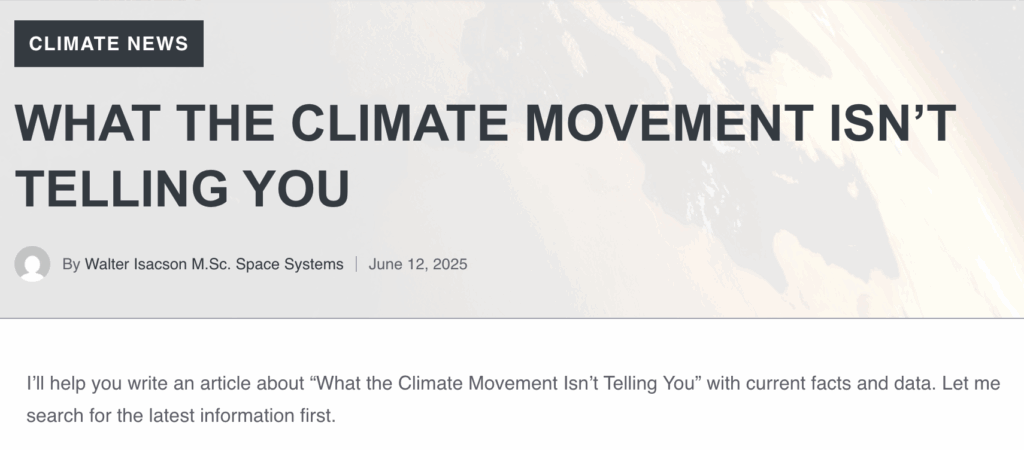
The first line of another piece, “What the Climate Movement Isn’t Telling You”, appeared to include the response to a prompt – an instruction given to an AI platform.

It read: “I’ll help you write an article about ‘What the Climate Movement Isn’t Telling You’ with current facts and data. Let me search for the latest information first.”

“As technology advances, integrating artificial intelligence (AI) into our operations offers exciting opportunities to enhance the journalism at Climate Cosmos,” reads the AI disclaimer on site’s “about us” page. It also states: “we clearly disclose when AI-generated content is used”. However, Isacson’s piece included no such disclosure.

The article falsely claimed that humanity is on course to stay within the temperature goals set by the 2015 Paris Agreement, using this as a launchpad to attack the climate movement for allegedly failing to “reflect these new realities”. 

Recent predictions suggest that the global average surface temperature is likely to increase to by anywhere between 1.9C and 2.9C by the end of the century, well above 1.5C limit set by the Paris Agreement.

This appears to confirm the concerns of technology experts who have warned that AI “has the potential to turbocharge climate disinformation”.

Climate Cosmos is “clearly the lowest possible level spam – they’re just trying to put out content out for some easy clicks, hence the clickbait-y titles,” said Philip Newell, communications co-chair of the Climate Action Against Disinformation (CAAD) coalition. “AI has brought the cost of disinformation down to nothing. It has automated bullshit.”

“It appears to be mostly AI slop, rather than a concerted disinformation operation,” he said – adding that AI has “no concern for accuracy”.

Climate Cosmos posted a host of articles on MSN every day and has more than 45,000 subscribers on the aggregator. However, in July, all of its MSN content disappeared, as did all the content produced by other publications belonging to its parent company.

A spokesperson for Microsoft, which owns MSN, told DeSmog: “when we become aware of instances that violate our policies, we take action to remove them as soon as possible.”
 
Newsbreak did not respond to DeSmog’s request for comment.

Even despite – or perhaps because – of this historical lack of editorial rigour, Climate Cosmos has been used by multiple anti-climate campaign groups and publications.

The website’s content has been cited by the Heartland Institute, Wattsupwiththat, the European Institute for Climate and Energy (EIKE), and the American Spectator. The climate denial project CFACT also reprinted an article from Climate Cosmos on its own site.

Climate Cosmos “appears to be climate denier propaganda posing as a science blog,” said Michael E. Mann, a leading climate scientist and Presidential Distinguished Professor in the Department of Earth and Environmental Science at the University of Pennsylvania." Excerpt from DeSmog