
Sunday, 13 January 2019
Like 'We want climate action now' on Facebook

'Retreat' Is Not An Option As A California Beach Town Plans For Rising Seas: NPR
 "Del Mar is one of countless coastal communities in California and
across the U.S. that is seeing the impacts of climate change and
preparing for worse to come.
"Del Mar is one of countless coastal communities in California and
across the U.S. that is seeing the impacts of climate change and
preparing for worse to come.By midcentury, tens of millions of U.S. homes and billions of dollars of property are likely to be destroyed or made unusable by increased flooding from rising seas and storms, according to a recent climate report by the U.S. government.
That leaves residents of seaside towns like Del Mar with an alarming choice: stay and fight those impacts, or turn and leave."
Read the NPR article
#sealevelrise #climatecatastrophe #climateaction
Thursday, 10 January 2019
We have already created extreme extreme weather
 |
| Hurricane Michael, October 9, 2018. Source: NOAA |
The Human Fingerprints on Extreme Weather
"Climate change is already taking a massive toll, and it’s only going to get worse."
"Hurricane Michael broke records Wednesday, when it became the most powerful cyclone ever recorded to make landfall along the Florida Panhandle. Abnormally warm waters fueled winds up to 155 miles per hour, which laid waste to homes and businesses caught in the storm’s path. As multiple outlets noted,
climate change likely fueled the record-breaking wind speeds. That fact
is notable given that both reporters and researchers have historically
been reticent to link any one storm to climate change.
Five
or ten years ago, if you asked a scientist how climate change figured
into a particular hurricane, she would demur, saying that it was
impossible to blame any single event on the overall warming trend. Those
days are over. In the last decade, scientists have developed
sophisticated tools for finding the human fingerprint on extreme
weather. The emerging field of attribution research, as it’s known,
investigates the role of climate change in specific events. A newly
published report
amassing more than 200 attribution studies makes clear that
heat-trapping carbon pollution is already making the weather measurably
more severe."
Read the Medium article
See also: Risks of 'domino effect' of tipping points greater...
#extremeweatherevents #humancausedclimatechange #hurricanemichael #cyclones #climatechange #climateactionnow
See also: Risks of 'domino effect' of tipping points greater...
#extremeweatherevents #humancausedclimatechange #hurricanemichael #cyclones #climatechange #climateactionnow
Talk is Cheap: Towards Active State Ownership in the Fossil Fuel Industry: Medium
 |
| Photo by Kevin Harris on Unsplash |
"The combustion of fossil fuels for energy is by far the largest source of greenhouse gas emissions and the energy sector will need change in order for long-term de-carbonization to succeed. So, it is disappointing that there has been little concrete climate action from the fossil fuel industry, despite commitments to the Paris Agreement."
Wednesday, 9 January 2019
Mental health added to impact of climate change as global damage grows: The Age

Scientists have identified for the first time an association between mean annual maximum temperatures pushed higher by climate change and suicides for both males and females across states and territories, according to a paper published by The Medical Journal of Australia on Thursday.
Read the article
#mentalhealth #climatecatastrophe #suicide #healthrisks #health #risingtemperatures #climateactionnow
Tuesday, 8 January 2019
China’s Climate Progress May Have Faltered in 2018, But It Seems to Be on the Right Path: DESMOG

Despite the recent setbacks, the most likely scenario is that China’s emissions will peak before 2030. How quickly they might decline after 2030 is not yet clear.
This is not to say China is doing everything it can to combat climate change.
Like the U.S. and all other countries, China must make its climate policies more ambitious if the world is to keep global warming well below 2 degrees Celsius, as the Paris climate accord is intended to do. For example, global emissions will be lower in the long run if China phases out its fossil fuel subsidies and stops building coal-fired power plants in other countries.
But given the pace of its economic growth, China’s accomplishments to date are notable. As the Center for American Progress, a think tank, found, if regulatory trends continue, by 2020 no American coal plants would meet China’s carbon emission standards.
That is a good reminder that the whole world, and not just China, needs to do more if we are to be spared from the worst impacts of climate change.

Phillip Stalley is Associate Professor and Fulbright Scholarship Program Advisor at DePaul University.
This article is republished from The Conversation under a Creative Commons license. Read the original article.
Main image: A woman in Beijing wearing a mask to avoid inhaling smog passes an anti-pollution mural. Credit: AP Photo/Andy Wong"
Sunday, 6 January 2019
Extreme heat increasing in both summer and winter: AGU100
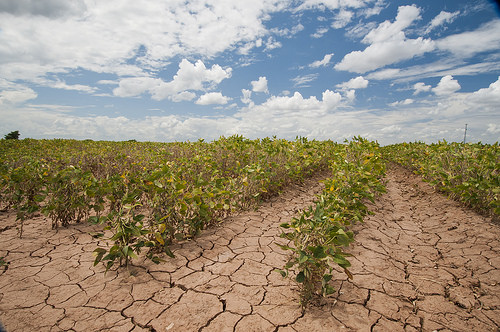 |
| Texas drought near Navasota, TX 2013. Credit: USDA |
A new study shows extreme heat events both in the summer and in the winter are increasing across the U.S. and Canada, while extreme cold events in summer and winter are declining.
A new study in the in Journal of Geophysical Research: Atmospheres, a publication of the American Geophysical Union, examined absolute extreme temperatures—high temperatures in summer and low temperatures in winter—but also looked at relative extreme temperature events—unusually cold temperatures and unusually warm temperatures throughout the year.
26 November 2018
Read AGU100 research
#globalheating #extremecoldevents #canada
Subscribe to:
Comments (Atom)