Showing posts with label climate catastrophe. Show all posts

Monday, 28 February 2022

Will predicted sea rise inundation and flooding affect property values in Coffs Harbour NSW?

#inundation  #sea rise  #searise  #climatecrisis  #climatechange  #ice  #melting ice
Coffs Harbour 7m rise. Click to enlarge.
As many homes in Coffs Harbour  are flooded because of an intense rain depression we need also to examine the affect of sea rise. 
 
We also must stop building in flood affected areas. Councils must stop approving development in flood affected areas. It is ridiculous to see new buildings flooded to their roofs. Insurance companies may pay for a while but not without future higher payment rates. In the end every taxpayer pays.
 
• We are looking more and more unlikely to prevent severe global heating.

• Scientists are predicting the melting of the ice covering Greenland with a subsequent sea level rise of 7m.

• This rise does not factor in sea rise from the melting of Antarctica and other ice.

• Already many properties are likely to flood when a high tide is combined with high local rainfall. What were a hundred year rainfall events are now ten year events.

• The frequency of high rainfall events will increase with global heating and more and more severe hurricanes are predicted because of warmer seas.

• Low coastal areas will be subjected to severe storm surges.

• Would you buy a property likely to be inundated in twenty years, fifty years, a hundred years? Many wouldn't. Even the perception of possible inundation will greatly affect property values.

• When certain properties are in less demand their value falls.

• Would you buy a property with a value likely to fall?

•  The view of Coffs Harbour above shows areas likely to be inundated by a 7m sea level rise.

• Property above a 10m rise will become highly sought after and will greatly rise in value.

Learn more about how sea rise inundation will affect Australian property.

Click here to go to Coastal Risk Australia site

'Retreat' Is Not An Option As A California Beach Town Plans For Rising Seas: NPR 


#inundation  #sea rise  #searise  #climatecrisis  #climatechange  #ice  #melting ice 

Friday, 4 September 2020

Carbon tariffs: an instrument for tackling climate change?: AXA

Carbon Tariffs: Another Name for Green Protectionism?

A Carbon Tariff model that might be acceptable to developing countries

Carbon tariffs are a tax on carbon-intensive imports, which recently triggered heated international debates. Certain industrialized countries have been advocating the adoption of carbon tariffs on products imported from developing countries, such as China. 

According to Marco Springmann, a physicist turned economist, the main reason is that certain rich nations have implemented binding targets to reduce greenhouse gas emissions, while poorer countries have so far resisted legal commitments. Additionally, because many of them simply do not set a price on carbon, they can produce cheaper carbon-intensive goods. Promoters of carbon tariffs thus think that taxing such goods at the border will make up for this difference in price and indirectly regulate the associated emissions.

However, almost a quarter of China’s CO2 emissions come from its

exports. So China and other nations view carbon tariffs as trade sanctions and protectionism. They even threatened to start a “trade war” if such schemes were to be put into place. They stress the role that carbon emissions have played in the industrialization of advanced economies and demand increased financial aid in order to reduce their emissions.

Carbon tariffs to finance clean development

To avoid this coming carbon war, Springmann proposes to recycle the tax revenues from carbon tariffs (claimed in the importing country) to the exporting country as investments in climate change mitigation and adaptation measures. This coupled scheme addresses the concerns about competitiveness and reducing emissions in one part of the world and economic progress in the other. Since it acknowledges the demand for imports as an emissions-causing factor, it may therefore represent a consensus solution within a global climate policy. According to Springmann, a preliminary assessment has indicated that the revenue from this scheme would range between $8 and $50 billion per year, depending on the price of carbon. In comparison, at the climate summit in Copenhagen in 2009, it was agreed to create a “Fast Start Fund” to support climate adaptation and clean technology in developing countries. The pledged contribution is $30 billion over the next three years. Carbon tariffs would add significant revenue streams to this effort."

Go to original AXA article by Marco Springmann (3 years)


 Related: Young people’s burden: requirement of negative CO2 emissions: Hansen et al


carbon tariffs, carbon footprint, impose trade tariffs on carbon offenders, carbon trading, climate catastrophe, #economy,

Saturday, 29 August 2020

2020 is a Warning That Our Civilization is Beginning to Fall Apart (excerpt): Medium

(Pics from this blog)

we want climate action now
  "Some Ages Have World Wars. Others Have Moonshots. Our Great Challenge is Preventing the Collapse of Civilization.


....................................................

Monday, 20 July 2020

Climate Change: Global Sea Level: NOAA

South Beach, Miami on May 3, 2007. Photo by Flickr user James WIlliamor, via a Creative Commons license.


"Sea level since 1880

The global mean water level in the ocean rose by 0.14 inches (3.6 millimeters) per year from 2006–2015, which was 2.5 times the average rate of 0.06 inches (1.4 millimeters) per year throughout most of the twentieth century. By the end of the century, global mean sea level is likely to rise at least one foot (0.3 meters) above 2000 levels, even if greenhouse gas emissions follow a relatively low pathway in coming decades.

In some ocean basins, sea level rise has been as much as 6-8 inches (15-20 centimeters) since the start of the satellite record. Regional differences exist because of natural variability in the strength of winds and ocean currents, which influence how much and where the deeper layers of the ocean store heat."

..........................

ADMIN: The above figures are now seen by some scientists as an underestimation of sea level rise. See article below.

Greenland shed ice at unprecedented rate in 2019; Antarctica continues to lose mass: EurekAlert


....................................


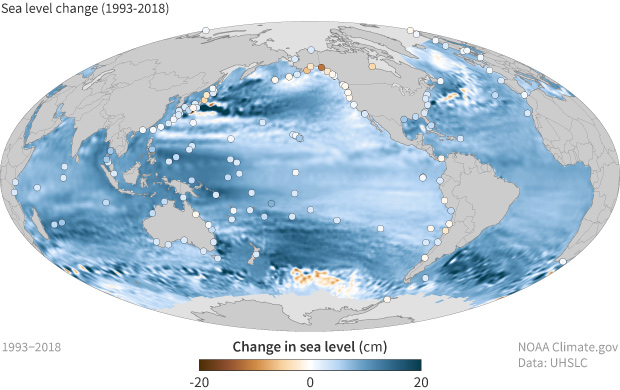
Global map of mean sea level change since 1993 with dots showing local sea level change on land


Between 1993 and 2018, mean sea level has risen across most of the world ocean (blue colors). In some ocean basins, sea level has risen 6-8 inches (15-20 centimeters). Rates of local sea level (dots) can be amplified by geological processes like ground settling or offset by processes like the centuries-long rebound of land masses from the loss of ice age glaciers. NOAA Climate.gov map, based on data provided by Philip Thompson, University of Hawaii. 
Past and future sea level rise at specific locations on land may be more or less than the global average due to local factors: ground settling, upstream flood control, erosion, regional ocean currents, and whether the land is still rebounding from the compressive weight of Ice Age glaciers. In the United States, the fastest rates of sea level rise are occurring in the Gulf of Mexico from the mouth of the Mississippi westward, followed by the mid-Atlantic. Only in Alaska and a few places in the Pacific Northwest are sea levels falling, though that trend will reverse under high greenhouse gas emission pathways.

In some ocean basins, sea level rise has been as much as 6-8 inches (15-20 centimeters) since the start of the satellite record in 1993.

Why sea level matters

In the United States, almost 40 percent of the population lives in relatively high population-density coastal areas, where sea level plays a role in flooding, shoreline erosion, and hazards from storms. Globally, 8 of the world’s 10 largest cities are near a coast, according to the U.N. Atlas of the Oceans.


In urban settings along coastlines around the world, rising seas threaten infrastructure necessary for local jobs and regional industries. Roads, bridges, subways, water supplies, oil and gas wells, power plants, sewage treatment plants, landfills—the list is practically endless—are all at risk from sea level rise. 

Higher background water levels mean that deadly and destructive storm surges, such as those associated with Hurricane Katrina, “Superstorm” Sandy, and Hurricane Michael—push farther inland than they once did. Higher sea level also means more frequent high-tide flooding, sometimes called “nuisance flooding” because it isn't generally deadly or dangerous, but it can be disruptive and expensive. (Explore past and future frequency of high-tide flooding at U.S. locations with the Climate Explorer, part of the U.S. Climate Resilience Toolkit.)


Nuisance flooding in Annapolis in 2012. Around the U.S., nuisance flooding has increased dramatically in the past 50 years. Photo by Amy McGovern.

In the natural world, rising sea level creates stress on coastal ecosystems that provide recreation, protection from storms, and habitat for fish and wildlife, including commercially valuable fisheries. As seas rise, saltwater is also contaminating freshwater aquifers, many of which sustain municipal and agricultural water supplies and natural ecosystems.


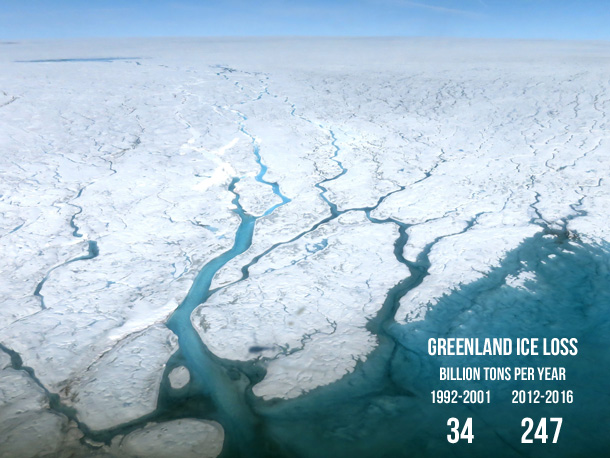
Photo of melt streams on the Greenland Ice Sheet in summer 2015
Melt streams on the Greenland Ice Sheet on July 19, 2015. Ice loss from the Greenland and Antarctic Ice Sheets as well as alpine glaciers has accelerated in recent decades. NASA photo by Maria-José Viñas.

Go to the original NOAA article by

Author: 
November 19, 2019

Other 2019 reports of ice melt predict a higher sea rise. See below.

Greenland shed ice at unprecedented rate in 2019; Antarctica continues to lose mass: EurekAlert

 ' "It is very likely that the current climate models overestimate the meltwater retention capacity of the ice sheet and underestimate the projected sea level rise coming from Greenland ... by a factor of two or three," he said. ' ICNews

Read the complete original Inside Climate News article


Wednesday, 6 May 2020

'Blown away': Safe climate niche closing fast, with billions at risk: SMH

By


As much as one-third of the world's population will be exposed to Sahara Desert-like heat within half a century if greenhouse gas emissions continue to rise at the pace of recent years.

Scientists from China, the US and Europe found that the narrow
climate niche that has supported human society would shift more over the next 50 years than it had in the preceding 6000 years.

"As many as 3.5 billion people will be exposed to "near-unliveable" temperatures averaging 29 degrees through the year by 2070. Less than 1 per cent of the Earth's surface now endures such heat.
That heat compares with the narrow 11- to 15-degree range that has supported civilisation over the past six millennia, according to research published Tuesday in the journal Proceedings of the National Academy of Sciences."

Xu Chi, a researcher at China's Nanjing University and one of the paper's authors, said: "We were frankly blown away by our own initial results. As our findings were so striking, we took an extra year to carefully check all assumptions and computations."

Read the complete SMH article

Sunday, 22 March 2020

The Frontline: experts answer your questions on the impacts of the climate emergency – as it happened: Ther Guardian

To mark the end of The Frontline series a panel of experts answer your questions about the climate crisis and how it is affecting Australia.
Ask Prof Lesley Hughes, Greg Mullins, Prof Michael Mann and Assoc Prof Donna Green your questions, and see the answers on our live blog. Email frontline.live@theguardian.com or tweet #frontlinelive

Thursday, 26 December 2019

If the Climate Change Crisis were World War II, it’s 1939: Medium

"The question is really, as Superchunk observed, “how fast?” Can we make this transition in time to prevent clathrate collapse or the popping of Yellowstone park? How many billions will die from famine, disease, water-shortages and toxic air pollution before we clean up the place? How many need to die before head-in-the-sand deniers get out of the way of those of us trying to make a difference?

To me a “climate emergency” means a war footing; and that means waging war against the deniers first, as they are the real obstacle. I’d be very happy to see a lot of our current senior political and corporate leaders hauled up in The Hague and charged with crimes against humanity, and I’d regard that as entirely appropriate. But that’s a fantasy and is, alas, unlikely to happen.

In various countries citizens are resorting to the courts to force their governments into action, and that’s certainly a pathway to progress in places where laws are designed to enforce the rights of ordinary people, rather than simply there to block action against climate change.

The sad truth is that almost no-one really believes that global warming, and the myriad other issues that stem from humanity’s abuse of the planet, are truly anything to get too worried about.

Most people I know, even those who completely accept that climate change is real and happening, continue to act as if they believe, deep-down, despite what they say, that the risks are overstated and, if impacts are going to be felt, they’ll be felt by other people and way in the distant, to them, future.

People may say that they accept the science, but they act as if they
don’t. A lot of people subscribe to a kind of magical thinking, wherein some hitherto undreamed of technological fix will just make the whole problem go away, so we can just continue polluting.

The emergency is upon us. We must urgently and radically change the way we generate power, fuel, and food, while putting in place adaptation measures to deal with the global warming already locked into the planetary system. If we do hit the runaway global warming tipping point, then no amount of adaptation will be possible. But simply explaining the facts clearly is usually written off as being alarmist. And that’s the core of the climate crisis."


See also

Climate change is a health emergency, RACGP declares: News GP

Sunday, 15 December 2019

Greta Thunberg’s speech at UN climate change conference

#criminales climáticos de la cárcel  #criminalesclimáticosdelacárcel

#jailclimatecriminals  #gaolclimatecriminals


Swedish activist Greta Thunberg says "we no longer have time to leave out the science," as she gave a speech at the U.N. global climate conference in Madrid - accusing world leader of “clever accounting and creative PR” to avoid action on the climate crisis. (Subscribe: https://bit.ly/C4_News_Subscribe
 
Thunberg told the crowd that the world's rapidly declining carbon budgets would be gone within eight years based on current emission levels. "How do you respond to the fact that basically nothing is being done about this without feeling the slightest bit of anger? And how do you communicate this without sounding alarmist? I would really like to know,” she said.
 
926K subscribers
Swedish activist Greta Thunberg says "we no longer have time to leave out the science," as she gave a speech at the U.N. global climate conference in Madrid - accusing world leader of “clever accounting and creative PR” to avoid action on the climate crisis. (Subscribe: https://bit.ly/C4_News_Subscribe) Thunberg told the crowd that the world's rapidly declining carbon budgets would be gone within eight years based on current emission levels. "How do you respond to the fact that basically nothing is being done about this without feeling the slightest bit of anger? And how do you communicate this without sounding alarmist? I would really like to know,” she said. #ClimateChange #ClimateCrisis #GlobalWarming

Climate Change and Why We Should Panic voiced by Keira Knightley | Extinction Rebellion Video


50.7K subscribers
British Academy Film Award and Academy Award nominee, Keira Knightley, OBE, has come out in support of Extinction Rebellion. Keira has lent her voice to defend the climate and tell the truth in this new, short film that summarises the crisis from how we got here, and what we must do now. The animation shows why government must enter crisis mode and choose a different path than the one we are on because it will lead us to extinction. Keira joins Emma Thompson, Stephen Fry, William Dafoe, Javier Bardem, Paloma Faith, Radiohead and all other people who know that we are facing an unprecedented global emergency.
 Learn more and #rebelforlife 
Website: https://Rebellion.Earth World Map of Extinction Rebellion Groups: http://bit.ly/2wri78B 

Friday, 15 November 2019

The facts about bushfires and climate change: Climate Council

The following excerpt is taken from a new Climate Council briefing paper titled This Is Not Normal, which finds the catastrophic bushfire conditions affecting NSW and Queensland have been aggravated by climate change. To read the briefing paper in full, click here.

This is not normal. As we write, New South Wales and Queensland have declared a state of emergency. There are also fires in South Australia and Western Australia. For the first time catastrophic bushfire conditions have been declared for Greater Sydney. Climate change has worsened the catastrophic bushfire conditions. The nature of bushfires in Australia has changed.
Bushfire conditions are now more dangerous than in the past, and the risk to people and property has increased. For well over 20 years, scientists have warned that climate change would increase the risk of extreme bushfires in Australia. This warning was accurate. Scientists expect extreme fire weather will continue to become more frequent and severe without substantial and rapid action to reduce greenhouse gas emissions.

Key Findings

  1. The catastrophic, unprecedented fire conditions currently affecting NSW and Queensland have been aggravated by climate change. Bushfire risk was exacerbated by record breaking drought, very dry fuels and soils, and record breaking heat.
    Bushfire conditions are now more dangerous than in the past. The risks to people and property have increased and fire seasons have lengthened. It is becoming more dangerous to fight fires in Australia.
  2.  
    The fire season has lengthened so substantially that it has already reduced opportunities for fuel reduction burning. This means it is harder to prepare for worsening conditions.
  3.  
    The costs of fighting fires are increasing. Australia relies on resource sharing arrangements between countries and states and territories within Australia. As seasons overlap and fires become more destructive, governments will be increasingly constrained in their ability to share resources and the costs of tackling fires will increase.
  4.  
    The government must develop an urgent plan to (1) prepare Australian communities, health and emergency services for escalating fire danger; and (2) rapidly phase out the burning of coal oil and gas which is driving more dangerous fires.

Read the complete Climate Council article

Wednesday, 9 October 2019

U.N. Climate Action Summit: World leaders announce plans to tackle climate change: Video


Days after millions of young people took to the streets worldwide to demand emergency action on climate change, leaders gathered at the United Nations on Monday to try to inject fresh momentum into stalling efforts to curb carbon emissions.

Chancellor Angela Merkel announced that Germany would double its contribution to a U.N. fund to support less developed countries to combat climate change to 4 billion euros from 2 billion euros.

New Zealand Prime Minister Jacinda Ardern said the country is determined to be the most "sustainable food-produced in the world," while Indian Prime Minister Modi pledged to increase the country's renewable energy capacity.

 Over 60 world leaders and CEOs of energy and financial companies are expected to address the United Nations conference and announce climate finance measures and transitioning from coal power.

 For more info, please go to https://globalnews.ca/news/5940258/gr...


See also

We are talking about 'drought-proofing' again – they are simplistic solutions that will destroy Australia : The Guardian


#jailclimatecriminals  #suefossilcorpdirectors  #climatecrisis

Wednesday, 2 October 2019

Satellite Data Record Shows Climate Change's Impact on Fires : NASA

"By Ellen Gray,
NASA's Earth Science News Team


Hot and dry. These are the watchwords for large fires. While every fire needs a spark to ignite and fuel to burn, the hot and dry conditions in the atmosphere determine the likelihood of a fire starting, its intensity and the speed at which it spreads. Over the past several decades, as the world has increasingly warmed, so has its potential to burn.

Since 1880, the world has warmed by 1.9 degrees Fahrenheit (1.09 degrees Celsius), with the five warmest years on record occurring in the last five years. Since the 1980s, the wildfire season has lengthened across a quarter of the world's vegetated surface, and in some places like California, fire has become nearly a year-round risk. The year 2018 was California's worst wildfire season on record, on the heels of a devasting 2017 fire season. In 2019, wildfires have already burned 2.5 million acres in Alaska in an extreme fire season driven by high temperatures, which have also led to massive fires in Siberia."

Near Ebor in NSW, Australia


Read the complete NASA article

It’s Time To Start Prosecuting Climate Criminals: Ecosystem Marketplace


#climatecriminals  #jailclimatecriminals  #jail the climate criminals  #climatecatastrophe


Monday, 30 September 2019

Climate Risk in the Housing Market Has Echoes of Subprime Crisis, Study Finds: NYT

"Asaf Bernstein, an economist at the University of Colorado in Boulder, said the findings highlighted another problem: By agreeing to buy mortgages for homes at risk from climate change, without charging a premium that reflects that risk, the federal government had effectively encouraged home construction and purchases in vulnerable areas.


“It’s basically an implicit subsidy,” Mr. Bernstein, who was not involved in the study, said.

Economists at both Fannie and Freddie have warned in the past of the risks that climate-related increases in flooding pose to the mortgage industry. In 2016, Sean Becketti, then the chief economist at Freddie Mac, wrote that rising seas “appear likely to destroy billions of dollars in property.”

“The economic losses and social disruption may happen gradually, but they are likely to be greater in total than those experienced in the housing crisis and Great Recession,” he wrote. “It is less likely that borrowers will continue to make mortgage payments if their homes are literally underwater.”

See also:

'It doesn't feel justifiable': The couples not having children because of climate change: SMH


Wednesday, 25 September 2019

'It doesn't feel justifiable': The couples not having children because of climate change: SMH

"Morgan and Adam have always wanted children but fears over climate change are making them reconsider.

The committed pair, aged 36 and 35, are part of a growing trend for young couples to abandon plans for a family because of the climate crisis.

Millions of people around the world rallied for climate action over the past two days, including 300,000 in Australia on Friday, ahead of a United Nations climate action summit on Monday."

' "I feel so sad, it's such a hard thing to let go of," says Morgan, who works in logistics. "My conscience says, 'I can't give this child what I've enjoyed, I can't give them the certainty of a future where they can be all that they can be ... or have the things they should have, like breathable air and drinkable water'."'