Showing posts with label heatwaves. Show all posts

Monday, 7 September 2020

Climate Change Poses Serious Threats to India's Food Security (excerpt): The Wire

Climatic factors like increased temperatures and extreme rainfall will affect productivity by causing physiological changes. Photo: Reuters
"Planning for the long-term impacts of climate change on agriculture appears to be rather low on the government's priority list.

Issues including the security clampdown in the Valley and slowdown in major sectors of the economy are dominating headlines. The agriculture ministry too would be occupied with formulating interventions to spur the economy of the erstwhile state of Jammu and Kashmir.


Climate change is no longer a distant threat. According to the Indian Meteorological Department, the annual mean temperature in the country has increased by 0.6 degrees Celsius between 1901 and 2018, when compared to pre-industrial levels. Eleven of the 15 warmest years have so far all been within the last 15 years with 2018 being the sixth warmest year in India’s recorded history.

The extent and degree of warming are going to get more severe. As carbon emissions continue and those which are built into the climate system take effect, temperatures across the world are expected to increase between 3-5 degree Celsius by 2100. India is among the countries which are likely to bear the worst of a warming planet due to its tropical location and relatively lower levels of income.

Agriculture and food production are likely to be significantly affected by climate change. According to one estimate, yields of major crops could decline by up to 25%. A recent IPCC report also warned that in the years to come, food security will stand threatened due to climate change coupled with increasing demands of the rising population.

The global population is expected to increase from 7.7 billion in 2019 to 8.5 billion by 2030 and 9.7 billion by 2050. According to the United Nation’s World Population Prospects (June 2019), the Indian population is projected to increase from 1.36 billion in 2019 to 1.5 billion by 2030 and 1.64 billion by 2050.

Crops, animal husbandry, as well as fisheries,
 are likely to be impacted. Photo: Reuters

Providing food and nutritional security to an entire population needs some serious planning and effective implementation. And we need to start now. 

Climatic factors like increased temperatures and extreme rainfall will affect productivity by causing physiological changes. In addition, they will affect soil fertility, the incidence of pest infestation and the availability of water. This will impact crops, animal husbandry as well as fisheries."................................

From The Wire 
by Siraj Hussain
19/Sep/2019

Wednesday, 6 May 2020

'Blown away': Safe climate niche closing fast, with billions at risk: SMH

By


As much as one-third of the world's population will be exposed to Sahara Desert-like heat within half a century if greenhouse gas emissions continue to rise at the pace of recent years.

Scientists from China, the US and Europe found that the narrow
climate niche that has supported human society would shift more over the next 50 years than it had in the preceding 6000 years.

"As many as 3.5 billion people will be exposed to "near-unliveable" temperatures averaging 29 degrees through the year by 2070. Less than 1 per cent of the Earth's surface now endures such heat.
That heat compares with the narrow 11- to 15-degree range that has supported civilisation over the past six millennia, according to research published Tuesday in the journal Proceedings of the National Academy of Sciences."

Xu Chi, a researcher at China's Nanjing University and one of the paper's authors, said: "We were frankly blown away by our own initial results. As our findings were so striking, we took an extra year to carefully check all assumptions and computations."

Read the complete SMH article

Sunday, 22 March 2020

The Frontline: experts answer your questions on the impacts of the climate emergency – as it happened: Ther Guardian

To mark the end of The Frontline series a panel of experts answer your questions about the climate crisis and how it is affecting Australia.
Ask Prof Lesley Hughes, Greg Mullins, Prof Michael Mann and Assoc Prof Donna Green your questions, and see the answers on our live blog. Email frontline.live@theguardian.com or tweet #frontlinelive

Tuesday, 24 December 2019

Climate change is a health emergency, RACGP declares: News GP

..... ‘There is a substantive and compelling body of medical and scientific evidence supporting the position that this is a health emergency,’ she said.

‘In Australia, strong voices are calling for the mitigation of climate impacts on the health of current and future generations, including in Aboriginal and Torres Strait Islander, rural and remote communities.

‘We acknowledge the serious threats posed to the health of children, older Australians and those in rural and remote communities. Climate change disproportionately affects the health of Australians with asthma, respiratory conditions and heart disease. The research demonstrates that women are at higher risk of death from climate change, in particular from climate-change-linked natural disasters.’

Dr Roeske said more deaths from heatwaves can be expected, with young generations likely to have their mental health affected.

Health impacts in Australia are also likely to include more deaths from the spread of infectious disease such as malaria and dengue, with diarrheal illnesses also expected to grow.

‘This is a signal to our members and to our patients and communities that GPs recognise climate change as a health emergency and are ready to respond to the multiple health challenges ahead,’ Dr Roeske said.

‘We believe the Australian Government should recognise and help address the health impacts of climate change.’


Read the original News GP article 

#criminales climáticos de la cárcel  #criminalesclimáticosdelacárcel

#jailclimatecriminals  #gaolclimatecriminals

#buyfromthebush 


Related:
Air pollution is much more harmful than you know: ...

Sunday, 22 December 2019

435 people died in an 1896 heatwave — but scientists say the extreme heat events of today are still hotter: ABC


"Newspaper reports describe temperatures in Bourke reaching 48.9 degrees Celsius on three occasions, and the maximum temperature remaining above 38C for 24 consecutive days.

As Australia endures a series of intense and record-breaking heatwaves this summer, the 1896 event is sometimes viewed as evidence that Australia has always experienced extraordinary heat, and that the effects of climate change are overblown.

But climate scientists say that is an oversimplification, and the heatwaves we experience today are significantly hotter than those in the past."

"The temperature recording methods used in 1896 were flawed

Methods of recording temperature were not standardised until the early 1900s, leading to inflated temperature readings before then.
The global standard for temperature measurement includes the use of a Stevenson screen, which is a white louvred box allowing ventilation and ensuring thermometers inside are never exposed to the sun. 

A Stevenson screen was not installed in Bourke until August 1908, meaning temperature readings from before that could be inflated by as much as 2C.

University of Melbourne climate researcher Linden Ashcroft said thermometers in Bourke were likely placed in sub-standard conditions in 1896.

"Some thermometers were under verandahs, or they were against stone buildings," she said."


Read the complete ABC article

#jailclimatecriminals

#jail climate criminals

Related:

How the Political Right Uses Fossil Fuels to Galvanize Opposition to Climate Action : Green Market Oracle

Monday, 14 October 2019

Hello From the Year 2050. We Avoided the Worst of Climate Change — But Everything Is Different: NYT

Let’s imagine for a moment that we’ve reached the middle of the century. It’s 2050, and we have a moment to reflect—the climate fight remains the consuming battle of our age, but its most intense phase may be in our rearview mirror. And so we can look back to see how we might have managed to dramatically change our society and economy. We had no other choice.
There was a point after 2020 when we began to collectively realize a few basic things.

One, we weren’t getting out of this unscathed. Climate change, even in its early stages, had begun to hurt: watching a California city literally called Paradise turn into hell inside of two hours made it clear that all Americans were at risk. When you breathe wildfire smoke half the summer in your Silicon Valley fortress, or struggle to find insurance for your Florida beach house, doubt creeps in even for those who imagined they were immune.

Two, there were actually some solutions. By 2020, renewable
energy was the cheapest way to generate electricity around the planet—in fact, the cheapest way there ever had been. The engineers had done their job, taking sun and wind from quirky backyard DIY projects to cutting-edge technology. Batteries had plummeted down the same cost curve as renewable energy, so the fact that the sun went down at night no longer mattered quite so much—you could store its rays to use later.

And the third realization? People began to understand that the biggest reason we weren’t making full, fast use of these new technologies was the political power of the fossil-fuel industry. 
Investigative journalists had exposed its three-decade campaign of denial and disinformation, and attorneys general and plaintiffs’ lawyers were beginning to pick them apart. And just in time.

Read the NYT article 

See also: 

Blame for Extinction Spreads to Methane Gas: NYT


#jailclimatecriminals  #suefossilcorpsdirectors

Wednesday, 21 August 2019

Death, blackouts, melting asphalt: ways the climate crisis will change how we live : The Guardian


"From power cuts to infrastructure failure, the impact of climate change on US cities will be huge – but many are already innovating to adapt."

"Deaths. According to the Centers for Disease Control and Prevention, an average of 658 people die every year from heat-related causes. From 1999 to 2010, 8,081 heat-related deaths were reported in the United States and occurred more commonly among older, younger and poorer populations. Urban heat islands retain heat overnight, preventing people from sleeping well and leading to even more health problems, says Lucy Hutyra, an associate professor of earth and environment at Boston University. Air pollution is often worst on hot days, and when people leave windows open for air flow, the quality of the air can cause respiratory problems. Warmer, moister conditions also mean that heavy rainfall and subsequent flooding is on the rise; so far this year 78 people have died as a result, according to the National Weather Service."


"Economic Impact. According to a 2018 study by Texas A&M University: “The growing number of extreme rainfall events that produce intense precipitation are resulting in –and will continue to result in – increased urban flooding unless steps are taken to mitigate their impacts.” The 2017 National Climate Assessment concluded: “Heavy downpours are increasing nationally, especially over the last three to five decades …[and that] … increases in the frequency and intensity of extreme precipitation events are projected for all U.S. regions.” Between 2007 and 2011 alone, urban flooding in Cook County, Illinois, resulted in over 176,000 claims or flood losses at a cost of $660m (£545m)."

Read complete The Guardian story

Related: 

Australia coal use is 'existential threat' to Pacific islands, says Fiji PM

Sunday, 4 August 2019

As temperatures soar, a ‘heat dome’ is coming to the Arctic: You Tube


After Europe experienced record-breaking temperatures this month, climate scientists are now concerned that a heat wave will settle farther north. This week, a so-called “heat dome” is expected to strike over the Arctic, causing worries about potential ice melt and rising sea levels. Washington Post reporter Andrew Freedman joins Hari Sreenivasan to discuss the causes and consequences.

PBS News July 28, 2019


 Related: 'People are dying': how the climate crisis has sparked an exodus to the US : The Guardian

Sunday, 28 July 2019

Heatwave: think it’s hot in Europe? The human body is already close to thermal limits elsewhere :The Conversation

Kolkata India
"And yes, there is a limit.

When the air temperature exceeds 35°C, the body relies on the evaporation of water – mainly through sweating – to keep core temperature at a safe level. This system works until the “wetbulb” temperature reaches 35°C. The wetbulb temperature includes the cooling effect of water evaporating from the thermometer, and so is normally much lower than the normal (“drybulb”) temperature reported in weather forecasts.

Once this wetbulb temperature threshold is crossed, the air is so full of water vapour that sweat no longer evaporates. Without the means to dissipate heat, our core temperature rises, irrespective of how much water we drink, how much shade we seek, or how much rest we take. Without respite, death follows – soonest for the very young, elderly or those with pre-existing medical conditions."

Read The Conversation article

Thursday, 4 July 2019

June was hottest ever recorded on Earth, European satellite agency announces: Independent

The hottest recorded June in Europe ever. Humans were non existent in last hot ages.
Independent video hottest June weather

Experts say climate change contributed to record-breaking temperatures across Europe

Last month was the hottest June ever recorded, the EU‘s satellite agency has announced.

Data provided by the Copernicus Climate Change Service (C3S), implemented by the European Centre for Medium-Range Weather Forecasts on behalf of the EU, showed that the global average temperature for June 2019 was the highest on record for the month.

The data showed European average ​temperatures were more than 2C above normal and temperatures were 6-10C above normal over most of France, Germany and northern Spain during the final days of the month, according to C3S.

The global average temperature was about 0.1C higher than during the previous warmest June in 2016.

Experts have said climate change made last week’s record-breaking European heatwave at least five times as likely to happen, according to recent analysis.

Read the full Independent article 

Related:  The Last Time The Globe Warmed: Video (EONS)


Friday, 5 April 2019

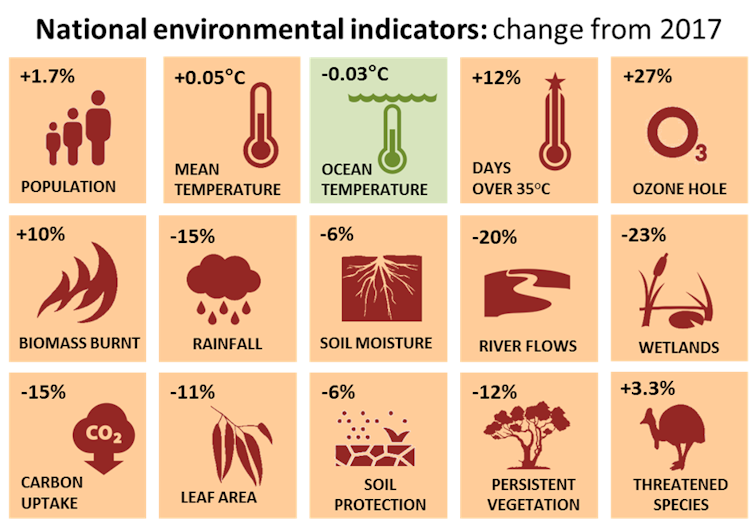
Australia’s 2018 environmental scorecard: a dreadful year that demands action: The Conversation


"Temperatures went up again, rainfall declined further, and the destruction of vegetation and ecosystems by drought, fire and land clearing continued. Soil moisture, rivers and wetlands all declined, and vegetation growth was poor.
In short, our environment took a beating in 2018, and that was even before the oppressive heatwaves, bushfires and Darling River fish kills of January 2019."

Dar
Indicators of Australia’s environment in 2018 compared with the previous year. Similar to national economic indicators, they provide a summary but also hide regional variations, complex interactions and long-term context. source: http://www.ausenv.online/2018


"Globally, the increase of greenhouse gases in the atmosphere accelerated again after slowing down in 2017. Global air and ocean temperatures remained high, sea levels increased further, and even the ozone hole grew again, after shrinking during the previous two years."

Read the article 

See also:

Australian Coalition government signs off with a budget tailored for climate denial: Renew Economy


Friday, 22 March 2019

Vote for your children's climate. Vote for your climate.


• Suddenly, many conservative politicians in Australia have 'backflipped'  and now publicly accept that we are living in an age of rapid climate change.... 

BUT

#climate change  #globalheating  #searise  #Liberal Party  #Labor Party
Vote for my future climate

• Many politicians still fail to grasp the catastrophic impacts of climate change all life on Earth will soon experience, therefore they are only 'greenwashing' their election campaigns.


• Most scientists believe we are very likely to heat the planet well beyond 2 degrees.

• The Liberal - National Party Coalition has loudly and publicly rebadged Tony Abbott's Direct Action funding, which inefficiently used your taxes to bribe polluters but has the proposed funding allocation by $200 million at the same time.


• Under the threat of an election defeat by a
The young want climate action
climate activist, Tony Abbott now says he believes in climate change.

• NSW has the biggest state economy yet it's contribution to planning for climate change and slowing global heating is pitiful.

• Yet some National Party and Liberal Party MPs still want to build new, subsidised, coal-powered energy generators even though renewable energy is cheaper and as reliable.

• The Federal Labor Party still supports the Queensland Labor Party's support of new, massive, coal mines. It has no plan to transition coal workers out of coal mining jobs.

• The above parties have no real planning for slowing and mitigating the effects of climate change. It is unlikely we will meet the Paris targets, (don't believe the false accounting of the the Liberal Party - National Party Coalition). 

Only candidates promising a massive attack on the causes of climate change and promising real planning for more economic downturns, droughts, heat waves, bush fires, epidemics, food and water shortages, health epidemics, ocean acidification, animal extinctions, sea inundations, property devaluations and waves of climate refugee immigration deserve your first vote.

Vote for your children's climate.

Vote for your climate. 

Related: Will predicted sea rise inundation affect property values in Coffs Harbour NSW?

#climate change  #globalheating  #searise  #Liberal Party  #Labor Party
 

Thursday, 17 January 2019

The world's 15 hottest sites on Tuesday were all in Australia: SMH


"Australia was home to all 15 of the world's hottest temperatures on Tuesday, a feat it may well repeat on Wednesday and beyond as a huge swath of the nation bakes in 45-degree-plus heat.


A slew of records have already fallen during the current heatwave and more are likely to be broken before a cool change breaks up the furnace later this week."


#heatwaves  #Australia  #risingtemperatures  #climateactionnow

Read the SMH article

Sunday, 6 January 2019

Extreme heat increasing in both summer and winter: AGU100

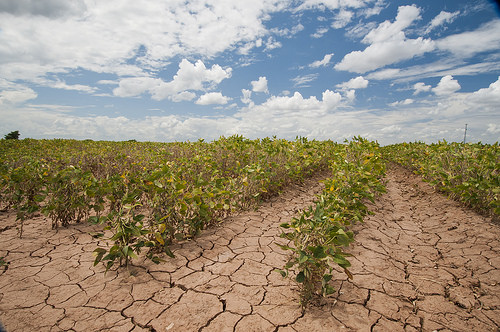
Texas drought near Navasota, TX 2013.
Credit: USDA

A new study shows extreme heat events both in the summer and in the winter are increasing across the U.S. and Canada, while extreme cold events in summer and winter are declining.

A new study in the in Journal of Geophysical Research: Atmospheres, a publication of the American Geophysical Union, examined absolute extreme temperatures—high temperatures in summer and low temperatures in winter—but also looked at relative extreme temperature events—unusually cold temperatures and unusually warm temperatures throughout the year.

26 November 2018


Read  AGU100 research

#globalheating  #extremecoldevents  #canada


Friday, 30 November 2018

The Guardian: Climate change already a health emergency, say experts

"Deadly heatwaves and spread of diseases affect people’s health today – report.

People’s health is being damaged today by climate change through effects ranging from deadly heatwaves in Europe to rising dengue fever in the tropics, according to a report.

Billions of hours of farmwork has been lost during high temperatures and global warming has damaged the ability to grow crops, it said."

Read The Guardian article 

Related:

Australia shamed – again – on climate, as UNEP report calls for urgent action


Monday, 19 November 2018

Siemens: What is climate change? Video


Now 2 degrees has been shown to be too high a limit. 1.5 degrees is what we must try for. 

"Climate Change is the bad news story that isn’t going away 

From heatwaves to hurricanes, from droughts to floods 

Extreme weather events are becoming more frequent, putting lives at risk Human activity is causing our climate to change 

The CO2 emissions from our cars, our industries and our power plants are heating up the planet 

To prevent further dangerous levels of climate change Countries around the world signed up to the Paris Agreement The Paris 

Agreement aims to keep global warming below 2 degrees To stop the planet getting warmer, we need to reduce the use of fossil fuels 

And increase the share of renewable energy, like from wind, solar and low carbon sources 

Climate action is everyone‘s responsibility: governments, businesses, communities, individuals 

The actions we can take to reduce our carbon footprint, like investing in green technologies can also reduce costs and create jobs The risks and costs of inaction are too high to ignore. 

So what are we waiting for? The time to act is now." Siemens Nov 3,  2017

Siemens