Friday, 16 November 2018

UTS Science in Focus: Will coral reefs survive climate change?


Published on Sep 6, 2018  With Dr Emma Camp
 
The world’s coral reefs are under threat. Environmental changes such as warming waters and pollution are causing ocean acidification, coral disease and coral bleaching. 
 
Australia’s world heritage listed, the Great Barrier Reef is no exception. At UTS, our marine scientists have been studying reef forming corals and coral reef fishes to better understand how environmental stressors and climate change will affect reefs—and the marine life they support.

Inside EPA head Andrew Wheeler’s highly effective campaign to sacrifice public health in favor of the fossil-fuel industry

The President’s Coal Warrior

If you could design the ideal character to assure the continuing domination of Big Coal and Big Oil in America and to reaffirm their faith in their God-given right to cook the climate in pursuit of profit, that character would look a lot like acting EPA Administrator Andrew Wheeler.

Go Rolling Stone Story

ABC: Australia's biggest oil and gas producer Woodside is now calling for a carbon price.


New UN report outlines ‘urgent, transformational’ change needed to hold global warming to 1.5°C

"Whether we are successful primarily depends on the rate at which government and non-state bodies take action to reduce emissions. Yet despite the urgency, current national pledges under the Paris Agreement are not enough to remain within a 3℃ temperature limit, let alone 1.5℃. 


Source: Australian Academy of Science.
Global warming is not just a problem for the future. The impacts are already being felt around the world, with declines in crop yields, biodiversity, coral reefs, and Arctic sea ice, and increases in heatwaves and heavy rainfall. Sea levels have risen by 40.5mm in the past decade and are predicted to continue rising for decades, even if all greenhouse emissions were reduced to zero immediately. Climate adaptation is already needed and will be increasingly so at 1.5℃ and 2℃ of warming."

Read the article in The Conversation

Wednesday, 14 November 2018

The Guardian: The Earth is in a death spiral. It will take radical action to save us

Illustration: Ben Jennings

By George Monbiot, November 14  2018

Climate breakdown could be rapid and unpredictable. We can no longer tinker around the edges and hope minor changes will avert collapse.

 Public figures talk and act as if environmental change will be linear and gradual. But the Earth’s systems are highly complex, and complex systems do not respond to pressure in linear ways. When these systems interact (because the world’s atmosphere, oceans, land surface and lifeforms do not sit placidly within the boxes that make study more convenient), their reactions to change become highly unpredictable. Small perturbations can ramify wildly. Tipping points are likely to remain invisible until we have passed them. We could see changes of state so abrupt and profound that no continuity can be safely assumed.

Read the original The Guardian article


GREENS WELCOME INVESTMENT IN NSW ENERGY TRANSMISSION INFRASTRUCTURE AS OPPORTUNITY FOR SUPPORTING NEW RENEWABLES

A fortnight after the Greens released their plan for eight renewable energy zones and upgrades to transmission projects in NSW, the State Government has today released its NSW Transmission Infrastructure Strategy.

The Greens have welcomed the four priority transmission projects identified in the strategy, including upgrades to the interconnectors with Queensland and Victoria, and a new interconnector with South Australia to enable renewable energy projects to connect to the grid and increase the resilience of the power network.

scifigeneration: New system opens the door to transforming CO2 into industrial fuels

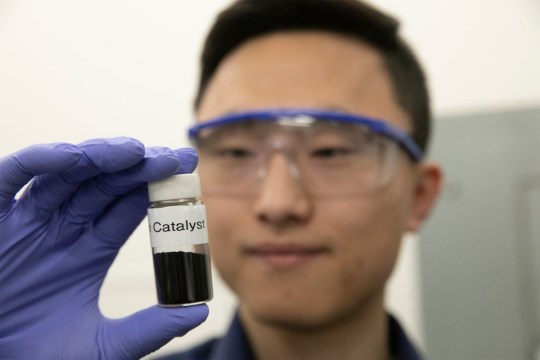
Imagine a day when – rather than being spewed into the atmosphere – the gases coming from power plants and heavy industry are instead captured and fed into catalytic reactors that chemically transform greenhouse gases like carbon dioxide into industrial fuels or chemicals and that emit only oxygen.

It’s a future that Haotian Wang says may be closer than many realize.

A Fellow at the Rowland Institute at Harvard, Wang and colleagues have developed an improved system to use renewable electricity to reduce carbon dioxide into carbon monoxide – a key commodity used in a number of industrial processes. The system is described in a November 8 paper published in Joule, a newly launched sister journal of Cell Press.

November 13 2018