Showing posts with label carbon dioxide. Show all posts

Friday, 13 November 2020

The 40 Things Biden Should Do First on Climate Change (excerpt): Bloomberg Green


Randolph Bell
Randolph Bell, Director for Global Energy Security, Atlantic Council

Take care of fugitive methane emissions.

“Failing to fully address methane leakage is increasingly a risk for the climate and for the U.S. economy. Methane makes up at least 10 percent of U.S. greenhouse gas emissions—recent analysis suggests far more—and is at least 25% more potent at trapping heat than carbon dioxide. With natural gas projected to play an important role in the global energy system even under aggressive decarbonization scenarios by providing low-carbon power in the developing world and feedstock for hydrogen production (with carbon capture and storage), addressing methane is crucial for meeting climate goals.”

“The U.S.’s methane problem has the attention of major oil & gas producers, who decried the Trump Administration’s August reversal of an Obama-era rule on methane. Engie’s decision last month, under pressure from the French government, to delay its $7 billion deal with U.S. LNG company NextDecade because of U.S. methane emissions underscores the risks to the U.S. economy.”

“President-elect Biden can immediately direct the EPA to initiate a new rulemaking process to ensure that industry monitors and addresses leaks in new equipment, as Obama’s rule did. Biden can also be more ambitious and address leaks in older equipment, an effort that was not completed under Obama.” —As told to Akshat Rathi


Saturday, 19 September 2020

More natural gas isn’t a “middle ground” — it’s a climate disaster (excerpt): Vox

To tackle climate change, natural gas has got to go.

 
Methane gas energy has to go. Leave gas in the ground.

"Methane leakage may make natural gas as bad as coal, but it’s not the reason gas has no future

The paper leads with a quick note on methane leakage in natural gas production. Methane is a fast-acting greenhouse gas with enormous short-term impacts on climate. It leaks at every stage of the natural gas production and transportation process.

While gas itself is less carbon-intensive than coal, if enough methane leaks during its production, its greenhouse gas advantages are wiped out.

Gas wells destroy farmland.
Does that much methane leak? Some studies have suggested that, yes, methane leakage is bad enough to make natural gas the greenhouse equivalent of coal. Other studies have suggested that gas still has an advantage (and proponents note that leakage could be reduced).

For our purposes here, it doesn’t matter. None of the five arguments against natural gas rely on any particular estimate of leakage. All of them would apply even if natural gas achieved zero leakage (which is impossible). The same is true regarding the local environmental impacts of natural gas production (air pollution, habitat loss, earthquakes) — they are dreadful, but even if they were eliminated, the following arguments would still apply.


1) Gas breaks the carbon budget

Honestly, this one is enough to rule out gas on its own. .......... "

Read the complete Vox article by

  Revealed: how the gas industry is waging war against climate action (excerpt) : The Guardian


Fact check on PM Morrison's gas plan.


 #methanegas,methane gas,greenhouse gas pollution,carbon dioxide,#economy,#stranded assets,#renewables,#jailclimatecriminals,


Thursday, 3 September 2020

Young people’s burden: requirement of negative CO2 emissions: Hansen et al

Abstract. 

The rapidity of ice sheet and sea level response to global temperature is difficult to predict
Melting ice sheets
Global temperature is a fundamental climate metric highly correlated with sea level, which implies that keeping shorelines near their present location requires keeping global temperature within or close to its preindustrial Holocene range. 

However, global temperature excluding short-term variability now exceeds +1C relative to the 1880–1920 mean and annual 2016 global temperature was almost +1.3C. 

We show that global temperature has risen well out of the Holocene range and Earth is now as warm as it was during the prior (Eemian) interglacial period, when sea level reached 6–9 m higher than today. 

Further, Earth is out of energy balance with present atmospheric composition, implying that more warming is in the pipeline, and we show that the growth rate of greenhouse gas climate forcing has accelerated markedly in the past decade.  

The rapidity of ice sheet and sea level response to global temperature is difficult to predict, but is dependent on the magnitude of warming. 

Targets for limiting global warming thus, at minimum, should aim to avoid leaving global temperature at Eemian or higher levels for centuries. 

Such targets now require “negative emissions”, i.e., extraction of CO2from the air. 

If phase down of fossil fuel emissions begins soon, improved agricultural and forestry practices,including reforestation and steps to improve soil fertility and increase its carbon content, may provide much of the necessary CO2 extraction. 

In that case, the magnitude and duration of global temperature excursion above the natural range of the current inter glacial (Holocene) could be limited and irreversible climate impacts could be minimized. 

In contrast, continued high fossil fuel emissions today place a burden on young people to undertake massive technological CO2 extraction if they are to limit climate change and its consequences. 

Proposed methods of extraction such as bio energy with carbon capture and storage (BECCS) or air capture of CO2 have minimal estimated costs of USD 89–535 trillion this century and also have large risks and uncertain feasibility.    

Continued high fossil fuel emissions unarguably sentences young people to either a massive, implausible cleanup or growing deleterious climate impacts or both.

James Hansen et al  
Published by Copernicus Publications on behalf of the European Geosciences Union. 

Correspondence to:James Hansen (jeh1@columbia.edu) 
Received: 22 September 2016 – Discussion started: 4 October 2016 Revised: 29 May 2017 – Accepted: 8 June 2017 – Published: 18 July 2017


Go to research article  

 
targets now require “negative emissions”, i.e., extraction of CO2from the air.
Newcastle with a 0.7m sea rise by 2100, below the 2010 official government planning estimate of 0.9m.


Related: 

Port Macquarie after a 7m sea level rise. Insurance risks affect property values now.

Related: 'Retreat' Is Not An Option As A California Beach Town Plans For Rising Seas: NPR 


Wednesday, 15 July 2020

Climate Explained: What the World Was Like the Last Time Carbon Dioxide Levels Were at 400ppm: EW

a hotter planet
climate change
What was the climate and sea level like at times in Earth’s history when carbon dioxide in the atmosphere was at 400ppm? 


The last time global carbon dioxide levels were consistently at or above 400 parts per million (ppm) was around four million years ago during a geological period known as the Pliocene Era (between 5.3 million and 2.6 million years ago). The world was about 3℃ warmer and sea levels were higher than today.


We know how much carbon dioxide the atmosphere contained in the past by studying ice cores from Greenland and Antarctica. As compacted snow gradually changes to ice, it traps air in bubbles that contain samples of the atmosphere at the time. We can sample ice cores to reconstruct past concentrations of carbon dioxide, but this record only takes us back about a million years.


Beyond a million years, we don't have any direct measurements of the composition of ancient atmospheres, but we can use several methods to estimate past levels of carbon dioxide. One method uses the relationship between plant pores, known as stomata, that regulate gas exchange in and out of the plant. The density of these stomata is related to atmospheric carbon dioxide, and fossil plants are a good indicator of concentrations in the past.


Another technique is to examine sediment cores from the ocean floor. The sediments build up year after year as the bodies and shells of dead plankton and other organisms rain down on the seafloor. We can use isotopes (chemically identical atoms that differ only in atomic weight) of boron taken from the shells of the dead plankton to reconstruct changes in the acidity of seawater. From this we can work out the level of carbon dioxide in the ocean.
The data from four-million-year-old sediments suggest that carbon dioxide was at 400ppm back then.

Sea Levels and Changes in Antarctica 


During colder periods in Earth's history, ice caps and glaciers grow and sea levels drop. In the recent geological past, during the most recent ice age about 20,000 years ago, sea levels were at least 120 meters lower than they are today.


Sea-level changes are calculated from changes in isotopes of oxygen in the shells of marine organisms. For the Pliocene Era, research shows the sea-level change between cooler and warmer periods was around 30-40 meters and sea level was higher than today. Also during the Pliocene, we know the West Antarctic Ice Sheet was significantly smaller and global average temperatures were about 3℃ warmer than today. Summer temperatures in high northern latitudes were up to 14℃ warmer.


This may seem like a lot but modern observations show strong polar amplification of warming: a 1℃ increase at the equator may raise temperatures at the poles by 6-7℃. It is one of the reasons why Arctic sea ice is disappearing.

Impacts in New Zealand and Australia  


Read the complete EW article

Tuesday, 26 November 2019

Stanford Study Says Renewable Power Eliminates Argument for Using Carbon Capture with Fossil Fuels: DESMOG

New research from Stanford University professor Mark Z. Jacobson questions the climate and health benefits of carbon capture technology against simply switching to renewable energy sources like wind and solar. Carbon capture technology is premised on two possible approaches to reducing climate pollution: removing carbon dioxide from the atmosphere anywhere in the world, an approach generally known as direct air capture, or removing it directly from the emissions source, such as the smoke stack of a fossil fuel power plant.

Wednesday, 14 August 2019

Forests, logging and climate change: IA

Logging has a serious effect on climate change, writes Frances Pike.

THE INTERGOVERNMENTAL PANEL for Climate Change (IPCC) recommends that "natural solutions" are employed to deal with climate change emergency. The immediate protection and restoration of natural systems for carbon dioxide removal (CDR) are preferred to geo-engineering and B.E.C.C.S — burning biomass as a fossil fuel substitute while using some sort of carbon capture and storage.

It is clear that the resilience of natural systems must be enhanced to withstand climate change impact, lest they falter and collapse, inhibiting their capacity for CDR.

The fairytale that burning wood instead of coal is carbon neutral continues to wreak havoc on the world’s extant forests. But that fairytale could soon end, taking with it the myth that the industrial logging of the world’s native forests has been and is now "sustainable".

For a long time, the falsity of carbon emission accounting for forest bioenergy has been apparently invisible to many policymakers. A Weekend Australian commentator said, in relation to UK power station Drax which has converted to wood: “The CO2 it emitted as a coal station was causing climate change; the increased CO2 now emitted from burning wood is defined by the EC bureaucrats as not existing”.

Read the complete article 

Related: Want to beat climate change? Protect our natural forests: The Conversation

Sunday, 4 August 2019

Video / Climate Scientist Jason Box: “Our Economic System Is Crashing With Reality”: Democracy Now


Published on Aug 2, 2019
 
A heat wave is causing unprecedented melting of the Greenland ice sheet. Meanwhile, the World Meteorological Organization just declared July 2019 the hottest month ever recorded. We speak with Jason Box, professor and ice climatologist at the Geological Survey of Denmark and Greenland, about the intensifying climate crisis. 

He says humanity must move toward living in balance with the environment. “If we don’t reduce greenhouse gas emissions and ultimately stabilize CO2 … there’s no real prospect for a stable society or even a governable society,” Box says. “Perpetual growth on a finite planet is, by definition, impossible.”

Related:  

Heatwave: think it’s hot in Europe? The human body is already close to thermal limits elsewhere :The Conversation

Wednesday, 10 July 2019

Restoring forests may be one of our most powerful weapons in fighting climate change: Vox


Preserve Forests
One of the technologies for tackling climate change I’m most excited about is direct air capture: using huge electric-powered scrubbing machines to filter carbon dioxide directly out of the air and either stashing it deep underground, or using it for industrial purposes.
 
Adding 2.2 billion acres of tree cover would capture two-thirds of man-made carbon emissions, a new study found.


Allowing the earth’s forests to recover could soak up a significant amount of humanity’s greenhouse gas emissions, according to new research. 

The worldwide assessment of current and potential forestation using satellite imagery appeared Thursday in the journal Science. It estimates that letting saplings regrow on land where forests have been cleared would increase global forested area by one-third and remove 205 billion metric tons of carbon from the atmosphere. That’s two-thirds of the roughly 300 billion metric tons of carbon humans have put up there since the dawn of the Industrial Revolution. 

“The point is that [reforestation is] so much more vastly powerful than anyone ever expected,” said Thomas Crowther, a professor of environmental systems science at ETH Zurich and a co-author of the paper. “By far, it’s the top climate change solution in terms of carbon storage potential.”


Some climate scientists who were not involved with the study disagree with its calculations and are warning against its “silver bullet” message. Still, supporting natural systems that can soak up carbon is widely accepted as a major component of any climate change mitigation strategy — in addition to deploying clean energy, switching to electric vehicles, and curbing consumption overall.


See also:

Three Surprising Solutions To Climate Change: Forbes

Monday, 17 June 2019

Climate crisis: CO2 levels rise to highest point since evolution of humans: Independent

“We don’t know a planet like this.”

" Levels of the damaging greenhouse gas carbon dioxide have reached an alarming new milestone at the world’s oldest measuring station in Hawaii.


The Mauna Loa Observatory, which has measured the parts per million (ppm) of CO2 in the atmosphere since 1958, took a reading of 415.26ppm in the air on 11 May – thought to be the highest concentration since humans evolved.


The Scripps Institution of Oceanography measures CO2 levels at Mauna Loa daily. The observatory, on Hawaii’s largest volcano, was built to test air quality on the remote Pacific islands because it is far from continents and pollution, while the area lacks vegetation, which can interfere with results.


The readings form the Keeling curve, which shows the rapid increase in CO2 levels in the atmosphere as a result of human activity.


The 1958 readings showed the concentration of CO2 was 313ppm in March 1958, and that had risen to 400ppm by May 2013.

Meteorologist Eric Holthouse retweeted the Mauna Loa readings and said: “This is the first time in human history our planet’s atmosphere has had more than 415ppm CO2.


“Not just in recorded history, not just since the invention of agriculture 10,000 years ago. Since before modern humans existed millions of years ago.

Thursday, 6 June 2019

Latest data shows steep rises in CO2 for seventh year : The Guardian

US Earth System Research Laboratory, measurements from Mauna Loa, Hawaii

Readings from Hawaii observatory bring threshold of 450ppm closer sooner than had been anticipated.

The concentration of carbon dioxide in the atmosphere has increased by the second highest annual rise in the past six decades, according to new data.

Atmospheric concentrations of the greenhouse gas were 414.8 parts per million in May, which was 3.5ppm higher than the same time last year, according to readings from the Mauna Loa observatory in Hawaii, where carbon dioxide has been monitored continuously since 1958.

Scientists have warned for more than a decade that concentrations of more than 450ppm risk triggering extreme weather events and temperature rises as high as 2C, beyond which the effects of global heating are likely to become catastrophic and irreversible.

Read The Guardian article


Tuesday, 14 May 2019

DESMOG: Renewables Offset 35 Times More CO2 Every Year Than All Carbon Capture Projects Ever, New Analysis Finds


By Justin Mikulka (6 min. read)
A new analysis by Clean Technica found that global investment in carbon capture and storage technology (CCS) adds up to roughly $7.5 billion total. It also examined how much, for that investment, CCS has reduced atmospheric carbon dioxide (CO2) levels compared to an equivalent investment in renewable power generation.

The analysis calculated that “wind and solar are displacing roughly 35 times as much CO2 every year as the complete global history of CCS.” Clean Technica's Mike Barnard concluded, “CCS is a rounding error in global warming mitigation.” 

Friday, 1 March 2019

California votes to extend cap-and-trade climate law to 2030

Who will bear the ciost of climate change?
Greenhouse gas pollution


 "California is challenging Mr Trump's decision to scrap his predecessor's environmental policies" July 2017
 
"California legislators have voted to extend a law to cut carbon emissions, weeks after President Donald Trump said the US would withdraw from the Paris climate accord. 

The policy, which requires firms to purchase permits to release pollutants, will be extended to the year 2030.

California Governor Jerry Brown said Republicans and Democrats had taken "courageous action" with the move.
The US state aims to cut greenhouse gases by 40% from 1990 levels by 2030."


"California is the second-biggest producer of carbon dioxide through fossil fuels among US states."

Read the BBC article

Related:

Sunday, 17 February 2019

FUEL TO THE FIRE HOW GEOENGINEERING THREATENS TO ENTRENCH FOSSIL FUELS AND ACCELERATE THE CLIMATE CRISIS

geoengineering is a risky answer to avoiding climate catastrophe
climate action now

"Executive Summary 


The present report investigates the early, ongoing, and often surprising role of the fossil fuel industry in developing, patenting, and promoting key geoengineering technologies. 

It examines how the most heavily promoted strategies for carbon dioxide removal and solar radiation modification depend on the continued production and combustion of carbon-intensive fuels for their viability. 

It analyzes how the hypothetical promise of future geoengineering is already being used by major fossil fuel producers to justify the continued production and use of oil, gas, and coal for decades to come. 

It exposes the stark contrast between the emerging narrative that geoengineering is a morally necessary adjunct to dramatic climate action, and the commercial arguments of key proponents that geoengineering is simply a way of avoiding or reducing the need for true systemic change, even as converging science and technologies demonstrate that shift is both urgently needed and increasingly feasible. 

Finally, it highlights the growing incoherence of advocating for reliance on speculative and risky geoengineering technologies in the face of mounting evidence that addressing the climate crisis is less about technology than about political will."

Read the original CIEL document 

See also  New Report Warns Geoengineering the Climate Is a '...

New Report Warns Geoengineering the Climate Is a 'Risky Distraction': Desmog

"It's not OK to profit from the wreckage of the climate" Bill McKibbon
climate change quote
" A new report makes the case that the fossil fuel industry prefers geoengineering as an approach for addressing climate change because it allows the industry to keep arguing for continued fossil fuel use.
 
In Fuel to the Fire: How Geoengineering Threatens to Entrench Fossil Fuels and Accelerate the Climate Crisis, the Center for International Environmental Law (CEIL) warns that geoengineering, which includes technologies to remove huge amounts of carbon dioxide and to shoot particles into the atmosphere to block sunlight, potentially offers more of a problem for the climate than a solution.

Our research shows that nearly all proposed geoengineering strategies fail a fundamental test: do they reduce emissions and help end our reliance on fossil fuels?” said CIEL President Carroll Muffett, who co-authored the report with the support of the Heinrich Boell Foundation.


Read the DeSmog Clearing the PR Pollution that Clouds Climate Science article
Read time: 7 mins

Tuesday, 29 January 2019

Big rise in atmospheric CO2 expected in 2019: BBC News

old gum trees Tarkeeth forest nsw
Old gum tree
"Met Office researchers expect to record one of the biggest rises in atmospheric concentrations of CO2 in 2019. 

Every year, the Earth's natural carbon sinks such as forests soak up large amounts of CO2 produced
#climatecriminals #climatechange #searise #climatecrisis #globalwarming
Criminal Countries
by human activities.

But in years when the tropical Pacific region is warmer like this year, trees and plants grow less and absorb smaller amounts of the gas. 

As a result, scientists say 2019 will see a much bigger CO2 rise than 2018."

Read the BBC article 

See also: Gum Trees and tghe fight against global warming.

#forests  #carbon sinks  #trees  #carbon dioxide  #anthropocene   #greenhouse gas pollution

Thursday, 17 January 2019

Meeting Paris Agreement Targets Would Create 24 Million Jobs Globally: Nexus Media


"A rapid transition to clean energy would create, not eliminate, jobs."

"The study, which appears in the journal International Labour Review, found that accelerating the transition to clean energy could add 24 million jobs globally by 2030. In reaching their conclusions, Montt and his colleagues developed a model of the world economy to reflect how it would look with widespread adoption of renewables and enhanced energy efficiency. They found the impact in the renewables sector will ripple across other industries, such as construction and manufacturing."

Read the Nexus Media article 

#jobs  #renewableenergy  # cleanenergy  #industries  #manufacturing  #construction  #climatechange

Monday, 31 December 2018

A Carbon Capture and Storage Plant


#carboncapture #carbonemissions #renewableenergy #climatecriminals #climatedeniers

Friday, 30 November 2018

Video: What you can do about climate change


Published on Apr 8, 2017

This video is a short, sweet, and pragmatic summary of climate change - what the problem is, why, and what you can actually do about it.

Friday, 23 November 2018

BBC: Climate change: Warming gas concentrations at new record high

Concentrations of key gases in the atmosphere that are driving up global temperatures reached a new high in 2017.
In their annual greenhouse gas bulletin, the World Meteorological Organization (WMO) says there is no sign of reversal in this rising trend.

Carbon dioxide levels reached 405 parts per million (ppm) in 2017, a level not seen in 3-5 million years.

Researchers also note the resurgence of a banned gas called CFC-11.

Read BBC article

Wednesday, 14 November 2018

scifigeneration: New system opens the door to transforming CO2 into industrial fuels

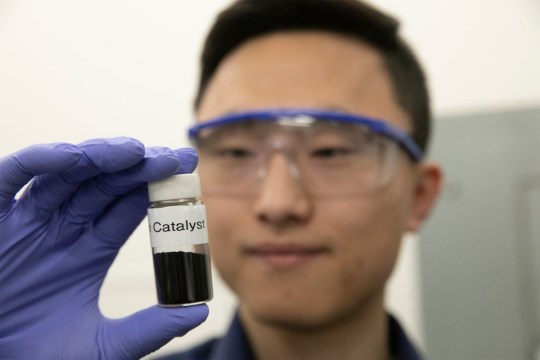
Imagine a day when – rather than being spewed into the atmosphere – the gases coming from power plants and heavy industry are instead captured and fed into catalytic reactors that chemically transform greenhouse gases like carbon dioxide into industrial fuels or chemicals and that emit only oxygen.

It’s a future that Haotian Wang says may be closer than many realize.

A Fellow at the Rowland Institute at Harvard, Wang and colleagues have developed an improved system to use renewable electricity to reduce carbon dioxide into carbon monoxide – a key commodity used in a number of industrial processes. The system is described in a November 8 paper published in Joule, a newly launched sister journal of Cell Press.

November 13 2018