Showing posts with label wind energy. Show all posts

Sunday, 1 November 2020

The Trump administration is burying dozens of studies detailing the promise of renewable energy, impeding a transition away from fossil fuels (excerpt): Grist

 ‘It just goes into a black hole’ 

Vote for my future climate

The Trump administration is burying dozens of studies detailing the promise of renewable energy, impeding a transition away from fossil fuels

on Oct 26, 2020

"But what went unsaid at the grip-and-grin was that one of those high-ranking officials, Dan Simmons of the U.S. Department of Energy doesn’t appear to fully support renewables. In fact, he has presided over his agency’s systematic squelching of dozens of government studies detailing its promise.

One pivotal research project, for example, quantifies hydropower’s unique potential to enhance solar and wind energy, storing up power in the form of water held back behind dams for moments when the wind isn’t blowing and the sun isn’t shining. By the time of the Hoover Dam ceremony, Simmons’ office at the Energy Department had been sitting on that particular study for more than a year.


In all, the department has blocked reports for more than 40 clean energy studies. The department has replaced them with mere presentations, buried them in scientific journals that are not accessible to the public, or left them paralyzed within the agency, according to emails and documents obtained by InvestigateWest, as well as interviews with more than a dozen current and former employees at the Department of Energy, or DOE, and its national labs.

Bottling up and slow-walking studies is already harming efforts to fight climate change, according to clean energy experts and others, because Energy Department reports drive investment decisions. Entrepreneurs worry that the agency’s practices under the current White House will ultimately hurt growth prospects for U.S.-developed technology."

Go to complete Grist story


 Related: Polling Shows Growing Climate Concern Among Americans. But Outsized Influence of Deniers Remains a Roadblock (excerpt): DeSmog


Thursday, 3 September 2020

'A shot in the arm:' Victoria backs clean energy in bid to fuel COVID-19 recovery: SMH

(Pics by this blog)

"Clean energy projects will receive a Victorian government funding boost in the hope of driving the state's battered economy out of the coronavirus downturn and avoiding a slump in wind and solar investment.

Victorian Energy Minister Lily D'Ambrosio is preparing to brief 


300 investors on Wednesday about the launch of a formal process to test interest in building 600 megawatts of renewable energy capacity statewide, which she said would drive down prices and create new jobs at a critical time."

.......................................

"Climate advocates say the unprecedented upheaval of COVID-19 presents a once-in-a-generation opportunity to accelerate the energy transition. Mr Thornton said there was now a "massive consensus" in Australia and around the world about the potential for renewable energy to play a leading role in the economic recovery from COVID-19."

By Nick Toscano and Miki Perkins

Go to the complete SMH article 


Related: 

Young people’s burden: requirement of negative CO2 emissions: Hansen et al


Thursday, 4 June 2020

Solar and wind’s stunning cost advantage sparks call for mass coal closure: RenewEconomy

bushfire climate emergency #jailclimatecriminals
climate emergency
A new global study has highlighted the growing advantage of wind and solar costs over new and even existing coal generators, so much so that a decision to replace 500GW (gigawatts) of old coal plant with new renewables would deliver annual savings of $23 billion ($A34 billion) and a timely $A1.4 trillion economic boost.

This is one of the headline findings of Renewable Power Generation Costs 2019, put together by the International Renewable Energy Agency, which notes that the cost of solar has fallen by 82 per cent over the past decade and onshore wind by 39 per cent.

This puts the cost of more than half the wind and solar farms installed across the globe in 2019 below the cheapest new coal plants, and below even many existing coal plants. Remember, this is a global average, so includes regions where the quality of the wind or solar resource may not be so good, and is for renewable generators completed in 2019.

Read the RenewEconomy story 

#jailclimatecriminals

Tuesday, 24 March 2020

Small, modular wind farms

small vertical-axis wind turbines
Professor John Dabiri and his team have been conducting research for over 8 years on the potential of small vertical-axis wind turbines (VAWTs) for wind farms. According to their data, by using the wind wakes that so drastically inflate the size of wind farms using horizontal-axis wind turbines (HAWTs) constructively, rather than destructively, a VAWT farm could produce the same amount of power in 1/10th the land area, using turbines that are around 1/8th as tall. This has huge potential for industrial power production, as Dabiri et al rightfully point out, but I see an equal potential in a smaller niche: energy independence.

Read the original post

Photovoltaic solar panels (PVs) are currently the standard for community energy independence, from experimental ecovillages, to exploited areas such as Puerto Rico or Navajo Nation, to more privileged people looking to reduce their reliance on fossil fuels. This makes sense - even using the synergistic VAWT layout, solar still outperforms wind in power-per-area, assuming roughly equal reliability of wind and sun. PVs have a host of other problems, though, most notably a very high energy input, high cost, reliance on industrial production, and lots of intermittency from nighttime, clouds, and winter requiring large batteries. On the other hand, VAWTs can be built by the communities hoping to use them, potentially at very low cost in both energy and money, and run much more consistently through the night and the winter - potentially making up for the extra land area

While the synergistic VAWT layout is very efficient in terms of power-per-area, the one concern I have is power-per-turbine. A dynamo on each windmill could inflate the cost of the system quickly, and though smaller generators can be built from salvaged electric motors, the ideal turbine for this system is too large for any consumer washing machine or dryer motor and so finding enough motors could be tough. I believe the best solution to this would be mechanical transmission to a central generator, either through something like a jerker line or - my preferred idea - water pressure. Each turbine could run a mechanical pump, sending water through a series of pipes to run a single, large water wheel - which could either be salvaged from old industrial machinery or built by the community. This system could be incorporated into plumbing, welling, purification/desalination, etc. and could even be attached to a gravity battery system, pumping water upward when supply exceeds demand to be run back through the turbine when demand exceeds supply and thus solving the intermittency problem. A system like this would also be really easy to expand as needed
Of course, this kind of design isn’t a catch-all solution - nothing is. Areas with more reliable sunlight (such as tropical regions or deserts) and/or less reliable wind might benefit more from solar power, whereas communities with small enough energy demands to be provided by a single HAWT (like Open-Source Ecology’s design, for instance) wouldn’t have to deal with wakes at all, and thus could provide their power with only the space needed for its physical structure and access to the wind. I definitely think there are cases where synergistic VAWT clusters would be a great fit, though, and I hope this post inspires engineers, makers, and communities to start working on a robust, open-source design for such a system


Read the original post

Tuesday, 22 October 2019

Wind and solar output beat brown coal in Australia for first time in September quarter: RenewEconomy

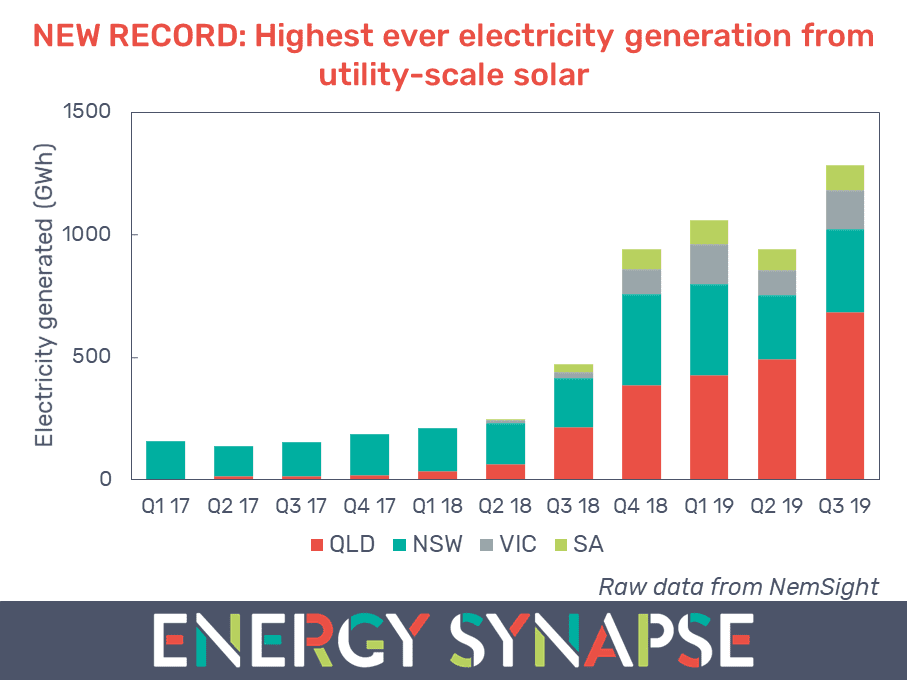
The combined output of wind and solar generation has beaten brown coal for the first time over a quarterly period in Australia’s main grid, according to new data from energy consultancy Energy Synapse.

Wind and solar have beaten brown coal over weekly and monthly periods in recent times, but not previously over a whole quarter.
“July to September 2019 was the first quarter ever where wind and solar (utility-scale plus rooftop) in the National Electricity Market generated more electricity than brown coal,” says Energy Synapse managing director Marija Petkovic.
“This is a significant tipping point in the transition to clean energy.”


According to the Energy Synapse data, utility-scale solar set a new record for electricity generation in the third quarter, despite the fact that it is not usually the best period for sunshine.
The output for the last three months from utility scale solar generation was 1,300HWh – almost three times the generation in the same time last year, which reflected the growth from newly connected solar farms in Queensland such as the Clermont, Haughton, and Rugby Run installations, and despite the fact that many facilities were turned off on occasions due to negative pricing.

Read the RenewEconomy article

See also:

The Climate Denial Machine: How the Fossil Fuel Industry Blocks Climate Action. 


#criminales climáticos de la cárcel  #criminalesclimáticosdelacárcel

#jailclimatecriminals  #gaolclimatecriminals  #climateaction  #wewantclimateactionnow

Monday, 14 October 2019

Hello From the Year 2050. We Avoided the Worst of Climate Change — But Everything Is Different: NYT

Let’s imagine for a moment that we’ve reached the middle of the century. It’s 2050, and we have a moment to reflect—the climate fight remains the consuming battle of our age, but its most intense phase may be in our rearview mirror. And so we can look back to see how we might have managed to dramatically change our society and economy. We had no other choice.
There was a point after 2020 when we began to collectively realize a few basic things.

One, we weren’t getting out of this unscathed. Climate change, even in its early stages, had begun to hurt: watching a California city literally called Paradise turn into hell inside of two hours made it clear that all Americans were at risk. When you breathe wildfire smoke half the summer in your Silicon Valley fortress, or struggle to find insurance for your Florida beach house, doubt creeps in even for those who imagined they were immune.

Two, there were actually some solutions. By 2020, renewable
energy was the cheapest way to generate electricity around the planet—in fact, the cheapest way there ever had been. The engineers had done their job, taking sun and wind from quirky backyard DIY projects to cutting-edge technology. Batteries had plummeted down the same cost curve as renewable energy, so the fact that the sun went down at night no longer mattered quite so much—you could store its rays to use later.

And the third realization? People began to understand that the biggest reason we weren’t making full, fast use of these new technologies was the political power of the fossil-fuel industry. 
Investigative journalists had exposed its three-decade campaign of denial and disinformation, and attorneys general and plaintiffs’ lawyers were beginning to pick them apart. And just in time.

Read the NYT article 

See also: 

Blame for Extinction Spreads to Methane Gas: NYT


#jailclimatecriminals  #suefossilcorpsdirectors

Thursday, 3 October 2019

Canberra’s green machines: ACT reaches 100% renewable electricity target:RenewEconomy

"The ACT has become the first Australian state or territory – with the exception of hydro-rich Tasmania – to source the equivalent of all its electricity from renewable sources, and in doing so has reduced its greenhouse gas emissions by around 40 per cent and given a significant boost to the Canberra economy.

In line with the contracted awarded via a reverse auction to identify the cheapest sources of renewable electricity, ACT is now purchasing the electricity produced by the Hornsdale Stage 3 wind farm in South Australia. The supply from the 109MW wind farm has now tipped the ACT over the 100% renewable electricity milestone."

Read the complete article 

Related: 

Satellite Data Record Shows Climate Change's Impact on Fires : NASA


#jailclimatecriminals  #jail climate criminals  #globalheating  #climatechange

Thursday, 20 June 2019

Polls Suggest the GOP's Climate and Environment Disinformation Efforts are Beginning to Falter : TGMO

"As reported in the Atlantic, several recent polls reveal that there is a nearly 10-point surge in concern about climate change among Americans."

"We’ve not seen anything like that in the 10 years we’ve been conducting the study," Anthony Leiserowitz, a researcher at Yale, told the Atlantic's Robsinson Meyer.

Extreme weather events are driving concern about climate change. Depending on where you live, flooding, hurricanes, droughts, superstorms and Nor’easters are all making it hard for people to ignore climate change."

Tuesday, 14 May 2019

DESMOG: Renewables Offset 35 Times More CO2 Every Year Than All Carbon Capture Projects Ever, New Analysis Finds


By Justin Mikulka (6 min. read)
A new analysis by Clean Technica found that global investment in carbon capture and storage technology (CCS) adds up to roughly $7.5 billion total. It also examined how much, for that investment, CCS has reduced atmospheric carbon dioxide (CO2) levels compared to an equivalent investment in renewable power generation.

The analysis calculated that “wind and solar are displacing roughly 35 times as much CO2 every year as the complete global history of CCS.” Clean Technica's Mike Barnard concluded, “CCS is a rounding error in global warming mitigation.” 

Wednesday, 14 November 2018

GREENS WELCOME INVESTMENT IN NSW ENERGY TRANSMISSION INFRASTRUCTURE AS OPPORTUNITY FOR SUPPORTING NEW RENEWABLES

A fortnight after the Greens released their plan for eight renewable energy zones and upgrades to transmission projects in NSW, the State Government has today released its NSW Transmission Infrastructure Strategy.

The Greens have welcomed the four priority transmission projects identified in the strategy, including upgrades to the interconnectors with Queensland and Victoria, and a new interconnector with South Australia to enable renewable energy projects to connect to the grid and increase the resilience of the power network.

Monday, 12 November 2018

Everything to Know About Coal (in Under 3 Minutes)


Published on Jan 4, 2018

Coal has helped power the United States for decades—but thanks to automation and natural gas, it’s now on the way out. Given the many benefits of renewables, that’s not such a bad thing. Take action here: http://www.ucsusa.org/coal