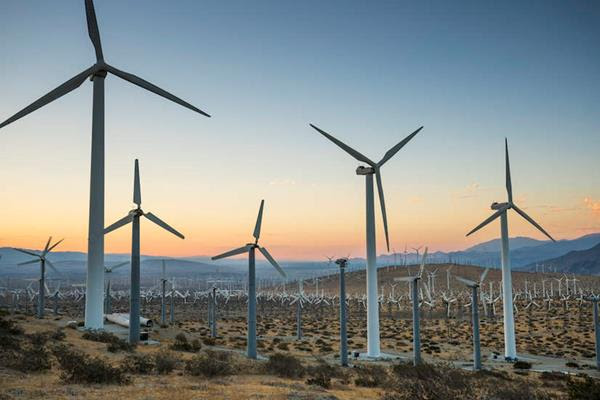
Professor John Dabiri and his team have been conducting research for over 8 years on the potential of small vertical-axis wind turbines
(VAWTs) for wind farms. According to their data, by using the wind
wakes that so drastically inflate the size of wind farms using
horizontal-axis wind turbines (HAWTs) constructively, rather than
destructively, a VAWT farm could produce the same amount of power in
1/10th the land area, using turbines that are around 1/8th as tall. This
has huge potential for industrial power production, as Dabiri et al
rightfully point out, but I see an equal potential in a smaller niche:
energy independence.
Read the original post
Photovoltaic solar panels (PVs) are currently the standard for
community energy independence, from experimental ecovillages, to
exploited areas such as
Puerto Rico or
Navajo Nation, to
more privileged people
looking to reduce their reliance on fossil fuels. This makes sense -
even using the synergistic VAWT layout, solar still outperforms wind in
power-per-area, assuming roughly equal reliability of wind and sun. PVs
have
a host of other problems,
though, most notably a very high energy input, high cost, reliance on
industrial production, and lots of intermittency from nighttime, clouds,
and winter requiring large batteries. On the other hand, VAWTs can be
built by the communities hoping to use them, potentially
at very low cost
in both energy and money, and run much more consistently through the
night and the winter - potentially making up for the extra land area
While the synergistic VAWT layout is very efficient in terms of power-per-area, the one concern I have is power-per-
turbine.
A dynamo on each windmill could inflate the cost of the system quickly,
and though smaller generators can be built from salvaged electric
motors, the ideal turbine for this system is too large for any consumer
washing machine or dryer motor and so finding enough motors could be
tough. I believe the best solution to this would be mechanical
transmission to a central generator, either through something like a
jerker line
or - my preferred idea - water pressure. Each turbine could run a
mechanical pump, sending water through a series of pipes to run a
single, large water wheel - which could either be salvaged from old
industrial machinery or built by the community. This system could be
incorporated into plumbing, welling, purification/desalination, etc. and
could even be attached to a gravity battery system, pumping water
upward when supply exceeds demand to be run back through the turbine
when demand exceeds supply and thus solving the intermittency problem. A
system like this would also be really easy to expand as needed
Of
course, this kind of design isn’t a catch-all solution - nothing is.
Areas with more reliable sunlight (such as tropical regions or deserts)
and/or less reliable wind might benefit more from solar power, whereas
communities with small enough energy demands to be provided by a single
HAWT (like
Open-Source Ecology’s design,
for instance) wouldn’t have to deal with wakes at all, and thus could
provide their power with only the space needed for its physical
structure and access to the wind. I definitely think there are cases
where synergistic VAWT clusters would be a great fit, though, and I hope
this post inspires engineers, makers, and communities to start working
on a robust, open-source design for such a system
Read the original post