New
Zealand climate minister says governments must not just return to the
way things were, and instead plot a new course to ease climate change
James Shaw
James Shaw, New Zealand’s climate change minister, has asked the
country’s independent climate change commission to check whether its
emissions targets under the Paris agreement are enough to limit global
heating to 1.5C. He explains why he’s prioritising the issue during a
strict national lockdown to stop the spread of Covid-19, which could
send New Zealand’s unemployment rate soaring.
To say that we find ourselves in an unprecedented moment is so
obvious and has been so often repeated it’s almost become white noise.
What is less obvious, however, is where we go from here.
In any significant crisis, let alone one as catastrophic as the
Covid-19 pandemic, it is an entirely understandable human reflex to want
things to “return to normal”, to “go back to the way they were before”.
And, when faced with economic headwinds – in recent decades, the
Asian financial crisis, the global financial crisis and, in our own
case, the Christchurch earthquakes) successive governments the world
over have directed their efforts to meeting public expectation and
getting back to business as usual.
Unfortunately, one of the features of business as usual was a highly
polluting and ecologically unsustainable economy on a pathway that was
locking in catastrophic climate change.
Successive responses to economic crises have seen climate change and
the natural environment we depend on for life on Earth as a
nice-to-have, something to think about once we’ve got the economy back
on track and there’s a bit more money to go round.
Seoul is to set a 2050 net zero emissions goal and end coal financing,
after the Democratic Party’s landslide victory in one of the world’s
first Covid-19 elections
South
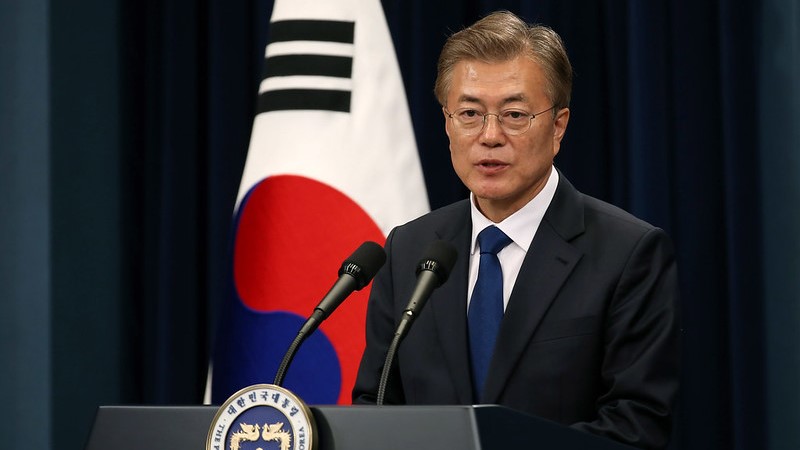
Korean President Moon Jae-in's landslide victory in the country's
parliamentary election gives his party a clear mandate to implement its
Green New Deal
(Photo: Republic of Korea/Jeon Han/Flickr)
South Korea
is on track to set a 2050 carbon neutrality goal and end coal financing
after its ruling Democratic Party won an absolute majority in the
country’s parliamentary elections on Wednesday.
President Moon Jae-in’s party won a landslide 180 seats in the
300-member National Assembly, up from 120 previously, in a huge show of
faith in his handling of the coronavirus pandemic.
The Democratic Party’s decisive victory will enable President Moon to
press ahead with its newly adopted Green New Deal agenda during the
last two years of his mandate.
Under the plan, South Korea has become the first country in East Asia to pledge to reach net zero emissions by 2050.
As part of the Paris Agreement, countries have agreed to submit
updated climate plans to 2030 and long-term decarbonisation strategies
to the UN before the end of the year.
In its climate manifesto
published last month, the Democratic Party promised to pass a “Green
New Deal” law that would steer the country’s transformation into a
low-carbon economy.
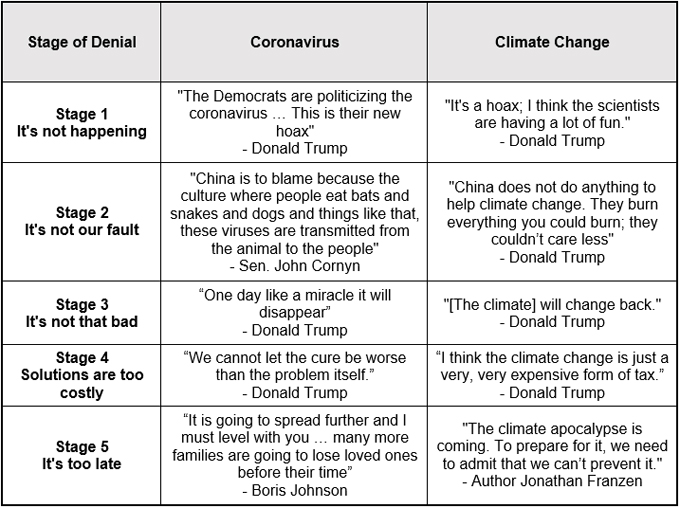
Whether denying coronavirus or climate change, many deploy the same unfounded strategies and messages.
For the climate community, observing U.S. national political leaders’ responses to the coronavirus pandemic has been like watching the climate crisis unfold
on fast-forward. Many – particularly on the political right – have
progressed through the same five stages of science denial in the face of
both threats.
For climate change, the denial process began decades ago. NASA climate scientist James Hansen testified to Congress in 1988 about the dangers posed by global warming; the fossil fuel industry formed the Global Climate Coalition
the very next year to launch a campaign casting doubt on mainstream
climate science. In November 1989, President George H.W. Bush’s chief of
staff, climate denier John Sununu, sabotaged efforts to develop the
first international climate change treaty. Exxon in particular spent the
following decades and tens of millions of dollars funding a network of
think tanks to propagate climate science denial. In a memo leaked in
2003, Republican strategist Frank Luntz advised G.O.P. politicians, “You
need to continue to make the lack of scientific certainty a primary
issue in the debate.”
Analysis
The same denial process has unfolded with coronavirus, but over a far
more compressed time frame. In both crises, early warnings from
scientific experts went unheeded and were often discouraged or suppressed.
As a result, the American government began responding only after each
threat’s impacts had become widespread and undeniable. At that point,
due to the missed opportunity to prevent the outbreak of impacts, much
of the response came in the form of damage control. America’s efforts to
“flatten the curve” of coronavirus cases, like its efforts to bend the
carbon emissions curve, were deployed too slowly.
The five stages of denial
In 2013, as the fifth Intergovernmental Panel on Climate Change report was due to be released, the five stages of climate denial
were on display in many conservative media outlets. Watching the
reactions to the unfolding coronavirus crisis in early 2020 created a
sense of déjà vu, as many leaders exhibited the same stages of
denial. In fact, many of the same actors who deny the climate crisis
also were (or still are) denying coronavirus threats. Some observers have remarked that the Venn diagram of coronavirus and climate deniers is nearly a circle.
Stage 1: Deny the problem exists. This is denial at
its most basic, as there is no need to solve a problem that doesn’t
exist. If the issue is a hoax, as the president repeatedly has asserted
about both global warming and coronavirus,
the status quo can be maintained. But denying a problem doesn’t change
its physical or epidemiological properties, so in the face of real
scientifically quantified threats, Stage 1 denial cannot last very long.
Stage 2: Deny responsibility. Upon accepting the
threat posed by coronavirus outbreaks, numerous conservative politicians
and pundits have tried to shift the blame to China, with many including the president labeling it “the Chinese virus,” echoed over 100 times on Fox News.
Similarly, after accepting that climate change is happening, many have
tried to blame it on natural cycles, or, if they accept humanity’s
responsibility, to likewise blame it on China. But here again denial falls short; shifting blame does not slow a physical or viral crisis.
Stage 3: Downplay the threat. President Trump spent weeks downplaying the threat of coronavirus, early maintaining
that it had only infected one person in America, that “one day like a
miracle it will disappear,” that “within a couple of days [the number of
infected Americans] is going to be down to close to zero,” and so on.
Fox News and other conservative media outlets followed his lead
in downplaying the risks. Similarly, Trump has said the climate “will
change back,” and conservative media outlets have spent decades arguing
that climate change is no big deal. Yet, as the devastation of
coronavirus and climate change impacts has become a reality, doubters
have been increasingly forced to move beyond Stage 3 denial. Stage 4: Attack the solutions as too costly. Trump
has claimed that coronavirus curve-flattening measures recommended by
experts – like long-term social distancing – are too costly. He instead
suggested preemptively loosening social distancing measures to reopen
the national economy “sooner rather than later” (an approach Fox News has also championed), as well as various unproven drug treatments, with Fox News again following suit. A number of ideologues have argued
that older Americans would rather die than cause the economic
disruption associated with extended social distancing. Some partisan
policymakers and pundits similarly oppose virtually all large-scale
climate solutions as too expensive, instead proposing worthwhile but
inadequate steps like simply planting trees or capturing carbon from
power plants to inexplicably use for extracting yet more fossil fuels.
Stage 5: It’s too late. Some have proposed, once it
became obvious that the coronavirus outbreak had become widespread, that
governments should just maintain the status quo, try to build herd immunity,
and cope with the consequences (such as overwhelmed health care systems
that could result in millions of deaths). Climate justice essayist Mary
Heglar coined the term “de-nihilist”
to describe those who have similarly succumbed to the fear that it’s
too late to stop climate change. Such attitudes only hamper efforts to
constructively address both problems.
Coronavirus is a learning opportunity for climate change
Because American leadership proceeded through these stages of denial, it wasted valuable months
that could have been spent preparing for and curbing the spread of
coronavirus. For comparison, South Korea diagnosed its first case of
COVID-19 on January 20 – the same day as the U.S. – but almost
immediately launched an aggressive program of testing, tracing, and quarantining.
By March, South Korea was conducting over 10,000 coronavirus tests
per day, and its new cases fell below 150 per day by mid-March. Despite a
population six times larger, the U.S. had reached the threshold of
10,000 new tests per day only on March 16,
and has consistently lagged in testing on a per capita basis. As
testing in the U.S. finally began to catch up to the viral spread, the
number of new coronavirus cases in America accelerated past 10,000 per
day by March 23, reaching 580,000, by April 14 compared to 10,564 South Korean cases (222 deaths) as of that date.
After this late start, Trump has regularly argued that the U.S.
“cannot let the cure be worse than the problem itself.” Those who oppose
climate solutions similarly argue that making investments to bend the
carbon emissions curve would be worse than the consequences of climate
change – consequences that include increased food insecurity;
intensified hurricanes, wildfires, heatwaves, droughts, and floods; and
more species extinctions, violent conflicts, and death.
Both arguments run counter to expert advice, misunderstand the
problem, and present a false choice. In reality, failing to make the
necessary early investments to head off each threat will result in
economy-crippling consequences, whether in the form of overwhelmed
health care systems in the case of coronavirus or more deadly extreme
weather events in the case of climate change. Experts agree that to protect both the economy and public health,
government responses must focus on flattening the coronavirus curve and
making investments to rapidly curb carbon pollution. In fact, a new study
on the 1918 flu pandemic found that measures like social distancing
“not only lower mortality, they also mitigate the adverse economic
consequences of a pandemic.” Nipping the problem quickly and
aggressively yields the best outcome for both the economy and public
health. Put simply, suffering and death are costly.
Observing the damage resulting from denial of both the coronavirus
and climate crises raises the question, how did humans evolve this
apparent psychological flaw? Physician-scientist Ajit Varki has hypothesized
that comprehending one’s own mortality is a psychological evolutionary
barrier for most species, because this realization would amplify the
fear of death and thus “would have then reduced the reproductive fitness
of such isolated individuals.” Varki posits that humans may have
overcome this barrier by developing denial as a coping mechanism, but
that “If this theory turns out to be the correct explanation for the
origin of the species, it might ironically also be now sowing the seeds
of our demise,” since denial now obstructs efforts to address threats
like climate change and coronavirus.
As climate activist and author Bill McKibben put it,
“You can’t negotiate with physics and chemistry, you can’t compromise
with them or spin them away … coronavirus is teaching us precisely this
lesson about biology as well. Reality is real and sometimes it bites
pretty hard.” Or, as Republican pollster Neil Newhouse said more bluntly, “Denial is not likely to be a successful strategy for survival.”
But because of its compressed time frame, coronavirus has provided
humanity an opportunity to learn this lesson and apply it to curbing the
worst of the climate crisis. Contrary to Stage 5 denial, it’s not yet
too late to avoid the most severe climate change impacts.
(CNN)At first glance, Christiana Figueres doesn't have that many reasons to be optimistic.The Costa Rican diplomat played a pivotal role in negotiating the Paris Climate Agreement in 2015. But while the deal was widely praised as a landmark achievement, it has since begun to crumble.
Yet Figueres says she still feels upbeat about fighting climate change.
"It's
a deliberate choice," she told CNN in a video call. "This is not about
subjecting ourselves to huge sacrifices that lead us to feeling that
we're having a worse life, it's actually exactly the opposite," she
said.
"This is about moving toward a much better life, a life that has better health conditions, that has better urban conditions, that has better transport conditions, that has safer investment conditions."
A
slight woman with short hair, Figueres has the sort of no-nonsense
attitude that's called for when the future of the world is at stake and
it's up to you to find a solution.
She took over as the UN's top climate official in 2010, following the failed Copenhagen climate summit in 2009.
When
the Paris Agreement was signed five years later, Figueres was widely
credited with making it happen. She also made the radical decision to
bring the private sector and NGOs into the negotiations.
Figueres
and the book's co-author Tom Rivett-Carnac, who were both speaking from
the Swiss ski resort of Davos for the World Economic Forum in January,
told CNN their "stubborn optimism" is inspired by changes they have
witnessed first hand.
"We are in a
different world than we were two years ago, the level of civil
disobedience that has emerged all around the world, we haven't seen for a
generation, it's incredibly positive," Rivett-Carnac said.
...................................
The problem, she said, is that there isn't much time to take this control: A decade, at best.
"Ten years from now, in 2030,
we will either have written a very positive story, or we will really be
condemned to an endless destruction. So for these 10 years we're
holding the pen," Figueres said.
Steep falls in emissions have been the pandemic’s immediate effect. But what’s needed is a green recovery
So
far, discussions of a coronavirus exit strategy have mainly focused on
the steps that could bring an end to the lockdown. In the short term,
both in the UK and elsewhere, there is nothing more desirable than
letting people resume their lives, once it is safe to do so.
But the speed of the “return to normal” is not the only thing that
matters. The manner in which the world’s leaders manage the colossal
economic and political shocks caused by the virus is also of the utmost
importance. And at the top of their list of priorities, alongside human
welfare, must be the biosphere and its future.
"Deniers argue that further disruption to economies and societies will be avoided at all costs.
Sorry to be the harbinger of denier disappointment, but there is
every reason to expect that the virus crisis will strengthen and
accelerate the imperative to transition to a low-carbon world by
mid-century."
.............................
"Time is of the essence
As Christiana Figueres, former executive secretary of the UN’s Framework Convention on Climate Change, states in her recent book:
“We are in the critical decade. It is no exaggeration to say that
what we do regarding emissions reductions between now and 2030 will
determine the quality of human life on this planet for hundreds of years
to come, if not more.”
This will require about a 50% reduction in emissions by 2030 – way more than is contemplated in the Paris agreement – to achieve even net zero emissions by 2050.
Read more:
Coronavirus is a wake-up call: our war with the environment is leading to pandemics There are a few “pluses” from the experience of coronavirus. Emissions are falling
(although clearly no one would advocate a global recession as a climate
strategy). And the response of governments to the crisis has seen
decisive domestic action – working individually, but together, in
meeting what is a global challenge.
Individual governments have demonstrated how quickly they can move
once they accept the reality of a crisis. We’ve also seen just how far
they’re prepared to go in terms of policy responses – lockdowns, social
distancing, testing, rapid and historically significant fiscal
expansions, and massive liquidity injections.
It’s noteworthy that issues that in “normal times” could not have
been ignored – such as civil liberties and concerns about intrusive
governments and effective competition – have so easily been set aside as
part of emergency responses."
New research has busted the myths around electric vehicles and
emissions – confirming that in virtually every part of the world,
including still coal-dominated Australia, switching to an electric
vehicle will lead to lower greenhouse gas emissions.
The study, published in the journal Nature Sustainability,
confirmed that in 95 per cent of the world, switching to an electric
vehicle from a petrol equivalent would lead to an overall reduction in
greenhouse emissions, even when the full life-cycle of a vehicle is
taken into account.
There has been some conjecture over the emissions savings that could
be achieved by a switch to an electric vehicle, with myths being pushed
by the likes of climate contrarion Bjorn Lomborg in the Murdoch media
that electric vehicles have no environmental benefits as they still may
still source their electricity from fossil fuel power stations.
But the study, led by researchers from Radboud University in the
Netherlands, working with the universities of Exeter and Cambridge,
found that electric vehicles did indeed lead to lower emissions, even in
regions where a large portion of electricity generation is sourced from
fossil fuels.