Showing posts with label Green New Deal. Show all posts

Thursday, 20 August 2020

Lessons From the Frontlines of Global Warming (excerpt): New Republic

"What interviews with flood, wildfire, and drought survivors can teach us about how to live amid the threat of climate change

 
What would you do if your house burned down or your neighborhood washed away in a flood?
Extreme heat kills

Ronnie Scott lost his wife when she tried to to rescue their dog and cat from floodwaters in West Virginia in 2016. Carole Duncan almost lost her 83-year-old father during Australia’s massive 2019 bushfires, the firefighters finding him just in time. 

KerryAnn Laufer returned home days after the 2019 Kincade Fire in California to find only her fireplace still standing, while Dave Mackey saw nearly every house in his neighborhood on Grand Bahama island washed away, pummeled by raging waters and 200-mile-per-hour winds from Hurricane Dorian.


What would you do if your house burned down or your neighborhood washed away in a flood?
Storms, wildfires, and other such disasters are getting more common and intense as climate change accelerates. Scott, Duncan, Laufer, and Mackey, who survived these extreme weather events, are among the lucky ones. But each of them found themselves changed by the experience.


What would you do if your house burned down or your neighborhood washed away in a flood? How would you respond if a cataclysmic weather event killed someone you love or forced you to abandon, perhaps forever, the place you call home? And how would it change the way you think about the world?


These questions are at the heart of a new “Voices from the Future”
What would you do if your house burned down or your neighborhood washed away in a flood?
Green new deal is cheap actually
interview series a small group of journalist, researchers, and I have developed at the Julie Ann Wrigley Global Futures Laboratory at Arizona State University. We have collected the stories and insights of nearly three dozen survivors on five continents, eight of which will be published in these pages over the next few weeks."


Original story 

Steven Beschloss is a professor of practice at the Walter Cronkite School of Journalism and Mass Communication and directs the Narrative Storytelling Initiative at Arizona State University. He has written for The New Yorker and The Washington Post, among other publications.


#California, #firestorms, #wildfire, Australia, cyclones, floods, Green New Deal, hurricanes, 


Sunday, 31 May 2020

Europe’s Recovery Plan Has Green Strings Attached: Bloomberg

  • Green Deal to become motor for growth in EU recovery effort
  • Access to EU funds will require alignment with green goals
     

Meeting the climate-neutrality goal is a key pillar of a 750 billion-euro ($824 billion) economic recovery plan unveiled by the European Commission, one of the Brussels-based executive’s top officials said.

Read more at Bloomberg

Monday, 25 May 2020

Gas lobby seizes Covid moment, and declares war on Australia’s future: RenewEconomy

And so it is with the extraordinary attack launched on Australia’s future by its incumbent fossil fuel industry, and the gas lobby in particular. Its casus belli is the Covid-19 pandemic, and the fossil fuel industry has been enabled to do this after being invited by the Morrison regime to do more or less at it pleases and design its own future.

The reach and sheer audacity of the proposals unveiled over the past week is extraordinary, and the lasting impact on Australia’s future may dwarf anything that Tony Abbott and his Far Right cheerleaders may have done; notwithstanding his white-anting of the Carbon Pollution Reductions Scheme more than a decade ago, the scrapping of the carbon price in 2014 and the unceasing campaign against science and engineering.

This is the critical decade. Scientists tell us, repeatedly and with a near unanimous voice, that serious emissions reductions must be achieved in the next 10 years if the world is to flatten the emissions curve and give itself half a chance of capping average global warming at less than 2°C. A target of 1.5°C may already be out of reach.

Australia finds itself at a critical juncture. It benefits from the stunning cost reductions in solar, wind and battery storage, and key institutions have mapped out a path to a high renewable energy grid. Experts are shining the light on a future of green manufacturing and “green energy exports” that could enhance the position of the country as a significant energy superpower.
But the fossil fuel industry and its backers, with their focus almost entirely on short-term profits and ideological claptrap, have other ideas. They have decided to throw a live grenade into Australia’s own economic bunker, and its environment, and put the future of the current and emerging generation at risk.

Consider the list of what has emerged from the government-appointed gas-industry led reviews in the past week, including the King Review, the Covid Commission, the technology investment roadmap, and from the intense pressure being put on energy regulators.


– Bastardising the remit of the Clean Energy Finance Corporation and the Australian Renewable Energy Agency in an attempt to to force them to invest away from renewable and smart and enabling technologies and into gas and carbon capture and storage

– Polluting the already controversial and ineffective Climate Solutions Fund by creating a “base-line” that industry experts suggest will allow big polluters to increase their emissions and get paid for doing so.'

– Delaying critical energy market rule changes and reforms that might have encouraged smart new technologies such as battery storage and demand management, and end the rorting of the current system by incumbent coal, gas and hydro generators.

– Pushing the case for gas and CCS in a “technology investment roadmap” that otherwise clearly identifies wind, solar, storage and other technologies such as EVs, heat pumps, energy efficiency and demand management as the cheapest and most reliable options.

However, none of these quite reaches the breadth, depth and cynicism of the so-called Covid-Commission, which appears entirely possessed with the narrow interests of the gas industry, from where many of these commissioners have emerged.


Read more of this Renew Economy story

Saturday, 25 April 2020

No green new deal for Australia as Coalition tightens embrace of fossil fuels: Renew Economy

The full economic impact of the Covid-19 is still yet unknown, but it is clear that world’s governments face a choice in their response: 
Do they look to protect industries in terminal decline, or do they look to the long-term, supporting new green industries to flourish in a post-Covid-19 future?

A growing number of experts and global leaders have joined calls for the response to Covid-19 to be a ‘green response’, including the implementation of a ‘Green New Deal’ for a sustainable economy popularised by US Democrats.

The Green New Deal provides a vision for a sustainable future economy, and integrates proposals for ambitious climate action, investment in clean energy, a circular economy and includes a boost to direct public sector investment in sustainable infrastructure, including electric vehicles and public transport systems.

Unfortunately for Australia it is becoming increasingly clear that the Morrison government is steadfast in giving life support to the fossil fuel industry, clearly indication its preference for short-term opportunities for fossil fuel interests, and its ministers have been clearly working  reinforce the position of the oil, gas and coal sectors.

Resources minister Keith Pitt has gone in to bat for the gas and coal sectors, while energy minister Angus Taylor is working to prop up demand for oil and relaxing already weak regulations on the oil sector, including fuel standards.

This includes the Morrison government gifting almost $100 million to the United States to purchase oil that will remain stored in the United State’s Strategic Petroleum Reserve.

On Wednesday, Taylor announced that the government would also be looking to soften fuel standards to allow the industry to redeploy stockpiled aviation fuels for use in other parts of the transport sector. Australia already has weak fuel standards by most international standards, and a further weakening of the standards will likely lead to worse environmental and health outcomes.

Pitt made the government’s priorities even clearer, welcoming the expansion of Australia’s gas sector with Arrow Energy’s commitment to a new gas project in Queensland. “Notwithstanding COVID-19, our energy and resources will be important in getting not just our economy back on its feet, but vital in assisting our important trading partners to kickstart their economies,” Pitt said.

“The Australian Government is committed to working with the oil and gas industry in order to provide support and flexibility given the changing circumstances at this time.

At the same time, Taylor – who doubles as emissions reduction minister –  has praised the electricity and gas sectors for overseeing significant falls in domestic prices. But he studiously avoided any mention of the ongoing significant cuts in greenhouse gas emissions in the grid, or the prominent role played in that by investment in wind and solar.

Despite Covid-19, the threat of climate change has not subsided and the need to transition the global energy system to one with significantly less greenhouse gas emissions will remain a pressing global issue during and after the world has dealt with the pandemic. And studies show that acting on climate change will deliver substantial economic benefits for those who embrace it.

The International Renewable Energy Agency this week published new analysis that shows ambitious investment in the clean energy sector would provide substantial benefits to the global community, boosting global economic output by as much as A$160 trillion by 2050 above a ‘business as usual’ scenario.

This included the potential to create almost 250,000 new jobs in Oceania’s renewable energy sector by 2050, with growth more than compensating for inevitable job losses in the fossil fuel sector.
A global poll conducted by Ipsos in April found that 71 per cent of adults globally still view climate change as serious a long-term crisis as Covid-19. The figure was lower in Australia, with 59 per cent agreeing with the proposition locally.

“Despite the environment taking a back seat compared with other current issues, it’s still important to people. There is strong support among the public for a green economic recovery from the COVID-19 crisis,” Ipsos Australia public affairs director, Jennifer Brook, said.

While it still sees a majority of Australians ranking the climate change response as equal importance with Covid-19, the Morrison government will likely see the weaker response as an opportunity to put climate action event further on the backburner.

Bruce Robertson from the Institute for Energy Economics and Financial Analysis told RenewEconomy that moves to prop up ailing parts of the fossil fuel sector were a mistake.

“While governments say they are not supposed to be picking winners, they are certainly not supposed to be picking losers,” Robertson said.

“Globally since the coronavirus pandemic, there’s been a permanent shift down in demand – and the world is swimming in gas and oil. How will this investment get us out of the hole? It is not a governments role to pick winners. It is definitely not a governments role to pick proven losing industries to shower tax payer dollars on.”

“The government is making big decisions about our future right now. We need a new normal, not going back to the old ways of a reliance on emissions-intensive gas, which is both a fossil fuel and a loss-making industry. Gas is not the industry of the future. We have the choice now. We can do things differently going forward,” Robertson added.

With a long-term view, strategic investments in the green infrastructure required for the long term offers the best possible economic response to the Covid-19 crisis.

The government can do this by heeding the calls of the clean energy sector to include investment and support for new zero-emissions generation and energy efficiency in stimulus measures.

Doing so will not only provide a powerful form of short-term economic stimulus, but will also leave Australia better placed in the long-term, well after the crisis of Covid-19 as been resolved.

Original article

RenewEconomy and the Smart Energy Council will be co-hosting a “virtual conference” on May 6, focusing on a renewables-led economic recovery, featuring industry leaders, analysts and advocates. More information and registration here.

RenewEconomy and its sister sites One Step Off The Grid and The Driven will continue to publish throughout the Covid-19 crisis, posting good news about technology and project development, and holding government, regulators and business to account. But as the conference market evaporates, and some advertisers pull in their budgets, readers can help by making a voluntary donation here to help ensure we can continue to offer the service free of charge and to as wide an audience as possible. Thankyou for your support.

 
Michael Mazengarb is a journalist with RenewEconomy, based in Sydney. Before joining RenewEconomy, Michael worked in the renewable energy sector for more than a decade.


Monday, 20 April 2020

South Korea to implement Green New Deal after ruling party election win: Climate Home News


Seoul is to set a 2050 net zero emissions goal and end coal financing, after the Democratic Party’s landslide victory in one of the world’s first Covid-19 elections 

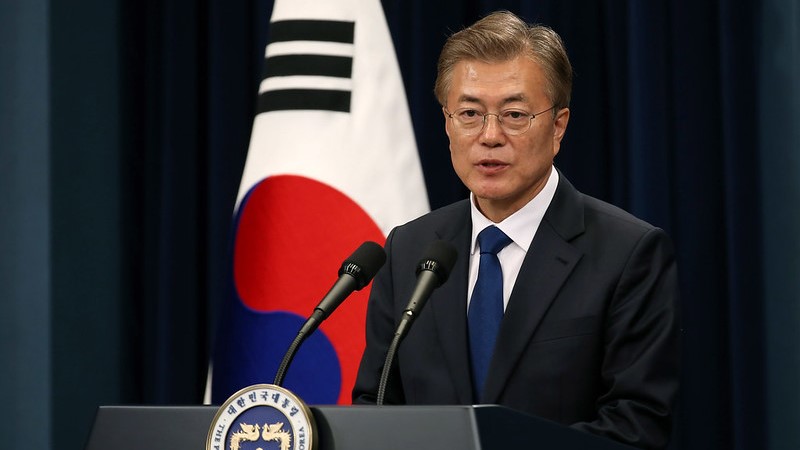
South Korean President Moon Jae-in's landslide victory in the country's parliamentary election gives his party a clear mandate to implement its Green New Deal (Photo: Republic of Korea/Jeon Han/Flickr)

South Korea is on track to set a 2050 carbon neutrality goal and end coal financing after its ruling Democratic Party won an absolute majority in the country’s parliamentary elections on Wednesday.

President Moon Jae-in’s party won a landslide 180 seats in the 300-member National Assembly, up from 120 previously, in a huge show of faith in his handling of the coronavirus pandemic.

The Democratic Party’s decisive victory will enable President Moon to press ahead with its newly adopted Green New Deal agenda during the last two years of his mandate.

Under the plan, South Korea has become the first country in East Asia to pledge to reach net zero emissions by 2050.

As part of the Paris Agreement, countries have agreed to submit updated climate plans to 2030 and long-term decarbonisation strategies to the UN before the end of the year.
Analysis: Which countries have a net zero carbon goal?
In its climate manifesto published last month, the Democratic Party promised to pass a “Green New Deal” law that would steer the country’s transformation into a low-carbon economy.


Read the original complete article

Monday, 14 October 2019

Hello From the Year 2050. We Avoided the Worst of Climate Change — But Everything Is Different: NYT

Let’s imagine for a moment that we’ve reached the middle of the century. It’s 2050, and we have a moment to reflect—the climate fight remains the consuming battle of our age, but its most intense phase may be in our rearview mirror. And so we can look back to see how we might have managed to dramatically change our society and economy. We had no other choice.
There was a point after 2020 when we began to collectively realize a few basic things.

One, we weren’t getting out of this unscathed. Climate change, even in its early stages, had begun to hurt: watching a California city literally called Paradise turn into hell inside of two hours made it clear that all Americans were at risk. When you breathe wildfire smoke half the summer in your Silicon Valley fortress, or struggle to find insurance for your Florida beach house, doubt creeps in even for those who imagined they were immune.

Two, there were actually some solutions. By 2020, renewable
energy was the cheapest way to generate electricity around the planet—in fact, the cheapest way there ever had been. The engineers had done their job, taking sun and wind from quirky backyard DIY projects to cutting-edge technology. Batteries had plummeted down the same cost curve as renewable energy, so the fact that the sun went down at night no longer mattered quite so much—you could store its rays to use later.

And the third realization? People began to understand that the biggest reason we weren’t making full, fast use of these new technologies was the political power of the fossil-fuel industry. 
Investigative journalists had exposed its three-decade campaign of denial and disinformation, and attorneys general and plaintiffs’ lawyers were beginning to pick them apart. And just in time.

Read the NYT article 

See also: 

Blame for Extinction Spreads to Methane Gas: NYT


#jailclimatecriminals  #suefossilcorpsdirectors

Monday, 2 September 2019

It’s Time to Try Fossil-Fuel Executives for Crimes Against Humanity: Jacobin

......"These are welcome attempts to hold the industry responsible for its role in warming our earth. It’s time, however, to take this series of legal proceedings to the next level: we should try fossil-fuel executives for crimes against humanity.

Guilty Beyond a Reasonable Doubt

Just one hundred fossil fuel producers — including privately held and state-owned companies — have been responsible for 71 percent of the greenhouse gas emissions released since 1988, emissions that have already killed at least tens of thousands of people through climate-fueled disasters worldwide.

Green New Deal advocates have been right to focus on the myriad ways that decarbonization can improve the lives of working-class Americans. But an important complement to that is holding those most responsible for the crisis fully accountable. It’s the right thing to do, and it makes clear to fossil-fuel executives that they could face consequences beyond vanishing profits."

Read the Jacobin story 

Related:

Great Barrier Reef outlook now 'very poor', Australian government review says: The Guardian