Showing posts with label climate deniers. Show all posts

Saturday, 26 September 2020

Merchants Of Doubt Full Movie

 "A documentary that looks at pundits-for-hire who present themselves as scientific authorities as they speak about topics like toxic chemicals, pharmaceuticals and climate change. Director: Robert Kenner" YouTube

See on YouTube site

Related: Climate Hustle 2: Showcasing a Thinning Roster of Climate Science Deniers (excerpt): DeSmog

Monday, 21 September 2020

"Only 16% of Americans realize that the consensus is above 90%." (excerpt): Skeptical Science

 "Expert consensus is a powerful thing. People know we don’t have the time or capacity to learn about everything, and so we frequently defer to the conclusions of experts. It’s why we visit doctors when we’re ill. The same is true of climate change: most people defer to the expert consensus of climate scientists. Crucially, as we note in our paper:

Public perception of the scientific consensus has been found to be a gateway belief, affecting other climate beliefs and attitudes including policy support.

That’s why those who oppose taking action to curb climate change have engaged in a misinformation campaign to deny the existence of the expert consensus. They’ve been largely successful, as the public badly underestimate the expert consensus, in what we call the “consensus gap.” Only 16% of Americans realize that the consensus is above 90%."


 Lead author John Cook explaining the team’s 2016 consensus paper.


Go to skepticalscience.com

Saturday, 19 September 2020

Meet the Money Behind The Climate Denial Movement (excerpt): Smithsonian Mag

Nearly a billion dollars a year is flowing into the organized climate change counter-movement

The overwhelming majority of climate scientists, international governmental bodies, relevant research institutes and scientific societies are in unison in saying that climate change is real, that it's a problem, and that we should probably do something about it now, not later. And yet, for some reason, the idea persists in some peoples' minds that climate change is up for debate, or that climate change is no big deal.

Click to enlarge

Actually, it's not “for some reason” that people are confused. There's a very obvious reason. There is a very well-funded, well-orchestrated climate change-denial movement, one funded by powerful people with very deep pockets. In a new and incredibly thorough study, Drexel University sociologist Robert Brulle took a deep dive into the financial structure of the climate deniers, to see who is holding the purse strings.

According to Brulle's research, the 91 think tanks and advocacy organizations and trade associations that make up the American climate denial industry pull down just shy of a billion dollars each year, money used to lobby or sway public opinion on climate change and other issues. (The grand total also includes funds used to support initiatives unrelated to climate change denial, as explained in a quote Brulle gave to The Guardian: “Since the majority of the organizations are multiple focus organizations, not all of this income was devoted to climate change activities.”)


“The anti-climate effort has been largely underwritten by conservative

billionaires,” says the Guardian, “often working through secretive funding networks. They have displaced corporations as the prime supporters of 91 think tanks, advocacy groups and industry associations which have worked to block action on climate change.”

“This is how wealthy individuals or corporations translate their economic power into political and cultural power,” he said. “They have their profits and they hire people to write books that say climate change is not real. They hire people to go on TV and say climate change is not real. It ends up that people without economic power don't have the same size voice as the people who have economic power, and so it ends up distorting democracy.


Go to complete Smithsonian Magazine article


Related: European Thinktanks Repeating ‘Well-worn’ US Climate Denial Tropes (excerpt): DeSmog

 #climateaction,#climate crisis,climate deniers,#jailclimatecriminals,global heating,political party donations from corporations,role of media,


European Thinktanks Repeating ‘Well-worn’ US Climate Denial Tropes (excerpt): DeSmog

Organisations promoting climate science denial and anti-environmentalism in Europe share the same rhetoric, narratives and right-wing links as their US counterparts, new research has found.
 

The paper published in the journal Climatic Change examines publications from eight of the most prominent contrarian thinktanks in six EU countries over 24 years from 1994 to 2018, and argues the organisations enjoy a “remarkable” level of political influence for their size.

These include the UK-based Global Warming Policy Foundation (GWPF), the Institute of Economic Affairs (IEA) and the Centre for Policy Studies (CPS), as well as the German Europäisches Institut für Klima und Energie (EIKE), the Austrian Economics Centre (AEC), Institut Économique Molinari (IEM) in France, Instituto Juan de Mariana (IJM) in Spain and the Liberales Institut (LI) in Switzerland.

The researchers found an increase in environmentally-focused activity

From DeSmog
by these organisations in Europe after 2007 and again between 2015 and 2018.

The publications echoed the arguments put forward by US thinktanks, with a fifth denying climate science outright. Of those which accepted that the planet is warming, many downplayed the role of people in causing it, were sceptical about policies to tackle the problem, or argued that climate change was actually a good thing.

As well as openly contesting climate science, many of the critiques were aimed at environmental campaigners, politicians or journalists.

Well-worn climate change counter-frames” spread by US thinktanks are being “consistently circulated” by European organisations, too, the research concludes.

Go to complete DeSmog article By Isabella Kaminski • Thursday, September 17, 2020


Related: How Climate Migration Will Reshape America Millions will be displaced. Where will they go? (excerpt) : NYT Magazine

Monday, 7 September 2020

Trump will roll back more environmental regulations if reelected, says EPA chief: CNBC

and lead to thousands of additional deaths from bad air quality
Koch industries fund Trump
 "Key Points
 
* President Trump will continue to weaken environmental regulations on industries if reelected in November, the EPA’s Andrew Wheeler told The Wall Street Journal. 

* The administration would establish a cost-benefit analysis of any new regulation and expand the use of “science transparency” to justify new regulations. 

* After three years in office, the administration sought to reverse
and lead to thousands of additional deaths from bad air quality
Politicians and Climate Change
more than 100 major environmental rules that it has deemed burdensome to the fossil fuel industry, even as climate change accelerates. 

* Analysts say many of the administration’s rollbacks could increase emissions and lead to thousands of additional deaths from bad air quality."
 
...........................
 
"Democratic presidential nominee Joe Biden has released a plan to put $2 trillion into green infrastructure and energy over four years to curb climate change and spur economic growth, which the Trump campaign has argued would hurt the oil and gas industry. "
 
Go to the CNBC article 

Published Thu, Sep 3 2020

Friday, 28 August 2020

As QAnon Conspiracy Spreads on the Far Right, Climate Science Deniers Jump Aboard (excerpt): DeSmog

QAnon could be the energy that stops a big push for any meaningful climate action
QAnon signs at a Trump rally
(Photos added by this blog)

"Back in December 2019, two conspiratorial worldviews collided as, for the first time, QAnon’s Q suggested his followers should question anew a topic that, by now, has been considered, and reconsidered, for decades: climate change.


QAnon could be the energy that stops a big push for any meaningful climate action
QAnon sign at a Trump rally in Manchester, New Hampshire on August 15, 2019. Credit: Marc NozellCC BY 2.0

The Paris Agreement on Climate is Another Scam to Ripoff Taxpayers and Enrich the Politicians,” the Q-Drop (the term QAnon followers use to refer to messages they believe come from some sort of government insider who signs messages with the letter Q) claimed, labeling climate action a “con.”


QAnon could be the energy that stops a big push for any meaningful climate action
Wikipedia says
In May, a second Q-Drop riffed on climate change, with a link to a snarky tweet about science and the Swedish teen climate activist Greta Thunberg by a would-be House Republican who’d lost her primary race in March.

Both of those Q-Drops were picked up by a report commissioned by a coalition of environmental groups and conducted by the research firm Graphika, which found that a group of vocal climate science deniers began using QAnon hashtags in May — and they haven’t stopped since.

The QAnon movement hasn’t traditionally covered climate change, but in May, when an influential QAnon account tweeted about climate denial, there was a notable and sustained increase of QAnon content shared within the climate denial group,” Michael Khoo, an advisor on disinformation for the environmental group Friends of the Earth, and Melissa Ryan, CEO of CARD Strategies and author of the Ctrl Alt-Right Delete weekly newsletters, wrote in an article published today on Medium."

......................

QAnon could be the energy that stops a big push for any meaningful climate action

Trump says QAnon conspiracy theorists are people who 'love our country' - National | G

...........................

"Clutching at Q’s Coattails


Not only is QAnon taking up climate denial, but prominent climate deniers have been taking up QAnon.

“The other thing we see is that the right needs QAnon more and more to amplify their messaging,” said Ryan.

Take, for example, Naomi Seibt, a young German YouTuber who has questioned climate science and who has worked with the Heartland Institute, a U.S. think tank and notorious promoter of climate science denial.

So do you want a beautiful planet that you can stare at but that’s it? It’s just like looking at a TV screen,” the Express, a UK newspaper, quoted Seibt as saying in May. “As a climate realist, I don’t deny that we don’t have some negative impact on the planet. But I don’t think that it’s related to CO2 emissions.”

Seibt briefly rose to broader prominence following a Washington Post article about her in February — though she remains far less well-known than Greta Thunberg, the young environmental activist who the Heartland Institute has sought to compare with Seibt. “She reportedly chose not to renew her contract with [the] Heartland [Institute] in April 2020 after facing potential fines from a regional broadcasting authority,” DeSmog’s profile on Seibt notes.

QAnon could be the energy that stops a big push for any meaningful climate action
QAnon

In addition to speaking about climate, Seibt has publicly spoken about her views on race and religion. “Seibt’s rise as the young face of climate skeptics has drawn scrutiny of her past remarks. 

On Friday, video circulated of Seibt’s remarks after a shooting at a German synagogue,” Bloomberg reported on February 28. “'The normal German consumer is at the bottom, so to speak. Then the Muslims come somewhere in between. And the Jew is at the top. That is the suppression characteristic,' she said in comments first reported by The Guardian.”

In July, the trial of that synagogue shooter, charged with murdering two people and the attempted murder of dozens more, began with the accused shooter stating that he felt he was “on the bottom rung of society” and that he was “superseded,” as he sought to justify horrific crimes.

QAnon could be the energy that stops a big push for any meaningful climate action

As in Germany, white supremacists in the U.S. have increasingly engaged in racially motivated “mass shooter” armed attacks on unarmed people. And QAnon followers have also begun committing violent acts. 

“I think it's also important to remember that the FBI has declared QAnon a domestic terrorism threat,” said Ryan, “and QAnon has inspired kidnappings, it has inspired at least one murder, it has inspired arson, there is a real danger from these folks who are drawn to this and become just embroiled in it.”

Go to the complete DeSmog article 

Related: Coronavirus doubters follow climate denial playbook: Yale Climate Connections


QAnon, Trump, conspiracy theorists, #fakenews, fake news, climate deniers, Paris Agreement, terrorism, #jailclimatecriminals,  

Saturday, 15 August 2020

Why COVID deniers and climate skeptics paint scientists as alarmist (excerpt): Grist


people trying to obstruct action deny the severity of the predicament
Climate Change Denial Tactics
In an interview with Fox News last month, President Donald Trump called Anthony Fauci, the country’s top infectious disease expert, an “alarmist,” using a pejorative straight from the playbook of those who deny the science behind climate change. Fauci rejected the characterization, describing himself as a “realist.”

For anyone paying attention to arguments about climate change over recent decades, Trump’s comment sounded awfully familiar: Scientists are alarmists, everything’s a hoax, and hysteria abounds.

 Michael Mann, a climatologist at Penn State University, wrote an op-ed for Newsweek this week drawing parallels between his experience and Fauci’s during COVID-19. Science deniers have lobbied attacks on the two public figures, he explained, sending death threats, calling them names, and questioning their expertise.
So what do terms like alarmist and hysteria really mean, where did they come from, and how can people respond to such accusations?"

"The strategies used to dismiss the threats of climate change and coronavirus follow a similar pattern, and they’re employed by many of the same people. It starts with denying the problem exists, as Naomi Oreskes, a professor of history at Harvard who studies disinformation, has explained. Then, people trying to obstruct action deny the severity of the predicament, say it’s too hard or too expensive to fix, and complain that their freedom is under threat. Denying the science requires dismissing what scientists are saying, and the easiest way to do that is by questioning their motives, impartiality, and rationality.

“If we don’t trust scientists or medical experts because we see them as alarmist or hysterical or as contributing overreaction, then we don’t trust the info they’re giving us,” said Emma Frances Bloomfield, an assistant professor of communication at the University of Nevada, Las Vegas."

Read the complete Grist article by Kate Yoder

See also:

'Two global health emergencies': doctors group backs green stimulus: The Age


climate deniers, Trump, COVID-19, #cambio-climatico, #climatecrisis, #climatecriminals, #corporations, #criminales-climáticos-de-la-cárcel, #


Thursday, 13 August 2020

Bill Nye's profanity-laced video goes viral: CNN "climate change deniers will be a thing of the past"


Science educator Bill Nye talks climate change with CNN's Brian Stelter and explains why he thinks climate change deniers will be a thing of the past. #CNN #News


climate deniers, anti-science, scientific consensus, #jailclimatecriminals, 
 
#jailclimatecriminals

Friday, 17 April 2020

Coronavirus doubters follow climate denial playbook: Yale Climate Connections

Whether denying coronavirus or climate change, many deploy the same unfounded strategies and messages.


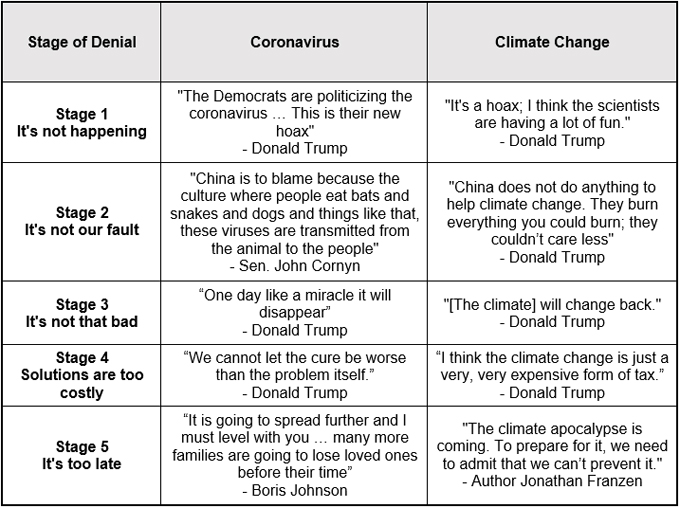
For the climate community, observing U.S. national political leaders’ responses to the coronavirus pandemic has been like watching the climate crisis unfold on fast-forward. Many – particularly on the political right – have progressed through the same five stages of science denial in the face of both threats.

Table
 
For climate change, the denial process began decades ago. NASA climate scientist

James Hansen testified to Congress in 1988 about the dangers posed by global warming; the fossil fuel industry formed the Global Climate Coalition the very next year to launch a campaign casting doubt on mainstream climate science. In November 1989, President George H.W. Bush’s chief of staff, climate denier John Sununu, sabotaged efforts to develop the first international climate change treaty. Exxon in particular spent the following decades and tens of millions of dollars funding a network of think tanks to propagate climate science denial. In a memo leaked in 2003, Republican strategist Frank Luntz advised G.O.P. politicians, “You need to continue to make the lack of scientific certainty a primary issue in the debate.”
Analysis

The same denial process has unfolded with coronavirus, but over a far more compressed time frame. In both crises, early warnings from scientific experts went unheeded and were often discouraged or suppressed. As a result, the American government began responding only after each threat’s impacts had become widespread and undeniable. At that point, due to the missed opportunity to prevent the outbreak of impacts, much of the response came in the form of damage control. America’s efforts to “flatten the curve” of coronavirus cases, like its efforts to bend the carbon emissions curve, were deployed too slowly.

The five stages of denial

In 2013, as the fifth Intergovernmental Panel on Climate Change report was due to be released, the five stages of climate denial were on display in many conservative media outlets. Watching the reactions to the unfolding coronavirus crisis in early 2020 created a sense of déjà vu, as many leaders exhibited the same stages of denial. In fact, many of the same actors who deny the climate crisis also were (or still are) denying coronavirus threats. Some observers have remarked that the Venn diagram of coronavirus and climate deniers is nearly a circle.

Stage 1: Deny the problem exists. This is denial at its most basic, as there is no need to solve a problem that doesn’t exist. If the issue is a hoax, as the president repeatedly has asserted about both global warming and coronavirus, the status quo can be maintained. But denying a problem doesn’t change its physical or epidemiological properties, so in the face of real scientifically quantified threats, Stage 1 denial cannot last very long.

Stage 2: Deny responsibility. Upon accepting the threat posed by coronavirus outbreaks, numerous conservative politicians and pundits have tried to shift the blame to China, with many including the president labeling it “the Chinese virus,” echoed over 100 times on Fox News. Similarly, after accepting that climate change is happening, many have tried to blame it on natural cycles, or, if they accept humanity’s responsibility, to likewise blame it on China. But here again denial falls short; shifting blame does not slow a physical or viral crisis.

Stage 3: Downplay the threat. President Trump spent weeks downplaying the threat of coronavirus, early maintaining that it had only infected one person in America, that “one day like a miracle it will disappear,” that “within a couple of days [the number of infected Americans] is going to be down to close to zero,” and so on. Fox News and other conservative media outlets followed his lead in downplaying the risks. Similarly, Trump has said the climate “will change back,” and conservative media outlets have spent decades arguing that climate change is no big deal. Yet, as the devastation of coronavirus and climate change impacts has become a reality, doubters have been increasingly forced to move beyond Stage 3 denial.

Stage 4: Attack the solutions as too costly. Trump has claimed that coronavirus curve-flattening measures recommended by experts – like long-term social distancing – are too costly. He instead suggested preemptively loosening social distancing measures to reopen the national economy “sooner rather than later” (an approach Fox News has also championed), as well as various unproven drug treatments, with Fox News again following suit. A number of ideologues have argued that older Americans would rather die than cause the economic disruption associated with extended social distancing. Some partisan policymakers and pundits similarly oppose virtually all large-scale climate solutions as too expensive, instead proposing worthwhile but inadequate steps like simply planting trees or capturing carbon from power plants to inexplicably use for extracting yet more fossil fuels.

Stage 5: It’s too late. Some have proposed, once it became obvious that the coronavirus outbreak had become widespread, that governments should just maintain the status quo, try to build herd immunity, and cope with the consequences (such as overwhelmed health care systems that could result in millions of deaths). Climate justice essayist Mary Heglar coined the term “de-nihilist” to describe those who have similarly succumbed to the fear that it’s too late to stop climate change. Such attitudes only hamper efforts to constructively address both problems.

Coronavirus is a learning opportunity for climate change

Because American leadership proceeded through these stages of denial, it wasted valuable months that could have been spent preparing for and curbing the spread of coronavirus. For comparison, South Korea diagnosed its first case of COVID-19 on January 20 – the same day as the U.S. – but almost immediately launched an aggressive program of testing, tracing, and quarantining.

By March, South Korea was conducting over 10,000 coronavirus tests per day, and its new cases fell below 150 per day by mid-March. Despite a population six times larger, the U.S. had reached the threshold of 10,000 new tests per day only on March 16, and has consistently lagged in testing on a per capita basis. As testing in the U.S. finally began to catch up to the viral spread, the number of new coronavirus cases in America accelerated past 10,000 per day by March 23, reaching 580,000, by April 14 compared to 10,564 South Korean cases (222 deaths) as of that date.

After this late start, Trump has regularly argued that the U.S. “cannot let the cure be worse than the problem itself.” Those who oppose climate solutions similarly argue that making investments to bend the carbon emissions curve would be worse than the consequences of climate change – consequences that include increased food insecurity; intensified hurricanes, wildfires, heatwaves, droughts, and floods; and more species extinctions, violent conflicts, and death.

Both arguments run counter to expert advice, misunderstand the problem, and present a false choice. In reality, failing to make the necessary early investments to head off each threat will result in economy-crippling consequences, whether in the form of overwhelmed health care systems in the case of coronavirus or more deadly extreme weather events in the case of climate change.
Experts agree that to protect both the economy and public health, government responses must focus on flattening the coronavirus curve and making investments to rapidly curb carbon pollution. In fact, a new study on the 1918 flu pandemic found that measures like social distancing “not only lower mortality, they also mitigate the adverse economic consequences of a pandemic.” Nipping the problem quickly and aggressively yields the best outcome for both the economy and public health. Put simply, suffering and death are costly.

Observing the damage resulting from denial of both the coronavirus and climate crises raises the question, how did humans evolve this apparent psychological flaw? Physician-scientist Ajit Varki has hypothesized that comprehending one’s own mortality is a psychological evolutionary barrier for most species, because this realization would amplify the fear of death and thus “would have then reduced the reproductive fitness of such isolated individuals.” 
 Varki posits that humans may have overcome this barrier by developing denial as a coping mechanism, but that “If this theory turns out to be the correct explanation for the origin of the species, it might ironically also be now sowing the seeds of our demise,” since denial now obstructs efforts to address threats like climate change and coronavirus.

WuhanWith climate and coronavirus, ‘the broad shape of the story is the same’

As climate activist and author Bill McKibben put it, “You can’t negotiate with physics and chemistry, you can’t compromise with them or spin them away … coronavirus is teaching us precisely this lesson about biology as well. Reality is real and sometimes it bites pretty hard.” Or, as Republican pollster Neil Newhouse said more bluntly, “Denial is not likely to be a successful strategy for survival.”

But because of its compressed time frame, coronavirus has provided humanity an opportunity to learn this lesson and apply it to curbing the worst of the climate crisis. Contrary to Stage 5 denial, it’s not yet too late to avoid the most severe climate change impacts.

Tuesday, April 14, 2020

From Yale Climate Connections

Tuesday, 7 April 2020

Sorry to disappoint climate deniers, but coronavirus makes the low-carbon transition more urgent: The Conversation

"Deniers argue that further disruption to economies and societies will be avoided at all costs. 

Sorry to be the harbinger of denier disappointment, but there is every reason to expect that the virus crisis will strengthen and accelerate the imperative to transition to a low-carbon world by mid-century."

.............................

"Time is of the essence

As Christiana Figueres, former executive secretary of the UN’s Framework Convention on Climate Change, states in her recent book:
“We are in the critical decade. It is no exaggeration to say that what we do regarding emissions reductions between now and 2030 will determine the quality of human life on this planet for hundreds of years to come, if not more.”
This will require about a 50% reduction in emissions by 2030 – way more than is contemplated in the Paris agreement – to achieve even net zero emissions by 2050.

Read more: Coronavirus is a wake-up call: our war with the environment is leading to pandemics

There are a few “pluses” from the experience of coronavirus. Emissions are falling (although clearly no one would advocate a global recession as a climate strategy). And the response of governments to the crisis has seen decisive domestic action – working individually, but together, in meeting what is a global challenge.

Individual governments have demonstrated how quickly they can move once they accept the reality of a crisis. We’ve also seen just how far they’re prepared to go in terms of policy responses – lockdowns, social distancing, testing, rapid and historically significant fiscal expansions, and massive liquidity injections.

It’s noteworthy that issues that in “normal times” could not have been ignored – such as civil liberties and concerns about intrusive governments and effective competition – have so easily been set aside as part of emergency responses."

Read The complete The Conversation story 

#jail climate criminals

Saturday, 1 February 2020

A Message From the Future With Alexandria Ocasio-Cortez: You Tube Video

Australia also needs a Green New Deal

The story of how fossil fuel corporations lie to us is shocking.

But we may have a green future! Maybe!


"What if we actually pulled off a Green New Deal? What would the future look like? The Intercept presents a film narrated by Alexandria Ocasio-Cortez and illustrated by Molly Crabapple.

Set a couple of decades from now, the film is a flat-out rejection of the idea that a dystopian future is a forgone conclusion. Instead, it offers a thought experiment: What if we decided not to drive off the climate cliff? What if we chose to radically change course and save both our habitat and ourselves? We realized that the biggest obstacle to the kind of transformative change the Green New Deal envisions is overcoming the skepticism that humanity could ever pull off something at this scale and speed. That’s the message we’ve been hearing from the “serious” center for four months straight: that it’s too big, too ambitious, that our Twitter-addled brains are incapable of it, and that we are destined to just watch walruses fall to their deaths on Netflix until it’s too late. This film flips the script. It’s about how, in the nick of time, a critical mass of humanity in the largest economy on earth came to believe that we were actually worth saving. Because, as Ocasio-Cortez says in the film, our future has not been written yet and “we can be whatever we have the courage to see.” 


Subscribe to our channel: https://interc.pt/subscribe 

Read the article from Naomi Klein: https://interc.pt/2UktTeE"


See also:

Bushfire survivors join claim against ANZ for financing climate crisis : The Guardian


Media ‘impartiality’ on climate change is ethically misguided and downright dangerous : The Conversation


"In September 2019, the editor of The Conversation, Misha Ketchell, declared The Conversation’s editorial team in Australia was henceforth taking what he called a “zero-tolerance” approach to climate change deniers and sceptics. Their comments would be blocked and their accounts locked. 


His reasons were succinct:
Climate change deniers and those shamelessly peddling pseudoscience and misinformation are perpetuating ideas that will ultimately destroy the planet.
From the standpoint of conventional media ethics, it was a dramatic, even shocking, decision. It seemed to violate journalism’s principle of impartiality – that all sides of a story should be told so audiences could make up their own minds.

But in the era of climate change, this conventional approach is out of date. A more analytical approach is called for.

The ABC’s editorial policy on impartiality offers the best analytical approach so far developed in Australia. It states that impartiality requires:
  • a balance that follows the weight of evidence

  • fair treatment
  • open-mindedness
  • opportunities over time for principal relevant perspectives on matters of contention to be expressed.
It stops short of saying material contradicting the weight of evidence should not be published, which is the position adopted explicitly by The Conversation and implicitly by Guardian Australia." ...........................................................................................................

"Twice we have been evacuated from our home. Twice
we have been among the lucky ones to return unhurt and find our home intact.

From this perspective, media acquiescence in climate change denial, failure to follow the weight of evidence, or continued adherence to an out-of-date standard of impartiality looks like culpable irresponsibility."


Read The Conversation article 

See also: 

Now that climate change is irrefutable, denialists like Andrew Bolt insist it will be good for us : The Guardian


jailclimatecriminals

Friday, 24 January 2020

Climate Change is a cause of attacks on democracy


As the climate crisis worsens and conflict increases over scarce resources expect more threats to authentic democracy.


In The Maldives

President Abdulla Yameen of the Maldives. AFP/Getty


"According to a 2017 study published in The Lancet, extreme weather could displace up to a billion people around the world by the middle of the twenty-first century—an unprecedented human migration will undoubtedly influence the politics of wealthy countries, pushing them to the right.
The best way to counteract this phenomenon is naturally to halt, or at least slow, the effects of climate change. So far, the Paris agreement is the only tangible result of those efforts, and its fate is far from certain .............  But this might change, if the problems caused by climate change—not just stronger hurricanes, droughts, and rising seas, but political rupture—keep washing up on the disappearing shorelines of wealthy governments."

Go to The New Republic article


Around the world


"In its 5th Assessment Report (2014), the Intergovernmental Panel on Climate Change (IPCC) unequivocally confirmed that climate change is real and that human-made greenhouse gas emissions are its primary cause. The report identified the increasing frequency of extreme weather events and natural disasters, rising sea-levels, floods, heat waves, droughts, desertification, water shortages, and the spread of tropical and vector-borne diseases as some of the adverse impacts of climate change. These phenomena directly and indirectly threaten the full and effective enjoyment of a range of human rights by people throughout the world, including the rights to life, water and sanitation, food, health, housing, self-determination, culture and development."

Go to the ohchr.org story


In Australia


"Scott Morrison (Australia's Prime Minister) has signalled a crackdown on “selfish, indulgent and apocalyptic” environmental activists."
Go to The New Daily story 


"It takes some chutzpah to stand up with a straight face and deliver a speech foreshadowing a government crackdown on protest activity while in the same breath declaring that a new insidious form of progressivism is intent on denying the liberties of Australians."

Go to The Guardian story


Our democratic freedoms are under threat in Australia and around the world.


Australian Federal Police raid the ABC offices

"Source confidentiality is one of journalists’ most central ethical principles. It is recognised by the United Nations and is vital to a functioning democracy and free, independent, robust and effective media. 

Go to The Conversation article


"If the major parties and politicians want to rebuild trust with voters, they will need to change the way they do politics: stop misusing their entitlements, strengthen political donations laws, tighten regulation of lobbyists, and slow the revolving door between political offices and lobbying positions."

Let's safeguard our democratic institutions such as free speech, restrictions on overwhelming amounts of corporate donations to political parties, freedom to protest, freedom to privacy, freedom to gather.
 

In the USA

Go to The Atlantic article: David Goldman / AP


"As heat, disaster risks, and rising seas bombard local governments, the ability of those governments to fulfill their basic functions—the delivery of services, the maintenance of the safety net, and managing civil, familial, and educational institutions—could be degraded, too. This could manifest in three distinct phenomena that are already on display in disaster-affected areas: the increased dominance of private and developer-class interests in local politics, the acceleration of existing wealth inequality, and the collapse of institutions dedicated to disaster response."

Go to The Atlantic article


Prominent media corporations are supporting climate deniers, fossil fuel dependent corporations and corporations whose profits depend on degrading the human environment.

Let's care for our vulnerable. 

Lets support action plans (see below) to tackle climate change.

Go to World Bank document


Thursday, 26 December 2019

Climate change deniers’ new battle front attacked : The Guardian

The battle between climate change deniers and the environment movement has entered a new, pernicious phase. That is the stark warning of one of the world’s leading climate experts, Michael Mann, director of the Earth System Science Center at Pennsylvania State University.

Mann told the Observer that although flat rejection of global warming was becoming increasingly hard to maintain in the face of mounting evidence, this did not mean climate change deniers were giving up the fight.

“First of all, there is an attempt being made by them to deflect attention away from finding policy solutions to global warming towards promoting individual behaviour changes that affect people’s diets, travel choices and other personal behaviour,” said Mann. “This is a deflection campaign and a lot of well-meaning people have been taken in by it.”

Read The Guardian article 

See also: 

435 people died in an 1896 heatwave — but scientists say the extreme heat events of today are still hotter: ABC


#criminales climáticos de la cárcel   #criminalesclimáticosdelacárcel  #jailclimatecriminals

#gaolclimatecriminals  #buyfromthebush

Sunday, 22 December 2019

435 people died in an 1896 heatwave — but scientists say the extreme heat events of today are still hotter: ABC


"Newspaper reports describe temperatures in Bourke reaching 48.9 degrees Celsius on three occasions, and the maximum temperature remaining above 38C for 24 consecutive days.

As Australia endures a series of intense and record-breaking heatwaves this summer, the 1896 event is sometimes viewed as evidence that Australia has always experienced extraordinary heat, and that the effects of climate change are overblown.

But climate scientists say that is an oversimplification, and the heatwaves we experience today are significantly hotter than those in the past."

"The temperature recording methods used in 1896 were flawed

Methods of recording temperature were not standardised until the early 1900s, leading to inflated temperature readings before then.
The global standard for temperature measurement includes the use of a Stevenson screen, which is a white louvred box allowing ventilation and ensuring thermometers inside are never exposed to the sun. 

A Stevenson screen was not installed in Bourke until August 1908, meaning temperature readings from before that could be inflated by as much as 2C.

University of Melbourne climate researcher Linden Ashcroft said thermometers in Bourke were likely placed in sub-standard conditions in 1896.

"Some thermometers were under verandahs, or they were against stone buildings," she said."


Read the complete ABC article

#jailclimatecriminals

#jail climate criminals

Related:

How the Political Right Uses Fossil Fuels to Galvanize Opposition to Climate Action : Green Market Oracle