..... ‘There is a substantive and compelling body of medical and scientific
evidence supporting the position that this is a health emergency,’ she
said.
‘In Australia, strong voices are calling for the mitigation of climate
impacts on the health of current and future generations, including in
Aboriginal and Torres Strait Islander, rural and remote communities.
‘We acknowledge the serious threats posed to the health of children,
older Australians and those in rural and remote communities. Climate
change disproportionately affects the health of Australians with asthma,
respiratory conditions and heart disease. The research demonstrates
that women are at higher risk of death from climate change, in
particular from climate-change-linked natural disasters.’
Dr Roeske said more deaths from heatwaves can be expected, with young generations likely to have their mental health affected.
Health impacts in Australia are also likely to include more deaths from
the spread of infectious disease such as malaria and dengue, with
diarrheal illnesses also expected to grow.
‘This is a signal to our members and to our patients and communities
that GPs recognise climate change as a health emergency and are ready to
respond to the multiple health challenges ahead,’ Dr Roeske said.
‘We believe the Australian Government should recognise and help address the health impacts of climate change.’
Despite an unremitting stream of warnings and studies we still are not
doing what we must to protect the natural world and keep temperatures
from warming beyond critical upper temperature limits. We were warned
about our impact on nature seven years ago in the GEO-5 report. Undeterred we continued to perpetrate genocide against nature. In 2012 scientists warned us that our oceans are dying but we did not respond. We have now decimated entire aquatic ecosystems and all around the world coral reefs are dead or dying.
We were warned not to surpass 1.5 degrees Celsius above preindustrial
norms. We ignored these warnings and we keep pumping climate change
causing greenhouse gases
into the atmosphere at record breaking rates. We are now at 1 degree C
above preindustrial norms, two thirds of the way to the point of no
return.
Everyone from Stephen Hawkings to President Obama have warned us of the urgent need to act on climate change. The world's leading scientific organizations
have also repeatedly warned us about climate change. This includes the
American Association for the Advancement of Science, the Royal Society,
the Royal Institution, NASA, the US National Academy of Sciences, the US
Geological Survey, and the national science bodies of dozens of
countries.
We have amassed an unparalleled body of research that convincingly
demonstrates we are on the cusp of an apocalypse. "By now, we know all
we need to know" Anne Olhoff
said recently. Olhoff is the head of strategy, climate and planning and
policy for the UNEP DTU (Technical University of Denmark) Partnership.
"The science is pretty clear, and very frightening," she said.
Read the original article
These warnings are not new. A half century ago climate models accurately predicted global warming. A brief review
of climate science shows us that we have known about the dangers of a
warming planet since the 1950s. In the last couple of decades scientists
have added to these warnings. In 2006 the Stern Review warned us that we had to urgently reduce our emissions to avoid the worst impacts of climate change. By 2012 dozens of studies made the case for anthropogenic climate change including a report from UNEP that warned that we are on the brink of a climate catastrophe. In 2013 The U.S. National Climate Assessment (NCA) report and an IPCC study reaffirmed that anthropogenic climate change is a real and growing problem.
PricewaterhouseCoopers (PwC) issued a climate warning in 2012 and so did the World Bank. We have seen countless scientific warnings including reports from PwC, AGU and the WMO, all of which have told us that we are are running out of time. Seven years ago the IEA and the WRI warned that we need to stop burning fossil fuels. Investors are continually being warned about the dangers of hydrocarbons and even oil companies have issued their own climate warnings. In fact, in the 1960s the fossil fuel industry's own science revealed that they are causing global warming.
We fail to act despite the preponderance of economic evidence
indicating that the benefits of climate action far outweigh the costs.
According to the Global Energy Transformation report, there are 160 trillion dollars worth of savings from climate action. Five years ago the wisdom of action was explained in the Risky Business Report. Climate change has also been the hot topic at the World Economic Forum (WED) in Davos Switzerland.
In 2017 two scientific warnings
stand out, the U.S. Global Change Research Program's fourth National
Climate Assessment (NCA4) and an open letter from the Alliance of World
Scientists. The letter is titled "Warning to Humanity: A Second Notice"
and it was published in BioScience. It was signed by more than 15,000
scientists from 184 countries. It warned humanity about the dangers of
climate change. The warning specifically said that humanity must change
its ways in order to protect the planet. It specifically points to
rising greenhouse gas emissions and deforestation.
A 2018 UN Intergovernmental Panel on Climate Change (IPCC)
study reaffirmed that we are teetering on the cusp of a man-made
climate calamity. The IPCC report warned that governments must take
urgent action to avoid "rapid, far-reaching and unprecedented changes in
all aspects of society". The report warned that by 2030 we will will
breech the upper threshold limit (1.5 C). A 2019 IPCC report warned that we are seeing accelerated ice melt and sea level rise.
Read the original article
In 2019, more than 10,000 scientists from 153 countries declared a
"climate emergency". The study is called "World scientists' warning of a
climate emergency". The seriousness of the threat was addressed by
biologist Jesse Bellemare who said "the climate crisis is real, and is a
major, even existential, threat to human societies." Bellemare is an
associate professor of biology at Smith College who is a signatory of
the study’s emergency declaration.
Researchers have warned us that we are facing the end of civilization. The well documented effects of catastrophic warming includes cataclysmic flooding from
sea level rise, more frequent and devastating extreme weather, massive wildfires, and chronic food shortages. But there may be an even worse
fate awaiting us in a world ravaged by runaway climate change. Simply
put, if we fail to act we are headed for a horrific disaster that will
adversely impact life on Earth.
Climate change is here and the only question that remains is just how
bad it will get. That is still up to us, but with each passing year we
ebb ever closer to tipping points
from which we may not be able to recover. The window of opportunity to
act is closing and the longer we wait the harder it will be.
"Newspaper reports describe temperatures in Bourke reaching 48.9
degrees Celsius on three occasions, and the maximum temperature
remaining above 38C for 24 consecutive days.
As Australia endures a series of intense and record-breaking heatwaves
this summer, the 1896 event is sometimes viewed as evidence that
Australia has always experienced extraordinary heat, and that the
effects of climate change are overblown.
But climate scientists
say that is an oversimplification, and the heatwaves we experience today
are significantly hotter than those in the past."
"The temperature recording methods used in 1896 were flawed
Methods
of recording temperature were not standardised until the early 1900s,
leading to inflated temperature readings before then. The global
standard for temperature measurement includes the use of a Stevenson
screen, which is a white louvred box allowing ventilation and ensuring
thermometers inside are never exposed to the sun.
A Stevenson
screen was not installed in Bourke until August 1908, meaning
temperature readings from before that could be inflated by as much as
2C.
University of Melbourne climate researcher Linden Ashcroft
said thermometers in Bourke were likely placed in sub-standard
conditions in 1896.
"Some thermometers were under verandahs, or they were against stone buildings," she said."
It is widely understood that in the main, conservative far-right
political movements support fossil fuels and oppose the veracity of
climate change and climate action. In the U.S. Republicans have worked with the old energy industry to subvert the facts for many years. Thanks to insidious disinformation
campaigns 73 percent of Republican voters have been hoodwinked into
believing that climate change is not a serious threat and 70 percent do
not believe that humans are the cause. The resistance to climate action
does not stop at disinformation. Republicans have actively thwarted the
democratic process through redistricting (gerrymandering) and voter suppression.
In Oregon Republican lawmakers refused to appear in the state
legislature to avoid passing a sweeping climate change bill by the
Democratic majority.
No individual has done more harm to global climate action that Donald
Trump. He has dismissed climate change as a "hoax" and his
administration's resistance to science is unprecedented. This president and his Republican minions actively support the expansion of fossil fuels and wanton deregulation. The Trump administration's raft of anti-environmental policy positions including withdrawal from the Paris Climate Agreement.
Trump has helped to pave the way for climate denial from far-right politicians in Brazil,
Finland, Germany and the Netherlands. They have stoked opposition to
climate action to build support for anti-science policy. The result is
the right wing leaderships in Hungary, Poland, the Czech Republic and
Estonia have all killed their net-zero emissions plans this year.
The key to resistance to science-based climate action can be found in
marrying opposition to fossil fuel tax hikes and resistance to climate
action. The so called yellow vest protests in France and other parts of
Europe illustrate this point. Opposing increases in gas prices serves as
both a mustering point of resistance and a segue to oppose climate
action. However, this is a manufactured crisis as gas taxes were already
high.
In a play on Trump's nationalistic "make America great again" French
President Emmanuel Macron has vowed to "make our planet great again".
French right wing political leaders have seized on Macron's climate
leadership to galvanize opposition to climate action. As one slogan put it, "Macron is concerned with the end of the world. We are concerned with the end of the month."
Similar contrarian sentiments can be found in other countries that support climate action including Sweden
which is widely recognized as one of the most climate forward nations
on the planet. Resistance to gas tax hikes in Sweden are called Bensinupproret.
The leader of the movement's 600,000 Facebook members is Peder Blohm
Bokenhielm he dismisses climate action as "hysteria". In climate
friendly Finland, opposition to climate action is also being used by the
right for partisan purposes. Finns Party chairman Jussi Halla-aho also
dismisses climate action as "hysteria".
However, it is becoming increasingly difficult to ignore climate
science, even for right wing politicians whose policy agendas are
commonly rooted in obfuscation and outright deception. The new
center-right European Commission President Ursula von der Leyen,
placed climate policy at the top of her "agenda for Europe," ahead of
even economic policy. "I want the European Green Deal to become Europe's
hallmark," she explained.
The current drought across much of eastern Australia has
demonstrated the dramatic effects climate variability can have on farm
businesses and households.
The drought has also renewed longstanding discussions around the
emerging effects of climate change on agriculture, and how governments
can best help farmers to manage drought risk.
A new study
released this morning by the Australian Bureau of Agricultural and
Resource Economics and Sciences offers fresh insight on these issues by
quantifying the impacts of recent climate variability on the profits of
Australian broadacre farms.
The findings demonstrate the importance of adaptation, innovation and
adjustment to the agriculture sector, and the need for policy responses
which promote – and don’t unnecessarily inhibit – such progress.
Measuring the effects of climate on farms
Measuring the effects of climate on farms is difficult given the many
other factors that also influence farm performance, including commodity
prices.
Further, the effects of rainfall and temperature on farm production
and profit can be complex and highly location and farm specific. To address this complexity, ABARES has developed a model based on more than 30 years of historical farm and climate data—farmpredict — which can identify effects of climate variability, input and output prices, and other factors on different types of farms.
Cropping farms most exposed
The model finds that cropping farms generally face greater climate
risk than beef farms, but also generate higher average returns. Cropping farm revenue and profits are lower in dry years, with large
reductions in crop yields and only small savings in input costs.
Low ambition from polluting nations derailed the COP25 climate talks.
Supplied by author Kate Dooley, University of Melbourne The United Nations’ COP25 climate talks concluded on Sunday morning in Madrid, almost 40 hours overtime. After two weeks of protracted talks meant to address the planetary warming emergency, world leaders spectacularly failed to reach any real outcomes.
The degree to which wealthy nations, including Australia, blocked progress on critical points of debate incensed both observers and country delegates.
These points included robust rules for the global trading of carbon credits, increased commitments for finance to help developing nations tackle climate change, and most importantly, raising ambition to a level consistent with averting catastrophic climate impacts. Australia’s Emissions Reduction Minister Angus Taylor, far left, with other delegates to the COP 25.JUAN CARLOS HIDALGO
High hopes
COP25 was a conference of “parties”, or nations, signed up to the Paris Agreement, which takes effect in 2021. I attended the conference as an observer.
Emissions reduction targets of nations signed up to Paris put Earth on track for a 3.2℃ temperature increase this century. However the Intergovernmental Panel on Climate Change says warming must be kept below 1.5℃ to avoid the most devastating climate impacts. Much was riding on the outcome in Madrid. However, it failed to deliver.
Read more:
Earth has a couple more chances to avoid catastrophic climate change. This week is one of them One of the key agenda items was Article 6 of the Paris Agreement, involving international carbon trading between nations. The previous COP in Poland failed to reach consensus on these trading rules, and after this latest meeting, many contentious issues remained unresolved. These include:
how to ensure that an overall reduction in global emissions is achieved and that the rules prevent double counting (or emissions reduction units being counted by both the buying and selling nation)
whether a levy would be applied to proceeds from carbon trading to finance adaptation in developing nations
the recognition of human and indigenous peoples’ rights, and social and environmental safeguards, given the harms caused by previous carbon trading mechanisms
critically for Australia, whether countries could use “carryover” carbon credits from the Kyoto Protocol to meet commitments under the Paris Agreement.
An indigenous woman from Amazon reacts during COP25, which largely failed to deliver.JUAN CARLOS HIDALGO/EPA
The question of Kyoto credits
Australia was pushing to allow use of Kyoto Protocol units, for which it drew scathing criticism from other nations, international media and observers. It plans to meet more than half its Paris target via this accounting loophole. Brazil, India, South Korea and China also want to carry over credits earned under the Clean Development Mechanism, a trading scheme under Kyoto.
Read more:
Now Australian cities are choking on smoke, will we finally talk about climate change? No consensus was reached. The negotiations for rules for carbon markets will now continue at COP26 in Glasgow next year, just weeks out from the Paris Agreement’s start date.
The argument will not be easily resolved. Five of the last seven COP meetings failed to reach a decision on carbon market rules, indicating the extent of international divisions, and calling into question the disproportionate focus on carbon trading, given its limited ability to address climate change.
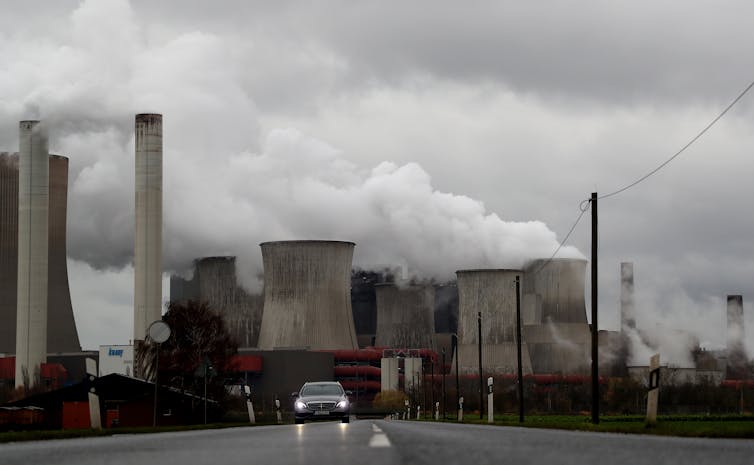
In Madrid, 31 nations signed up to the San Jose principles, seeking to ensure environmental integrity in carbon markets. Upholding these principles would mean emissions must go down, not up as a result of trading carbon. Steam rises a German coal-fired power plant. The COP25 failed to make progress on cutting emissions from coal and other sources.EPA/FRIEDEMANN VOGEL
Other failures
The conference also discussed measures to strengthen the governance and finance arrangements of the Warsaw International Mechanism, a measure designed to compensate poor nations for climate damage.
Little progress was made on mobilising finance from developed nations. The US, which will soon exit the Paris Agreement, played a key role in stymieing progress. It resisted efforts for broad governance arrangements, and pushed for language in the rulebook which would exclude high-emittiong nations from liability for the loss and damage experienced by vulnerable countries under climate change.
Read more:
Global emissions to hit 36.8 billion tonnes, beating last year's record high At Glasgow, all nations under Paris are required to submit new emissions reduction commitments. It was widely expected that the Madrid meeting would strongly urge nations to ensure these targets were more ambitious than the last. Instead, the final text only “reminds” parties to “communicate” their commitments in 2020.
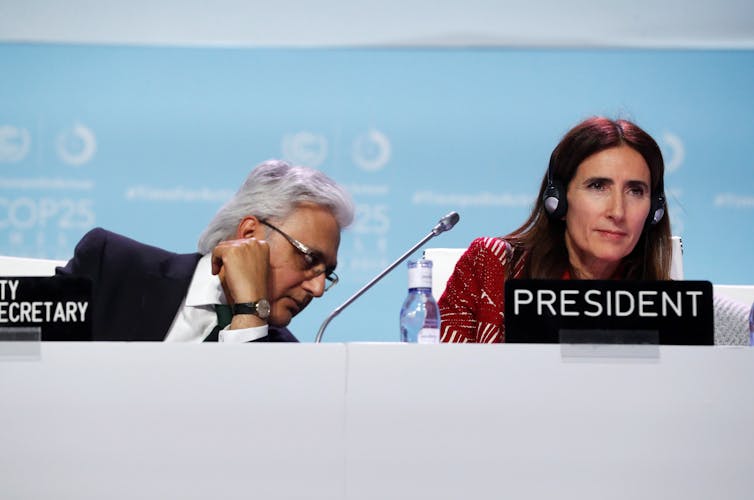
President of COP25, Carolina Schmidt (right), and UN official Ovais Sarmad.EPA/MAST IRHAM
‘Crime against humanity’
When the COP finally closed on Sunday morning, the meeting had failed to reach consensus on increasing emissions reduction ambition to the level required.
The results are disheartening. The world has let another chance slip by to tackle the climate crisis, and time is fast running out. The implications of this were perhaps summed up best by the low-lying Pacific island state of Tuvalu, whose representative Ian Fry said of the outcome:
There are millions of people all around the world who are already suffering from the impacts of climate change. Denying this fact could be interpreted by some to be a crime against humanity.
Australia, US and Brazil threatening
‘spirit’ of the Paris Agreement, says Costa Rican minister, as fractious
talks could drag into the weekend
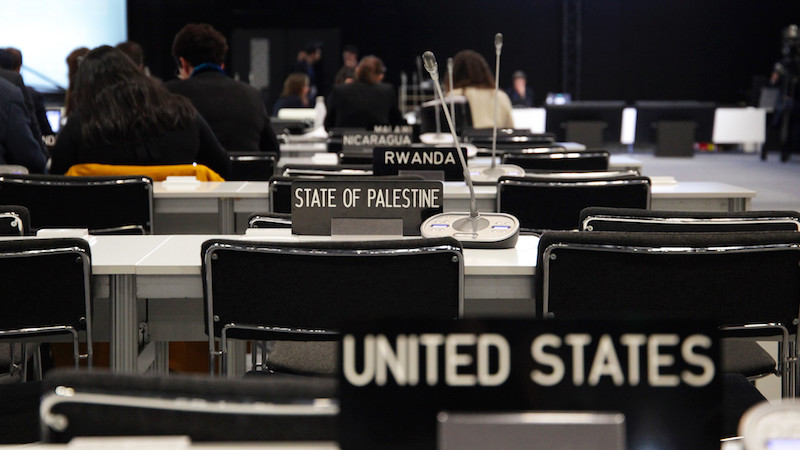
The plenary room at Cop25 in Madrid. Diplomats are locked in tense negotiations to try and find a deal (Photo: UNFCCC)
Negotiations at the UN climate
talks are going into extra time as diplomats are at loggerheads over
commitments to boost ambition and rules to set-up a new global carbon
market.
As the second week of negotiations drew to a close, negotiators were
set to work through the night on Friday to find landing zones and
finalise the last unresolved rules of the Paris Agreement. “We are reaching the final hours of the Cop and now is time to show
the world we are capable of reaching an agreement,” Cop25 president
Carolina Schmidt told negotiators.
“The eyes of the world are on us. Our kids, the women of the world,
indigenous people, our communities, the youth will not understand that
we are not able to get to an agreement that is committed ambition to the
world. It is our responsibility to find that agreement,” she said.
But entrenched positions have run into political deadlock, with little progress on the most contentious issues, including creating a new carbon market, known as Article 6.