Showing posts with label fossil fuel industry. Show all posts

Sunday, 24 January 2021

Coalition quietly adds fossil fuel industry leaders to emissions reduction panel (excerpts): The Guardian


"The Morrison government has quietly appointed fossil fuel industry leaders and a controversial economist to a committee responsible for ensuring the integrity of projects that get climate funding.

Critics have raised concerns about whether some appointees to the Emissions Reduction Assurance Committee may have a potential conflict of interest that could leave its decisions open to legal challenge.

The overhaul of the committee follows the government indicating it plans to expand the industries that can access its $2.5bn emissions reduction fund, including opening it to carbon capture and storage (CCS) projects by oil and gas companies."

........

 "Bill Hare, the chief executive and senior scientist with Climate Analytics, said it appeared the government had appointed “mostly people concerned with the status quo” rather than aiming for a rapid shift towards zero emissions.

He said he was concerned the government planned to allow fossil fuel companies to receive climate funding for merely reducing emissions below inflated estimates of what their CO2 output otherwise might be."

............

"The emissions reduction fund has so far operated with limited success in reducing national emissions. The government has paid $740m for emissions cuts and signed contracts for another $1.66bn. Despite this, national emissions had dipped only slightly since the Coalition was elected in 2013 prior to the Covid-19 shutdown.

Government data shows the small reduction was overwhelmingly due to the rise of solar and wind energy, which are not supported through the fund." 

 To go to the original The Guardian article

Tuesday, 24 November 2020

Climate Deniers Are Claiming EVs Are Bad for the Environment — Again. Here’s Why They’re Wrong. (excerpt): DeSmog

Charging electric vehicle
 "A new paper published Tuesday, November 17, by the conservative think tank the Competitive Enterprise Institute (CEI), raises environmental concerns with electric vehicles in what appears to be the latest attempt by organizations associated with fossil fuel funding to pump the brakes on the transportation sector’s transition away from petroleum and towards cleaner electricity.

In the U.S., the transportation sector is the largest contributor to planet-warming emissions. Climate and energy policy experts say electrifying vehicles is necessary to mitigate these emissions.

In fact, scientists recently warned that if the country has any hope of reaching the Paris climate targets of limiting warming to below 2 degrees Celsius (3.6 degrees Fahrenheit), 90 percent of all light-duty cars on the road must be electric by 2050.

But the Competitive Enterprise Institute — a longtime disseminator of disinformation on climate science and supported by petroleum funding sources including the oil giant ExxonMobil and petrochemical billionaire Koch foundations — dismisses this imperative and instead tries to portray electrified transport as environmentally problematic in a paper titled, “Would More Electric Vehicles Be Good for the Environment?”

“This is a grab bag of old and misleading claims about EVs [electric

vehicles],” said David Reichmuth, a senior engineer in the clean transportation program at the Union of Concerned Scientists. “If you want to answer this question [posed by the report’s title], you have to also look at the question of what are the impacts of the current gasoline and diesel transport system, and this report just ignores that.”.."


See complete DeSmog article
By Dana Drugmand • Tuesday, November 17

Related:   Trump gutted environmental protections. How quickly can Biden restore them? (excerpt): GRIST

Friday, 20 November 2020

Trump gutted environmental protections. How quickly can Biden restore them? (excerpt): GRIST

President Donald Trump hands coal miners the pen he used to sign a bill eliminating
 regulations on the mining industry in the Roosevelt Room at the White House in Washington, 
D.C. Nicholas Kamm / AFP / Getty Images
Just a month before he won the U.S. presidential election in 2016, Donald Trump vowed to spend his time in office systematically slashing government rules. “I would say 70 percent of regulations can go,” Trump told a crowd of town hall attendees in New Hampshire. “It’s just stopping businesses from growing.”

Now, four years later, it looks like Trump did his best to keep those promises. Over the course of his term, Trump has erased or watered-down dozens upon dozens of regulations designed to keep pollutants out of the water, air, and soil. He has allowed oil and gas companies to leak planet-warming methane into the air. He has told power plants that they can keep emitting dangerous levels of carbon dioxide. If all those rules stand, according to one analysis, they will be responsible for 1.8 billion metric tons of additional greenhouse gas emissions by 2035.

With President-elect Joe Biden preparing to move into the White


House in January, this anti-environment era is about to come to an end. Biden has promised to re-enter the Paris Agreement, prioritize climate change across the federal government, and push for sweeping clean-energy legislation. But putting the most ambitious plans in place will prove especially difficult if Republicans keep control of the Senate. (Democrats will have one more chance to recapture the chamber in two Georgia runoffs, though they’re facing tough odds.)

 See complete Grist article 


Related:  Politicians Try to Rally Support for Coal Despite Economics and Biden Presidential Win (excerpt): DeSmog


#climatecriminals, Trump, #fossilfuelcompanies, fossil fuel industry, Biden,


Thursday, 19 November 2020

NO FUTURE IN GAS - video

"Renewables provide the cheapest source of energy and are creating the energy jobs of the present AND the future.

Yet, our State (Victorian) Government has given the go ahead to open up polluting gas fields and a mega gas import terminal that will have little to no impact on our gas bills but a huge impact on our climate. To cut power prices, we need to invest in renewables and help get Brunswick and Victoria off gas. Download our fact sheet here. 

Didn't know there was a problem with gas? Watch this video." 

Dr Tim Read - Greens MP


Wednesday, 18 November 2020

Faith Institutions Announce Largest-Ever Joint Divestment From Fossil Fuels (excerpt): 350

"Commitments highlight need for governments to increase ambition
on climate action.


WASHINGTON - Today, 47 faith institutions announce their divestment from fossil fuels, making the largest-ever joint announcement of divestment among religious leaders. These include Catholic, Protestant, and Jewish institutions from 21 countries.

Participating institutions include the Commission of the Bishops’ Conferences of the European Union, American Jewish World Service, and Anglican and Methodist churches across the United Kingdom. The full list of participating institutions is here.

The announcement coincides with the fifth anniversary of the Paris agreement on climate change. Faith leaders’ action puts pressure on government leaders, and their commitment to clean energy stands in stark contrast with many governments’ failure to deliver ambitious energy strategies. "

Go to complete 350.0rg article


Related:
Politicians Try to Rally Support for Coal Despite Economics and Biden Presidential Win (excerpt): DeSmog


divestment, 350, fossil fuel industry, Paris Agreement, faith institutions, jail climate criminals

Monday, 21 September 2020

Pandemic lands 'worst body blow' in modern history on fossil fuel companies (excerpt): Yale Climate Connections


 "......“Serious stress, serious stress.”

“An industry in its last days.”

“Steady decline [in growth, demand] for the past decade.”

“Cratering.”

Those are a few of the characterizations of today’s oil, natural gas, and coal industries put forward by several independent journalists, writers, and analysts in the new edition of the “This is Not Cool” video series.

… And then, along came the coronavirus and the COVID-19 challenges, providing one more blow to the energy industry.

Even pre-pandemic, the conventional energy sector “already had plans to cancel major infrastructure projects like pipelines,” independent journalist Keith Schneider told Yale Climate Connections. And with the pandemic, oil and gas experienced “the worst body blow in its modern contemporary history,” he said.

Journalist and writer Antonia Juhasz agrees, pointing to “an industry in its last days, it’s just getting hit from too many sides.”

“Most of the new electricity generation coming online today is coming from wind and solar,” says Houston Chronicle reporter Chris Tomlinson. And professor Dan Kammen of the University of California Berkeley says solar and wind have been the cheapest energy options worldwide for at least the past three consecutive years.

Kammen also says that he believes solar and wind energy initiatives can advance two to three times as many job opportunities as traditional fossil fuel projects: That would be critical to help long-time coal and other fossil fuel industry employees whose decades of work has been critical to economic development … and who society cannot simply leave stranded as momentum turns toward a clean economy. Tending to the plight of those workers whose jobs are lost will have to be part of the energy-options puzzle, interviewees say."..."

Watch the video

Go Yale Climate Connections


Related: Scottish green hydrogen scheme gears up to fuel ferries, buses and trains (excerpt): The Guardian

Wednesday, 16 September 2020

Compromised: Genie Energy and the Murdoch media’s climate denial (excerpt): Michael West Media

(Pics by this blog)

See the interesting article below. 

The TV series 'The Rise of the Murdoch Dynasty' will soon be screened on ABC TV.

"Rupert Murdoch’s News Corporation has been integral to the propaganda war"
Murdoch series coming to ABC TV


"Rupert Murdoch, Dick Cheney, former CIA director James Woolsey, former US Treasury head Larry Summers, former US Energy Secretary Bill Richardson, hedge fund boss Michael Steinhardt and Jacob Rothschild have something in common. They are all on the board of oil and gas explorer, Genie Energy. Gas industry whistleblower Simone Marsh explores Rupert Murdoch’s fossil fuel interests.

Psychological warfare, or psywar, is the use of propaganda against an enemy, supported by such military, economic or political measures as may be required. Such propaganda is generally intended to demoralise the enemy, to break his will to fight or resist, and sometimes render him favourably disposed to one’s position. 
"News Corporation has been integral to the propaganda war"
Book: Hack Attack
Psychological warfare, winning the “hearts and minds” of the civil population, has been integral to the climate war.

And Rupert Murdoch’s News Corporation has been integral to the propaganda war; so much so that its Australian business has come under serious pressure this year amid anger over the coverage of the bushfires by major titles The Australian, the Herald Sun, Daily Telegraph, the Courier Mail and Foxtel’s Sky News.

Overnight, Rupert Murdoch’s son James publicly rebuked Murdoch’s Fox News over its climate denialism. Last week, a senior executive, Emily Townsend, took the extraordinary step of going public to criticise her own media organisation for its “dangerous” coverage of climate change. 

Behind the propaganda

"Rupert Murdoch’s News Corporation has been integral to the propaganda war"
Threats to democracy
The Murdoch press has always been avidly in favour of fossil fuels and notorious for spreading doubt about the science of global warming. It is worth looking, therefore, at the formal links between Rupert Murdoch and the oil and gas sector.

For a start, News Corp companies in Australia have extensive commercial arrangements with multinational oil and gas corporations. They take big advertising dollars, although how big remains a secret. Their newspapers stage “roundtables” or corporate conferences at which journalists and executives mingle with fossil fuel executives. Yet, rival media Nine Entertainment and its Australian Financial Review masthead does the same.

Where News is different is in Murdoch’s direct financial interest in oil and gas exploration in the Middle East, investments which also compromise New Corp’s coverage of Middle East politics and Israeli expansionism.

Murdoch has aligned himself with fossil fuel interests globally via the American Australian Association (AAA), and Genie Oil and Gas. Genie oil and gas is a division of Genie Energy and has been involved plans to frack in Israel. Its big project now, however, is exploring for oil in the Golan Heights, which is disputed territory once controlled by Syria."....................................."

Go to the complete Michael West Media article
by | Jan 15, 2020


Tuesday, 15 September 2020

Just 100 companies responsible for 71% of global emissions, study says (excerpt): The Guardian (3 years old but still relevant)

Pics from this blog

Note: A three year old article but what has changed apart from some greenwashing?

A relatively small number of fossil fuel producers and their investors could hold the key to tackling climate change

Just 100 companies have been the source of more than 70% of the world’s greenhouse gas emissions since 1988, according to a new report.

 
Exxon

The Carbon Majors Report (pdf) “pinpoints how a relatively small set of fossil fuel producers may hold the key to systemic change on carbon emissions,” says Pedro Faria, technical director at environmental non-profit CDP, which published the report in collaboration with the Climate Accountability Institute. 

Traditionally, large scale greenhouse gas emissions data is collected at a national level but this report focuses on fossil fuel producers. Compiled from a database of publicly available emissions figures, it is intended as the first in a series of publications to highlight the role companies and their investors could play in tackling climate change.

The report found that more than half of global industrial emissions since 1988 – the year the Intergovernmental Panel on Climate Change was established – can be traced to just 25 corporate and state-owned entities. The scale of historical emissions associated with these fossil fuel producers is large enough to have contributed significantly to climate change, according to the report.

Tuesday, 8 September 2020

Canada's Climate Action Rating by the 'Climate Action Tracker' (Excerpt)


At the Climate Action Tracker site countries are evaluated according to the sufficiency of climate action.
Check out your country at the site.

(Excerpt- Pics by this blog)


"At 2 Dec 2019     Rating: Insufficient"

"Canada continues with the incremental implementation of its Pan-Canadian Framework on Clean Growth and Climate, its overarching strategy for reducing emissions, adopted in 2016; often in the face of provincial pushback. The Government is implementing its coal-fired power plant phase-out, but it clearly needs to take more climate action, as emissions are projected to still be above 1990 levels beyond 2030, far from its Paris Agreement target and nowhere near a 1.5˚C-compatible pathway.

Large enough to be seen from
 space, tailings ponds in
 Alberta’s oil sands region
National Geographic
The federal government had been facing strong headwinds against climate action at the provincial level, with four provinces (Saskatchewan, Manitoba, Ontario, and New Brunswick) challenging the constitutionality of its mandatory federal carbon pricing system. These provinces have no - or insufficient - climate plans and the carbon pricing system applies to them while these court challenges proceed. The first of the cases was recently decided in favour of the federal government and will now be appealed to the highest court in the country, the Supreme Court.

The headwinds reached gale force in April with the election of a conservative government in Alberta. The new government has already begun rolling back the province’s climate policy, while the federal government has stated that it will apply the federal carbon pricing ‘backstop’ to Alberta as well.

Monday, 7 September 2020

‘Climate Donors’ Flock to Biden to Counter Trump’s Fossil Fuel Money (excerpt): New York Times

(Pics by this blog)
Democratic donors “want action” on fossil fuels
Koch Industries are behind Trump

WASHINGTON — In 2009, the Obama administration’s environmental team called a group of climate activists to the White House to deliver a message: Climate change doesn’t sell and only provokes economic attacks from the right that are too difficult to counter.

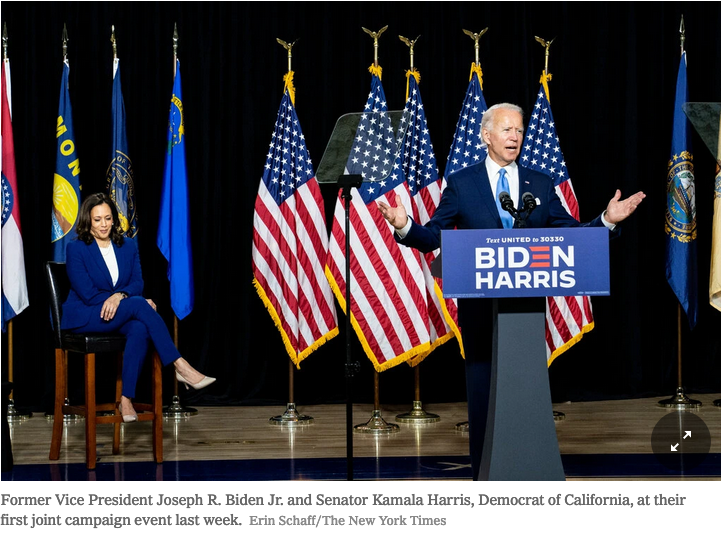
As former Vice President Joseph R. Biden Jr. prepares to assume the Democratic Party’s presidential nomination, the changing climate is now a core campaign issue — and a focus for fund-raising. Plans for tackling rising global temperatures will be in the spotlight Wednesday at the Democratic convention. And Mr. Biden has raised more than $15 million in candidate contributions from hundreds of new donors who specifically identify with climate change as a cause.


Democratic donors “want action” on fossil fuels
Biden: Build Back Better

That climate-specific fund-raising may make up just about 5 percent of the total he has raised so far. It’s dwarfed by fossil fuel donations to President Trump, who took in $10 million from a single fund-raiser in June, held by the oil billionaire Kelcy Warren, and whose super PAC,America First Action, has seen millions pour in from coal and oil moguls, according to the Center for Responsive Politics, which tracks campaign donations.

It is not known how much unregulated money is going to super PACs aligned with Democrats from other self-identified climate donors.

But the hard money climate donations represent a growing counterweight to oil, gas and coal money that has long warped the
Democratic donors “want action” on fossil fuels
Biden and Harris at first joint campaign event.
energy conversation in Washington. Self-identified “climate donors” are a new phenomenon in the 2020 election and are working overtime to show candidates that campaigning to eliminate emissions from fossil fuels pays — in cash.

“That is a sea change. We’ve now got a class of people called ‘climate donors’ in a way we had environmental donors before,” said David Bookbinder, general counsel for the Niskanen Center, a nonpartisan think tank in Washington.

Democratic donors “want action” on fossil fuels
Trump's environmental rollbacks
Climate has taken over as an issue on its own. People are finally understanding that we have a truly existential crisis on our hands,” Mr. Bookbinder added. Publicly embracing climate change solutions was viewed as a political liability, as recently as a decade ago, he said. During Barack Obama’s re-election run in 2012, the issue was hardly mentioned.'

Now donors are sending a new message: “We want to make it easy to do the right thing. We should reward campaigns and candidates for having the right policies,” said Matt Rogers, a co-founder of the digital thermostat company Nest."  ............

"A version of this article appears in print on
Lisa Friedman
Aug. 19, 2020"


 Trump, Biden, Harris, #climatechange, fossil fuel industry, Koch brothers, political party donations from corporations, Democrats, Republicans, #jailclimatecriminals

Friday, 21 August 2020

Climate grief expected to be widespread soon but it's still not openly acknowledged (excerpt): ABC

"Feeling miserable, anxious, helpless and just generally terrible because the world is becoming less habitable? You're not alone.

"The good news is there are strategies that may help you cope. The bad news is the pandemic we're now facing may test your passion and enthusiasm for climate action.

Kurtis Baute says he has been dealing with a lot of 'climate grief'.

Kurtis Baute recently sought out
 professional help to cope with
 his despair about climate change.
(Supplied: Kurtis Baute)
For the past 18 months, Canadian scientist Kurtis Baute says he has been dealing with a lot of 'climate grief'.

"Basically I can't stop thinking about the fact that millions of people, real people, are dying or will die because of something that is completely unavoidable," he recently announced on his YouTube channel. 

"We can stop using fossil fuels but so far we've completely failed to do so...it feels completely out of control and it's depressing."

Climate grief — or eco anxiety/despair — is a strong psychological response to the current and future loss of habitats, species and ecosystems.

It's recognised by the Australian Psychological Society (APS) and sufferers may feel emotions like fear, anger, guilt, shame, grief, loss and helplessness.

It can be related to the direct impacts of climate change, such as drought or bushfire. But it can also take the form of a sense of doom or even existential crisis about our warming world.
In some ways it's a lot like the grief we experience when someone dies.

The health industry predicts it will be common place in the next 10 years.

There's no ritual around loss of environment
Becoming more environmentally engaged
 

The danger of unvalidated grief

Climate grief is often categorised as a form of disenfranchised grief which means it isn't always publicly or openly acknowledged.

"There's no ritual around loss of environment," says Tristan Snell, a counselling psychologist and researcher in environmental psychology at Deakin University.

"When you lose someone, there's a funeral and all sorts of ways people connect and this helps process that loss. That's just not the case for loss of environment." 

People experiencing disenfranchised grief can feel unsupported or
People experiencing disenfranchised grief can feel unsupported
The thought of climate catastrophe can be overwhelming
ashamed, and consequently can be very reluctant to talk with friends, family or a professional.

"People may feel this isn't something someone else can help with," says Dr Snell.

This can then snowball into major physical and mental health problems.

Some will feel this more than others

Researchers, including Dr Snell, are currently trying to gauge the mental health impacts of climate change and recent climate-related events on Australians with this survey which you can get involved in

However, the latest research says that if you're between 15 and 24-years-old you are at higher risk of feeling climate grief, with almost half of young Victorians feel extremely frustrated, fearful, sad and outraged about climate change.


 • Spend time in nature to remind yourself it's a source of strength
Climate change is causing grief
"How to cope


Clinical psychologists are developing strategies to help people work through climate grief, but research is still quite limited.

However you may find the follow tactics help with feelings of emotional distress:

Gather trusted and authoritative information on the topic to ensure your knowledge on climate change is correct
 
• Become more environmentally engaged by getting involved in land care or tree planting for example — taking action to better the planet is thought to relieve some anticipatory grief 
 
• Spend time in nature to remind yourself it's a source of strength


Talk with like-minded family or friends and if needed, seek professional help"

Read the complete ABC article 

Related:  We need action to prevent further catastophic fires and we need to be prepared for wildfires


#cambio-climatico, #climateaction, #climate crisis, #climateemergency, #criminales-climáticos-de-la-cárcel, #jailclimatecriminals, #人类灭绝, #气候变化, fossil fuel industry, 


Thursday, 21 May 2020

The UK government was ready for this pandemic. Until it sabotaged its own system: UK Guardian

"We were second in the world for preparedness. Then Boris Johnson et al deliberately de-prepared us.

............

"Exercise Cygnus, a pandemic simulation conducted in 2016, found that the impacts in care homes would be catastrophic unless new measures were put in place. The government insists that it heeded the findings of this exercise and changed its approach accordingly. If this is correct, by allowing untested patients to be shifted from hospitals to care homes, while failing to provide the extra support and equipment the homes needed and allowing agency workers to move freely within and between them, it knowingly breached its own protocols. Tens of thousands of highly vulnerable people were exposed to infection.

In other words, none of these are failures of knowledge or capacity. They are de-preparations, conscious decisions not to act. They start to become explicable only when we recognise what they have in common: a refusal to frontload the costs. This refusal is common in countries whose governments fetishise what we call “the market”: the euphemism we use for the power of money.

Johnson’s government, like that of Donald Trump and Jair Bolsonaro, represents a particular kind of economic interest. For years politicians of their stripe have been in conflict with people who perform useful services: nurses, teachers, care workers and the other low-paid people who keep our lives ticking, whose attempts to organise and secure better pay and conditions are demonised by ministers and in the media.

This political conflict is always fought on behalf of the same group: those who extract wealth. The war against utility is necessary if you want to privatise public services, granting lucrative monopolies or fire sales of public assets to friends in the private sector. It’s necessary if you want to hold down public sector pay and the minimum wage, cutting taxes and bills for the same funders and lobbyists. It is necessary if corporations are to be allowed to outsource and offshore their workforces, and wealthy people can offshore their income and assets.

The interests of wealth extractors are, by definition, short term. They divert money that might otherwise have been used for investment into dividends and share buybacks. They dump costs that corporations should legitimately bear on to society in general, in the form of pollution (the car and road lobbies) or public health disasters (soft drinks and junk food producers). They siphon money out of an enterprise or a nation as quickly as possible, before the tax authorities, regulators or legislators catch up.

Years of experience have shown that it is much cheaper to make political donations, employ lobbyists and invest in public relations than to change lucrative but harmful commercial policies. Working through the billionaire press and political systems that are highly vulnerable to capture by money, in the UK, US and Brazil they have helped ensure that cavalier and reckless people are elected. Their chosen representatives have an almost instinctive aversion to investment, to carrying a cost today that could be deferred, delayed or dumped on someone else.

It’s not that any of these interests – whether the Daily Mail or the US oil companies – want coronavirus to spread. It’s that the approach that has proved so disastrous in addressing the pandemic has been highly effective, from the lobbyists’ point of view, when applied to other issues: delaying and frustrating action to prevent climate breakdown; pollution; the obesity crisis; inequality; unaffordable rent; and the many other plagues spread by corporate and billionaire power.

Thanks in large part to their influence, we have governments that fail to protect the public interest, by design. This is the tunnel. This is why the exits are closed. This is why we will struggle to emerge.

George Monbiot is a Guardian columnist"

Read more

Saturday, 1 February 2020

A Message From the Future With Alexandria Ocasio-Cortez: You Tube Video

Australia also needs a Green New Deal

The story of how fossil fuel corporations lie to us is shocking.

But we may have a green future! Maybe!


"What if we actually pulled off a Green New Deal? What would the future look like? The Intercept presents a film narrated by Alexandria Ocasio-Cortez and illustrated by Molly Crabapple.

Set a couple of decades from now, the film is a flat-out rejection of the idea that a dystopian future is a forgone conclusion. Instead, it offers a thought experiment: What if we decided not to drive off the climate cliff? What if we chose to radically change course and save both our habitat and ourselves? We realized that the biggest obstacle to the kind of transformative change the Green New Deal envisions is overcoming the skepticism that humanity could ever pull off something at this scale and speed. That’s the message we’ve been hearing from the “serious” center for four months straight: that it’s too big, too ambitious, that our Twitter-addled brains are incapable of it, and that we are destined to just watch walruses fall to their deaths on Netflix until it’s too late. This film flips the script. It’s about how, in the nick of time, a critical mass of humanity in the largest economy on earth came to believe that we were actually worth saving. Because, as Ocasio-Cortez says in the film, our future has not been written yet and “we can be whatever we have the courage to see.” 


Subscribe to our channel: https://interc.pt/subscribe 

Read the article from Naomi Klein: https://interc.pt/2UktTeE"


See also:

Bushfire survivors join claim against ANZ for financing climate crisis : The Guardian


Thursday, 19 December 2019

How the Political Right Uses Fossil Fuels to Galvanize Opposition to Climate Action : Green Market Oracle

It is widely understood that in the main, conservative far-right political movements support fossil fuels and oppose the veracity of climate change and climate action. In the U.S. Republicans have worked with the old energy industry to subvert the facts for many years. Thanks to insidious disinformation campaigns 73 percent of Republican voters have been hoodwinked into believing that climate change is not a serious threat and 70 percent do not believe that humans are the cause. The resistance to climate action does not stop at disinformation. Republicans have actively thwarted the democratic process through redistricting (gerrymandering) and voter suppression. In Oregon Republican lawmakers refused to appear in the state legislature to avoid passing a sweeping climate change bill by the Democratic majority.
No individual has done more harm to global climate action that Donald Trump. He has dismissed climate change as a "hoax" and his administration's resistance to science is unprecedented. This president and his Republican minions actively support the expansion of fossil fuels and wanton deregulation. The Trump administration's raft of anti-environmental policy positions including withdrawal from the Paris Climate Agreement.

Trump has helped to pave the way for climate denial from far-right politicians in Brazil, Finland, Germany and the Netherlands. They have stoked opposition to climate action to build support for anti-science policy.  The result is the right wing leaderships in Hungary, Poland, the Czech Republic and Estonia have all killed their net-zero emissions plans this year.

The key to resistance to science-based climate action can be found in marrying opposition to fossil fuel tax hikes and resistance to climate action. The so called yellow vest protests in France and other parts of Europe illustrate this point. Opposing increases in gas prices serves as both a mustering point of resistance and a segue to oppose climate action. However, this is a manufactured crisis as gas taxes were already high.

In a play on Trump's nationalistic "make America great again" French President Emmanuel Macron has vowed to "make our planet great again". French right wing political leaders have seized on Macron's climate leadership to galvanize opposition to climate action. As one slogan put it, "Macron is concerned with the end of the world. We are concerned with the end of the month."

Similar contrarian sentiments can be found in other countries that support climate action including Sweden which is widely recognized as one of the most climate forward nations on the planet. Resistance to gas tax hikes in Sweden are called Bensinupproret. The leader of the movement's 600,000 Facebook members is Peder Blohm Bokenhielm he dismisses climate action as "hysteria". In climate friendly Finland, opposition to climate action is also being used by the right for partisan purposes. Finns Party chairman Jussi Halla-aho also dismisses climate action as "hysteria".

However, it is becoming increasingly difficult to ignore climate science, even for right wing politicians whose policy agendas are commonly rooted in obfuscation and outright deception. The new center-right European Commission President Ursula von der Leyen, placed climate policy at the top of her "agenda for Europe," ahead of even economic policy. "I want the European Green Deal to become Europe's hallmark," she explained.


From Green Market Oracle 

#jail climate criminals  #gaol climate criminals 

See also:

The Madrid climate talks failed spectacularly. Here's what went down: The Conversation

Monday, 9 December 2019

The big polluters’ masterstroke was to blame the climate crisis on you and me : The Guardian

Let’s stop calling this the Sixth Great Extinction. Let’s start calling it what it is: the “first great extermination”. A recent essay by the environmental historian Justin McBrien argues that describing the current eradication of living systems (including human societies) as an extinction event makes this catastrophe sound like a passive accident.

While we are all participants in the first great extermination, our responsibility is not evenly shared. The impacts of most of the world’s people are minimal. Even middle-class people in the rich world, whose effects are significant, are guided by a system of thought and action that is shaped in large part by corporations.


The Guardian’s polluters series reports that just 20 fossil fuel companies, some owned by states, some by shareholders, have produced 35% of the carbon dioxide and methane released by human activities since 1965. This was the year in which the president of the American Petroleum Institute told his members that the carbon dioxide they produced could cause “marked changes in climate” by the year 2000. They knew what they were doing.

Even as their own scientists warned that the continued extraction of fossil fuels could cause “catastrophic” consequences, the oil companies pumped billions of dollars into thwarting government action. They funded thinktanks and paid retired scientists and fake grassroots organisations to pour doubt and scorn on climate science. They sponsored politicians, particularly in the US Congress, to block international attempts to curtail greenhouse gas emissions. They invested heavily in greenwashing their public image.

These efforts continue today, with advertisements by Shell and Exxon that create the misleading impression that they’re switching from fossil fuels to renewable energy. In reality, Shell’s annual report reveals that it invested $25bn in oil and gas last year. But it provides no figure for its much-trumpeted investments in low-carbon technologies. Nor was the company able to do so when I challenged it.

Read The Guardian's George Monbiot article 

See also:

Climate change forcing millions out of homes: report: 9 NEWS


#criminales climáticos de la cárcel

#criminalesclimáticosdelacárcel

#jailclimatecriminals

#gaolclimatecriminals

Tuesday, 3 December 2019

‘War against nature must stop’: UN chief

The United Nations has slammed the world’s efforts to stop climate change as “utterly inadequate”, as it pleaded for countries to stop humanity’s “war against nature”.
 
Secretary-General Antonio Guterres said global warming could pass the “point of no return” and called for the world to find more political will to combat climate change.

“Our war against nature must stop, and we know that it is possible,” Mr Guterres said on Sunday ahead of the two-week global climate summit in Madrid.

Insisting that his message was “one of hope, not of despair”, the UN chief said the world has the scientific knowledge and the technical means to limit global warming.“We simply have to stop digging and drilling and take advantage of the vast possibilities offered by renewable energy and nature-based solutions,” Mr Guterres said.

Read the original article

Wednesday, 13 November 2019

How realistic a goal is decarbonizing the economy?: Medium


An analysis of the size of the US green economy shows that despite the subsidies to the oil and coal industry by the world’s most vocal denier of the climate emergency, sales and employment figures for the 24 economic subsectors that make up renewable energies, environmental protection and the provision of low-carbon goods and services, represent more than $1.3 trillion dollars in turnover, and is growing by around 20% annually, and employs some 9.5 million people, giving it a much greater economic impact than the entire fossil fuel industry.
Enrique Dans  

Oct 28 · 3 min read

Read the Medium article 

Related:

Just 20 Companies Are Responsible for 35% of All Greenhouse Gas Emissions: Medium