"What interviews with flood, wildfire, and drought survivors can teach us about how to live amid the threat of climate change
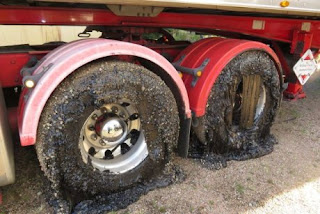
Extreme heat kills
Ronnie Scott lost his wife when she tried to
to rescue their dog and cat from floodwaters in West Virginia in 2016.
Carole Duncan almost lost her 83-year-old father during Australia’s
massive 2019 bushfires, the firefighters finding him just in time.
KerryAnn Laufer returned home days after the 2019 Kincade Fire in
California to find only her fireplace still standing, while Dave Mackey
saw nearly every house in his neighborhood on Grand Bahama island washed
away, pummeled by raging waters and 200-mile-per-hour winds from
Hurricane Dorian.
Storms,
wildfires, and other such disasters are getting more common and intense
as climate change accelerates. Scott, Duncan, Laufer, and Mackey, who
survived these extreme weather events, are among the lucky ones. But
each of them found themselves changed by the experience.
What
would you do if your house burned down or your neighborhood washed away
in a flood? How would you respond if a cataclysmic weather event killed
someone you love or forced you to abandon, perhaps forever, the place
you call home? And how would it change the way you think about the
world?
These questions are at the heart of a new
“Voices from the Future”
Green new deal is cheap actually
interview series a small group of journalist,
researchers, and I have developed at the Julie Ann Wrigley Global
Futures Laboratory at Arizona State University. We have collected the
stories and insights of nearly three dozen survivors on five continents,
eight of which will be published in these pages over the next few
weeks."
Steven Beschloss is a professor of practice at
the Walter Cronkite School of Journalism and Mass Communication and
directs the Narrative Storytelling Initiative at Arizona State
University. He has written for The New Yorker and The Washington Post, among other publications.
#California, #firestorms, #wildfire, Australia, cyclones, floods, Green New Deal, hurricanes,
Scientists have repeatedly warned that the effects of climate change would include more extreme weather.(Supplied: Gena Dray)
Scientists have warned us about the dangers of 2 degrees of warming — at the moment, we're heading for more than that.(ABC News: Jordan Hayne)
'Scientists
have spelt out this out repeatedly for 30 years, and environmental
groups have championed the cause. But both made mistakes.
For
too long, scientists believed that the facts spoke for themselves, that
all they had to do was get them out there. And the NGOs had a tendency
come across as self-righteous, or guilt-trippy.
I was already on board — with me they were preaching to the choir — but I don't think they pulled in enough other people.
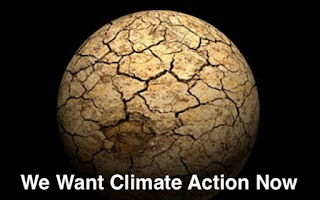
Climate Action Now
But
here we are. After years of drought at home, and increasingly extreme
weather all over the world, polling shows that most of us get it enough
to think climate change is a problem and that we should do something
about it.
And yet we've done very little. I want to know why. That's why I've made this series.
And yes, part of it turns out to be the fossil fuel industry.
Part of it turns out to be that change is hard, and that it's been
easier for politicians to do little, especially when they are themselves
divided.
Not that it can't be done — and there is hope. We'll get to that too. I hope you'lljoin me for Hot Mess."'
By Richard Aedy for Hot Mess
Richard Aedy has been a journalist for more than 30 years. He's been concerned about climate change for most of that time. He's been at Radio National since 1998.
Katta O'Donnell, 23, is suing the Government over the risks
to her investments through climate change.
(Supplied: Molly Townsend)
A
23-year-old Melbourne law student is suing the Australian Government
for failing to disclose the risk climate change poses to Australians'
super and other safe investments.
Key points:
The
world-first case alleges the Government failed in its duty to disclose
climate change's impact on the value of government bonds
The case is being led by a 23-year-old student and investor who says she did it to "protect her future"
Experts say it could open the floodgates for other litigation by tying climate change to real-world financial risk
The
world-first case filed on Wednesday in the Federal Court alleges the
Government, as well as two government officials, failed in a duty to
disclose how climate change would impact the value of government bonds.
Katta
O'Donnell, the head litigant for the class action suit, said she hoped
the case would change the way Australia handled climate change.
"I'm
suing the Government because I'm 23 [and] I think I need to be aware of
the risks to my money and to the whole of society and the Australian
economy," Ms O'Donnell said.
"I think the Government needs to stop keeping us in the dark so we can be aware of the risks that we're all faced with."
Experts say it is the first where a national government has been sued for its lack of transparency on climate risks.
Government
bonds are considered the safest form of investment, with most
Australians invested in them through compulsory superannuation.
Bonds
are similar to shares, but instead of investing in companies, the
investor lends a government money to build infrastructure and fund
critical services such as health, welfare and national security.
Ms O'Donnell, who has invested in bonds independently from her super, said she did it to "protect her future".
However
bonds, like shares, can lose value if they become less attractive to
the market. This can occur if investors question a government's ability
to repay them due to rising government debt, ethical or reputational
reasons.
Ms O'Donnell said watching the impact of bushfires in Australia made her worry about the value of her bonds.
Despite
the Government not disclosing climate-related risks to its investment
products, government regulators are increasingly forcing companies to
disclose how climate change will impact their shareholders.
APRA is working with corporate
regulator ASIC and the Reserve Bank of Australia to ensure public
companies are examining climate risk, disclosing it to investors, and
acting on it.
Ms O'Donnell's lawyer, David Barnden from Equity Generation Lawyers, said the duty to be transparent extended to the Government.
"We allege that the Government is misleading and deceiving investors by not telling them about the risks," Mr Barnden said.
Experts say the drought and the threat of bushfires
in Australia exposes
the Government
to more financial risk compared to other countries.
What was the climate and sea level like at times in
Earth’s history when carbon dioxide in the atmosphere was at 400ppm?
The last time global carbon dioxide levels were consistently at or above 400 parts per million (ppm) was around four million years ago during a geological period known as the Pliocene Era (between 5.3 million and 2.6 million years ago). The world was about 3℃ warmer and sea levels were higher than today.
We
know how much carbon dioxide the atmosphere contained in the past by
studying ice cores from Greenland and Antarctica. As compacted snow
gradually changes to ice, it traps air in bubbles that contain samples of the atmosphere at the time.
We can sample ice cores to reconstruct past concentrations of carbon
dioxide, but this record only takes us back about a million years.
Beyond
a million years, we don't have any direct measurements of the
composition of ancient atmospheres, but we can use several methods to
estimate past levels of carbon dioxide. One method uses the relationship
between plant pores, known as stomata, that regulate gas exchange in
and out of the plant. The density of these stomata is related to atmospheric carbon dioxide, and fossil plants are a good indicator of concentrations in the past.
Another
technique is to examine sediment cores from the ocean floor. The
sediments build up year after year as the bodies and shells of dead
plankton and other organisms rain down on the seafloor. We can use
isotopes (chemically identical atoms that differ only in atomic weight)
of boron taken from the shells of the dead plankton to reconstruct
changes in the acidity of seawater. From this we can work out the level
of carbon dioxide in the ocean. The data from four-million-year-old sediments suggest that carbon dioxide was at 400ppm back then.
Sea Levels and Changes in Antarctica
During colder periods in Earth's history, ice caps and
glaciers grow and sea levels drop. In the recent geological past, during
the most recent ice age about 20,000 years ago, sea levels were at
least 120 meters lower than they are today.
Sea-level changes are calculated from changes in isotopes of oxygen in the shells of marine organisms. For the Pliocene Era, research
shows the sea-level change between cooler and warmer periods was around
30-40 meters and sea level was higher than today. Also during the
Pliocene, we know the West Antarctic Ice Sheet was significantly smaller
and global average temperatures were about 3℃ warmer than today. Summer
temperatures in high northern latitudes were up to 14℃ warmer.
This may seem like a lot but modern observations show strong polar amplification
of warming: a 1℃ increase at the equator may raise temperatures at the
poles by 6-7℃. It is one of the reasons why Arctic sea ice is
disappearing.
Decorated former firefighter and climate action advocate Greg Mullins
says current fire chiefs have been effectively gagged from raising the
bushfire risks created by global warming with politicians.
Mr
Mullins said he had "deep concerns over climate change", which was
fuelling "unprecedented" bushfires in evidence to a Senate inquiry into
the 2019-20 bushfire season on Wednesday.
Asked
by Victorian Liberal senator James Paterson if he thought
Climate change key to cause of wildfires
"the current
serving fire chiefs are gagged in some way", Mr Mullins replied: "yes".
Mr
Mullins, a former Fire and Rescue NSW commissioner, said when he was in
the role "some things were out of bounds and often climate change was
one of those issues, even to the point of having to work around it when
preparing documents, and I think that is a tragedy".
Greens
senator Janet Rice asked Mr Mullins if it was "still the case" that
fire chiefs were discouraged from raising the effect of climate change
on bushfire risks with politicians.
"I know it's the case," Mr Mullins said. "I’ve had a number of discussions and it's clear."
Mr Mullins had a 39-year career in NSW Fire and Rescue, and was appointed commissioner in 2003. He retired in 2017.
Mr
Mullins was representing the Emergency Leaders for Climate Action
group, which comprises 33 former fire and emergency service leaders from
around the country.
Mr Mullins said he was pressured not to speak out on climate change when he was a public servant.
"We
self-censored because we knew what would be acceptable, and what would
not, for certain political masters and if you went outside those bounds
life could be made very unpleasant for you," he said.
Significantly less property may be have been lost to the fires if the government had heeded their warnings,
and moved to secure lease agreements for an expanded fleet of water
bombing aircraft ahead of the most recent fire season, Mr Mullins said.
"These aircraft weren’t available and arrived too late," he said.
'The
history of war tells us that such events are usually launched on
doubtful and fabricated pretexts: The US war in Iraq, the German
invasion in Europe at the start of WWII, all the way back to Julius
Caesar’s invasion of Britain, and just about every war in between.
And
so it is with the extraordinary attack launched on Australia’s future
by its incumbent fossil fuel industry, and the gas lobby in particular.
Its casus belli is the Covid-19 pandemic, and the fossil fuel
industry has been enabled to do this after being invited by the Morrison
regime to do more or less at it pleases and design its own future.
The
reach and sheer audacity of the proposals unveiled over the past week
is extraordinary, and the lasting impact on Australia’s future may dwarf
anything that Tony Abbott and his Far Right cheerleaders may have done;
notwithstanding his white-anting of the Carbon Pollution Reductions
Scheme more than a decade ago, the scrapping of the carbon price in 2014
and the unceasing campaign against science and engineering.
This
is the critical decade. Scientists tell us, repeatedly and with a near
unanimous voice, that serious emissions reductions must be achieved in
the next 10 years if the world is to flatten the emissions curve and
give itself half a chance of capping average global warming at less than
2°C. A target of 1.5°C may already be out of reach.
Australia finds itself at a critical juncture. It benefits from the
stunning cost reductions in solar, wind and battery storage, and key
institutions have mapped out a path to a high renewable energy grid. Experts are shining the light on a future of green manufacturing and “green energy exports” that could enhance the position of the country as a significant energy superpower. But
the fossil fuel industry and its backers, with their focus almost
entirely on short-term profits and ideological claptrap, have other
ideas. They have decided to throw a live grenade into Australia’s own
economic bunker, and its environment, and put the future of the current
and emerging generation at risk.
Consider
the list of what has emerged from the government-appointed gas-industry
led reviews in the past week, including the King Review, the Covid
Commission, the technology investment roadmap, and from the intense
pressure being put on energy regulators.
– Delaying critical energy market rule changes and reforms
that might have encouraged smart new technologies such as battery
storage and demand management, and end the rorting of the current system
by incumbent coal, gas and hydro generators.
– Pushing the case for gas and CCS in a “technology investment roadmap”
that otherwise clearly identifies wind, solar, storage and other
technologies such as EVs, heat pumps, energy efficiency and demand
management as the cheapest and most reliable options.
However,
none of these quite reaches the breadth, depth and cynicism of the
so-called Covid-Commission, which appears entirely possessed with the
narrow interests of the gas industry, from where many of these
commissioners have emerged.
"The
Washington Post’s examination of accelerated warming in the waters off
Tasmania marks this year’s final installment of its global series “2C:
Beyond the Limit,” which identified hot spots around the world. The
investigation has shown that disastrous impacts from climate change
aren’t a problem lurking in the distant future: They are here now.
Nearly a tenth of the planet has already warmed 2 degrees Celsius
since the late 19th century, and the abrupt rise in temperature related
to human activity has transformed parts of the Earth in radical ways.
In the United States, New Jersey is among the fastest-warming states,
and its average winter has grown so warm that lakes no longer freeze as
they once did. Canadian islands are crumbling into the sea because a
blanket of sea ice no longer protects them from crashing waves.
Fisheries from Japan to Angola to Uruguay are collapsing as their waters
warm. Arctic tundra is melting away in Siberia and Alaska, exposing the
remains of woolly mammoths buried for thousands of years and flooding
the gravesites of indigenous people who have lived in an icy world for
centuries.
Australia is a poster child for climate change. Wildfires are currently raging on the outskirtsof itsmost iconic city and drought is choking a significant portion of the country."
"The coal industry in New South Wales and Queensland is using as much water as all of Sydney’s households, according to new research.
A new report by University of Adelaide water resources academic Ian
Overton, commissioned by the Australian Conservation Foundation, used
public data to examine the impact of coal mining and coal-fired power on
water resources.
It finds the amount of water consumed by coal mining and coal-fired power in NSW and Queensland is about 383bn litres a year, roughly equivalent to the household water needs of 5.2 million people."
' “While farmers recover from the last devastating drought and prepare
for the next, each year the coal industry uses as much freshwater as
every household in Queensland or the entire population of Sydney,” she
said.
“When
you add coal-fired electricity’s water consumption and contamination to
its climate pollution, it’s clear Australia should rapidly replace
coal-fired power with clean energy.
“Becoming a modern renewable energy nation will enable us to weather
future shocks and become a safer, more sustainable and resilient
country.” '
The
full economic impact of the Covid-19 is still yet unknown, but it is
clear that world’s governments face a choice in their response: Do they
look to protect industries in terminal decline, or do they look to the
long-term, supporting new green industries to flourish in a
post-Covid-19 future?
A growing number of experts and global
leaders have joined calls for the response to Covid-19 to be a ‘green
response’, including the implementation of a ‘Green New Deal’ for a
sustainable economy popularised by US Democrats.
The Green New
Deal provides a vision for a sustainable future economy, and integrates
proposals for ambitious climate action, investment in clean energy, a
circular economy and includes a boost to direct public sector investment
in sustainable infrastructure, including electric vehicles and public
transport systems.
Unfortunately for Australia it is becoming
increasingly clear that the Morrison government is steadfast in giving
life support to the fossil fuel industry, clearly indication its
preference for short-term opportunities
for fossil fuel interests, and its ministers have been clearly working
reinforce the position of the oil, gas and coal sectors.
Resources minister Keith Pitt has gone in to bat for the gas and coal
sectors, while energy minister Angus Taylor is working to prop up
demand for oil and relaxing already weak regulations on the oil sector,
including fuel standards.
This includes the Morrison government gifting almost $100 million to the United States to purchase oil that will remain stored in the United State’s Strategic Petroleum Reserve.
On
Wednesday, Taylor announced that the government would also be looking
to soften fuel standards to allow the industry to redeploy stockpiled
aviation fuels for use in other parts of the transport sector. Australia
already has weak fuel standards by most international standards, and a
further weakening of the standards will likely lead to worse
environmental and health outcomes.
Pitt made the government’s
priorities even clearer, welcoming the expansion of Australia’s gas
sector with Arrow Energy’s commitment to a new gas project in
Queensland. “Notwithstanding COVID-19, our energy and resources will be
important in getting not just our economy back on its feet, but vital in
assisting our important trading partners to kickstart their economies,”
Pitt said.
“The Australian Government is committed to working
with the oil and gas industry in order to provide support and
flexibility given the changing circumstances at this time.
At the same time, Taylor – who doubles as emissions reduction minister – has praised the electricity and gas sectors for overseeing significant falls in domestic prices. But he studiously
avoided any mention of the ongoing significant cuts in greenhouse gas
emissions in the grid, or the prominent role played in that by
investment in wind and solar.
Despite Covid-19, the threat of climate change has not subsided and
the need to transition the global energy system to one with
significantly less greenhouse gas emissions will remain a pressing
global issue during and after the world has dealt with the pandemic. And
studies show that acting on climate change will deliver substantial
economic benefits for those who embrace it.
The International
Renewable Energy Agency this week published new analysis that shows
ambitious investment in the clean energy sector would provide
substantial benefits to the global community, boosting global economic
output by as much as A$160 trillion by 2050 above a ‘business as usual’ scenario.
This
included the potential to create almost 250,000 new jobs in Oceania’s
renewable energy sector by 2050, with growth more than compensating for
inevitable job losses in the fossil fuel sector. A global poll
conducted by Ipsos in April found that 71 per cent of adults globally
still view climate change as serious a long-term crisis as Covid-19. The
figure was lower in Australia, with 59 per cent agreeing with the
proposition locally.
“Despite the environment taking a back seat
compared with other current issues, it’s still important to people.
There is strong support among the public for a green economic recovery
from the COVID-19 crisis,” Ipsos Australia public affairs director,
Jennifer Brook, said.
While it still sees a majority of
Australians ranking the climate change response as equal importance with
Covid-19, the Morrison government will likely see the weaker response
as an opportunity to put climate action event further on the backburner.
Bruce Robertson from the Institute for Energy Economics and Financial
Analysis told RenewEconomy that moves to prop up ailing parts of the
fossil fuel sector were a mistake.
“While governments say they are
not supposed to be picking winners, they are certainly not supposed to
be picking losers,” Robertson said.
“Globally since the
coronavirus pandemic, there’s been a permanent shift down in demand –
and the world is swimming in gas and oil. How will this investment get
us out of the hole? It is not a governments role to pick winners. It is
definitely not a governments role to pick proven losing industries to
shower tax payer dollars on.”
“The government is making big
decisions about our future right now. We need a new normal, not going
back to the old ways of a reliance on emissions-intensive gas, which is
both a fossil fuel and a loss-making industry. Gas is not the industry
of the future. We have the choice now. We can do things differently
going forward,” Robertson added.
With a long-term view, strategic
investments in the green infrastructure required for the long term
offers the best possible economic response to the Covid-19 crisis.
The
government can do this by heeding the calls of the clean energy sector
to include investment and support for new zero-emissions generation and
energy efficiency in stimulus measures.
Doing so will not only
provide a powerful form of short-term economic stimulus, but will also
leave Australia better placed in the long-term, well after the crisis of
Covid-19 as been resolved.
RenewEconomy and its sister sites One Step Off The Grid and The Driven
will continue to publish throughout the Covid-19 crisis, posting good
news about technology and project development, and holding government,
regulators and business to account. But as the conference market
evaporates, and some advertisers pull in their budgets, readers can help
by making a voluntary donation here
to help ensure we can continue to offer the service free of charge and
to as wide an audience as possible. Thankyou for your support.
Michael
Mazengarb is a journalist with RenewEconomy, based in Sydney. Before
joining RenewEconomy, Michael worked in the renewable energy sector for
more than a decade.
I wonder if my child will ever have the innocence I had two months ago,
of not having to think about whether the air will kill you
Sitting, nauseous with morning sickness, on a park bench in the
bright heat of an unusually hot spring day my partner and I watch
children march past us, striking from school: “What’s the point of an education if we have no future,” their signs say.
My heart relocates itself, sinking down somewhere around my ankles.
They have 10 more years of habitable planet than the baby I am carrying.
In early summer of the same year, after a miscarriage, I find myself
pregnant again in the week that megafires tear through the state.
There
are 70-metre flames producing their own weather systems, driving them
further on across the countryside, through the bushland that relies on
fire to stimulate new life, on to forests that have never before burnt.
..... ‘There is a substantive and compelling body of medical and scientific
evidence supporting the position that this is a health emergency,’ she
said.
‘In Australia, strong voices are calling for the mitigation of climate
impacts on the health of current and future generations, including in
Aboriginal and Torres Strait Islander, rural and remote communities.
‘We acknowledge the serious threats posed to the health of children,
older Australians and those in rural and remote communities. Climate
change disproportionately affects the health of Australians with asthma,
respiratory conditions and heart disease. The research demonstrates
that women are at higher risk of death from climate change, in
particular from climate-change-linked natural disasters.’
Dr Roeske said more deaths from heatwaves can be expected, with young generations likely to have their mental health affected.
Health impacts in Australia are also likely to include more deaths from
the spread of infectious disease such as malaria and dengue, with
diarrheal illnesses also expected to grow.
‘This is a signal to our members and to our patients and communities
that GPs recognise climate change as a health emergency and are ready to
respond to the multiple health challenges ahead,’ Dr Roeske said.
‘We believe the Australian Government should recognise and help address the health impacts of climate change.’
The current drought across much of eastern Australia has
demonstrated the dramatic effects climate variability can have on farm
businesses and households.
The drought has also renewed longstanding discussions around the
emerging effects of climate change on agriculture, and how governments
can best help farmers to manage drought risk.
A new study
released this morning by the Australian Bureau of Agricultural and
Resource Economics and Sciences offers fresh insight on these issues by
quantifying the impacts of recent climate variability on the profits of
Australian broadacre farms.
The findings demonstrate the importance of adaptation, innovation and
adjustment to the agriculture sector, and the need for policy responses
which promote – and don’t unnecessarily inhibit – such progress.
Measuring the effects of climate on farms
Measuring the effects of climate on farms is difficult given the many
other factors that also influence farm performance, including commodity
prices.
Further, the effects of rainfall and temperature on farm production
and profit can be complex and highly location and farm specific. To address this complexity, ABARES has developed a model based on more than 30 years of historical farm and climate data—farmpredict — which can identify effects of climate variability, input and output prices, and other factors on different types of farms.
Cropping farms most exposed
The model finds that cropping farms generally face greater climate
risk than beef farms, but also generate higher average returns. Cropping farm revenue and profits are lower in dry years, with large
reductions in crop yields and only small savings in input costs.
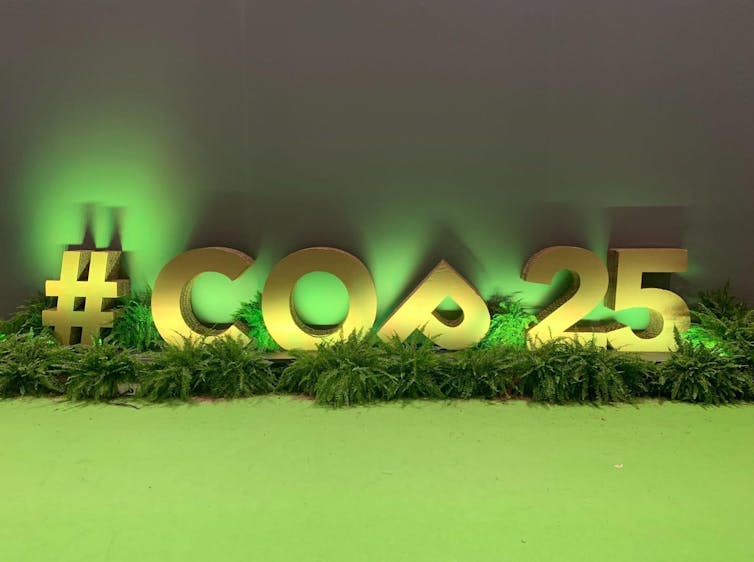
Low ambition from polluting nations derailed the COP25 climate talks.
Supplied by author Kate Dooley, University of Melbourne The United Nations’ COP25 climate talks concluded on Sunday morning in Madrid, almost 40 hours overtime. After two weeks of protracted talks meant to address the planetary warming emergency, world leaders spectacularly failed to reach any real outcomes.
The degree to which wealthy nations, including Australia, blocked progress on critical points of debate incensed both observers and country delegates.
These points included robust rules for the global trading of carbon credits, increased commitments for finance to help developing nations tackle climate change, and most importantly, raising ambition to a level consistent with averting catastrophic climate impacts. Australia’s Emissions Reduction Minister Angus Taylor, far left, with other delegates to the COP 25.JUAN CARLOS HIDALGO
High hopes
COP25 was a conference of “parties”, or nations, signed up to the Paris Agreement, which takes effect in 2021. I attended the conference as an observer.
Emissions reduction targets of nations signed up to Paris put Earth on track for a 3.2℃ temperature increase this century. However the Intergovernmental Panel on Climate Change says warming must be kept below 1.5℃ to avoid the most devastating climate impacts. Much was riding on the outcome in Madrid. However, it failed to deliver.
Read more:
Earth has a couple more chances to avoid catastrophic climate change. This week is one of them One of the key agenda items was Article 6 of the Paris Agreement, involving international carbon trading between nations. The previous COP in Poland failed to reach consensus on these trading rules, and after this latest meeting, many contentious issues remained unresolved. These include:
how to ensure that an overall reduction in global emissions is achieved and that the rules prevent double counting (or emissions reduction units being counted by both the buying and selling nation)
whether a levy would be applied to proceeds from carbon trading to finance adaptation in developing nations
the recognition of human and indigenous peoples’ rights, and social and environmental safeguards, given the harms caused by previous carbon trading mechanisms
critically for Australia, whether countries could use “carryover” carbon credits from the Kyoto Protocol to meet commitments under the Paris Agreement.
An indigenous woman from Amazon reacts during COP25, which largely failed to deliver.JUAN CARLOS HIDALGO/EPA
The question of Kyoto credits
Australia was pushing to allow use of Kyoto Protocol units, for which it drew scathing criticism from other nations, international media and observers. It plans to meet more than half its Paris target via this accounting loophole. Brazil, India, South Korea and China also want to carry over credits earned under the Clean Development Mechanism, a trading scheme under Kyoto.
Read more:
Now Australian cities are choking on smoke, will we finally talk about climate change? No consensus was reached. The negotiations for rules for carbon markets will now continue at COP26 in Glasgow next year, just weeks out from the Paris Agreement’s start date.
The argument will not be easily resolved. Five of the last seven COP meetings failed to reach a decision on carbon market rules, indicating the extent of international divisions, and calling into question the disproportionate focus on carbon trading, given its limited ability to address climate change.
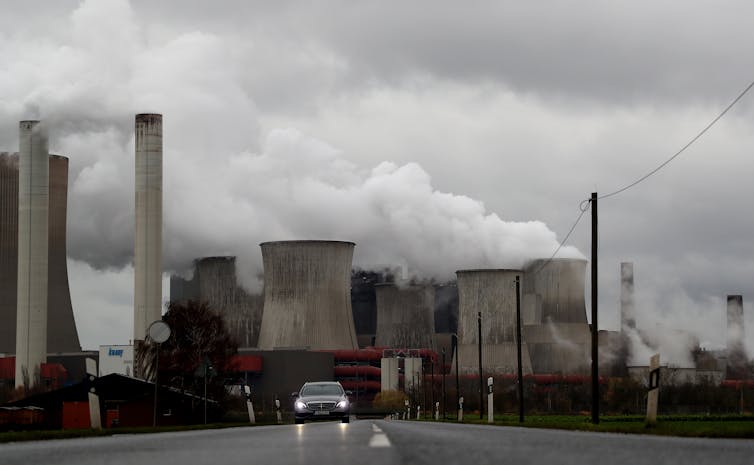
In Madrid, 31 nations signed up to the San Jose principles, seeking to ensure environmental integrity in carbon markets. Upholding these principles would mean emissions must go down, not up as a result of trading carbon. Steam rises a German coal-fired power plant. The COP25 failed to make progress on cutting emissions from coal and other sources.EPA/FRIEDEMANN VOGEL
Other failures
The conference also discussed measures to strengthen the governance and finance arrangements of the Warsaw International Mechanism, a measure designed to compensate poor nations for climate damage.
Little progress was made on mobilising finance from developed nations. The US, which will soon exit the Paris Agreement, played a key role in stymieing progress. It resisted efforts for broad governance arrangements, and pushed for language in the rulebook which would exclude high-emittiong nations from liability for the loss and damage experienced by vulnerable countries under climate change.
Read more:
Global emissions to hit 36.8 billion tonnes, beating last year's record high At Glasgow, all nations under Paris are required to submit new emissions reduction commitments. It was widely expected that the Madrid meeting would strongly urge nations to ensure these targets were more ambitious than the last. Instead, the final text only “reminds” parties to “communicate” their commitments in 2020.
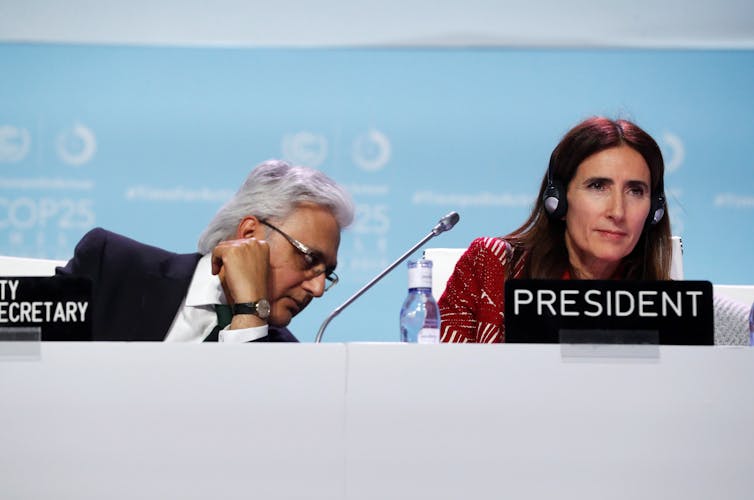
President of COP25, Carolina Schmidt (right), and UN official Ovais Sarmad.EPA/MAST IRHAM
‘Crime against humanity’
When the COP finally closed on Sunday morning, the meeting had failed to reach consensus on increasing emissions reduction ambition to the level required.
The results are disheartening. The world has let another chance slip by to tackle the climate crisis, and time is fast running out. The implications of this were perhaps summed up best by the low-lying Pacific island state of Tuvalu, whose representative Ian Fry said of the outcome:
There are millions of people all around the world who are already suffering from the impacts of climate change. Denying this fact could be interpreted by some to be a crime against humanity.
Australia, US and Brazil threatening
‘spirit’ of the Paris Agreement, says Costa Rican minister, as fractious
talks could drag into the weekend
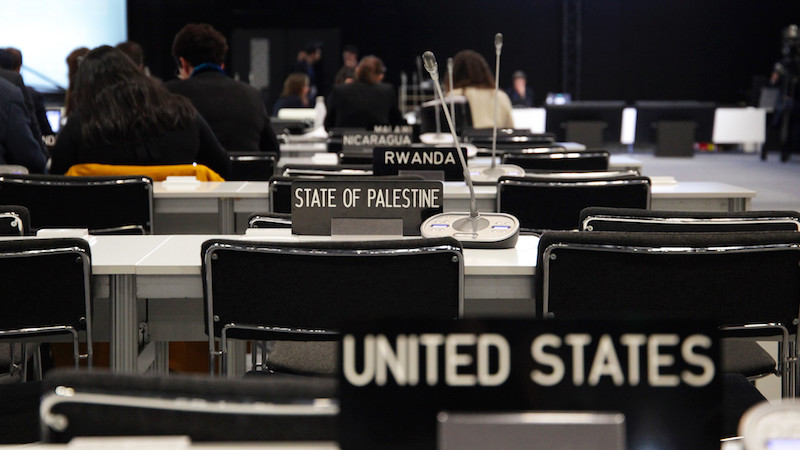
The plenary room at Cop25 in Madrid. Diplomats are locked in tense negotiations to try and find a deal (Photo: UNFCCC)
Negotiations at the UN climate
talks are going into extra time as diplomats are at loggerheads over
commitments to boost ambition and rules to set-up a new global carbon
market.
As the second week of negotiations drew to a close, negotiators were
set to work through the night on Friday to find landing zones and
finalise the last unresolved rules of the Paris Agreement. “We are reaching the final hours of the Cop and now is time to show
the world we are capable of reaching an agreement,” Cop25 president
Carolina Schmidt told negotiators.
“The eyes of the world are on us. Our kids, the women of the world,
indigenous people, our communities, the youth will not understand that
we are not able to get to an agreement that is committed ambition to the
world. It is our responsibility to find that agreement,” she said.
But entrenched positions have run into political deadlock, with little progress on the most contentious issues, including creating a new carbon market, known as Article 6.
continue down this course. On November 11, Lisa Friedman of the New
York Times reported on a draft memo circulating among Environmental
Protection Agency officials that, if enacted, would sharply limit the kinds of scientific studies the agency can use
to consider the impact of air pollution. Yet there’s good reason to
believe the EPA and other global public health agencies should be moving
in the opposite direction and considering a wider range of studies about the harms of air pollution.
That’s because in addition to its impacts to lung and
cardiovascular functioning, it seems increasingly clear that pollution
has a significant effect on cognitive function over both the short and
long term. A spate of studies released in recent years indicate that
people work less efficiently and make more mistakes on higher-pollution
days, and that long-term exposure to air pollution “ages” the brain and
increases the odds of dementia.
These consequences are not nearly as dramatic as dying,
of course. But they are spread across a huge swath of the population.
And since cognitive function is linked to almost everything else in
life, the implications are potentially enormous.
Many current EPA documents don’t mention the impact of air pollution on brain functioning, and landmark Obama-era regulatory efforts like the Clean Power Plan
don’t cite cognitive benefits as part of their cost-benefit analysis.
But a growing body of research indicates that the harms of air pollution
are more wide-ranging and systematic than we’ve realized.
The new research on pollution and cognition ......"

 Storms,
wildfires, and other such disasters are getting more common and intense
as climate change accelerates. Scott, Duncan, Laufer, and Mackey, who
survived these extreme weather events, are among the lucky ones. But
each of them found themselves changed by the experience.
Storms,
wildfires, and other such disasters are getting more common and intense
as climate change accelerates. Scott, Duncan, Laufer, and Mackey, who
survived these extreme weather events, are among the lucky ones. But
each of them found themselves changed by the experience.