Thursday, 6 August 2020

Parents Share Emotional Bushfire Stories from Australian Black Summer 2019-20: Video


Australian Parents for Climate Action

Australian parents share heartbreaking experiences from the 2019-20 Black Summer, and demand government climate action to protect our children. 
 
 Ask your elected reps to support climate-positive COVID-19 recovery projects: www.ap4ca.org/the_covid_recovery 
 
Read our bushfire inquiry submissions: www.ap4ca.org/bushfires
 

Do something about it says Obama.


Five climate change science misconceptions – debunked: The Conversation excerpt

#climateaction, #economy, #fossilfuelcompanies, #jailclimatecriminals, #lawmakers, #renewables, #USA, corrupting donations
#Cambioclimatico
"The science of climate change is more than 150 years old and it is probably the most tested area of modern science


However the energy industry, political lobbyists and others have spent the last 30 years sowing doubt about the science where none really exists. The latest estimate is that the world’s five largest publicly-owned oil and gas companies spend about US$200m each year on lobbying to control, delay or block binding climate-motivated policy.


This organised and orchestrated climate change science denial has
contributed to the lack of progress in reducing global green house gas (GHG) emissions - to the point that we are facing a global climate emergency. And when climate change deniers use certain myths – at best fake news and at worse straight lies – to undermine the science of climate change, ordinary people can find it hard to see through the fog. Here are five commonly used myths and the real science that debunks them. " The Conversation


Read The Conversation article 


Wednesday, 5 August 2020

In Oregon and Five Other States, Youth Are Making Legal Cases for Climate Action: DeSmog excerpt

Youth vs. Gov climate lawsuit rally mural of earth in San Franscisco

American Youth v. Climate Change


"American Youth v. Climate Change


The case is one in dozens filed across America against the federal and state governments on behalf of youth. It is part of a largely pro-bono effort coordinated by Our Children’s Trust, an Oregon-based nonprofit, in partnership with attorneys nationwide and also abroad. The plaintiffs in this case are represented by Crag Law Center.


The legal theory underpinning Chernaik v. Brown and other youth climate litigation derives from the public trust doctrine — the concept that natural resources are held in trust by governments that must protect them. It dates back to Roman times but has been asserted in American courts, mostly in cases to do with navigable waterways, and notoriously when the Supreme Court stopped the state of Illinois from giving the shore of Lake Michigan to a railroad company."


Related:

'How can I prepare my children for climate change?' : Yale Climate Connections

Tuesday, 4 August 2020

Leadership on climate needed: CSIRO report : Canberra Times (excerpt)


In a technical report about the 2019-20 bushfires commissioned by Prime Minister Scott Morrison, the CSIRO warned climate and disaster risks were growing across Australia. 
The report, tendered to the Royal Commission into National Natural Disaster Arrangements on Monday, described many of the risks as systemic which required "coordinated, system-wide responses beyond emergency and disaster management to address".
"There is growing demand - from society and the financial services
and disaster management sectors in particular - for coordinated action across all economic sectors, government portfolios and levels of decision making to mitigate climate and disaster risks, build resilience and adapt to change," CSIRO said.


#jail climate criminals   #cambioclimatico
Erosion caused by sea level rise
"There are opportunities for a more harmonised, coordinated and collective approach which are hampered by under-developed, fragmented or uncoordinated awareness, understanding, and approaches to 'systemic risk' assessment and management in Australia."


However the high levels of "contestation and disinformation" about climate change meant there were "low levels of public understanding" of the causes and effects of climate and disaster risks. 

Read the complete Canberra Times Aug 4 article by Katie Burgess 


See also:

Names and Locations of the Top 100 People Killing the Planet: The Decolonial Atlas


Sunday, 2 August 2020

There is an answer to post Covid-19 economic chaos.

Before the Covid-19 pandemic, climate change was the significant factor looming to ruin unprepared economies. Now that world economies are in deep depression it is 'green new deals' that can provide jobs in the future.


#cambio-climatico  #climatechange   #economies  #greennewdeal
When investors start to take notice of 'climate change'.


"The Climate Council’s report, ‘Compound Costs: How Climate Change is Damaging Australia’s Economy’, finds there are few forces affecting the Australian economy that can match the scale, persistence and systemic risk associated with climate change."

"As the Deputy Governor of the Reserve Bank of Australia noted, the risks that climate change poses to the Australian economy are “ first order” and have knock-on implications for macroeconomic policy (Debelle 2019)."

https://www.climatecouncil.org.au/resources/compound-costs-how-climate-change-damages-australias-economy/


We have a few years to mitigate the worst effects of climate change.
Climate Change is Real but Time is Running Out


"5. The severe costs of climate change outlined in this report are not inevitable. To avoid the costs of climate change increasing exponentially, greenhouse gas emissions must decline to net zero emissions before 2050. Investments in resilience and adaptation will be essential to reduce or prevent losses in the coming decades.


• Increasing resilience to extreme weather and climate change should become a key component of urban planning, infrastructure design and building standards.

• Buildings and infrastructure must be built to withstand future climate hazards and to facilitate the transition to a net zero emissions economy. 

• A credible national climate policy is needed to safeguard our economy by reducing the direct costs of climate change, and avoiding economic risks associated with a sudden, disruptive or disorderly transition to net zero emissions. "      https://www.climatecouncil.org.au/resources/compound-costs-how-climate-change-damages-australias-economy/


"3. The property market is expected to lose $571 billion in value by 2030 due to climate change and extreme weather, and will continue to lose value in the coming decades if emissions remain high.

• One in every 19 property owners face the prospect of insurance premiums that will be effectively unaffordable by 2030 (costing 1% or more of the property value per year). 

• Some Australians will be acutely and catastrophically affected. Low-lying properties near rivers and coastlines are particularly at risk, with flood risks increasing progressively and coastal inundation risks emerging as a major threat around 2050.

• Certain events which are likely to become more common because of climate change are not covered by commercial insurance, including coastal inundation and erosion. 
• More than $226 billion in commercial, industrial, road, rail, and residential assets will be at risk from sea level rise alone by 2100, if greenhouse gas emissions continue at high levels. "   
     https://www.climatecouncil.org.au/resources/compound-costs-how-climate-change-damages-australias-economy


"Extreme events like droughts, heatwaves, cyclones and floods have an impact on agriculture and food production; this is already affecting Australia’s economy and will cost us much more in the future."

https://www.climatecouncil.org.au/resources/compound-costs-how-climate-change-damages-australias-economy



“We will pay for climate breakdown one way or another, so it makes sense to spend the money now to reduce emissions rather than wait until later to pay a lot more for the consequences… It’s a cliché, but it’s true: An ounce of prevention is worth a pound of cure.” 
Nobel Prize-winning economist Joseph Stiglitz, a professor at Columbia University


#jailclimatecriminals  #criminalesclimáticosdelacárcel
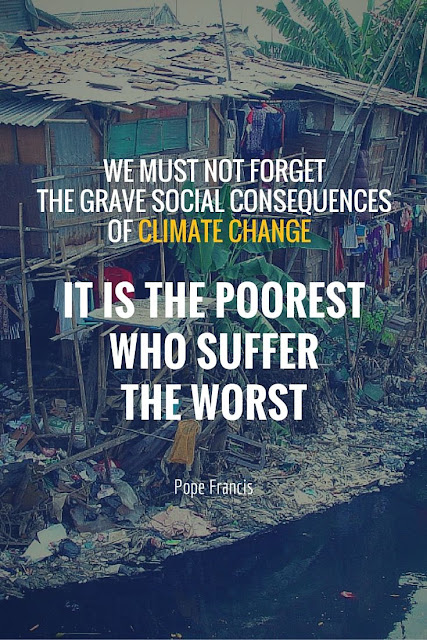
Climate Change will affect the poor the most.


Rewiring America says: "This real–world experience (WW3) illustrates the employment potential of a rapid transition to a clean energy economy. Probably the only viable project of the scale necessary to reignite economic growth and return to full employment is decarbonizing America’s energy system.This is equally true in many other countries in the world.Rewiring America

"Increasing employment under the transition to a zero–carbon is driven by the requirement for more labor in manufacturing, installation, and maintenance of renewables than their counterpart fossil fuel technologies. 

It takes more people to install and keep a wind farm running than it does to drill a well and keep it pumping for the same amount of energy overtime. Renewables get their fuels for free, whereas fossil fuels cost money. It takes more labor and maintenance to access those free renewable fuels. This is a very desirable trade off in an economy with massive unemployment." 
Rewiring America
 

The Guardian


Related: Seizing the moment: how Australia can build a green economy from the Covid-19 wreckage : The Guardian (excerpt)


Related: Is your local government body climate change ready?


#jailclimatecriminals   #gaolclimatecriminals   #climatescience   #economy  

#Australia, #cambio-climatico, #climateaction, #economy, #criminalesclimáticosdelacárcel, #fossilfuelcompanies, #greennewdeal, 


Saturday, 1 August 2020

Seizing the moment: how Australia can build a green economy from the Covid-19 wreckage : The Guardian (excerpt)

Solar farm in Darling Downs, Queensland. The idea of helping jumpstart the economy by also tackling the climate crisis is gaining currency across the political spectrum. Photograph: AAP


"Detailed research by the Grattan Institute suggests an Australian green steel industry could create 25,000 jobs in regional areas that now rely on coalmining, offering a potential path ahead for workers likely to be hardest hit by international steps to cut emissions. 

Among the report’s conclusions: “Australian governments need to be honest with carbon workers: their attempts to protect carbon jobs from global forces will ultimately fail.”
In one of the most challenging areas to address, the faltering aluminium industry, Simon Holmes à Court, a senior adviser to the Climate and Energy College at the University of Melbourne, is looking at how to give four large smelters, which use up to 15% of electricity from the national grid, a viable future in a renewable energy world. He says technology originally developed in Australia could give them the ability to rapidly dial up or down the amount of energy they consume, turning them into a “virtual battery” that helps stabilise the grid and provides an extra income stream to owners.

Garnaut says the economic crash only strengthens the case that he laid out late last year in his book Superpower – that Australia could have an affordable clean electricity system running at more than three times its existing capacity powering a transformed economy, including new minerals industries.

The former government climate adviser, now a professorial fellow at the University of Melbourne, says entrenched low interest rates should increase the pace at which renewable energy replaces coal, as capital costs are down and the fuel used in clean power generation costs nothing. Among Garnaut’s messages is that governments should not fear taking on greater debt to fuel a low-carbon recovery that could include new or expanded clean industries in hydrogen, aluminium, steel, silicon and ammonia.
Wilder says there is cause to be optimistic. “Ironically, this crisis has pushed climate change to the fore in discussions of the economy around the globe,” he says.


There is now significant acceptance that climate change is a threat to the economy. And there is an opportunity to rebuild in a way that makes the economy more resilient, if we choose to take it.' "

Go to The Guardian article 

Related:

Gas lobby seizes Covid moment, and declares war on Australia’s future: RenewEconomy

#cambio-climatico, #Australia, #climatechange, #greennewdeal, #greenrecovery, #jailclimatecriminals, steel industry,