Showing posts with label #climatecrisis. Show all posts

Thursday, 5 November 2020

State Backers of Anti-Protest Bills Received Campaign Funding from Oil and Gas Industry, Report Finds (excerpt): DeSmog

 "Politicians responsible for drafting laws criminalizing pipeline protests in Louisiana, West Virginia, and Minnesota did so after receiving significant funding from the fossil fuel industry, according to a new report by the Institute for Policy Studies, a progressive think tank based in Washington, D.C.

The major pipelines studied in the report disproportionately impact historically disenfranchised communities who, in turn find themselves potentially targeted by the protest criminalization measures, often framed as efforts to protect “critical infrastructure,” the report details.

Under the premise of protecting infrastructure projects,” the Institute wrote, “these laws mandate harsh charges and penalties for exercising constitutional rights to freely assemble and to protest.”

Marathon Petroleum, one of three large fossil fuel companies the report names as driving state-level efforts to criminalize pipeline protests, is also facing new allegations of electoral wrong-doing in the form of a Federal Election Commission complaint alleging that the company made over $1 million in contributions to Republican super PACs that are barred by rules preventing federal contractors from providing that sort of funding."

...................

“Micheal Hennigan and the oil corporations lobbying for these bills are obviously trying to criminalize dissent, not protect public health,” said Jesse Coleman, a senior researcher with Documented, a watchdog group. “Look at what has actually caused pipeline explosions, leaks, and other problems — it's not the oil industry critics.”

“These projects are dangerous by design,” Coleman added, “and trying to shift the focus to boogeymen protesters is a cheap trick to avoid scrutiny.”

Go to original DeSmog article by Sharon Kelly 


Related: Polling Shows Growing Climate Concern Among Americans. But Outsized Influence of Deniers Remains a Roadblock (excerpt): DeSmog


also


Meet the Money Behind The Climate Denial Movement (excerpt): Smithsonian Mag

Saturday, 12 September 2020

The Climate Disasters We Ignore Today Will Eventually Come for Us (excerpt): Gizmodo


Even if the world does act, some climate disasters may be inevitable
Vehicles ply on waterlogged Delhi-Gurgaon Expressway
 near Narsingpur after heavy rains, in Gurugram
..... "In a just world, this would be major news, even in the faraway U.S. Perhaps stories about the local covid-19 crises we’re seeing across the country would get more attention, but surely, the displacement of millions deserves a spot on the front page. And yet.


If you didn’t know these floods were happening, I’m not here to scold you. Tragedies take place around the world every day, from bombings to hunger. Plus, here in the U.S., things are pretty awful for lots of people, too. It’s difficult if not impossible to keep up with every bad thing happening in all places. It’s also, frankly, easier for many of us in the Global North to ignore crises that are happening to poor people far away. When these crises do surface in news reports, many of us are taught to treat them as inevitable — things are simply more difficult for people “over there.”


This can all lead us to feel insulated from these horrors. We need to
Even if the world does act, some climate disasters may be inevitable
Local residents look at a submerged bus in a waterlogged road 
underpass after monsoon rainfalls in New Delhi
 (Photo: Prakash Singh, Getty Images)
fight that impulse. Caring about our fellow human beings is the right thing to do, sure. But even if empathy isn’t your thing, there’s also an uncomfortable reality: Climate disasters will eventually come for us all if we don’t act now. 


The deafening silence about climate change-fuelled weather in the Global South isn’t limited to the recent floods in South Asia. People have died in deluges in India and Bangladesh in previous years, too — hundreds last year, 1,000 in 2018, over 1,200 in 2017. Hurricane Dorian, one of the most intense hurricanes to ever form in the Atlantic Ocean, absolutely ravaged the Bahamas just last year. Yet it has all but faded from popular memory in the U.S. aside from the saga of Sharpiegate. And nearly three years after Hurricane Maria hit Puerto Rico, thousands are still without homes and the power grid recently crashed again in the face of a moderate tropical storm yet these stories of widespread suffering are rarely found on front pages. 


Even if the world does act, some climate disasters may be inevitable
World leaders plan for climate change
All of this devastation was not inevitable. World leaders could have taken steps to move us away from fossil fuels decades ago. They also could have poured far more resources into helping vulnerable people adapt before emergencies strike, and rebuild after they do. But they’ve made clear they won’t do much of that of their own accord — they claim it’s too expensive, too difficult, too impractical. We need a mass movement that shows them we won’t take no for an answer, and part of that is recognising the toll the crisis is already taking and acting with urgency and compassion.
World leaders already have blood on their hands. Every life these actions could have saved is important. Each of the hundreds of Indian and Bangladeshi people killed by the ongoing monsoons in India deserved better. And we all deserve better than to see this continue.


That’s not just because it’s the right thing to do. It’s also our only option. Eventually, ecological horror will come for all of us. It might be in a month, a year, or 20 years, but eventually, a storm, heat wave, or tornado will come banging down your door. The time to change course is now, starting with, at a minimum, acknowledging the impacts the climate crisis on the poorest among us. 


Even if the world does act, some climate disasters may be inevitable
We want climate action now
Even if the world does act, some climate disasters may be inevitable since we’ve already overheated the planet and left people vulnerable. We won’t be able to stop every flood or heat wave from taking place. But what’s not inevitable is our treatment of some people as disposable. If we prioritise taking steps to help people adapt and prepare, countless lives could be saved. Stopping deforestation of catchment areas and restoring wetlands, for instance, could go a long way to better shielding communities in India and Bangladesh from rising waters. So could national policies to provide more resilient housing to all people, and international policies to prioritise aid to the struggling countries that are hit hardest......"

Go to complete Gizmodo story by Dharna Noor, August 21, 2020

Related:  Climate Change Poses Serious Threats to India's Food Security (excerpt): The Wire


Saturday, 5 September 2020

A bit rich: business groups want urgent climate action, after resisting it for 30 years (excerpt): The Conversation

There is no systemic government response (federal, state and local) to build resilience to climate risks.
Renewable Energy
"Australia has seen the latest extraordinary twist in its climate soap opera. An alliance of business and environment groups declared the nation is “woefully unprepared” for climate change and urgent action is needed. 

And yesterday, Australian Industry Group – one of the alliance members – called on the federal government to spend at least A$3.3 billion on renewable energy over the next decade. 


Read more: The too hard basket: a short history of Australia's aborted climate policies


There is no systemic government response (federal, state and local) to build resilience to climate risks.
Bushfire readiness
The alliance, known as the Australian Climate Roundtable, formed   in 2015. It comprises ten business and environmental bodies, including the Business Council of Australia, National Farmers

Federation and the Australian Council of Trade Unions (ACTU).
Last week, the group stated

There is no systemic government response (federal, state and local) to build resilience to climate risks. Action is piecemeal; uncoordinated; does not engage business, private sector investment, unions, workers in affected industries, community sector and communities; and does not match the scale of the threat climate change represents to the Australian economy, environment and society.
There is no systemic government response (federal, state and local) to build resilience to climate risks.
Drought
This is ironic, since many of the statement’s signatories spent decades fiercely resisting moves towards sane climate policy. Let’s look back at a few pivotal moments."

Read the complete The Conversation article 


There is no systemic government response (federal, state and local) to build resilience to climate risks.
Youth want

 Related:  Will predicted sea rise inundation affect property values in Newcastle, NSW?
#climateaction, #climatecrisis, #bushfires, economic impact, government response, #jailclimatecriminals

Wednesday, 19 August 2020

Greenland's melting ice sheet has passed the point of no return, scientists say (excerpt): USA Today

STORY HIGHLIGHTS

• Greenland's ice sheet dumps more than 280 billion metric tons
Even if global warming were to stop today, the ice sheet would continue shrinking.
of melting ice into the ocean each year.

 
•  Even if global warming were to stop today, the ice sheet would continue shrinking.
• Scientists analyzed 40 years of satellite data from more than 200 large glaciers draining into the ocean.

Greenland's melting ice sheet has passed the point of no return. 
In fact, glaciers on the island have shrunk so much that even if global warming were to stop today, the ice sheet would continue shrinking, a new study suggests.

"Glacier retreat has knocked the dynamics of the whole ice sheet into a constant state of loss," study co-author Ian Howat, an earth scientist from Ohio State University, said in a statement. "Even if the climate were to stay the same or even get a little colder, the ice sheet would still be losing mass."

This "tipping point" means the snowfall that replenishes the ice sheet each year cannot keep up with the ice that is flowing into the ocean from melting glaciers.


Saturday, 15 August 2020

Why COVID deniers and climate skeptics paint scientists as alarmist (excerpt): Grist


people trying to obstruct action deny the severity of the predicament
Climate Change Denial Tactics
In an interview with Fox News last month, President Donald Trump called Anthony Fauci, the country’s top infectious disease expert, an “alarmist,” using a pejorative straight from the playbook of those who deny the science behind climate change. Fauci rejected the characterization, describing himself as a “realist.”

For anyone paying attention to arguments about climate change over recent decades, Trump’s comment sounded awfully familiar: Scientists are alarmists, everything’s a hoax, and hysteria abounds.

 Michael Mann, a climatologist at Penn State University, wrote an op-ed for Newsweek this week drawing parallels between his experience and Fauci’s during COVID-19. Science deniers have lobbied attacks on the two public figures, he explained, sending death threats, calling them names, and questioning their expertise.
So what do terms like alarmist and hysteria really mean, where did they come from, and how can people respond to such accusations?"

"The strategies used to dismiss the threats of climate change and coronavirus follow a similar pattern, and they’re employed by many of the same people. It starts with denying the problem exists, as Naomi Oreskes, a professor of history at Harvard who studies disinformation, has explained. Then, people trying to obstruct action deny the severity of the predicament, say it’s too hard or too expensive to fix, and complain that their freedom is under threat. Denying the science requires dismissing what scientists are saying, and the easiest way to do that is by questioning their motives, impartiality, and rationality.

“If we don’t trust scientists or medical experts because we see them as alarmist or hysterical or as contributing overreaction, then we don’t trust the info they’re giving us,” said Emma Frances Bloomfield, an assistant professor of communication at the University of Nevada, Las Vegas."

Read the complete Grist article by Kate Yoder

See also:

'Two global health emergencies': doctors group backs green stimulus: The Age


climate deniers, Trump, COVID-19, #cambio-climatico, #climatecrisis, #climatecriminals, #corporations, #criminales-climáticos-de-la-cárcel, #


Saturday, 8 August 2020

World's three hottest Julys happened in the last five years: Reuters (excerpt)

BRUSSELS (Reuters) -

#heatwaves,  #jailclimatecriminals
We want climate action now
 "Last month was the world’s third-hottest July on record, new data show — the latest milestone in a global warming trend that has seen the three hottest Julys within the last five years.


With the heat has come a high level of ice melt in the Arctic, where the extent of sea ice last month hit the lowest level for July since the polar satellite record-keeping began four decades ago, according to the European Union’s Copernicus Climate Change Service. 

“It’s on a global scale, and all months are warming.”
California burnt
The new findings come as France and Belgium brace for a possible weekend heat wave, while Italian roads near an Alpine glacier were closed amid warnings that high temperatures could cause ice to collapse. 


“It’s not just a summer thing,” said Copernicus senior scientist Freja Vamborg. “It’s on a global scale, and all months are warming.” 


The heat has also been linked with wildfires that have been scorching patches of Siberian forestAtmospheric temperature records dating back to the mid-19th century reveal the last five years to be the hottest yet. In terms of records for the month of July, only 2019 and 2016 were warmer than last month. "

Go to complete Reuters article 

See also:

This Is Inequity at the Boiling Point: The Conversation (excerpt)


HERE IS THE SAME ARTICLE IN MANDARIN.


世界上三个最炎热的七月发生在过去五年中:路透社(节选)
布鲁塞尔(路透社)-

#热浪,监狱气候犯罪分子
我们现在要采取气候行动
 “新数据显示,上个月是有记录以来世界上第三最热的七月。这是全球变暖趋势的最新里程碑,
过去五年来,这是最热的三个七月。


伴随着热量的到来,北极地区的冰层融化程度很高,据欧盟哥白尼气候变化服务局称,
上个月海冰的程度达到了自四十多年前极地卫星保持记录以来的七月份的最低水平。 。

“它在全球范围内,而且所有月份都在变暖。”
加州烧毁
新发现是在法国和比利时为周末可能出现的热浪做好准备的同时,
意大利阿尔卑斯山冰川附近的道路因警告高温可能导致冰塌而关闭。


哥白尼资深科学家Freja Vamborg说:“这不仅仅是夏天。” 
“它在全球范围内,而且所有月份都在变暖。”


高温还与野火联系在一起,野火一直在烧焦西伯利亚森林
始于19世纪中叶的大气温度记录显示,过去五年是最热的。
就7月份的记录而言,只有2019年和2016年比上个月温暖。 ”

去完成路透社的文章
 
Shìjiè shàng sān gè zuì yánrè de qī yuè fāshēng 
zài guòqù wǔ nián zhōng: Lùtòu shè (jiéxuǎn)
bùlǔsài'ěr (lùtòu shè)-

#rèlàng, jiānyù qìhòu fànzuì fēnzǐ
wǒmen xiànzài yào cǎiqǔ qìhòu xíngdòng
 “xīn shùjù xiǎnshì, shàng gè yuè shì yǒu jìlù 
yǐlái shìjiè shàng dì sān zuì rè de qī yuè. 
Zhè shì quánqiú biàn nuǎn qūshì de zuìxīn lǐchéngbēi, 
guòqù wǔ niánlái, zhè shì zuì rè de sān gè qī yuè.


Bàn suí zháo rèliàng de dàolái, 
běijídìqū de bīng céng rónghuà chéngdù hěn gāo, 
jù ōuméng gē bái ní qìhòu biànhuà fúwù jú chēng, 
shàng gè yuè hǎi bīng de chéngdù dádàole zì sìshí duō nián qián jí dì wèixīng 
bǎochí jìlù yǐlái de qī yuèfèn de zuìdī shuǐpíng. .

“Tā zài quánqiú fànwéi nèi, érqiě suǒyǒu yuèfèn dōu zài biàn nuǎn.”
Jiāzhōu shāohuǐ
xīn fāxiàn shì zài fàguó hé bǐlìshí wèi zhōumò kěnéng 
chūxiàn de rèlàng zuò hǎo zhǔnbèi de tóngshí, 
yìdàlì ā'ěrbēisī shān bīngchuān fùjìn de dàolù yīn jǐnggào gāowēn kěnéng dǎozhì 
bīng tā ér guānbì.


Gē bái ní zīshēn kēxuéjiā Freja Vamborg shuō:“Zhè bùjǐn jǐn shì xiàtiān.” 
“Tā zài quánqiú fànwéi nèi, érqiě suǒyǒu yuèfèn dōu zài biàn nuǎn.”


Gāowēn hái yǔ yěhuǒ liánxì zài yīqǐ, yěhuǒ yīzhí zài shāo jiāo xībólìyǎ sēnlín
shǐ yú 19 shìjì zhōngyè de dàqì wēndù jìlù xiǎnshì, guòqù wǔ nián shì zuì rè de. 
Jiù 7 yuèfèn de jìlù ér yán, zhǐyǒu 2019 nián hé 2016 nián bǐ shàng gè yuè wēnnuǎn. ”

Qù wánchéng lùtòu shè de wénzhāng

#heatwaves, #climatechange, #climatecrisis, #drought, #extremeheat, #wildfire, 
#人类灭绝

Friday, 7 August 2020

This Is Inequity at the Boiling Point: The Conversation (excerpt)


https://www.nytimes.com/interactive/2020/08/06/climate/climate-change-inequality-heat.html?campaign_id=3&emc=edit_MBAU_p_20200806&instance_id=21045&nl=morning-briefing&regi_id=94643053&section=backStory&segment_id=35452&te=1&user_id=8e8e563fc4e5a5c16b6b437d6b7137af
Heatwaves

"This Is Inequity at the Boiling Point


It was a record 125 degrees Fahrenheit in Baghdad in July, and 100 degrees above the Arctic Circle this June. Australia shattered its summer heat records as wildfires, fueled by prolonged drought, turned the sky fever red. 


For 150 years of industrialization, the combustion of coal, oil and gas has steadily released heat-trapping gases into the atmosphere, driving up average global temperatures and setting heat records. Nearly everywhere around the world, heat waves are more frequent and longer lasting than they were 70 years ago. 

But a hotter planet does not hurt equally. If you’re poor and
https://www.nytimes.com/interactive/2020/08/06/climate/climate-change-inequality-heat.html?campaign_id=3&emc=edit_MBAU_p_20200806&instance_id=21045&nl=morning-briefing&regi_id=94643053&section=backStory&segment_id=35452&te=1&user_id=8e8e563fc4e5a5c16b6b437d6b7137af
Heatwaves
marginalized, you’re likely to be much more vulnerable to extreme heat. You might be unable to afford an air-conditioner, and you might not even have electricity when you need it. You may have no choice but to work outdoors under a sun so blistering that first your knees feel weak and then delirium sets in. Or the heat might bring a drought so punishing that, no matter how hard you work under the sun, your corn withers and your children turn to you in hunger.
It’s not like you can just pack up and leave. So you plant your corn higher up the mountain. You bathe several times a day if you can afford the water. You powder your baby to prevent heat rash. You sleep outdoors when the power goes out, slapping mosquitoes. You sit in front of a fan by yourself, cursed by the twin dangers of isolation and heat. 

Extreme heat is not a future risk. It’s now. It endangers human health, food production and the fate of entire economies. And it’s worst for those at the bottom of the economic ladder in their societies. See what it’s like to live with one of the most dangerous and stealthiest hazards of the modern era. 

Photographs by Myrto Papadopoulos in Athens, Ilana Panich-Linsman in Houston, KC Nwakalor in the Niger Delta, Nigeria, Daniele Volpe in Jocotán, Guatemala, Saumya Khandelwal in Lucknow, India, and Juan Arredondo in New York City."


‘Nature doesn’t trust us any more’: Arctic heatwave stokes permafrost thaw: Climate Home News


Wednesday, 5 August 2020

In Oregon and Five Other States, Youth Are Making Legal Cases for Climate Action: DeSmog excerpt

Youth vs. Gov climate lawsuit rally mural of earth in San Franscisco

American Youth v. Climate Change


"American Youth v. Climate Change


The case is one in dozens filed across America against the federal and state governments on behalf of youth. It is part of a largely pro-bono effort coordinated by Our Children’s Trust, an Oregon-based nonprofit, in partnership with attorneys nationwide and also abroad. The plaintiffs in this case are represented by Crag Law Center.


The legal theory underpinning Chernaik v. Brown and other youth climate litigation derives from the public trust doctrine — the concept that natural resources are held in trust by governments that must protect them. It dates back to Roman times but has been asserted in American courts, mostly in cases to do with navigable waterways, and notoriously when the Supreme Court stopped the state of Illinois from giving the shore of Lake Michigan to a railroad company."


Related:

'How can I prepare my children for climate change?' : Yale Climate Connections

Saturday, 25 July 2020

9 Ways to assist Australia's farmers with climate change

"Global warming affects agriculture in a number of ways, including through changes in average temperatures, rainfall, and climate extremes (e.g., heat waves); changes in pests and diseases; changes in atmospheric carbon dioxide and ground-level ozone concentrations; changes in the nutritional quality of some foods; and ..."

Climate change and agriculture - Wikipedia


.....................................


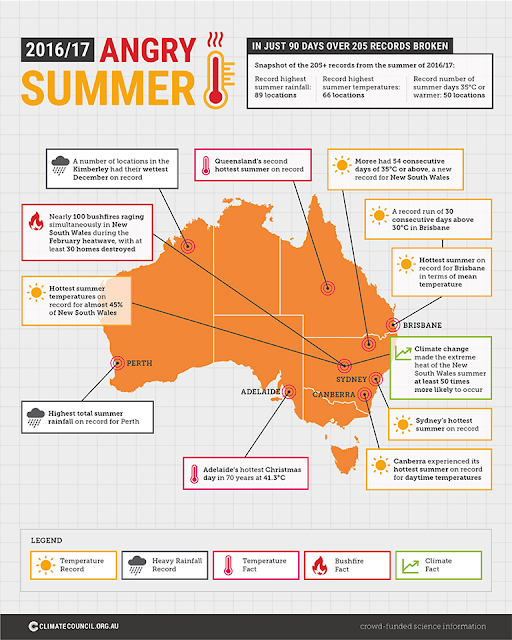
Climaste Council meme
Angry Summer by The Climate Council


It is obvious that many farmers are going to be displaced because of climate change. As their usual crops become unviable and broad scale farming becomes uneconomical because of costs, it is impossible to continue to subsidise farmers that continue to farm or to graze unsuitable animals in an unsustainable fashion. Yet farmers need government support and Australia requires food production.


#jailclimatecriminals, #farmingpractices, #climatecrisis
Australia must learn to manage with less surface water. Artesian water resources must be husbanded.

Suggested Actions

1. “What we still don’t have in the year 2019 is a national (Australian) strategy on climate change in agriculture. There’s still no actual framework to help farmers manage these risks and implement solutions,” she said. Verity Morgan-Schmidt, the chief executive of Farmers for Climate Action

2. Revitalise, with extra funding, our agricultural support services that have provided excellent research and development in the past, new crops and animal husbandry practices can be developed.

3. Provide education for farmers that demonstrate alternative farming practices, for example move from cattle to goats.

4. Only subsidise farmers that change their practice to accommodate a changing climate and protect our soils but retrain farmers unable to accommodate change.

5. Encourage small farming practices such as permaculture, greenhouse production, urban farms.

Note: Intensive farming practices have been shown to be as productive as industrial broad scale farming.

6.  Stop selling water off or subsidising in any way corporations that persist in growing water hungry crops such as cotton and almonds in water scarce areas.

7.  Protect our surface and artesian water from destructive and unsustainable industries.

8.  Support farmers to plan moves from floodplains or cope with more flooding. 


#jailclimatecriminals, #cambioclimatico
Droughts will occur more often. Soils will erode. Desertification will occur.


9.  Encourage farmers to 'get a yield' with new products.

" 'Agritourism, insect farming off waste resources, bush tucker foods — there are options out there, but it's not traditional agriculture in that sense.'

" 'We need support structures, new ideas, people helping us transition to these other production industries. ' "

She (Anika) believes the first step needs to come from the energy sector to buy more time for other industries to develop response strategies.

'The easiest way to put the brakes on what we are experiencing is to transition away from dirty fossil fuel energy to clean, renewable energy; that then takes the pressure off other industries.' "


An article by Preparations for Climate Change

See also:  Preparing for a Climate Change Health Crisis

Wednesday, 22 July 2020

Prepare for even far more economic chaos than the depression caused by Covid-19

Graeme Mackay

"The Climate Council’s report, ‘Compound Costs: How Climate Change is Damaging Australia’s Economy’, finds there are few forces affecting the Australian economy that can match the scale, persistence and systemic risk associated with climate change."

Prepare for even far more economic chaos than the depression caused by Covid-19.

 
"As the Deputy Governor of the Reserve Bank of Australia noted, the risks that climate change poses to the Australian economy are “ first order” and have knock-on implications for macroeconomic policy (Debelle 2019)."

https://www.climatecouncil.org.au/resources/compound-costs-how-climate-change-damages-australias-economy/


"5. The severe costs of climate change outlined in this report are not inevitable. To avoid the costs of climate change increasing exponentially, greenhouse gas emissions must decline to net zero emissions before 2050. Investments in resilience and adaptation will be essential to reduce or prevent losses in the coming decades.


  • Increasing resilience to extreme weather and climate change should become a key component of urban planning, infrastructure design and building standards.
  • Buildings and infrastructure must be built to withstand future climate hazards and to facilitate the transition to a net zero emissions economy.
  • A credible national climate policy is needed to safeguard our economy by reducing the direct costs of climate change, and avoiding economic risks associated with a sudden, disruptive or disorderly transition to net zero emissions. "      https://www.climatecouncil.org.au/resources/compound-costs-how-climate-change-damages-australias-economy/


"3. The property market is expected to lose $571 billion in value by 2030 due to climate change and extreme weather, and will continue to lose value in the coming decades if emissions remain high.

  • One in every 19 property owners face the prospect of insurance premiums that will be effectively unaffordable by 2030 (costing 1% or more of the property value per year).
  • Some Australians will be acutely and catastrophically affected. Low-lying properties near rivers and coastlines are particularly at risk, with flood risks increasing progressively and coastal inundation risks emerging as a major threat around 2050.
  • Certain events which are likely to become more common because of climate change are not covered by commercial insurance, including coastal inundation and erosion.
  • More than $226 billion in commercial, industrial, road, rail, and residential assets will be at risk from sea level rise alone by 2100, if greenhouse gas emissions continue at high levels. "        https://www.climatecouncil.org.au/resources/compound-costs-how-climate-change-damages-australias-economy

"Extreme events like droughts, heatwaves, cyclones and floods have an impact on agriculture and food production; this is already affecting Australia’s economy and will cost us much more in the future."

https://www.climatecouncil.org.au/resources/compound-costs-how-climate-change-damages-australias-economy


“We will pay for climate breakdown one way or another, so it makes sense to spend the money now to reduce emissions rather than wait until later to pay a lot more for the consequences… It’s a cliché, but it’s true: An ounce of prevention is worth a pound of cure.” 
Nobel Prize-winning economist Joseph Stiglitz, a professor at Columbia University


Related:    Prepare for more severe storms

Monday, 20 July 2020

David Attenborough, the voice of Our Planet: “Things are going to get worse”: Vox

"The voice of some of the most stunning nature documentaries ever made is pessimistic about the future of wildlife on earth.


#cambioclimatico, #jailclimatecriminals


“Unless we act within the next 10 years, we are in real trouble,” Attenborough told Vox.
Shannon Finney/Getty Images


David Attenborough is the most famous nature storyteller on television. The 92-year-old producer, narrator, and documentarian essentially invented the genre of television nature documentaries in his decades-long career at the BBC. Programs like Life on Earth, Blue Planet, and Planet Earth have brought the wild world into the homes of urban dwellers for decades."


"Attenborough has also recently lent his voice to a BBC documentary called Climate Change: The Facts, which explains the science and grim statistics fueling the climate change threat.

“I find it hard to exaggerate the peril,” Attenborough said at the IMF earlier in April, according to the Guardian. “This is the new extinction and we are half way through it. We are in terrible, terrible trouble and the longer we wait to do something about it the worse it is going to get.” "


Sunday, 19 July 2020

HYDROGEN The once and future fuel? Opinion


"London, 19 June: Desperate policy makers trying to reach Net Zero targets that are unaffordable and infeasible are rushing into the premature adoption of hydrogen as a last ditch attempt to save the current agenda.

Hydrogen gas may contribute to greenhouse gases
Hydrogen Gas


Dr John Constable, author of the study, said: 

“Hydrogen has genuine long term potential as a universal energy carrier to supplement electricity, but current methods of production are hugely expensive and will stress fresh water supplies. Target-driven haste is already resulting in accidents. Counterproductive and naive policies are compromising the hydrogen future.” "

"Faced with the task of eliminating carbon dioxide emissions while sustaining economic growth, the UK government, like others around the world, is promoting hydrogen as an energy carrier for sectors of the economy such as heavy transport and peak winter heating that are extremely difficult to decarbonize.

The wisdom of this policy, with a special focus on the United Kingdom, is addressed in a new historical and technical study published today by the GWPF.

The study concludes that current enthusiasm is a desperate measure that will jeopardise the long-term promise of hydrogen for the sake of short-term political optics.

Because of the accelerated timetable required by arbitrary targets, it is necessary to manufacture hydrogen via two expensive and energetically inefficient commodity production processes, the electrolysis of water, and the reforming of natural gas.

Electrolysis is extremely expensive, and the reforming of methane emits carbon dioxide and so requires Carbon Capture and Sequestration, which is not only costly but unproven at the required scale. Both these commodity processes imply high levels of fresh water consumption.

The prudent approach, obvious since the 1970s and still the official long-range policy of the government of Japan, is to aim for hydrogen production by the thermal decomposition of sea water employing advanced nuclear reactors, which alone might conceivably make hydrogen cheap. This is, however, very difficult chemical and nuclear engineering, and its realisation lies well into the future."


Hydrogen Gas
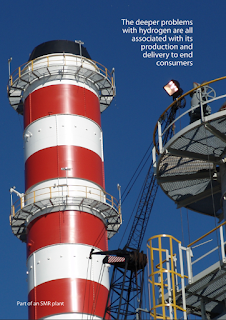
Part of an SMR plant
The paper also notes that hasty introduction will not give enough time for safe societal adjustment to the inherent dangers of a fugitive and readily ignited gas that has a strong tendency to technical detonation (combustion with a supersonic combustion frontier). The learning experience could be needlessly painful and deadly.


Ref Climate Change Institute comment on Hydrogen: The Once And Future Fuel (pdf)


Related:

'Terrifying': Scientists dig deep for missing piece of climate puzzle: SMH

 #cambio-climatico


Wednesday, 15 July 2020

Climate Explained: What the World Was Like the Last Time Carbon Dioxide Levels Were at 400ppm: EW

a hotter planet
climate change
What was the climate and sea level like at times in Earth’s history when carbon dioxide in the atmosphere was at 400ppm? 


The last time global carbon dioxide levels were consistently at or above 400 parts per million (ppm) was around four million years ago during a geological period known as the Pliocene Era (between 5.3 million and 2.6 million years ago). The world was about 3℃ warmer and sea levels were higher than today.


We know how much carbon dioxide the atmosphere contained in the past by studying ice cores from Greenland and Antarctica. As compacted snow gradually changes to ice, it traps air in bubbles that contain samples of the atmosphere at the time. We can sample ice cores to reconstruct past concentrations of carbon dioxide, but this record only takes us back about a million years.


Beyond a million years, we don't have any direct measurements of the composition of ancient atmospheres, but we can use several methods to estimate past levels of carbon dioxide. One method uses the relationship between plant pores, known as stomata, that regulate gas exchange in and out of the plant. The density of these stomata is related to atmospheric carbon dioxide, and fossil plants are a good indicator of concentrations in the past.


Another technique is to examine sediment cores from the ocean floor. The sediments build up year after year as the bodies and shells of dead plankton and other organisms rain down on the seafloor. We can use isotopes (chemically identical atoms that differ only in atomic weight) of boron taken from the shells of the dead plankton to reconstruct changes in the acidity of seawater. From this we can work out the level of carbon dioxide in the ocean.
The data from four-million-year-old sediments suggest that carbon dioxide was at 400ppm back then.

Sea Levels and Changes in Antarctica 


During colder periods in Earth's history, ice caps and glaciers grow and sea levels drop. In the recent geological past, during the most recent ice age about 20,000 years ago, sea levels were at least 120 meters lower than they are today.


Sea-level changes are calculated from changes in isotopes of oxygen in the shells of marine organisms. For the Pliocene Era, research shows the sea-level change between cooler and warmer periods was around 30-40 meters and sea level was higher than today. Also during the Pliocene, we know the West Antarctic Ice Sheet was significantly smaller and global average temperatures were about 3℃ warmer than today. Summer temperatures in high northern latitudes were up to 14℃ warmer.


This may seem like a lot but modern observations show strong polar amplification of warming: a 1℃ increase at the equator may raise temperatures at the poles by 6-7℃. It is one of the reasons why Arctic sea ice is disappearing.

Impacts in New Zealand and Australia  


Read the complete EW article