Exactly
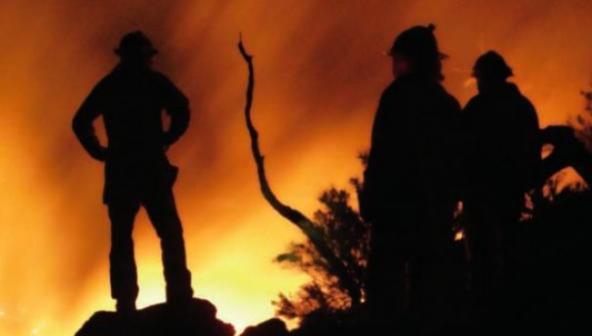
12 months ago today, the huge Gospers Mountain Fire started from a
lightning strike north-west of Sydney. The fire burned for almost 80
days, and became the biggest forest fire in Australia's recorded
history.
One
year on, the fire has left a heart-wrenching scar on both the landscape
and the communities it tore through. This is what climate change looks
like.
In
just a few days, the Royal Commission will hand down its findings into
the 2019-20 bushfire season, and it's imperative that it clearly
acknowledges the role of climate change in fuelling the 2019-20
bushfires.
Jake Sullivan says the former vice-president, if elected, won’t ‘pull any punches’ on what is a global problem Joe Biden
will not pull any punches with allies including Australia in seeking to
build international momentum for stronger action on the climate crisis,
an adviser to the US presidential candidate has said.
"If elected in November, Biden will hold heavy emitters such as
Biden and Harris
China
accountable for doing more “but he’s also going to push our friends to
do more as well”, according to Jake Sullivan, who was the national
security adviser to Biden when he was vice-president and is now in the
candidate’s inner circle.
In a wide-ranging podcast interview
with the Sydney-based Lowy Institute, Sullivan also signalled that
Biden would work closely with Australia and other regional allies in
responding to the challenges posed by the rise of China.
While Australia’s prime minister, Scott Morrison,
is likely to welcome the pledge of US coordination with allies on
regional security issues, there may be unease in government ranks about
the potential for tough conversations about Australia’s climate
policies.
The Coalition government has resisted calls to embrace a target of net-zero emissions by 2050 and it proposes to use Kyoto carryover credits to meet Australia’s 2030 emission reductions pledge. Some Coalition backbenchers still openly dispute climate science......"
"Ice is melting at a surprisingly fast rate underneath Shirase
Glacier Tongue in East Antarctica due to the continuing influx of warm
seawater into the Lützow-Holm Bay.
Hokkaido University
scientists have identified an atypical hotspot of sub-glacier melting
in East Antarctica. Their findings, published in the journal Nature Communications,
could further understandings and predictions of sea level rise caused
by mass loss of ice sheets from the southernmost continent.
The 58th Japanese Antarctic Research Expedition had a very rare
opportunity to conduct ship-based observations near the tip of East
Antarctic Shirase Glacier when large areas of heavy sea ice broke up,
giving them access to the frozen Lützow-Holm Bay into which the glacier
protrudes.
“Our data suggests that the ice directly beneath the Shirase Glacier
Tongue is melting at a rate of 7–16 meters per year,” says Assistant
Professor Daisuke Hirano of Hokkaido University’s Institute of Low
Temperature Science. “This is equal to or perhaps even surpasses the
melting rate underneath the Totten Ice Shelf, which was thought to be
experiencing the highest melting rate in East Antarctica, at a rate of
10–11 meters per year.”'
"The Antarctic ice sheet, most of which is in East Antarctica, is
Earth’s largest freshwater reservoir. If it all melts, it could lead to a
60-meter rise in global sea levels. Current predictions estimate global
sea levels will rise one meter by 2100 and more than 15 meters by 2500.
Thus, it is very important for scientists to have a clear understanding
of how Antarctic continental ice is melting, and to more accurately
predict sea level fluctuations.
"Rising consumption by the affluent has a far greater environmental impact than the birth rate in poorer nations
When a major study
was published last month, showing that the global population is likely
to peak then crash much sooner than most scientists had assumed, I
naively imagined that people in rich nations would at last stop blaming
all the world’s environmental problems on population growth. I was
wrong. If anything, it appears to have got worse. Next week the BirthStrike movement
– founded by women who, by announcing their decision not to have
children, seek to focus our minds on the horror of environmental
collapse – will dissolve itself,
because its cause has been hijacked so virulently and persistently by
population obsessives. The founders explain that they had
“underestimated the power of ‘overpopulation’ as a growing form of
climate breakdown denial”.
It
is true that, in some parts of the world, population growth is a major
driver of particular kinds of ecological damage, such as the expansion
of small-scale agriculture into rainforests, the bushmeat trade and
local pressure on water and land for housing. But its global impact is
much smaller than many people claim.
The formula for calculating people’s environmental footprint is
simple, but widely misunderstood: Impact = Population x Affluence x
Technology (I = PAT). The global rate of consumption growth, before the
pandemic, was 3% a year. Population growth is 1%. Some people assume
this means that the rise in population bears one-third of the
responsibility for increased consumption. But population growth is
overwhelmingly concentrated among the world’s poorest people, who have scarcely any A or T
to multiply their P. The extra resource use and greenhouse gas
emissions caused by a rising human population are a tiny fraction of the
impact of consumption growth."
The last generation who can do something about climate change.
An extraordinary statement by 10 groups says the nation’s future prosperity is at risk without a coherent response
Business,
industry, farming and environmental leaders have joined forces to warn
Australia is “woefully unprepared” for the impact of climate change over
the coming decades and to urge the Morrison government to do far more
to cut emissions and improve the country’s resilience.
Food systems must adapt
An extraordinary statement
by 10 organisations, several with close ties to the Coalition, said
climate change was already having a “real and significant” impact on the
economy and community. The groups, representing the breadth of
Australian society, called on the federal and state governments to act
immediately to reduce and manage the risks.
Organisations including the Business Council of Australia, the
Australian Industry Group, the National Farmers’ Federation, the
Australian Aluminium Council and the ACTU said public debate about the
cost of doing more to reduce emissions had too often not considered the
cost of climate change to the economy, environment and society.
The statement, issued under the Australian Climate Roundtable banner, said Australia’s future prosperity would be at risk unless it had a coherent national response to the crisis. “The scale of costs and breadth of the impact of climate change for
people in Australia is deeply concerning and will escalate over time,”
it said. “It is in Australia’s national interest that we do all we can
to contribute to successful global action to minimise further
temperature rises and take action to manage the changes we can’t avoid.”
The statement said the expert advice made clear temperatures were
increasing, extreme climate-related events such as heatwaves and
bushfires were becoming more intense and frequent, and natural systems
were suffering irreversible damage. Some communities were now in a
constant state of recovery from successive natural disasters with
growing economic ramifications.
Agriculture must adapt
It said inaction would lead to unprecedented economic damage to
Australia and its regional trading partners, heightened risks to
financial stability – particularly as the insurance industry became
compromised – and significant threats to the agriculture, forestry,
tourism and fishing industries. There
would be severe pressure on government budgets due to a dramatic fall
in tax revenue and a rise in natural disasters that demanded emergency
response and recovery spending and there would be major and long-lived
social and health impacts, including loss of life.
The roundtable concluded Australia must play its fair part in
international efforts to limit average global heating to 1.5C above
pre-industrial levels, or at most to well below a 2C increase.
That meant setting a target of net-zero emissions by mid-century and
introducing policies to meet it that aimed to lift social equity and the
country’s global competitive advantage in a zero-emissions world.
The Morrison government has rejected calls that it back the
goal of net-zero emissions by 2050. The target has been adopted by more
than 70 countries, all Australian states and a growing number of
business and investors, including fossil fuel companies. National
emissions have dipped 1.5% since the Coalition was elected in 2013 after falling about 14% in six years under Labor.
Our cities will inundate from sea rise.
The roundtable said even with ambitious global action Australia faced
escalating costs due to unavoidable climate change from historical
emissions, and must act swiftly to improve resilience. It said the
country was “woefully unprepared” for the scale of threats that would
emerge as it lacked a systemic government response at any level.
"Some Ages Have World Wars. Others Have Moonshots. Our Great Challenge is Preventing the Collapse of Civilization.
Let me explain what I mean by “accelerating pulsation of disaster.” Take the example of California’s wildfires. They’re the direct result
of climate change. Hotter temperatures, hotter oceans, bigger storms,
more lightning, drier vegetation — bang! A near certainty of historic
fires igniting."
Wildfire emergency
"So California’s burning…again. Just
like it was last year, and the year before that, and so on. In a few
months, it’ll be Australia’s turn to be hit by megafires, all over
again. They’ll be worse than last year, at least if we average it all
over a decade or so. That’s because, of course, fire is seasonal. And as
we head into the age of catastrophe, “megafire season” will become a
part of our lives. The world will develop Fire Belts, of which
California and Australia are becoming a part."
"Then there are Flood Belts. While the pandemic raged, much of Asia flooded. The West didn’t take much notice — even though China’s largest dam is now at it’s limits.
And yet the megafloods Asia just experienced are just like megafires —
natural phenomena that are getting worse on a seasonal, yearly cycle.
Within a decade or two, these floods will also threaten habitability.
Expect much greater sea level rise as land-ice melts
...................................
"Are
you beginning to get what I mean by “accelerating pulsation of
disaster” yet? As we head into the age of catastrophe, a new range of
calamities will become our dismal new normal. They’ll recur, in cycles.
Only each time the cycle spins, they’ll get worse and worse. Megafires,
megafloods, pandemics, extinctions."
Sea Rise will flood cities
................................................
The accelerating pulsation of disaster. Life
is going to feel scary, strange, dislocating, anxiety-inducing. As soon
as this disaster ebbs — phew, the megafire’s over! — here comes another
one. Now it’s megaflood season. Now it’s Covid season. Christ, now
there’s a new pandemic. What the? You and I were born live at the very
tail end of a golden age of human stability. That age is now over, and
the transition into the age of apocalypse is going to feel deeply
frightening. 2020 was just the beginning. It’s going to get much, much
worse, before — if — it ever gets better.
Melting Land ice on Greenland
As all
those cycles of catastrophe, operating at annual, semiannual, decadal
scales get worse and worse, ultimately, our systems will begin to
buckle, and then break. Faster and harder than we think.
Think of California right about now. A wildfire is bad. A respiratory pandemic is really bad. But megafires during a respiratory pandemic? What now? They have conflicting objectives: quarantine and stay at home, versus evacuate and firefight."
........................
Heatwaves kill
"They then face a stark dilemma. To
fight accelerating waves of natural calamity, fire, flood, drought,
famine, then saps resources that are needed to invest in tomorrow. We
fight that megafire, we try to build a barrier against tomorrow’s mega
flood. There go all those schools, hospitals, universities, libraries,
parks, roads, high-speed trains we wanted to build, expand, renew.
Simply fending off catastrophe will take a larger and large share of our resources. That
leaves less left over to invest in the things which really improve
people’s quality of life, whether healthcare, education, retirement, and
so on.
What happens as a result of that? Well, people’s qualities of life fall. Depression and frustration and unhappiness grow. And the predictable consequence of that is more extremism. Discontented masses tend to turn to demagogues, who blame all of a society’s problems on hated minorities. The age of catastrophe will be a boon to tomorrow’s Trumps.
And yet even all this just takes to about the mid 2030s or so. After that? That’s when the real fireworks begin."
"By about then, the limits of our civilization’s fundamental systems will have been breached.
Insurance and banking systems won’t be able to cover the losses of
burning states and flooded cities. They’ll go bankrupt, and probably
demand huge bailouts. Those bankruptcies will have a devastating
consequence. Not just the lack of credit, but a sharp rise in the cost
of it. Translation, you’re probably living in debt right now — whether
mortgage, credit card debt, car loans, student debt, medical debt, or
all of the above — and the interest rates on all that are going to
skyrocket. Somebody has to pay for the risk and costs of all this sudden
catastrophe. And it’s probably going to be you, in the hidden form of
paying massively more interest on all that debt you already can’t pay off."
Properties will become uninsurable
As
insurance and financial systems go broke, and the costs of accessing
money and credit spike, huge waves of businesses will close. Most small
businesses exist on razor-thin margins, from restaurants and bars to
nail salons and hobby shops. When their rents double and the interest on
their loans triples and they can’t get any more credit — at exactly the
same time as their customer base is falling apart? Bang! They go broke,
too. And all the millions of people they employ — small businesses are still the heart of the economy — are unemployed. The cycle of depression and poverty accelerates."
"This is not a drill, my friends. It’s
time to stop acting like it is, burying our pretty vacant little heads
in Netflix-and-chill and Instagram envy and the latest gender pronoun
and Fakebook friends. That’s all, history will rightly say, garbage for
the human mind and spirit. This is it. We’re not going to get another chance." "
"Anthropologist Wade Davis on how COVID-19 signals the end of the American era"
"Never in our lives have we experienced such a global
phenomenon. For the first time in the history of the world, all of
humanity, informed by the unprecedented reach of digital technology, has
come together, focused on the same existential threat, consumed by the
same fears and uncertainties, eagerly anticipating the same, as yet
unrealized, promises of medical science."
"At the root of this transformation and decline lies an ever-widening
chasm between Americans who have and those who have little or nothing.
Economic disparities exist in all nations, creating a tension that can
be as disruptive as the inequities are unjust. In any number of
settings, however, the negative forces tearing apart a society are
mitigated or even muted if there are other elements that reinforce
social solidarity — religious faith, the strength and comfort of family,
the pride of tradition, fidelity to the land, a spirit of place.
But when all the old certainties are shown to be lies, when the
promise of a good life for a working
"...as a buffoon of a president.."
family is shattered as factories
close and corporate leaders, growing wealthier by the day, ship jobs
abroad, the social contract is irrevocably broken. For two generations,
America has celebrated globalization with iconic intensity, when, as any
working man or woman can see, it’s nothing more than capital on the
prowl in search of ever cheaper sources of labor.
For many years, those on the conservative right in the United States
have invoked a nostalgia for the 1950s, and an America that never was,
but has to be presumed to have existed to rationalize their sense of
loss and abandonment, their fear of change, their bitter resentments and
lingering contempt for the social movements of the 1960s, a time of new
aspirations for women, gays, and people of color. In truth, at least in
economic terms, the country of the 1950s resembled Denmark as much as
the America of today. Marginal tax rates for the wealthy were 90
percent. The salaries of CEOs were, on average, just 20 times that of
their mid-management employees."
"The Australian Climate Roundtable
(ACR) is a forum that brings together leading organisations from the
business, farming, investment, union, social welfare and environmental
sectors. Since 2014 we have sought and found common ground on responding
to the challenge of climate change." 28 Aug 2020
"What the experts say Climate
change is already having a real and significant impact on the economy
and community. Australian temperatures are increasing, extreme
climate-related events such as heat waves and bushfires are becoming
more intense and frequent, natural systems are suffering irreversible
damage, some communities are in a constant state of recovery from
successive natural disasters, and the economic and financial impacts of
these changes continue to grow.
Sea Level Rise will affect our cities
Even with ambitious global action in line with the objectives of the
Paris Agreement, Australia will experience escalating costs from the
climate change associated with historical emissions. These costs will be
significant and will require a concerted national response to manage
these now unavoidable climate related damages.
Health risks for children because of climate change
The Intergovernmental Panel on Climate Change advises that global
emissions will need to reach net-zero by around 2050 to achieve the
goals of the Paris Agreement. If the world fails to meet the objectives
of the Paris Agreement, and instead continues its current emissions
pathway, climate change would have far-reaching economic, environmental
and social effects on Australia. It is unlikely that Australia and the
world can remain prosperous in this scenario.
Australia requires a risk assessment for climate change.
These effects include but are not limited to:
* Unprecedented economic damage to Australia and our regional trading
partners from acute (e.g. extreme events) and chronic (e.g. sea level
rise) changes in climate. Significant impacts on coastal regions,
agriculture, human productivity and infrastructure. The economy-wide
costs of not achieving the Paris Agreement objectives far outweigh the
costs of a smooth transition to net-zero emissions. * Risks to financial stability and particularly the insurance
industry. The ability of the insurance and reinsurance markets to
support Australian investments and communities would be compromised.
Drought
* Major acute and long-lived human and community social andhealth
impacts. This includes both loss of life and livelihood from extreme
events through to long-term medical conditions such as post-traumatic
stress disorder. Many communities and regions will suffer a constant
cycle of natural disaster and rebuilding or face relocation.
* Irreversible damage to Australian unique natural heritage, including
Australia's iconic and internationally significant ecosystems such as
the Great Barrier Reef and Kakadu National Park.
* Significant threats to agriculture, forestry, nature-based tourism
Destroyed forests
and fisheries. Unconstrained climate change is a risk to Australia's
domestic food security.
The impacts of climate change will also put many governments under
fiscal stress. Tax revenues will fall dramatically and increases in the
frequency and severity of weather events and other natural disasters,
which invoke significant emergency management responses and recovery
expenditures, indicate that pressure on government budgets will be
especially severe.
"It
showed us bushfires through forested regions on a scale that we have
not seen in Australia in recorded history, and fire behaviour that took
even experienced firefighters by surprise."
The
main causes were a drought which had made the land extremely dry and
ready to burn, hot and windy weather, and climate change.
NSW Premier Gladys Berejiklian said on Tuesday: "The next fire season is already upon us."
"CLIMATE CHANGE, FOOD SECURITY, AND AGROBIODIVERSITY: TOWARD A JUST, RESILIENT, AND SUSTAINABLE FOOD SYSTEM Carmen G. Gonzalez*
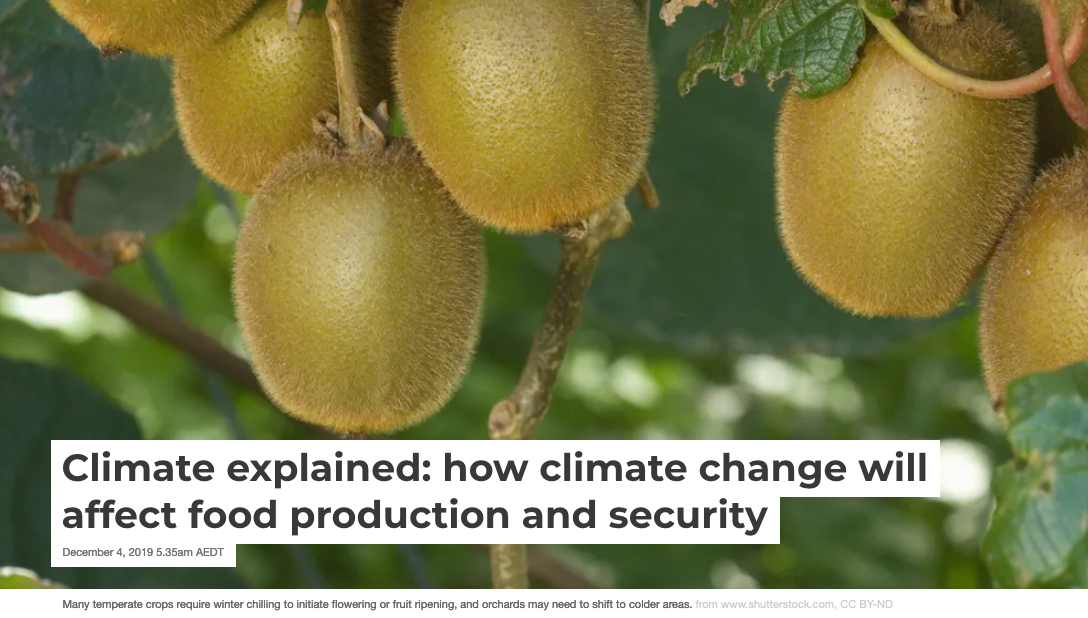
Climate change will cause more food shortages
The global food system is in a state of profound crisis. Decades of misguided aid, trade, and production policies have generated record levels of world hunger despite bountiful harvests and soaring profits for the transnational corporations that dominate the global food supply. The rapid expansion of industrial agriculture has produced an unprecedented loss of plant genetic diversity, making the world's food supply dangerously vulnerable to wide-spread crop failure akin to that of the Irish potato famine.In addition, climate change threatens to wreak havoc on food production by increasing the frequency and severity of extreme weather events, depressing agricultural yields, reducing the productivity of the world's fisheries,and placing additional pressure on scarce water resources.
* Professor of Law, Seattle University School of Law
.............
sustainable food systems
This Article examines the underlying causes of the global food crisis and recommends specific measures to address the distinct but related problems of food insecurity, loss of genetic resources, and climate change."