Tuesday, 17 December 2019

Push for carbon loopholes sends climate talks into overtime: Skeptical Science


Australia, US and Brazil threatening ‘spirit’ of the Paris Agreement, says Costa Rican minister, as fractious talks could drag into the weekend
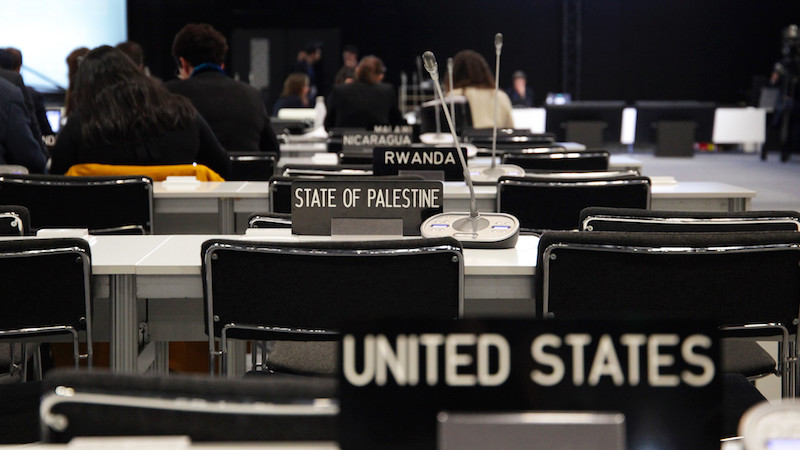
Cop25 in Madrid
The plenary room at Cop25 in Madrid. Diplomats are locked in tense negotiations to try and find a deal (Photo: UNFCCC)
Negotiations at the UN climate talks are going into extra time as diplomats are at loggerheads over commitments to boost ambition and rules to set-up a new global carbon market.

As the second week of negotiations drew to a close, negotiators were set to work through the night on Friday to find landing zones and finalise the last unresolved rules of the Paris Agreement.
“We are reaching the final hours of the Cop and now is time to show the world we are capable of reaching an agreement,” Cop25 president Carolina Schmidt told negotiators.

“The eyes of the world are on us. Our kids, the women of the world, indigenous people, our communities, the youth will not understand that we are not able to get to an agreement that is committed ambition to the world. It is our responsibility to find that agreement,” she said.

But entrenched positions have run into political deadlock, with little progress on the most contentious issues, including creating a new carbon market, known as Article 6.

Push for carbon loopholes sends climate talks into overtime by Chloé Farand, Climate Home News, Dec 13, 2019

Click here to access the entire article as posted on the Climate Home News website.

Sunday, 15 December 2019

Greta Thunberg’s speech at UN climate change conference

#criminales climáticos de la cárcel  #criminalesclimáticosdelacárcel

#jailclimatecriminals  #gaolclimatecriminals


Swedish activist Greta Thunberg says "we no longer have time to leave out the science," as she gave a speech at the U.N. global climate conference in Madrid - accusing world leader of “clever accounting and creative PR” to avoid action on the climate crisis. (Subscribe: https://bit.ly/C4_News_Subscribe
 
Thunberg told the crowd that the world's rapidly declining carbon budgets would be gone within eight years based on current emission levels. "How do you respond to the fact that basically nothing is being done about this without feeling the slightest bit of anger? And how do you communicate this without sounding alarmist? I would really like to know,” she said.
 
926K subscribers
Swedish activist Greta Thunberg says "we no longer have time to leave out the science," as she gave a speech at the U.N. global climate conference in Madrid - accusing world leader of “clever accounting and creative PR” to avoid action on the climate crisis. (Subscribe: https://bit.ly/C4_News_Subscribe) Thunberg told the crowd that the world's rapidly declining carbon budgets would be gone within eight years based on current emission levels. "How do you respond to the fact that basically nothing is being done about this without feeling the slightest bit of anger? And how do you communicate this without sounding alarmist? I would really like to know,” she said. #ClimateChange #ClimateCrisis #GlobalWarming

Climate Change and Why We Should Panic voiced by Keira Knightley | Extinction Rebellion Video


50.7K subscribers
British Academy Film Award and Academy Award nominee, Keira Knightley, OBE, has come out in support of Extinction Rebellion. Keira has lent her voice to defend the climate and tell the truth in this new, short film that summarises the crisis from how we got here, and what we must do now. The animation shows why government must enter crisis mode and choose a different path than the one we are on because it will lead us to extinction. Keira joins Emma Thompson, Stephen Fry, William Dafoe, Javier Bardem, Paloma Faith, Radiohead and all other people who know that we are facing an unprecedented global emergency.
 Learn more and #rebelforlife 
Website: https://Rebellion.Earth World Map of Extinction Rebellion Groups: http://bit.ly/2wri78B 

Saturday, 14 December 2019

Air pollution is much more harmful than you know: Vox

"The Trump administration is making a bad problem worse. 

Air pollution — mostly fine particulates, but also ozone and nitrogen oxides — has risen in recent years, in part due to ongoing rollbacks of regulations relating to air pollution, leading to what a team of researchers at Carnegie Mellon estimate is nearly 10,000 extra deaths per year

Policymakers in the Trump administration seem determined to
ABC
continue down this course. On November 11, Lisa Friedman of the New York Times reported on a draft memo circulating among Environmental Protection Agency officials that, if enacted, would sharply limit the kinds of scientific studies the agency can use to consider the impact of air pollution. Yet there’s good reason to believe the EPA and other global public health agencies should be moving in the opposite direction and considering a wider range of studies about the harms of air pollution. 

That’s because in addition to its impacts to lung and cardiovascular functioning, it seems increasingly clear that pollution has a significant effect on cognitive function over both the short and long term. A spate of studies released in recent years indicate that people work less efficiently and make more mistakes on higher-pollution days, and that long-term exposure to air pollution “ages” the brain and increases the odds of dementia. 

These consequences are not nearly as dramatic as dying, of course. But they are spread across a huge swath of the population. And since cognitive function is linked to almost everything else in life, the implications are potentially enormous. 

Many current EPA documents don’t mention the impact of air pollution on brain functioning, and landmark Obama-era regulatory efforts like the Clean Power Plan don’t cite cognitive benefits as part of their cost-benefit analysis. But a growing body of research indicates that the harms of air pollution are more wide-ranging and systematic than we’ve realized.

The new research on pollution and cognition ......"

Read more. Original Vox article

#criminales climáticos de la cárcel   #criminalesclimáticosdelacárcel

#jailclimatecriminals  #gaolclimatecriminals

Related: Climate change forcing millions out of homes: report: 9 NEWS

Related: Sydney smoke three times worse this NSW bushfire season, but health effects from 'medium-term' exposure unclear

Friday, 13 December 2019

Taylor avoids mention of bushfires as Australia given a zero for climate policy: RenewEconomy

"Australia has outdone itself in its latest performance on climate ambition. In an entirely fossil-worthy result Australia has just received a massive gong in the annual Climate Change Performance Index released today by Germanwatch, New Climate Institute and the Climate Action Network,” the Fossil of the Day citation says.

“What really jumps out is that while the Australian government is saying that it is taking meaningful action on climate change, it received a ZERO out of 100 on climate policy in the CCPI. On any measure zero is an outright failure! It’s no wonder that Australia’s climate pollution has been going up and up under the current government.”

It is understood that Angus Taylor had intended to leave Madrid following his address to the conference, but it is unknown whether he may now extend his stay, as the issue of the Kyoto carryover has yet to be resolved.

New Zealand and South Africa have effectively been appointed as mediators in the dispute over the Kyoto carryover issue, as Australia locks horns with over 100 other countries that want to see the Kyoto-era units excluded from the Paris Agreement.

A certain answer on whether other countries will consent to Australia using its surplus Kyoto units to meet its 2030 target may not be known until the closure of the conference at the end of the week."

Read the complete article 

#criminales climáticos de la cárcel

#criminalesclimáticosdelacárcel

#jailclimatecriminals

#gaolclimatecriminals

Thursday, 12 December 2019

'Sydney is angry': Protesters march to demand urgent action on climate change: SMH

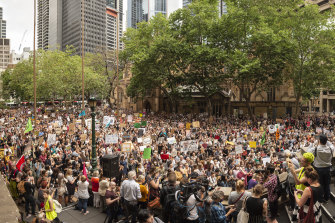
An estimated 20,000 protesters marched from Town Hall to Hyde Park on Wednesday evening, taking over George Street to demand stronger climate action as bushfires continue to rage across the state.

The event, titled "NSW is Burning, Sydney is Choking - Climate Emergency Rally!", was swiftly set up on Facebook last week by Extinction Rebellion, Uni Students for Climate Justice, and Greens MP David Shoebridge, in response to horrendous air conditions and ongoing bushfires across the state.

Thousands of protesters gathered at Town Hall on Wednesday.

Thousands of protesters gathered at Town Hall on Wednesday.Credit:Wolter Peeters
Buses were diverted away from Elizabeth Street and Park Street because of the march, with some buses delayed by up to 30 minutes and more than 60 routes affected.

After a series of speeches, the crowd began marching down York Street at 6.40pm, before turning onto Park Street and heading east towards Elizabeth Street and Hyde Park.
NSW Police Inspector Gary Coffey said "it’s a very big crowd", and later told the Herald there were an estimated 20,000 people in attendance.


Chloe Rafferty, one of the organisers, said she was angry about the lack of climate action from all levels of government.

"The state is angry, Sydney is angry," she said. "I have hope that people will see the need to take action into their own hands and disrupt business as usual, we can't let the biggest city in Australia having hazardous air quality become the new normal."

High school student Amy Lamont addressed the thousands of protesters wearing P2 face masks and said: "The reality is these fires will be around all summer."
"The rage we all rightly feel right now needs to grow if we have any chance of actually challenging that destruction of the status quo that is burning around us," she said.
"Only we, the majority, have the ability to hold the rich and political elites in this country accountable.

"Students shouldn't have to worry when going to school that they might come back to a burnt home."
David Whitson has been attending protests dressed as a koala since October.
"When you talk about silent Australians, I don’t think of anything more silent than our beloved flora and fauna," he said.
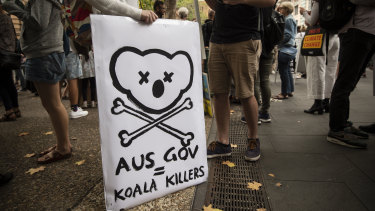
The loss of wildlife, especially Koala Bears, were the focal point for this protest sign.
The loss of wildlife, especially Koala Bears, were the focal point for this protest sign.Credit:Wolter Peeters
He said he thought bushfires would occur early next year, but "it’s caught everyone by surprise how early and severe the fires are".

Fire Brigade Employees Union state secretary Leighton Drury has been a firefighter for 20 years and said the fires ravaging NSW are the "worst we’ve had in decades".


  Related :

Australia bushfires factcheck: are this year's fires unprecedented? : The Guardian


#criminales climáticos de la cárcel

#criminalesclimáticosdelacárcel

#jailclimatecriminals

#gaolclimatecriminals

Wednesday, 11 December 2019

Climate explained: seven reasons to be wary of waste-to-energy proposals


"I was in Switzerland recently and discovered that they haven’t had any landfill since the early 2000s, because all of their waste is either recycled or incinerated to produce electricity. How “green” is it to incinerate waste in order to produce electricity? Is it something New Zealand should consider, so that 1) we have no more landfill, and 2) we can replace our fossil-fuel power stations with power stations that incinerate waste?
Burning rubbish to generate electricity or heat sounds great: you get rid of all your waste and also get seemingly “sustainable” energy. What could be better? 

Many developed countries already have significant “waste-to-energy” incineration plants and therefore less material going to landfill (although the ash has to be landfilled). These plants often have recycling industries attached to them, so that only non-recyclables end up in the furnace. If it is this good, why the opposition?

Here are seven reasons why caution is needed when considering waste-to-energy incineration plants.


Read more: Why municipal waste-to-energy incineration is not the answer to NZ's plastic waste crisis


Stifling innovation and waste reduction

  1. Waste-to-energy plants require a high-volume, guaranteed waste stream for about 25 years to make them economically viable. If waste-to-energy companies divert large amounts of waste away from landfills, they need to somehow get more waste to maintain their expensive plants. For example, Sweden imports its waste from the UK to feed its “beasts”. 
  2. The waste materials that are easiest to source and have buyers for recycling - like paper and plastic - also produce most energy when burned.
  3. Waste-to-energy destroys innovation in the waste sector. As a result of China not accepting our mixed plastics, people are now combining plastics with asphalt to make roads last longer and are making fence posts that could be replacing treated pine posts (which emit copper, chrome and arsenic into the ground). If a convenient waste-to-energy plant had been available, none of this would have happened.
  4. Waste-to-energy reduces jobs. Every job created in the incineration industry removes six jobs in landfill, 36 jobs in recycling and 296 jobs in the reuse industry.
  5. Waste-to-energy works against a circular economy, which tries to keep goods in circulation. Instead, it perpetuates our current make-use-dispose mentality.
  6. Waste-to-energy only makes marginal sense in economies that produce coal-fired electricity – and then only as a stop-gap measure until cleaner energy is available. New Zealand has a green electricity generation system, with about 86% already coming from renewable sources and a target of 100% renewable by 2035, so waste-to-energy would make it a less renewable energy economy. 
  7. Lastly, burning waste and contaminated plastics creates a greater environmental impact than burning the equivalent oil they are made from. These impacts include the release of harmful substances like dioxins and vinyl chloride as well as mixtures of many other harmful substances used in making plastics, which are not present in oil.

Read more: Circular fashion: turning old clothes into everything from new cotton to fake knees


Landfills as mines of the future

European countries were driven to waste-to-energy as a result of a 2007 directive that imposed heavy penalties for countries that did not divert waste from landfills. The easiest way for those countries to comply was to install waste-to-energy plants, which meant their landfill waste dropped dramatically.
New Zealand does not have these sorts of directives and is in a better position to work towards reducing, reusing and recycling end-of-life materials, rather than sending them to an incinerator to recover some of the energy used to make them.

Is New Zealand significantly worse than Europe in managing waste? About a decade ago, a delegation from Switzerland visited New Zealand Ministry for the Environment officials to compare progress in each of the waste streams. Both parties were surprised to learn that they had managed to divert roughly the same amount of waste from landfill through different routes.

This shows that it is important New Zealand doesn’t blindly follow the route other countries have used and hope for the same results. Such is the case for waste-to-energy.

There is also an argument to be made for current landfills. Modern, sanitary landfills seal hazardous materials and waste stored over the last 50 years presents future possibilities of landfill mining. 

Many landfills have higher concentrations of precious metals, particularly gold, than mines and some are being mined for those metals. As resources become scarcer and prices increase, our landfills may become the mines of the future.

From The Conversation 

Related: 

The big polluters’ masterstroke was to blame the climate crisis on you and me : The Guardian

 #criminales climáticos de la cárcel

#criminalesclimáticosdelacárcel

#jailclimatecriminals

#gaolclimatecriminals