Showing posts with label air pollution. Show all posts

Thursday, 10 September 2020

Australian coal worker of 40 years embraces renewables: Climate Council video


Tony Wolfe has worked in coal for over forty years. But he knows it's time for a change - it's time to embrace renewables. Australia needs clean jobs to reboot its economy. That's why we created the Clean Jobs Plan. 
 
Learn more about it here: https://climc.nl/3hAZdSW -- 
 
 The Climate Council is Australia's leading independent, community-funded climate change communications organisation. We're a catalyst propelling Australia to take bold, effective steps to address the climate crisis. We're made up of some of the country’s leading climate scientists, health, renewable energy and policy experts, as well as a team of staff, and a huge community of volunteers and supporters who power our work. 
 
Find out more and connect with us here: → Website: https://www.climatecouncil.org.au → Facebook: https://www.facebook.com/climatecouncil → Instagram: https://www.instagram.com/theclimatec... → Twitter: https://twitter.com/climatecouncil

Wednesday, 25 March 2020

Why don’t we treat the climate crisis with the same urgency as coronavirus? / The Guardian

"It is a global emergency that has already killed on a mass scale and threatens to send millions more to early graves. As its effects spread, it could destabilise entire economies and overwhelm poorer countries lacking resources and infrastructure. But this is the climate crisis, not the coronavirus. Governments are not assembling emergency national plans and you’re not getting push notifications transmitted to your phone breathlessly alerting you to dramatic twists and developments from South Korea to Italy.

More than 3,000 people have succumbed to coronavirus yet, according to the World Health Organization, air pollution alone – just one aspect of our central planetary crisis – kills seven million people every year. There have been no Cobra meetings for the climate crisis, no sombre prime ministerial statements detailing the emergency action being taken to reassure the public. In time, we’ll overcome any coronavirus pandemic. With the climate crisis, we are already out of time, and are now left mitigating the inevitably disastrous consequences hurtling towards us."

.....................................

"Imagine, then, that we felt the same sense of emergency about the climate crisis as we do about coronavirus. What action would we take? As the New Economic Foundation’s Alfie Stirling points out, a strict demarcation between the two crises in unwise. After all, coronavirus may trigger a global slowdown: the economic measures in response to this should be linked to solving the climate crisis. “What tends to happen in a recession is policy-makers panic about what the low-lying fruits are; it’s all supply chains and sticking plasters,” he tells me. During the 2008 crash, for example, there was an immediate cut in VAT and interest rates, but investment spending wasn’t hiked fast enough, and was then slashed in the name of austerity. According to NEF research, if the coalition government had funded additional zero-carbon infrastructure, it would not only have boosted the economy but could have reduced residential emissions by 30%. This time round, there’s little room to cut already low interest rates or boost quantitative easing; green fiscal policy must be the priority."

Read the whole original story 

"Coronavirus poses many challenges and threats, but few opportunities. A judicious response to global heating would provide affordable transport, well-insulated homes, skilled green jobs and clean air. Urgent action to prevent a pandemic is of course necessary and pressing. But the climate crisis represents a far graver and deadlier existential threat, and yet the same sense of urgency is absent. Coronavirus shows it can be done – but it needs determination and willpower, which, when it comes to the future of our planet, are desperately lacking."

Read the whole original story 

Sunday, 22 March 2020

The Frontline: experts answer your questions on the impacts of the climate emergency – as it happened: Ther Guardian

To mark the end of The Frontline series a panel of experts answer your questions about the climate crisis and how it is affecting Australia.
Ask Prof Lesley Hughes, Greg Mullins, Prof Michael Mann and Assoc Prof Donna Green your questions, and see the answers on our live blog. Email frontline.live@theguardian.com or tweet #frontlinelive

Saturday, 14 December 2019

Air pollution is much more harmful than you know: Vox

"The Trump administration is making a bad problem worse. 

Air pollution — mostly fine particulates, but also ozone and nitrogen oxides — has risen in recent years, in part due to ongoing rollbacks of regulations relating to air pollution, leading to what a team of researchers at Carnegie Mellon estimate is nearly 10,000 extra deaths per year

Policymakers in the Trump administration seem determined to
ABC
continue down this course. On November 11, Lisa Friedman of the New York Times reported on a draft memo circulating among Environmental Protection Agency officials that, if enacted, would sharply limit the kinds of scientific studies the agency can use to consider the impact of air pollution. Yet there’s good reason to believe the EPA and other global public health agencies should be moving in the opposite direction and considering a wider range of studies about the harms of air pollution. 

That’s because in addition to its impacts to lung and cardiovascular functioning, it seems increasingly clear that pollution has a significant effect on cognitive function over both the short and long term. A spate of studies released in recent years indicate that people work less efficiently and make more mistakes on higher-pollution days, and that long-term exposure to air pollution “ages” the brain and increases the odds of dementia. 

These consequences are not nearly as dramatic as dying, of course. But they are spread across a huge swath of the population. And since cognitive function is linked to almost everything else in life, the implications are potentially enormous. 

Many current EPA documents don’t mention the impact of air pollution on brain functioning, and landmark Obama-era regulatory efforts like the Clean Power Plan don’t cite cognitive benefits as part of their cost-benefit analysis. But a growing body of research indicates that the harms of air pollution are more wide-ranging and systematic than we’ve realized.

The new research on pollution and cognition ......"

Read more. Original Vox article

#criminales climáticos de la cárcel   #criminalesclimáticosdelacárcel

#jailclimatecriminals  #gaolclimatecriminals

Related: Climate change forcing millions out of homes: report: 9 NEWS

Related: Sydney smoke three times worse this NSW bushfire season, but health effects from 'medium-term' exposure unclear

Thursday, 12 December 2019

'Sydney is angry': Protesters march to demand urgent action on climate change: SMH

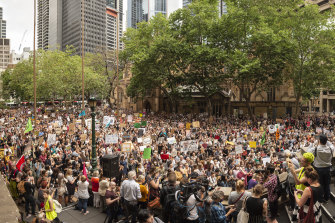
An estimated 20,000 protesters marched from Town Hall to Hyde Park on Wednesday evening, taking over George Street to demand stronger climate action as bushfires continue to rage across the state.

The event, titled "NSW is Burning, Sydney is Choking - Climate Emergency Rally!", was swiftly set up on Facebook last week by Extinction Rebellion, Uni Students for Climate Justice, and Greens MP David Shoebridge, in response to horrendous air conditions and ongoing bushfires across the state.

Thousands of protesters gathered at Town Hall on Wednesday.

Thousands of protesters gathered at Town Hall on Wednesday.Credit:Wolter Peeters
Buses were diverted away from Elizabeth Street and Park Street because of the march, with some buses delayed by up to 30 minutes and more than 60 routes affected.

After a series of speeches, the crowd began marching down York Street at 6.40pm, before turning onto Park Street and heading east towards Elizabeth Street and Hyde Park.
NSW Police Inspector Gary Coffey said "it’s a very big crowd", and later told the Herald there were an estimated 20,000 people in attendance.


Chloe Rafferty, one of the organisers, said she was angry about the lack of climate action from all levels of government.

"The state is angry, Sydney is angry," she said. "I have hope that people will see the need to take action into their own hands and disrupt business as usual, we can't let the biggest city in Australia having hazardous air quality become the new normal."

High school student Amy Lamont addressed the thousands of protesters wearing P2 face masks and said: "The reality is these fires will be around all summer."
"The rage we all rightly feel right now needs to grow if we have any chance of actually challenging that destruction of the status quo that is burning around us," she said.
"Only we, the majority, have the ability to hold the rich and political elites in this country accountable.

"Students shouldn't have to worry when going to school that they might come back to a burnt home."
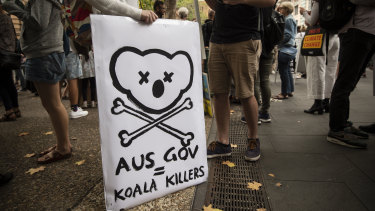
David Whitson has been attending protests dressed as a koala since October.
"When you talk about silent Australians, I don’t think of anything more silent than our beloved flora and fauna," he said.
The loss of wildlife, especially Koala Bears, were the focal point for this protest sign.
The loss of wildlife, especially Koala Bears, were the focal point for this protest sign.Credit:Wolter Peeters
He said he thought bushfires would occur early next year, but "it’s caught everyone by surprise how early and severe the fires are".

Fire Brigade Employees Union state secretary Leighton Drury has been a firefighter for 20 years and said the fires ravaging NSW are the "worst we’ve had in decades".


  Related :

Australia bushfires factcheck: are this year's fires unprecedented? : The Guardian


#criminales climáticos de la cárcel

#criminalesclimáticosdelacárcel

#jailclimatecriminals

#gaolclimatecriminals

Wednesday, 11 December 2019

Climate explained: seven reasons to be wary of waste-to-energy proposals


"I was in Switzerland recently and discovered that they haven’t had any landfill since the early 2000s, because all of their waste is either recycled or incinerated to produce electricity. How “green” is it to incinerate waste in order to produce electricity? Is it something New Zealand should consider, so that 1) we have no more landfill, and 2) we can replace our fossil-fuel power stations with power stations that incinerate waste?
Burning rubbish to generate electricity or heat sounds great: you get rid of all your waste and also get seemingly “sustainable” energy. What could be better? 

Many developed countries already have significant “waste-to-energy” incineration plants and therefore less material going to landfill (although the ash has to be landfilled). These plants often have recycling industries attached to them, so that only non-recyclables end up in the furnace. If it is this good, why the opposition?

Here are seven reasons why caution is needed when considering waste-to-energy incineration plants.


Read more: Why municipal waste-to-energy incineration is not the answer to NZ's plastic waste crisis


Stifling innovation and waste reduction

  1. Waste-to-energy plants require a high-volume, guaranteed waste stream for about 25 years to make them economically viable. If waste-to-energy companies divert large amounts of waste away from landfills, they need to somehow get more waste to maintain their expensive plants. For example, Sweden imports its waste from the UK to feed its “beasts”. 
  2. The waste materials that are easiest to source and have buyers for recycling - like paper and plastic - also produce most energy when burned.
  3. Waste-to-energy destroys innovation in the waste sector. As a result of China not accepting our mixed plastics, people are now combining plastics with asphalt to make roads last longer and are making fence posts that could be replacing treated pine posts (which emit copper, chrome and arsenic into the ground). If a convenient waste-to-energy plant had been available, none of this would have happened.
  4. Waste-to-energy reduces jobs. Every job created in the incineration industry removes six jobs in landfill, 36 jobs in recycling and 296 jobs in the reuse industry.
  5. Waste-to-energy works against a circular economy, which tries to keep goods in circulation. Instead, it perpetuates our current make-use-dispose mentality.
  6. Waste-to-energy only makes marginal sense in economies that produce coal-fired electricity – and then only as a stop-gap measure until cleaner energy is available. New Zealand has a green electricity generation system, with about 86% already coming from renewable sources and a target of 100% renewable by 2035, so waste-to-energy would make it a less renewable energy economy. 
  7. Lastly, burning waste and contaminated plastics creates a greater environmental impact than burning the equivalent oil they are made from. These impacts include the release of harmful substances like dioxins and vinyl chloride as well as mixtures of many other harmful substances used in making plastics, which are not present in oil.

Read more: Circular fashion: turning old clothes into everything from new cotton to fake knees


Landfills as mines of the future

European countries were driven to waste-to-energy as a result of a 2007 directive that imposed heavy penalties for countries that did not divert waste from landfills. The easiest way for those countries to comply was to install waste-to-energy plants, which meant their landfill waste dropped dramatically.
New Zealand does not have these sorts of directives and is in a better position to work towards reducing, reusing and recycling end-of-life materials, rather than sending them to an incinerator to recover some of the energy used to make them.

Is New Zealand significantly worse than Europe in managing waste? About a decade ago, a delegation from Switzerland visited New Zealand Ministry for the Environment officials to compare progress in each of the waste streams. Both parties were surprised to learn that they had managed to divert roughly the same amount of waste from landfill through different routes.

This shows that it is important New Zealand doesn’t blindly follow the route other countries have used and hope for the same results. Such is the case for waste-to-energy.

There is also an argument to be made for current landfills. Modern, sanitary landfills seal hazardous materials and waste stored over the last 50 years presents future possibilities of landfill mining. 

Many landfills have higher concentrations of precious metals, particularly gold, than mines and some are being mined for those metals. As resources become scarcer and prices increase, our landfills may become the mines of the future.

From The Conversation 

Related: 

The big polluters’ masterstroke was to blame the climate crisis on you and me : The Guardian

 #criminales climáticos de la cárcel

#criminalesclimáticosdelacárcel

#jailclimatecriminals

#gaolclimatecriminals

Wednesday, 12 June 2019

Protesting Trump is Essential to the Survival of Life on the Planet : The Green Market Oracle

Global Heating Denying Trump
"The climate crisis and the rapid degradation of the Earth's biodiversity represent existential threats. In the face of these interrelated catastrophes the leader of the most powerful nation on Earth is exacerbating these realities.

Early in June, American President Donald Trump's visit to the UK was met by hundreds of thousands of protestors. In total the visit spawned more than two dozen anti-Trump protests across the UK. During his stay Trump also added more lies to the over 10,000 he has told since becoming president. Despite a protracted discussion on climate change with Prince Charles, Trump remains stubbornly resistant to the facts. During this visit the liar-and-chief used the occasion to once again deny the reality of global warming.

Tuesday, 12 March 2019

Victoria can, and should, lead the country on climate change: SMH

climate protectors, climate activism, IPCC, #climatechange  #climatecrisis
Grey Power Climate Protectors
"Many people see climate change as a federal domain, but actually the states are responsible for energy supply and have most of the regulatory levers – like the EPA – to cut pollution across all sectors of the economy. Plus Andrews has already done the hard yards cranking up the renewables we will need as we phase out Victoria’s ageing coal power stations.

All of which means Victoria can, and should, lead the entire country on the issue.

The Intergovernmental Panel on Climate Change says that human civilisation has just 12 years to avert an ecological and humanitarian catastrophe. We live in an extraordinary time and it calls for extraordinary leadership, not merely sound management. The Andrews government has just won an election with a massive mandate on climate change and renewable energy and here is the perfect political moment to act. Will they seize it?"

Read the SMH article

Tuesday, 5 March 2019

The worst-case scenario

#global warming  #climate change  climatechange  globalwarming  sealevelrise
Vote for my future climate

"Stephen Schneider explores what a world with 1,000 parts per million of CO 2 in its atmosphere might look like."

.... "Fairness must also be taken into account, given that some people would be at much greater risk than others: poor people in hot countries with little adaptive capacity, for instance, indigenous peoples and those exposed to hurricanes or wildfires, or living in low-lying areas. The elderly and children with asthma or other lung ailments would be particularly affected by urban air pollution or wildfire smoke plumes exacerbated by the extreme warming.


The economic outlook is no better. With warming of just 1–3 °C, projections show a mixture of benefit and loss. More than a few degrees of warming, however, and aggregate monetary impacts become negative virtually everywhere; and in a 1,000 p.p.m. scenario current literature suggests the outcomes would be almost universally negative and could amount to a substantial loss of gross domestic product. Millions of people at risk from flooding and
water supply problems would provide further economic challenges." ...
.