Showing posts with label #waterresources. Show all posts

Tuesday, 25 August 2020

CLIMATE CHANGE, FOOD SECURITY, AND AGROBIODIVERSITY: C.G. Gonzalez

"CLIMATE CHANGE, FOOD SECURITY, AND AGROBIODIVERSITY: TOWARD A JUST, RESILIENT, AND SUSTAINABLE FOOD SYSTEM Carmen G. Gonzalez* 

The global food system is in a state of profound crisis
Climate change will cause more food shortages

 
The global food system is in a state of profound crisis. Decades of misguided aid, trade, and production policies have generated record levels of world hunger despite bountiful harvests and soaring profits for the transnational corporations that dominate the global food supply. The rapid expansion of industrial agriculture has produced an unprecedented loss of plant genetic diversity,  making the world's food supply dangerously vulnerable to wide-spread crop failure akin to that of the Irish potato famine.  In addition, climate change threatens to wreak havoc on food production by increasing the frequency and severity of extreme weather events, depressing agricultural yields, reducing the productivity of the world's fisheries,  and placing additional pressure on scarce water resources. 

* Professor of Law, Seattle University School of Law
 .............
 
The global food system is in a state of profound crisis
sustainable food systems

This Article examines the underlying causes of the global food crisis and recommends specific measures to address the distinct but related problems of food insecurity, loss of genetic resources, and climate change." 

Go to the scholarly article by Carmen g. Gonzalez


Related:
The global food system is in a state of profound crisis
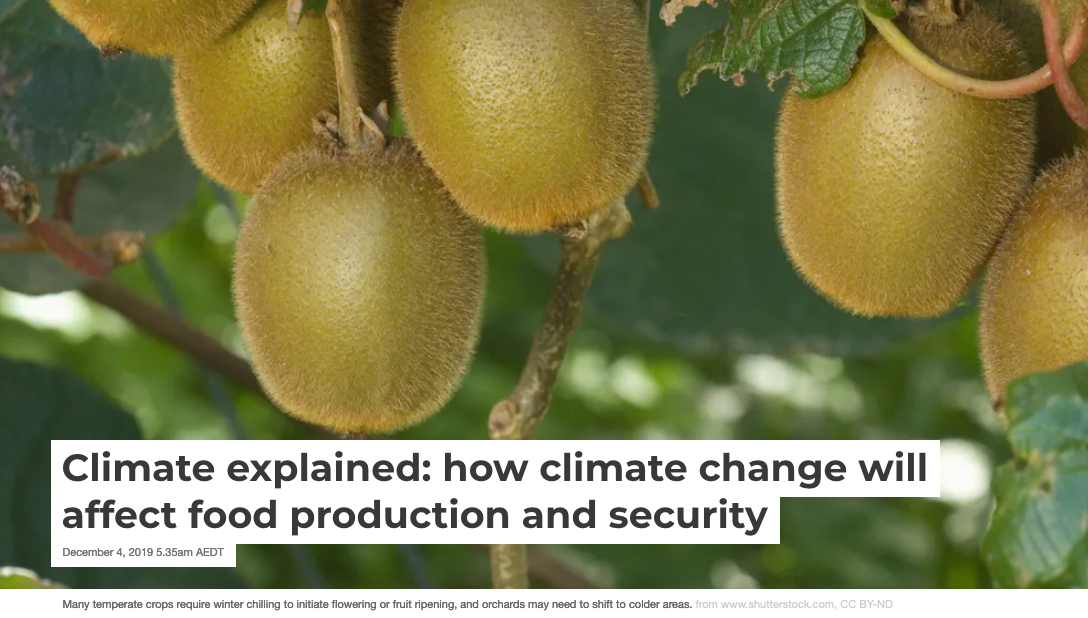
Chilling requirements for food crops

 Related:  9 Ways to assist Australia's farmers with climate change


The global food system is in a state of profound crisis
Some Costa Rican forests returned after removing cattle farming subsidies


Saturday, 25 July 2020

9 Ways to assist Australia's farmers with climate change

"Global warming affects agriculture in a number of ways, including through changes in average temperatures, rainfall, and climate extremes (e.g., heat waves); changes in pests and diseases; changes in atmospheric carbon dioxide and ground-level ozone concentrations; changes in the nutritional quality of some foods; and ..."

Climate change and agriculture - Wikipedia


.....................................


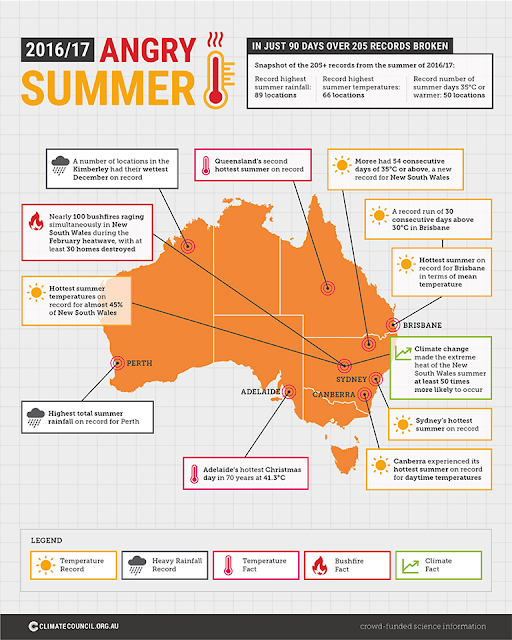
Climaste Council meme
Angry Summer by The Climate Council


It is obvious that many farmers are going to be displaced because of climate change. As their usual crops become unviable and broad scale farming becomes uneconomical because of costs, it is impossible to continue to subsidise farmers that continue to farm or to graze unsuitable animals in an unsustainable fashion. Yet farmers need government support and Australia requires food production.


#jailclimatecriminals, #farmingpractices, #climatecrisis
Australia must learn to manage with less surface water. Artesian water resources must be husbanded.

Suggested Actions

1. “What we still don’t have in the year 2019 is a national (Australian) strategy on climate change in agriculture. There’s still no actual framework to help farmers manage these risks and implement solutions,” she said. Verity Morgan-Schmidt, the chief executive of Farmers for Climate Action

2. Revitalise, with extra funding, our agricultural support services that have provided excellent research and development in the past, new crops and animal husbandry practices can be developed.

3. Provide education for farmers that demonstrate alternative farming practices, for example move from cattle to goats.

4. Only subsidise farmers that change their practice to accommodate a changing climate and protect our soils but retrain farmers unable to accommodate change.

5. Encourage small farming practices such as permaculture, greenhouse production, urban farms.

Note: Intensive farming practices have been shown to be as productive as industrial broad scale farming.

6.  Stop selling water off or subsidising in any way corporations that persist in growing water hungry crops such as cotton and almonds in water scarce areas.

7.  Protect our surface and artesian water from destructive and unsustainable industries.

8.  Support farmers to plan moves from floodplains or cope with more flooding. 


#jailclimatecriminals, #cambioclimatico
Droughts will occur more often. Soils will erode. Desertification will occur.


9.  Encourage farmers to 'get a yield' with new products.

" 'Agritourism, insect farming off waste resources, bush tucker foods — there are options out there, but it's not traditional agriculture in that sense.'

" 'We need support structures, new ideas, people helping us transition to these other production industries. ' "

She (Anika) believes the first step needs to come from the energy sector to buy more time for other industries to develop response strategies.

'The easiest way to put the brakes on what we are experiencing is to transition away from dirty fossil fuel energy to clean, renewable energy; that then takes the pressure off other industries.' "


An article by Preparations for Climate Change

See also:  Preparing for a Climate Change Health Crisis