Showing posts with label water security. Show all posts

Thursday, 17 September 2020

Body count: How climate change is killing us: Paddy Manning's Book


"True stories of loss and courage from people at the frontlines of Australia's worst climate-fuelled disasters - bushfire, heatwaves, flash-floods, disease outbreaks and now the latest in a new age of pandemics. 


What are the health risks of climate change, why weren't we warned and what are Australian governments doing about it?"
"Suddenly, when the country caught fire, people realised what the government has not: that climate change is killing us.

But climate deaths didn’t start in 2019. Medical officers have been warning of a health emergency as temperatures rise for years, and for at least a decade Australians have been dying from the plagues of climate change – from heat, flood, disease, smoke. And now, pandemic.

In this detailed, considered, compassionate book, Paddy Manning paints us the big picture. He revisits some headline events which might have faded in our memory – the Brisbane Floods of 2011; Melbourne’s thunderstorm asthma fatalities of 2016 – and brings to our attention less well-publicised killers: the soil-borne diseases that amplify after a flood; the fact that heat itself has killed more people than all other catastrophes put together. In each case, he has interviewed scientists to explore the link to climate change and asks how – indeed, whether – we can better prepare ourselves in the future.

Most importantly, Manning has spoken to survivors and the families of victims, creating a monument to those we have already lost. Donna Rice and her 13-year-old son Jordan. Alison Tenner. The Buchanan family. These are stories of humans at their most vulnerable, and also often at their best. In extremis, people often act to save their loved ones above themselves. As Body Count shows, we are now all in extremis, and it is time to act.

 
#climate crisis, #climateemergency, #Australia, #California, Oregon, #climatefires, #USA, smoke, infectious diseases, #foodsecurity, water security, #heatwaves,
Climate Fires in the USA


Respected journalist Paddy Manning tells these stories of tragedy and loss, heroism and resilience, in a book that is both monument and warning.

‘A climate emergency tour de force.' Dr Bob Brown

'True stories of heroism and unimaginable loss...Body Count is a brilliant exposition of why we must deal with the climate problem now.' Ross Garnaut

'Climate change kills. … Through the accounts of people who have lost so much, Paddy Manning drives home the deeply personal impact of climate change. Governments continue to ignore the impact on climate change on human health at OUR peril. The future of our planet and our future generations depends on everyone playing their part, today.' Professor Kerryn Phelps

'A stunningly powerful call to political leaders everywhere who hear the warnings of the devastating impacts of climate change on health but fail to act.' Dr Helen Haines, independent member for Indi

‘Moving stories of heroic courage and tragic loss. A pause to reflect on the lives lost and how urgently we need change.’ David Pocock, former Wallabies captain"


#climate crisis, #climateemergency, #Australia, #California, Oregon, #climatefires, #USA, smoke, infectious diseases, #foodsecurity, water security, #heatwaves,
Children Face Unique Health Threats Due To Climate Change


Related: How Climate Migration Will Reshape America Millions will be displaced. Where will they go? (excerpt) : NYT Magazine

#climate crisis, #climateemergency, #Australia, #California, Oregon, #climatefires, #USA, smoke, infectious diseases, #foodsecurity, water security, #heatwaves,  

Wednesday, 16 September 2020

How Climate Migration Will Reshape America Millions will be displaced. Where will they go? (excerpt) : NYT Magazine

(Pics by this blog)

a nation on the cusp of a great transformation
Hurricane Michael left this
" ....... I wanted to know if this was beginning to change. Might Americans finally be waking up to how climate is about to transform their lives? And if so — if a great domestic relocation might be in the offing — was it possible to project where we might go? To answer these questions, I interviewed more than four dozen experts: economists and demographers, climate scientists and insurance executives, architects and urban planners, and I mapped out the danger zones that will close in on Americans over the next 30 years. The maps for the first time combined exclusive climate data from the Rhodium Group, an independent data-analytics firm; wildfire projections modeled by United States Forest Service researchers and others; and data about America’s shifting climate niches, an evolution of work first published by The Proceedings of the National Academy of Sciences last spring. (See a detailed analysis of the maps.) "


a nation on the cusp of a great transformation
Sea rise and no planned retreat

"What I found was a nation on the cusp of a great transformation. Across the United States, some 162 million
people — nearly one in two — will most likely experience a decline in the quality of their environment, namely more heat and less water. For 93 million of them, the changes could be
particularly severe, and by 2070, our analysis suggests, if carbon emissions rise at extreme levels, at least four million Americans could find themselves living at the fringe, in places decidedly outside the ideal niche for human life. The cost of resisting the new climate reality is mounting. Florida officials have already acknowledged that defending some roadways against the sea will be unaffordable. And the nation’s federal flood-insurance program is for the first time requiring that some of its payouts be used to retreat from climate threats across the country. It will soon prove too expensive to maintain the status quo. "


........................


a nation on the cusp of a great transformation
Some predicted sea rise may be too conservative

"Let’s start with some basics. Across the country, it’s going to get hot. Buffalo may feel in a few decades like Tempe, Ariz., does today, and Tempe itself will sustain 100-degree average summer temperatures by the end of the century. Extreme humidity from New Orleans to northern Wisconsin will make summers increasingly unbearable, turning otherwise seemingly survivable heat waves into debilitating health threats. Fresh water will also be in short supply, not only in the West but also in places like Florida, Georgia and Alabama, where droughts now regularly wither cotton fields. By 2040, according to federal government projections, 
extreme water shortages will be nearly ubiquitous west of Missouri. The Memphis Sands Aquifer, a crucial water supply for Mississippi, Tennessee, Arkansas and Louisiana, is already overdrawn by hundreds of millions of gallons a day. Much of the Ogallala Aquifer — which supplies nearly a third of the nation’s irrigation groundwater — could be gone by the end of the century."


Go to complete, extensive New York Times Magazine article

Related:  Trump baselessly questions climate science during California wildfire briefing (excerpt): CNN

#America, #climaterefugees, #extremeheat, #searise, #USA, climate migration, water security

Wednesday, 9 September 2020

Water wars: How conflicts over resources are set to rise amid climate change: World Economic Forum

global warming is increasing competition for water around the world
Water shortages for one in four children in areas of extreme water shortage by 2040

   • From erratic rainfall to severe droughts, global warming is increasing competition for water around the world, with water-related conflicts on the rise.
 
  • According to the WRI, more than two billion people live in countries experiencing "high" water stress.
 
  • Conserving forests, wetlands and watersheds, including those around cities, can help absorb rainfall, helping stem crop losses from flooding and drought.

From Yemen to India, and parts of Central America to the African Sahel, about a quarter of the world's people face extreme water shortages that are fueling conflict, social unrest and migration, water experts said on Wednesday.
With the world's population rising and climate change bringing more erratic rainfall, including severe droughts, competition for scarcer water is growing, they said, with serious consequences.
"If there is no water, people will start to move. If there is no water, politicians are going to try and get their hands on it and they might start to fight over it," warned Kitty van der Heijden, head of international cooperation at the Netherlands' foreign ministry.


global warming is increasing competition for water around the world
Map of baseline water stress for countries

One in four children worldwide will be living in areas of extremely high water stress by 2040, researchers estimated.

"It's threats like these that keep me up at night," the diplomat told a webinar hosted by the World Resources Institute (WRI), a U.S.-based research group.
global warming is increasing competition for water around the world
African boy gathering muddy water


 According to the WRI, 17 countries face "extremely high" levels of water stress, while more than two billion people live in countries experiencing "high" water stress.

In terms of water availability, "at some point we are going to hit the wall, and that wall might be different in different places", Heijden said.

Climate change is compounding the challenge, she said, with cities such as India's Chennai and South Africa's Cape Town battling severe water shortages in recent years related in part to erratic rainfall.
Disputes over water have for millenia served as a flashpoint, driving political instability and conflict, the water experts said.
And "the risks of water-related disputes are growing .. in part because of growing scarcity over water", said Peter Gleick, co-founder of the California-based Pacific Institute, which jointly published the report with WRI and The Water, Peace and Security Partnership.
global warming is increasing competition for water around the world
Drought affecting Central American farming
But as water scarcity grows, water systems are also increasingly becoming targets in other types of conflicts, said Gleick, whose institute has compiled a chronology of water conflicts that dates back 5,000 years.
In Yemen, years of fighting has destroyed water infrastructure, leaving millions without safe water to drink or grow crops. Wells and other water facilities also have been targets in Somalia, Iraq, Syria and other countries, he said.
Smarter irrigation
Climate change is compounding the challenge
India is already hot
Recurring droughts in parts of Central America and the African Sahel in recent years have triggered migration as subsistence farmers, whose harvests have been decimated by low rainfall, seek refuge and jobs in other countries.
One key to tackling water scarcity is boosting investment in more sparing use of water in agriculture, an industry that absorbs more than two-thirds of the water used by people each year, the experts said.

Monday, 7 September 2020

Climate Change Poses Serious Threats to India's Food Security (excerpt): The Wire

Climatic factors like increased temperatures and extreme rainfall will affect productivity by causing physiological changes. Photo: Reuters
"Planning for the long-term impacts of climate change on agriculture appears to be rather low on the government's priority list.

Issues including the security clampdown in the Valley and slowdown in major sectors of the economy are dominating headlines. The agriculture ministry too would be occupied with formulating interventions to spur the economy of the erstwhile state of Jammu and Kashmir.


Climate change is no longer a distant threat. According to the Indian Meteorological Department, the annual mean temperature in the country has increased by 0.6 degrees Celsius between 1901 and 2018, when compared to pre-industrial levels. Eleven of the 15 warmest years have so far all been within the last 15 years with 2018 being the sixth warmest year in India’s recorded history.

The extent and degree of warming are going to get more severe. As carbon emissions continue and those which are built into the climate system take effect, temperatures across the world are expected to increase between 3-5 degree Celsius by 2100. India is among the countries which are likely to bear the worst of a warming planet due to its tropical location and relatively lower levels of income.

Agriculture and food production are likely to be significantly affected by climate change. According to one estimate, yields of major crops could decline by up to 25%. A recent IPCC report also warned that in the years to come, food security will stand threatened due to climate change coupled with increasing demands of the rising population.

The global population is expected to increase from 7.7 billion in 2019 to 8.5 billion by 2030 and 9.7 billion by 2050. According to the United Nation’s World Population Prospects (June 2019), the Indian population is projected to increase from 1.36 billion in 2019 to 1.5 billion by 2030 and 1.64 billion by 2050.

Crops, animal husbandry, as well as fisheries,
 are likely to be impacted. Photo: Reuters

Providing food and nutritional security to an entire population needs some serious planning and effective implementation. And we need to start now. 

Climatic factors like increased temperatures and extreme rainfall will affect productivity by causing physiological changes. In addition, they will affect soil fertility, the incidence of pest infestation and the availability of water. This will impact crops, animal husbandry as well as fisheries."................................

From The Wire 
by Siraj Hussain
19/Sep/2019

Tuesday, 25 August 2020

CLIMATE CHANGE, FOOD SECURITY, AND AGROBIODIVERSITY: C.G. Gonzalez

"CLIMATE CHANGE, FOOD SECURITY, AND AGROBIODIVERSITY: TOWARD A JUST, RESILIENT, AND SUSTAINABLE FOOD SYSTEM Carmen G. Gonzalez* 

The global food system is in a state of profound crisis
Climate change will cause more food shortages

 
The global food system is in a state of profound crisis. Decades of misguided aid, trade, and production policies have generated record levels of world hunger despite bountiful harvests and soaring profits for the transnational corporations that dominate the global food supply. The rapid expansion of industrial agriculture has produced an unprecedented loss of plant genetic diversity,  making the world's food supply dangerously vulnerable to wide-spread crop failure akin to that of the Irish potato famine.  In addition, climate change threatens to wreak havoc on food production by increasing the frequency and severity of extreme weather events, depressing agricultural yields, reducing the productivity of the world's fisheries,  and placing additional pressure on scarce water resources. 

* Professor of Law, Seattle University School of Law
 .............
 
The global food system is in a state of profound crisis
sustainable food systems

This Article examines the underlying causes of the global food crisis and recommends specific measures to address the distinct but related problems of food insecurity, loss of genetic resources, and climate change." 

Go to the scholarly article by Carmen g. Gonzalez


Related:
The global food system is in a state of profound crisis
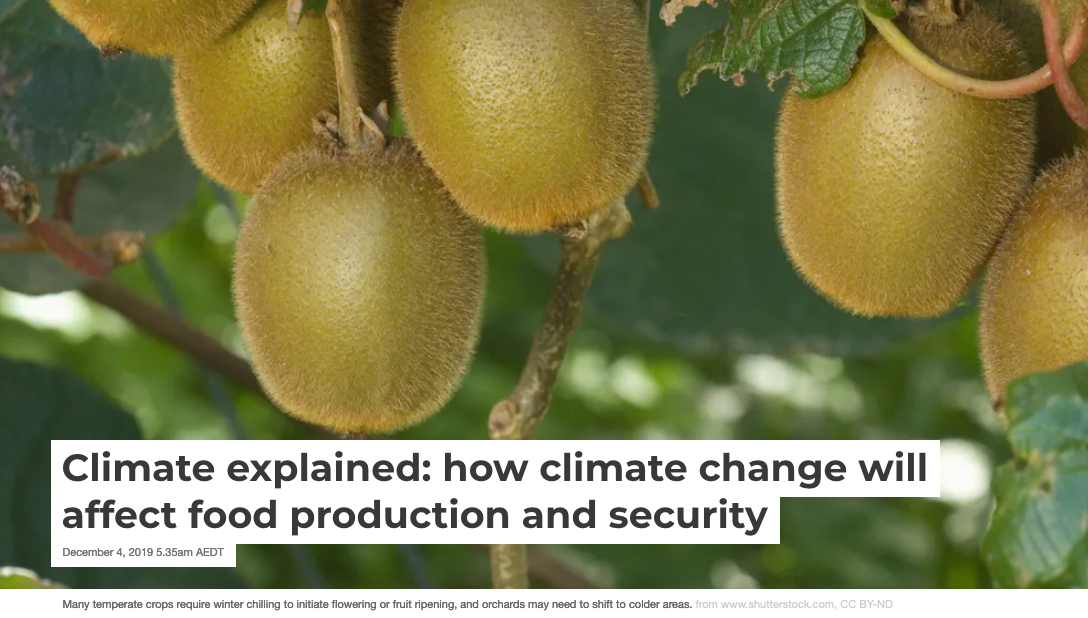
Chilling requirements for food crops

 Related:  9 Ways to assist Australia's farmers with climate change


The global food system is in a state of profound crisis
Some Costa Rican forests returned after removing cattle farming subsidies


Wednesday, 6 May 2020

'Blown away': Safe climate niche closing fast, with billions at risk: SMH

By


As much as one-third of the world's population will be exposed to Sahara Desert-like heat within half a century if greenhouse gas emissions continue to rise at the pace of recent years.

Scientists from China, the US and Europe found that the narrow
climate niche that has supported human society would shift more over the next 50 years than it had in the preceding 6000 years.

"As many as 3.5 billion people will be exposed to "near-unliveable" temperatures averaging 29 degrees through the year by 2070. Less than 1 per cent of the Earth's surface now endures such heat.
That heat compares with the narrow 11- to 15-degree range that has supported civilisation over the past six millennia, according to research published Tuesday in the journal Proceedings of the National Academy of Sciences."

Xu Chi, a researcher at China's Nanjing University and one of the paper's authors, said: "We were frankly blown away by our own initial results. As our findings were so striking, we took an extra year to carefully check all assumptions and computations."

Read the complete SMH article

Thursday, 9 January 2020

Climate Change is a cause of attacks on democracy

As the climate crisis worsens and conflict increases over scarce resources expect more threats to authentic democracy.


In The Maldives

President Abdulla Yameen of the Maldives. AFP/Getty


"According to a 2017 study published in The Lancet, extreme weather could displace up to a billion people around the world by the middle of the twenty-first century—an unprecedented human migration will undoubtedly influence the politics of wealthy countries, pushing them to the right.

The best way to counteract this phenomenon is naturally to halt, or at least slow, the effects of climate change. So far, the Paris agreement is the only tangible result of those efforts, and its fate is far from certain .............  But this might change, if the problems caused by climate change—not just stronger hurricanes, droughts, and rising seas, but political rupture—keep washing up on the disappearing shorelines of wealthy governments."

Go to The New Republic article


Around the world


"In its 5th Assessment Report (2014), the Intergovernmental Panel on Climate Change (IPCC) unequivocally confirmed that climate change is real and that human-made greenhouse gas emissions are its primary cause. The report identified the increasing frequency of extreme weather events and natural disasters, rising sea-levels, floods, heat waves, droughts, desertification, water shortages, and the spread of tropical and vector-borne diseases as some of the adverse impacts of climate change. These phenomena directly and indirectly threaten the full and effective enjoyment of a range of human rights by people throughout the world, including the rights to life, water and sanitation, food, health, housing, self-determination, culture and development."

Go to the ohchr.org story


In Australia


"Scott Morrison (Australia's Prime Minister) has signalled a crackdown on “selfish, indulgent and apocalyptic” environmental activists."
Go to The New Daily story 


"It takes some chutzpah to stand up with a straight face and deliver a speech foreshadowing a government crackdown on protest activity while in the same breath declaring that a new insidious form of progressivism is intent on denying the liberties of Australians."

Go to The Guardian story


Our democratic freedoms are under threat in Australia and around the world.


Australian Federal Police raid the ABC offices

"Source confidentiality is one of journalists’ most central ethical principles. It is recognised by the United Nations and is vital to a functioning democracy and free, independent, robust and effective media. 

Go to The Conversation article


"If the major parties and politicians want to rebuild trust with voters, they will need to change the way they do politics: stop misusing their entitlements, strengthen political donations laws, tighten regulation of lobbyists, and slow the revolving door between political offices and lobbying positions."

Let's safeguard our democratic institutions such as free speech, restrictions on overwhelming amounts of corporate donations to political parties, freedom to protest, freedom to privacy, freedom to gather.
 

In the USA

Go to The Atlantic article: David Goldman / AP


"As heat, disaster risks, and rising seas bombard local governments, the ability of those governments to fulfill their basic functions—the delivery of services, the maintenance of the safety net, and managing civil, familial, and educational institutions—could be degraded, too. This could manifest in three distinct phenomena that are already on display in disaster-affected areas: the increased dominance of private and developer-class interests in local politics, the acceleration of existing wealth inequality, and the collapse of institutions dedicated to disaster response."

Go to The Atlantic article


Prominent media corporations are supporting climate deniers, fossil fuel dependent corporations and corporations whose profits depend on degrading the human environment.

Let's care for our vulnerable. 

Lets support action plans (see below) to tackle climate change.

Go to World Bank document


Wednesday, 25 September 2019

'It doesn't feel justifiable': The couples not having children because of climate change: SMH

"Morgan and Adam have always wanted children but fears over climate change are making them reconsider.

The committed pair, aged 36 and 35, are part of a growing trend for young couples to abandon plans for a family because of the climate crisis.

Millions of people around the world rallied for climate action over the past two days, including 300,000 in Australia on Friday, ahead of a United Nations climate action summit on Monday."

' "I feel so sad, it's such a hard thing to let go of," says Morgan, who works in logistics. "My conscience says, 'I can't give this child what I've enjoyed, I can't give them the certainty of a future where they can be all that they can be ... or have the things they should have, like breathable air and drinkable water'."'

Wednesday, 11 September 2019

Time to rethink Australia's fire fighting resources.


📷: Bindi Cox
Our wildfires are taking lives, destroying homes and infrastructure and stressing our rural communities. 

Our firefighters in Australia, both paid and volunteer, are out there risking injury and putting their lives on the line, or at the very least sacrificing their work. Employers, often small business employers, are supporting them. Are our firefighters sufficient in number?


"There are still 50 fires burning across New South Wales, with 21 fires uncontained. A total of 630 firefighters have been deployed across the state. A fire in Bees Nest, north-west of Dorrigo in the Armidale area, is currently over 66,500 hectares and out of control." September 10


What are we losing in these fires?

📷 Photo Credit: Darren, Jimboomba Police
 • Of course we are losing homes and infrastructure. Communities are being traumatised. We are now wondering whether drought stricken communities will have the required water to fight the inevitable fires that climate change is increasing. 

• We now have a new fire category, 'extreme'.

• We are also losing precious forests and biodiversity. This week the Gondwana World Heritage Area has been severely damaged.

"The Gondwana Rainforests of Australia, World Heritage Area, contains the most extensive areas of subtropical rainforest in the world, large areas of warm temperate rainforest, and the majority of the world's Antarctic beech cool temperature rainforest. These extraordinary areas still contain ancient and primitive plants and animals from which life on Earth evolved." NSW National Parks

The same fire began in the Guy Fawkes River National Park and by September10,  had burned 66,500 hectares and was 'out of control'.
 
"The park is a significant conservation site with amazing biodiversity. There are 24 threatened animal species you might encounter here, including the brush-tailed rock-wallabies that can often be seen in the park’s rocky areas." National Parks


There has been a world wide reaction to careless burning of the Amazon forests. Other countries are busily planting trees to protect soils and store carbon, yet Australia is busy clearing trees and fighting forest fires with limited resources. 


It is time to review our fire fighting resources.

We know some extra resources have been ordered or already purchased.

"New South Wales has signed a contract with United States-based Coulson Aviation to purchase three aircraft for firebombing duties, including a modified Boeing 737 large air tanker.

  
NSW buys Boeing 737 large air tanker for firefighting ...


https://australianaviation.com.au › 2019/05 › nsw-buys-boeing-737-large-..."

As we face an increasing number of fierce fires in an extended fire season, it is time to ask:

Are we allowing our rural communities to suffer unnecessarily?

Why are we allowing our world heritage forests with unique biodiversity to burn?

Do we have sufficient resources to fight fires and to extinguish them quickly?

Why are we still reliant on volunteers? Why are we putting volunteers at risk?

Do we have enough air support?

Is a budget surplus a priority over expanding our firefighting resources and better protecting our communities? 

Related:

What if we stopped pretending Climate Change could be prevented.