Showing posts with label food shortages. Show all posts

Tuesday, 25 August 2020

CLIMATE CHANGE, FOOD SECURITY, AND AGROBIODIVERSITY: C.G. Gonzalez

"CLIMATE CHANGE, FOOD SECURITY, AND AGROBIODIVERSITY: TOWARD A JUST, RESILIENT, AND SUSTAINABLE FOOD SYSTEM Carmen G. Gonzalez* 

The global food system is in a state of profound crisis
Climate change will cause more food shortages

 
The global food system is in a state of profound crisis. Decades of misguided aid, trade, and production policies have generated record levels of world hunger despite bountiful harvests and soaring profits for the transnational corporations that dominate the global food supply. The rapid expansion of industrial agriculture has produced an unprecedented loss of plant genetic diversity,  making the world's food supply dangerously vulnerable to wide-spread crop failure akin to that of the Irish potato famine.  In addition, climate change threatens to wreak havoc on food production by increasing the frequency and severity of extreme weather events, depressing agricultural yields, reducing the productivity of the world's fisheries,  and placing additional pressure on scarce water resources. 

* Professor of Law, Seattle University School of Law
 .............
 
The global food system is in a state of profound crisis
sustainable food systems

This Article examines the underlying causes of the global food crisis and recommends specific measures to address the distinct but related problems of food insecurity, loss of genetic resources, and climate change." 

Go to the scholarly article by Carmen g. Gonzalez


Related:
The global food system is in a state of profound crisis
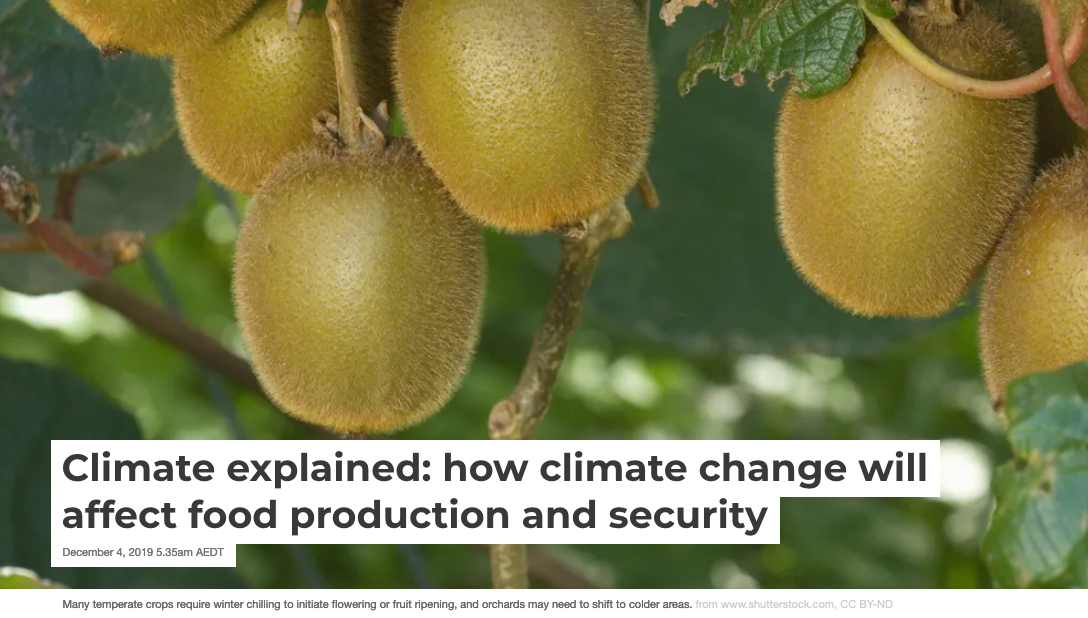
Chilling requirements for food crops

 Related:  9 Ways to assist Australia's farmers with climate change


The global food system is in a state of profound crisis
Some Costa Rican forests returned after removing cattle farming subsidies


Saturday, 22 August 2020

WHO Manifesto for a healthy recovery from COVID-19: Video


The WHO Manifesto for a healthy recovery from COVID-19 lists six steps to create a healthier , fairer  and greener world while investing to maintain and resuscitate the economy. 
 

Sunday, 22 March 2020

The Frontline: experts answer your questions on the impacts of the climate emergency – as it happened: Ther Guardian

To mark the end of The Frontline series a panel of experts answer your questions about the climate crisis and how it is affecting Australia.
Ask Prof Lesley Hughes, Greg Mullins, Prof Michael Mann and Assoc Prof Donna Green your questions, and see the answers on our live blog. Email frontline.live@theguardian.com or tweet #frontlinelive

Thursday, 9 January 2020

Climate Change is a cause of attacks on democracy

As the climate crisis worsens and conflict increases over scarce resources expect more threats to authentic democracy.


In The Maldives

President Abdulla Yameen of the Maldives. AFP/Getty


"According to a 2017 study published in The Lancet, extreme weather could displace up to a billion people around the world by the middle of the twenty-first century—an unprecedented human migration will undoubtedly influence the politics of wealthy countries, pushing them to the right.

The best way to counteract this phenomenon is naturally to halt, or at least slow, the effects of climate change. So far, the Paris agreement is the only tangible result of those efforts, and its fate is far from certain .............  But this might change, if the problems caused by climate change—not just stronger hurricanes, droughts, and rising seas, but political rupture—keep washing up on the disappearing shorelines of wealthy governments."

Go to The New Republic article


Around the world


"In its 5th Assessment Report (2014), the Intergovernmental Panel on Climate Change (IPCC) unequivocally confirmed that climate change is real and that human-made greenhouse gas emissions are its primary cause. The report identified the increasing frequency of extreme weather events and natural disasters, rising sea-levels, floods, heat waves, droughts, desertification, water shortages, and the spread of tropical and vector-borne diseases as some of the adverse impacts of climate change. These phenomena directly and indirectly threaten the full and effective enjoyment of a range of human rights by people throughout the world, including the rights to life, water and sanitation, food, health, housing, self-determination, culture and development."

Go to the ohchr.org story


In Australia


"Scott Morrison (Australia's Prime Minister) has signalled a crackdown on “selfish, indulgent and apocalyptic” environmental activists."
Go to The New Daily story 


"It takes some chutzpah to stand up with a straight face and deliver a speech foreshadowing a government crackdown on protest activity while in the same breath declaring that a new insidious form of progressivism is intent on denying the liberties of Australians."

Go to The Guardian story


Our democratic freedoms are under threat in Australia and around the world.


Australian Federal Police raid the ABC offices

"Source confidentiality is one of journalists’ most central ethical principles. It is recognised by the United Nations and is vital to a functioning democracy and free, independent, robust and effective media. 

Go to The Conversation article


"If the major parties and politicians want to rebuild trust with voters, they will need to change the way they do politics: stop misusing their entitlements, strengthen political donations laws, tighten regulation of lobbyists, and slow the revolving door between political offices and lobbying positions."

Let's safeguard our democratic institutions such as free speech, restrictions on overwhelming amounts of corporate donations to political parties, freedom to protest, freedom to privacy, freedom to gather.
 

In the USA

Go to The Atlantic article: David Goldman / AP


"As heat, disaster risks, and rising seas bombard local governments, the ability of those governments to fulfill their basic functions—the delivery of services, the maintenance of the safety net, and managing civil, familial, and educational institutions—could be degraded, too. This could manifest in three distinct phenomena that are already on display in disaster-affected areas: the increased dominance of private and developer-class interests in local politics, the acceleration of existing wealth inequality, and the collapse of institutions dedicated to disaster response."

Go to The Atlantic article


Prominent media corporations are supporting climate deniers, fossil fuel dependent corporations and corporations whose profits depend on degrading the human environment.

Let's care for our vulnerable. 

Lets support action plans (see below) to tackle climate change.

Go to World Bank document


Sunday, 11 August 2019

Can Earth be saved? Climate change is threatening the world's food supply, according to a UN panel.: Al Jazeera


Report after report have been warning about the dangers of climate change - and that it is happening right now.

The United Nations Intergovernmental Panel on Climate Change has put the minds of more than 100 scientists together.

What they are saying is alarming: Not only are rising temperatures threatening the planet, but so are the world's eating habits.

The way food is farmed is drastically degrading the Earth's land, and scientists predict that is making global warming worse and will lead to food shortages.

So, how will governments respond to this warning?

Presenter: Mohamed Jamjoom


Guests:
Simon Lewis - Professor of global change science at University College London
Patrick Holden - CEO of Sustainable Food Trust
Jan Kowalzig - Senior climate policy adviser at Oxfam Germany

Sunday, 4 August 2019

Video / Climate Scientist Jason Box: “Our Economic System Is Crashing With Reality”: Democracy Now


Published on Aug 2, 2019
 
A heat wave is causing unprecedented melting of the Greenland ice sheet. Meanwhile, the World Meteorological Organization just declared July 2019 the hottest month ever recorded. We speak with Jason Box, professor and ice climatologist at the Geological Survey of Denmark and Greenland, about the intensifying climate crisis. 

He says humanity must move toward living in balance with the environment. “If we don’t reduce greenhouse gas emissions and ultimately stabilize CO2 … there’s no real prospect for a stable society or even a governable society,” Box says. “Perpetual growth on a finite planet is, by definition, impossible.”

Related:  

Heatwave: think it’s hot in Europe? The human body is already close to thermal limits elsewhere :The Conversation

Friday, 21 June 2019

Old spy satellite images show just how fast ice is melting from the glaciers in the Himalayas: USA Today

"Picture 3 million Olympic-size swimming pools full of water.

That's how much ice melts from glaciers in the Himalayas each year, a new study suggests, and climate change is the primary cause. 

Even more concerning is that the ice melt has doubled in recent years: Himalayan glaciers have been losing the equivalent of more than a foot and half of ice each year since 2000 – which is double the amount of melting that took place from 1975 to 2000. 

“This is the clearest picture yet of how fast Himalayan glaciers are melting over this time interval and why,” said study lead author Joshua Maurer, a Ph.D. candidate at Columbia University’s Lamont-Doherty Earth Observatory.

Overall, the Asian mountain range, which includes Mount Everest, has been losing ice at a rate of about 1% a year since 2000.


Wednesday, 22 May 2019

The heat is on over the climate crisis. Only radical measures will work : The Guardian

Experts agree that global heating of 4C by 2100 is a real possibility. The effects of such a rise will be extreme and require a drastic shift in the way we live


Drowned cities; stagnant seas; intolerable heatwaves; entire nations uninhabitable… and more than 11 billion humans. A four-degree-warmer world is the stuff of nightmares and yet that’s where we’re heading in just decades.


While governments mull various carbon targets aimed at keeping human-induced global heating within safe levels – including new ambitions to reach net-zero emissions by 2050 – it’s worth looking ahead pragmatically at what happens if we fail. After all, many scientists think it’s highly unlikely that we will stay below 2C (above pre-industrial levels) by the end of the century, let alone 1.5C. Most countries are not making anywhere near enough progress to meet these internationally agreed targets.

Read The Guardian Article 

See also:

A Postmortem for Survival: on science, failure and action on climate change


Friday, 22 March 2019

Vote for your children's climate. Vote for your climate.


• Suddenly, many conservative politicians in Australia have 'backflipped'  and now publicly accept that we are living in an age of rapid climate change.... 

BUT

#climate change  #globalheating  #searise  #Liberal Party  #Labor Party
Vote for my future climate

• Many politicians still fail to grasp the catastrophic impacts of climate change all life on Earth will soon experience, therefore they are only 'greenwashing' their election campaigns.


• Most scientists believe we are very likely to heat the planet well beyond 2 degrees.

• The Liberal - National Party Coalition has loudly and publicly rebadged Tony Abbott's Direct Action funding, which inefficiently used your taxes to bribe polluters but has the proposed funding allocation by $200 million at the same time.


• Under the threat of an election defeat by a
The young want climate action
climate activist, Tony Abbott now says he believes in climate change.

• NSW has the biggest state economy yet it's contribution to planning for climate change and slowing global heating is pitiful.

• Yet some National Party and Liberal Party MPs still want to build new, subsidised, coal-powered energy generators even though renewable energy is cheaper and as reliable.

• The Federal Labor Party still supports the Queensland Labor Party's support of new, massive, coal mines. It has no plan to transition coal workers out of coal mining jobs.

• The above parties have no real planning for slowing and mitigating the effects of climate change. It is unlikely we will meet the Paris targets, (don't believe the false accounting of the the Liberal Party - National Party Coalition). 

Only candidates promising a massive attack on the causes of climate change and promising real planning for more economic downturns, droughts, heat waves, bush fires, epidemics, food and water shortages, health epidemics, ocean acidification, animal extinctions, sea inundations, property devaluations and waves of climate refugee immigration deserve your first vote.

Vote for your children's climate.

Vote for your climate. 

Related: Will predicted sea rise inundation affect property values in Coffs Harbour NSW?

#climate change  #globalheating  #searise  #Liberal Party  #Labor Party
 

Saturday, 16 February 2019

Global warming is increasing the chances of worldwide harvest failure on the scale of the tragic 19th century drought and famine that claimed 50 million lives.

Awaiting aid in drought-ravaged Somalia in 2011.
Awaiting aid in drought-ravaged Somalia in 2011. Image: Stuart Price/UN Multimedia
"LONDON − Climate change driven by human-induced global warming could recreate the conditions for a re-run of one of the most tragic episodes in human history, the Great Drought and Global Famine of 1875 to 1878.
Those years were marked by widespread and prolonged droughts in Asia, Brazil and Africa, triggered by a coincidence of unusual conditions in the Pacific, Indian, and North Atlantic Oceans.

The famine – made more lethal by the political constraints linked to 19th-century colonial domination of three continents – is now thought to have claimed up to 50 million lives.

And the message contained in new research published in the Journal of Climate is stark: what happened before could happen again."

#foodshortages  #famine  #global heating  #climate action  #asia  #brazil  #africa  

See also  New Report Warns Geoengineering the Climate Is a '...

Monday, 10 December 2018

World Economic Forum: Climate change is speeding up. Our response needs to be even faster

There is no more room in the atmosphere for our carbon.pollution
"The race is on. This northern summer’s deadly, record-breaking heatwaves and wildfires leave us in no doubt that the impacts of global warming are accelerating, in many cases much faster than scientists predicted. 


One of the most important, but least understood, aspects of the Paris Agreement is that it legally obliges every country to deepen its emission reduction targets every five years. I call this five-yearly cycle the Agreement’s beating heart, because it provides the life force for achieving the temperature goals that will keep the worst impacts of global warming at bay."

Read the WEF article 

 #carbon #china #usa #coalmining #globalwarming #climateaction #carbondioxide #1.5 degrees

WEF: Climate change is making our food less nutritious

Vital crops from wheat to rice are at risk of becoming less nutritious due to rising carbon levels.
Image: REUTERS/Desmond Boylan DB/jk
"Rising carbon emissions could make vital food crops from wheat to rice less nutritious and endanger the health of hundreds of millions of the world's poorest, scientists said on Monday.

Certain staple crops grown in open fields with elevated carbon dioxide levels had up to 17 percent lower levels of protein, iron and zinc compared to those grown amid less of the gas, according to a study in the journal Nature Climate Change."

Read WEF article.

Friday, 30 November 2018

The Guardian: Climate change already a health emergency, say experts

"Deadly heatwaves and spread of diseases affect people’s health today – report.

People’s health is being damaged today by climate change through effects ranging from deadly heatwaves in Europe to rising dengue fever in the tropics, according to a report.

Billions of hours of farmwork has been lost during high temperatures and global warming has damaged the ability to grow crops, it said."

Read The Guardian article 

Related:

Australia shamed – again – on climate, as UNEP report calls for urgent action