Ice sheets in Greenland and Antarctica whose melting rates are
rapidly increasing have raised the global sea level by 1.8cm since the
1990s, and are matching the Intergovernmental Panel on Climate Change's
worst-case climate warming scenarios.
According
to a new study from the University of Leeds and the Danish
Meteorological Institute, if these rates continue, the ice sheets are
expected to raise sea levels by a further 17cm and expose an additional
16 million people to annual coastal flooding by the end of the century.
Since the ice sheets were first monitored by satellite in the 1990s,
melting from Antarctica has pushed global sea levels up by 7.2mm, while
Greenland has contributed 10.6mm. And the latest measurements show that
the world's oceans are now rising by 4mm each year.
"Although we anticipated the ice sheets would lose increasing amounts
of ice in response to the warming of the oceans and atmosphere, the
rate at which they are melting has accelerated faster than we could have
imagined," said Dr. Tom Slater, lead author of the study and climate
researcher at the Centre for Polar Observation and Modelling at the
University of Leeds.
"The melting is overtaking the climate models we use to guide us, and we are in danger of being unprepared for the risks posed by sea level rise."
"Our homes have become sanctuaries — places of refuge in the time of coronavirus. But they can't protect us from all threats.
Analysts
say the houses we've built, and where we've built them, could increase
our future vulnerability as we face the ongoing effects of climate
change.
Analysts fear insurers may withdraw
from areas they don't believe
are profitable.(ABC News: Tim Swanston)
With increased damage to houses through
catastrophic fires, floods and other disasters, the global insurance
market is under increasing stress, and there are fears whole communities
could become impoverished or homeless.
Experts
doubt industry players and governments have fully come to terms with the
issue — and they worry about some of the financial mechanisms insurance
companies have put in place to share the risk.
Too focused on past catastrophes
Insurers
have a short-term focus and often fail to be proactive in assessing
future problems, according to Jason Thistlethwaite, a Canada-based
academic and expert on insurance practice.
He says
while global climate models are forward looking, the actuarial practices
used for risk modelling in the insurance industry are not.
Put bluntly, insurers still spend most of their time looking in the rear-view mirror.
Erosion could cost some homeowners their entire asset, experts warn.(ABC RN: Antony Funnell)
Where
there has been a shift in attitude, though, is among "reinsurers" —
essentially, the insurance companies for insurance companies.
"Reinsurers
are starting to grasp that these extreme events are something known as
correlated risk, meaning that there is a common cause underlying them,"
Professor Thistlethwaite says.
"So, Australia may
have a good year with very few claims in the primary insurance market,
but reinsurance rates may still go up because there is bad flooding in
the Philippines or the United Kingdom, for instance.
"They
are operating at a global scale that allows them to pick up on data
points that provide a much more coherent pattern that shows extreme
weather events are getting worse and contributing to higher losses."
He says that broader, interconnected understanding of
risk is starting to filter down to primary insurers, as they themselves
experience increasing reinsurance costs.
Nevertheless,
he's predicting a rationalisation of the primary insurance market, with
some companies going bust and others simply withdrawing from areas they
don't believe profitable.
Rise of the 'red zones of risk'
Professor
Thistlethwaite says it's already happening in the United States in
regions regularly affected by major climate-related events, such as
hurricanes and tornados.
And it's also beginning to occur in Australia, according to Karl Mallon, director of science at the organisation Climate Risk.
"If
we see emissions continuing in the current direction, the level of
warming continuing in the same direction, and if we continue to see a
sort of blind attitude to what's happening, then our risk will rise to
about one in 10 properties," he says.
"Ninety per
cent of properties may be OK, as in they are still insurable, even
though the costs might be elevated. [But] one in 10 may really cross into the red zone territory."
Early last year the
Insurance Council of Australia accused Dr Mallon of "scaremongering",
but its president Richard Enthoven has since acknowledged that changing
weather systems could potentially make some parts of Australia
"uninsurable".
Dr Mallon cites parts of the Gold
Coast in Queensland, the Central Coast in New South Wales, and West
Lakes in South Australia as regions facing an impending crisis.
Legal
expert Justine Bell-James warns that coastal communities could face a
double hit: not only could their houses become uninsurable, but some
homeowners could lose their entire asset due to erosion."
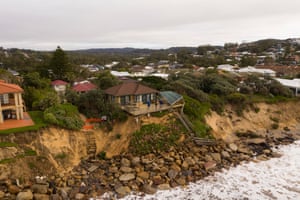
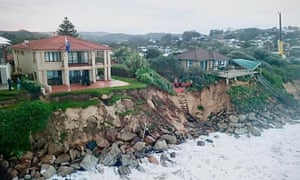
Coastal erosion in the suburb of Wamberal on the Central Coast of NSW
where homes are at risk of collapse after huge swells hit the state’s
beaches on Thursday.
Photograph: James D Morgan/Getty Images
Several houses on Ocean View Drive now dangerously close to cliff edge as huge waves wash away beaches.
The worst-hit suburb was Wamberal, where large beachfront homes have
been significantly damaged as the sandy soil they were built on was
stripped away.
Comment by blog admin : As sea level rises and higher storm surges destroy more beachfront property the owners will lobby for unaffordable sea walls but ratepayers will resist. Coastal retreat will become the norm. Will you buy where sea rise and coastal surges will occur?
"New study says building defenses along Jersey Shore would cost billions and suggests the fossil-fuel industry should pay
New Jersey would have to pay almost $25 billion to build almost 2,700
miles of seawalls to protect its coastal communities from anticipated
sea-level rise by 2040, according to the latest study on the state’s vulnerability to rising ocean levels.
The Center for Climate Integrity, a Washington, DC-based advocacy
group, said New Jersey faces the sixth-biggest bill for sea-wall
construction of any state, while low-lying Cumberland County would have
to pay the most — $5.8 billion for 532 miles of seawalls — among New
Jersey’s counties."