Showing posts with label insurance. Show all posts

Friday, 16 October 2020

Florida Sees Signals of a Climate-Driven Housing Crisis (excerpt): NYT

"Home sales in areas most vulnerable to sea-level rise began falling around 2013, researchers found. Now, prices are following a similar downward path."

In Florida, home sales in areas at high risk from sea-level rise

have fallen compared to areas at low risk.


"The idea that climate change will eventually ruin the value of coastal homes is neither new nor particularly controversial. In 2016, the then-chief economist for the federal mortgage giant Freddie Mac warned that rising seas “appear likely to destroy billions of dollars in property and to displace millions of people.” By 2045, more than 300,000 existing coastal homes will be at risk of flooding regularly, the Union of Concerned Scientists concluded in 2018.

The question that has occupied researchers is how soon, and how quickly, people will respond to that risk by demanding price discounts or fleeing the market. Previous research has begun to tackle that question, showing that climate change, far from being a distant threat, is already starting to hurt real estate values."


Credit...Rose Marie Cromwell for The New York Times

"Then, starting in 2013, something started to change. While sales in safer areas kept climbing, sales in vulnerable ones began to fall. By 2018, the last year for which Dr. Keys and Mr. Mulder obtained data, sales in vulnerable areas trailed safer areas by 16 percent to 20 percent.

A few things happened around that time that might have made prospective home buyers more worried about climate risk, Dr. Keys said. An international report the previous year highlighted the risks of extreme weather events. After that report came out, Google searches in Florida for “sea level rise” spiked.

And people from the Northeast, who account for a significant portion of Florida home buyers, had just lived through Hurricane Sandy, which damaged some 650,000 homes and caused 8.5 million people to lose power, some for months."


Go to NYT original full length story 


Related: I’m an American Climate Emigrant (excerpts): Sierra


Saturday, 5 September 2020

Choosing A Place To Retire? Factor In Climate Change (excerpt): Forbes


The hazards of wildfires and extreme heat are also intensifying due to climate change.
Hurricane damage
(Pics added by this blog)

"When Bill and Annemarie Kachur retired in early 2016, they saw no reason to go anywhere. The gray shingled bungalow in Myrtle Beach, S.C. had been their home for more than 15 years.

“I’ve been here so long, it’s a sense of roots now for me,” says Bill, 65, who spent his early career hopping around the country, working on-air at various radio stations. 

Plus, they were already in a haven for retirees. “I like the fact that there isn’t a winter,” says Annemarie, who’ll be 65 in September.
But in recent years, their idyllic spot about 2 ½ miles from the Atlantic Ocean has revealed an ominous side: hurricane season. “I just noticed that the last four or five years, we keep getting hammered,” recalls Bill.

Two Hurricane Evacuations Since 2016

Since 2016, the Kachurs have ridden out four hurricanes, including two evacuations to safer ground.

“Ten months out of the year, it’s great,” says Bill. “And then there’s a couple months out of the year when you’re walking on eggshells and you’re a little bit concerned about what’s blowin’ in the wind, so to speak.” 

Warm, beachy spots on the Atlantic, Pacific and Gulf Coasts have been retirement magnets for decades. But, as Hurricane Laura just underscored, they’re also squarely in the crosshairs of the changing climate, effects of which are already evident in many of the nation’s most popular retirement destinations.

The hazards of wildfires and extreme heat are also intensifying due to climate change.
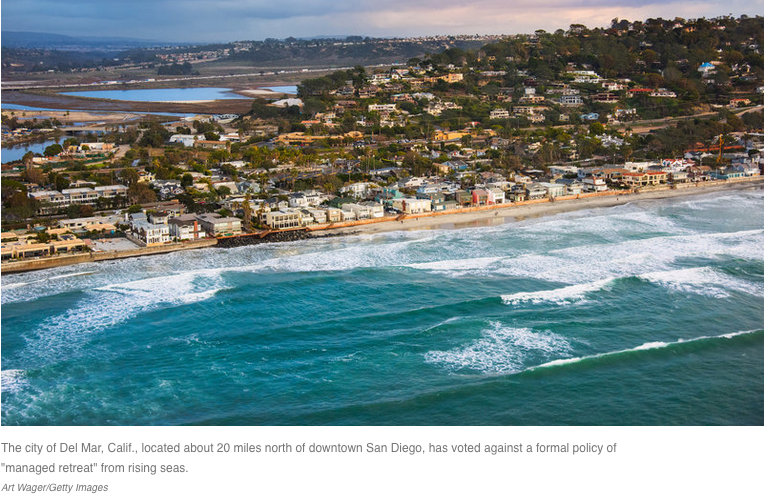
Planned retreat from rising seas


Climate Change and Retirement Location Decisions

“Current climate and future climate is absolutely something that people should be thinking about when deciding where to live, where to retire,” advises Radley Horton, a climate scientist at Columbia University’s Earth Institute, who has focused on climate adaptation strategies. “Those are absolutely critical concerns when you think about impacts directly on the home, but also livability outdoors — things like critical infrastructure, too,” says Horton.

The hazards of wildfires and extreme heat are also intensifying due to climate change.
Californian Wildfires
Rising seas are threatening things we tend to take for granted in many areas, like major freeways, airports and sewage treatment plants. The hazards of wildfires and extreme heat are also intensifying due to climate change."

Where then to retire to? : Read complete Forbes article: By Craig Miller, Science Journalist

Related: Port Macquarie after a 7m sea level rise. Insurance risks affect property values now.

Related: 'Retreat' Is Not An Option As A California Beach Town Plans For Rising Seas: NPR

hurricanes, #searise, #bushfires, property values, insurance, #America, #Australia, #Houston, #wildfire,  

Friday, 14 August 2020

Sea Level Rise Effect on Mumbai of 1.5m rise

Mumbai, land at risk from 1.5m sea rise
 • We are looking more and more unlikely to prevent global heating.

• Scientists are predicting the melting of the ice covering Greenland with a subsequent sea level rise of 7m.

• This rise does not factor in sea rise from the melting of Antarctica and other ice.

• Already many properties are likely to flood when a high tide is combined with high local rainfall. 
 

What were a hundred year rainfall events are now ten year events.


Mumbai, land at risk with 1.0m sea rise
 
• The frequency of high rainfall events will increase with global heating and more and more severe hurricanes are predicted because of warmer seas.


• Low coastal areas will be subjected to severe storm surges.

• Would you buy a property likely to be inundated in twenty years, fifty years, a hundred years? Many wouldn't. Even the perception of possible inundation will greatly affect property values. Some properties will become more expensive to insure or become impossible to insure

• When certain properties are in less demand their value falls.

• Would you buy a property with a value that is likely to fall?

•  The view of Mumbai above shows areas likely to be inundated by a 1.5m and a 1.0m sea level rise.

• Property above a 10m rise will become highly sought after and will greatly increase in value.

Learn more about how sea rise inundation will affect India's property, indeed any property, at climatecentral.org


Related:

Greenland shed ice at unprecedented rate in 2019; Antarctica continues to lose mass: EurekAlert


Melbourne: predicted flooding with a conservative sea level rise of only 1.5m


#sea level rise, #Greenland ice melt, #sea ice, #climateaction, #climatechange, #jailclimatecriminals, #cambio-climatico,  

Friday, 24 July 2020

Insuring your home may get harder and more expensive as climate change increases risks: ABC


Climate change, #jailclimatecriminals
Threatened by rising sea level
"Our homes have become sanctuaries — places of refuge in the time of coronavirus. But they can't protect us from all threats.


Analysts say the houses we've built, and where we've built them, could increase our future vulnerability as we face the ongoing effects of climate change.

Destroyed units  #jailclimatecriminals
Analysts fear insurers may withdraw
 from areas they don't believe
 are profitable.(ABC News: Tim Swanston)
With increased damage to houses through catastrophic fires, floods and other disasters, the global insurance market is under increasing stress, and there are fears whole communities could become impoverished or homeless.

Experts doubt industry players and governments have fully come to terms with the issue — and they worry about some of the financial mechanisms insurance companies have put in place to share the risk.

Too focused on past catastrophes

Insurers have a short-term focus and often fail to be proactive in assessing future problems, according to Jason Thistlethwaite, a Canada-based academic and expert on insurance practice.

He says while global climate models are forward looking, the actuarial practices used for risk modelling in the insurance industry are not.

Put bluntly, insurers still spend most of their time looking in the rear-view mirror.

Sandbags and temporary fencing stretch down a beach at the base of a large, eroded sand dunes.
Erosion could cost some homeowners their entire asset, experts warn.(ABC RN: Antony Funnell)

Where there has been a shift in attitude, though, is among "reinsurers" — essentially, the insurance companies for insurance companies.


"Reinsurers are starting to grasp that these extreme events are something known as correlated risk, meaning that there is a common cause underlying them," Professor Thistlethwaite says.

"So, Australia may have a good year with very few claims in the primary insurance market, but reinsurance rates may still go up because there is bad flooding in the Philippines or the United Kingdom, for instance.

"They are operating at a global scale that allows them to pick up on data points that provide a much more coherent pattern that shows extreme weather events are getting worse and contributing to higher losses."

He says that broader, interconnected understanding of risk is starting to filter down to primary insurers, as they themselves experience increasing reinsurance costs.

Nevertheless, he's predicting a rationalisation of the primary insurance market, with some companies going bust and others simply withdrawing from areas they don't believe profitable.

Rise of the 'red zones of risk'

Professor Thistlethwaite says it's already happening in the United States in regions regularly affected by major climate-related events, such as hurricanes and tornados.

And it's also beginning to occur in Australia, according to Karl Mallon, director of science at the organisation Climate Risk.

"If we see emissions continuing in the current direction, the level of warming continuing in the same direction, and if we continue to see a sort of blind attitude to what's happening, then our risk will rise to about one in 10 properties," he says.

"Ninety per cent of properties may be OK, as in they are still insurable, even though the costs might be elevated. [But] one in 10 may really cross into the red zone territory."

Early last year the Insurance Council of Australia accused Dr Mallon of "scaremongering", but its president Richard Enthoven has since acknowledged that changing weather systems could potentially make some parts of Australia "uninsurable".

Dr Mallon cites parts of the Gold Coast in Queensland, the Central Coast in New South Wales, and West Lakes in South Australia as regions facing an impending crisis.

Legal expert Justine Bell-James warns that coastal communities could face a double hit: not only could their houses become uninsurable, but some homeowners could lose their entire asset due to erosion."


A huge percentage of homes may become uninsurable.
The eroding sea at Wamberal NSW.


Wednesday, 20 May 2020

While the world looked the other way, corporate giants abandoned coal: SMH

"The decisions to exit coal by big financial institutions is carefully tracked by Australian energy finance analyst Tim Buckley, who says 133 globally significant financial institutions have announced their exit from coal, 10 in the past two weeks. That, he says, is "triple the run-rate of last year".

On April 17 Austria eliminated coal from its grid when it closed its last coal-fired plant. "Coal power in Austria is history," said the utility chief. 

"The future belongs to renewable energy."
In the same week Sweden closed its last coal-fired plant two years earlier than planned. The two countries join Belgium celebrating coal-free status."
 ..................................

"On the last day of the month Allianz, one of the world’s biggest insurers with an astronomical investment book, said it would not invest in coal or insure it.

Coal-fired power would be verboten. It will exclude dealings with any corporate that derives more than 30 per cent of its revenue from coal (in two years to be 25 per cent). Farewell also to any partner owning infrastructure that services coal, such as ports or rail, which it now views as long-term toxic and stranded assets.

Once a huge financier of coal, Allianz confirms a massive pivot to renewables."


Read more

Thursday, 26 December 2019

Climate change could end mortgages as we know them: CBS


Read the CBS article

Climate change could end mortgages as we know them


Climate change could punch a hole through the financial system by making 30-year home mortgages — the lifeblood of the American housing market — effectively unobtainable in entire regions across parts of the U.S. 

That's what the future could look like without policy to address climate change, according to the latest research from the Federal Reserve Bank of San Francisco. The bank is considering these and other risks on Friday in an unprecedented conference on the economics of climate change.

For the financial sector, adapting to climate change isn't just an issue of improving their market share. "It is a function of where there will be a market at all," wrote Jesse Keenan, a scholar who studies climate adaptation, in the Fed's introduction.

No more mortgages?.....

Read the CBS article 

 Related:

How the Political Right Uses Fossil Fuels to Galvanize Opposition to Climate Action : Green Market Oracle

#criminalesclimáticosdelacárcel  #jailclimatecriminals  #gaolclimatecriminals

#buyfromthebush  #berejiklianbushfires

Monday, 30 September 2019

Climate Risk in the Housing Market Has Echoes of Subprime Crisis, Study Finds: NYT

"Asaf Bernstein, an economist at the University of Colorado in Boulder, said the findings highlighted another problem: By agreeing to buy mortgages for homes at risk from climate change, without charging a premium that reflects that risk, the federal government had effectively encouraged home construction and purchases in vulnerable areas.


“It’s basically an implicit subsidy,” Mr. Bernstein, who was not involved in the study, said.

Economists at both Fannie and Freddie have warned in the past of the risks that climate-related increases in flooding pose to the mortgage industry. In 2016, Sean Becketti, then the chief economist at Freddie Mac, wrote that rising seas “appear likely to destroy billions of dollars in property.”

“The economic losses and social disruption may happen gradually, but they are likely to be greater in total than those experienced in the housing crisis and Great Recession,” he wrote. “It is less likely that borrowers will continue to make mortgage payments if their homes are literally underwater.”

See also:

'It doesn't feel justifiable': The couples not having children because of climate change: SMH


Wednesday, 31 July 2019

Moody’s Buys Climate Data Firm, Signaling New Scrutiny of Climate Risks:New York Times

Investors are taking global heating/climate change seriously.

"Moody’s Corporation has purchased a controlling stake in a firm that measures the physical risks of climate change, the latest indication that global warming can threaten the creditworthiness of governments and companies around the world.

The rating agency bought a majority share in Four Twenty Seven, a California-based company that measures a range of hazards, including extreme rainfall, hurricanes, heat stress and sea level rise, and tracks their impact on 2,000 companies and 196 countries. In the United States, the data covers 761 cities and more than 3,000 counties. 

“We are taking these risks very seriously,” said Myriam Durand, global head of assessments at Moody’s Investors Service, who said the purchase would allow its credit analysts to be more precise in their review of climate related risks. “You can’t mitigate what you don’t understand.”

The purchase is the latest in a series of moves by rating agencies to better account for the effects of climate change on the ability of governments to pay back the money they borrow by issuing bonds. Global warming can threaten that ability in a variety of ways."


Monday, 29 July 2019

How BHP's climate stance caught its fellow miners on the hop: Financial Review

" 'Society’s combustion of fossil fuels and industrial processes like steelmaking and agriculture have released greenhouse gases at rates much faster than at any other time in the geological past.'

It could be a line from any climate change rally over the past two decades.

Instead the words came straight from the mouth of BHP chief executive Andrew Mackenzie, who warned in a speech in London on Tuesday of an "escalation towards a crisis" and signalled the resources giant would push customers to reduce emissions."


But is this just 'greenwashing' ?

Saturday, 15 June 2019

Climate Change and the Reinsurance Implications: Insurance Journal

Climate Crisis - Insurance Risks
"Climate change presents “high exposure risk” to insurers and their policyholders on many fronts:

General liability claims for third-party bodily injury and property damage, directors and officers claims for a company’s failure to properly disclose climate-related or failure to align its business model with a low-carbon future and first-party loss, including business interruption.

To date, there have been minimal coverage actions relating to climate change, but expect that to change given the increasing number of underlying lawsuits and related activity, “coupled with the staggering liability that is at stake."

Read all The Insurance Journal article

Thursday, 9 May 2019

Study: Sea level rise causes Texas coastal homeowners to lose millions in potential property value: Houston Chronicle

"Sea level rise has cost Texas homeowners $76.4 million in potential property value, with Galveston hit the hardest, a new study released Tuesday found.

First Street Foundation and Columbia University analysts examined about 3 million coastal properties in Texas. Using a combination of real estate transactions and tidal flooding exposure, they found that from 2005 to 2017, homes in Galveston lost $9.1 million in potential value, followed by Jamaica Beach (which lost $8.6. million) and the Bolivar Peninsula ($8.1 million). It’s not necessarily that these coastal homes decreased in value by these amounts, the authors say, but that they didn’t appreciate as much as similar homes not exposed to tidal flooding. Researchers factored in square footage, proximity to amenities and economic trends like the 2008 housing recession."

Sunday, 5 May 2019

The Bank of England lays bare the “very real” trillion-dollar risks of climate change: QUARTZ

My message today is simple. Climate change poses significant risks to the economy and to the financial system, and while these risks may seem abstract and far away, they are in fact very real, fast approaching, and in need of action today.
That’s how Sarah Breeden began her speech titled “Avoiding the storm: Climate change and the financial system” (pdf) yesterday. Breeden is the Bank of England’s executive director of International Banks Supervision and she was speaking at the Official Monetary & Financial Institutions Forum in London.

The urgency in Breeden’s speech was also on display on London’s streets. Earlier in the day, the environmental group Extinction Rebellion blocked traffic in five iconic locations across the city in a peaceful, non-violent protest to bring attention to “inactivity” of governments on fighting climate change.


Sunday, 28 April 2019

Is the Australian coalition government suggesting we shouldn’t try to limit global warming to below two degrees?

The cost of doing nothing about climate change
"Not explicitly, but it is worth asking. 

One of the odd things about the Coalition’s analysis is that it is partly based on a World Bank-backed study that found global carbon prices in 2030 would need to be between US$50 and US$100 to limit global warming to two degrees. But it doesn’t acknowledge that the Coalition has also committed to the two degrees goal (and more) by signing the Paris agreement.

Should we also assume the equivalent of up to a US$100 carbon price under Coalition policies? Or is it walking away from its commitment to Paris?

Media reporting often focuses on the cost of climate policy while ignoring the other side of the equation – the cost of doing nothing. Several studies have suggested it is significant.

A paper in the journal Nature estimated warming of between two and a half and three degrees could cut per-capita economic output by between 15% and 25% this century. Four degrees would be worse again.

This sort of scenario is increasingly being considered and factored in by insurers and long-term investors, who say they want action to avoid it. Whether political leaders and newspaper editors are listening is another question."

Read The Guardian article

Thursday, 18 April 2019

With Climate Losses Rising, Central Banks Push Greener Finance: Bloomberg

Weather related catastrophes are increasing
"The measures are aimed at building awareness about the potential losses as global temperatures increase, making storms more powerful and weather less predictable. It’s also seeking to encourage funding for greener projects that would reduce emissions and make renewables more affordable.


“If some companies and industries fail to adjust to this new world, they will fail to exist,” Carney and Villeroy said in a Guardian newspaper article on Wednesday. They warned that a “massive” reallocation of capital was necessary to prevent global warming, with the banking system playing a pivotal role."

Read the complete Bloomberg story 

See also:

Thursday, 11 April 2019

Port Macquarie after a 7m sea level rise. Insurance risks affect property values now.

Port Macquarie after 7m sea level rise. Click to enlarge
Port Macquarie with 7m sea level rise: Click to enlarge.
• We are looking more and more unlikely to prevent global heating.

• Scientists are predicting the melting of the ice covering Greenland  with a subsequent sea level rise of 7m.

• This rise does not factor in sea rise from the melting of Antarctica and other ice.

• Already many properties and infrastructures are likely to flood when a high tide is combined with high local rainfall. What were a hundred year rainfall events are now ten year events.

• The frequency of high rainfall events will increase with global heating and more and more severe hurricanes are predicted because of warmer seas.

• Low coastal areas will also be subjected to severe storm surges.

• Would you buy a property likely to be inundated in twenty years, fifty years, a hundred years? Many wouldn't. Even the perception of possible inundation will greatly affect property values. Insurers are already reluctant to insure many properties that were once only likely to flood every 100 years.

• When certain properties are in less demand their value falls.

• Would you buy a property with a value likely to fall?

•  The view of Port Macquarie above shows areas likely to be inundated by even a 7m sea level rise. Note the flooding of infrastructure and roads. Water supply will be affected. How could levees hold back such an onslaught?

• Property above a 10m rise will become highly sought after and will greatly rise in value. Property able to be accessed by road will increase in value but properties isolated by sea rise will lose value. New, costly road routes above the Hastings River floodplain will be required. Will NSW be able to afford to update all its infrastructure? Of course local government will be raising rates in an attempt to maintain infrastructure.


Isaac Cordal sculpture depicting politicians discussing global warming

Learn more about how sea rise inundation will affect Australian property.

Click here to go to Coastal Risk Australia site

Related: 'Retreat' Is Not An Option As A California Beach Town Plans For Rising Seas: NPR 


#inundation  #sea rise  #searise  #climatecrisis  #climatechange  #ice  #melting ice  #insurancerisk  #floods  #climate catastrophe  #Port Macquarie

Saturday, 6 April 2019

Urunga NSW: Very affected by sea level rise.

Unundation of Urunga NSW with 7m sea rise. Click to enlarge.
• We are looking more and more unlikely to prevent global heating.

• Scientists are predicting the melting of the ice covering Greenland  with a subsequent sea level rise of 7m.

• This rise does not factor in sea rise from the melting of Antarctica and other ice.

• Already many properties and infrastructures are likely to flood when a high tide is combined with high local rainfall. What were a hundred year rainfall events are now ten year events.

• The frequency of high rainfall events will increase with global heating and more and more severe hurricanes are predicted because of warmer seas.

• Low coastal areas will also be subjected to severe storm surges.

• Would you buy a property likely to be inundated in twenty years, fifty years, a hundred years? Many wouldn't. Even the perception of possible inundation will greatly affect property values. Insurers are already reluctant to insure many properties that were once only likely to flood every 100 years.

• When certain properties are in less demand their value falls.

• Would you buy a property with a value likely to fall?

•  The view of Urunga above shows areas likely to be inundated by even a 7m sea level rise. Note the flooding of infrastructure and roads. Newry Island has disappeared.

• Property above a 10m rise will become highly sought after and will greatly rise in value. Property able to be accessed by road will increase in value but properties isolated by sea rise will lose value. New, costly road routes above the Bellinger/Kalang Rivers floodplain will be required. Will NSW be able to afford to update all its infrastructure? Water supply will be affected.


Isaac Cordal sculpture depicting politicians discussing global warming

Learn more about how sea rise inundation will affect Australian property.

Click here to go to Coastal Risk Australia site

'Retreat' Is Not An Option As A California Beach Town Plans For Rising Seas: NPR 


#inundation  #sea rise  #searise  #climatecrisis  #climatechange  #ice  #melting ice  #insurancerisk  #floods  #climate catastrophe  #Urunga

Thursday, 21 March 2019

Will sea rise affect property values in Kempsey? It looks like it.

Kempsey NSW with a 7m sea rise. Click to enlarge.
• We are looking more and more unlikely to prevent global heating.

• Scientists are predicting the melting of the ice covering Greenland  with a subsequent sea level rise of 7m.

• This rise does not factor in sea rise from the melting of Antarctica and other ice.

• Already many properties are likely to flood when a high tide is combined with high local rainfall. What were a hundred year rainfall events are now ten year events.

• The frequency of high rainfall events will increase with global heating and more and more severe hurricanes are predicted because of warmer seas.

• Low coastal areas will be subjected to severe storm surges.

• Would you buy a property likely to be inundated in twenty years, fifty years, a hundred years? Many wouldn't. Even the perception of possible inundation will greatly affect property values. Insurers are already reluctant to insure many properties that were once only likely to flood every 100 years.

• When certain properties are in less demand their value falls.

• Would you buy a property with a value likely to fall?

•  The view of Kempsey above shows areas likely to be inundated by a 7m sea level rise.

• Property above a 10m rise will become highly sought after and will greatly rise in value.

Learn more about how sea rise inundation will affect Australian property.

Click here to go to Coastal Risk Australia site

'Retreat' Is Not An Option As A California Beach Town Plans For Rising Seas: NPR 


#inundation  #sea rise  #searise  #climatecrisis  #climatechange  #ice  #melting ice  #insurancerisk  #floods  #climate catastrophe 

Will sea rise caused by climate change affect property values in Nambucca Heads? It seems so.

Nambucca Heads with sea rise of 7m. Click to enlarge
• We are looking more and more unlikely to prevent global heating.

• Scientists are predicting the melting of the ice covering Greenland with a subsequent sea level rise of 7m.

• This rise does not factor in sea rise from the melting of Antarctica and other ice.

• Already many properties are likely to flood when a high tide is combined with high local rainfall. What were a hundred year rainfall events are now ten year events.

• The frequency of high rainfall events will increase with global heating and more and more severe hurricanes are predicted because of warmer seas.

• Low coastal areas will be subjected to severe storm surges.

• Would you buy a property likely to be inundated in twenty years, fifty years, a hundred years? Many wouldn't. Even the perception of possible inundation will greatly affect property values. Insurers are already reluctant to insure many properties that were once only likely to flood every 100 years.

• When certain properties are in less demand their value falls.

• Would you buy a property with a value likely to fall?

•  The view of Nambucca Heads above shows areas likely to be inundated by a 7m sea level rise.

• Property above a 10m rise will become highly sought after and will greatly rise in value.

Learn more about how sea rise inundation will affect Australian property.

Click here to go to Coastal Risk Australia site

'Retreat' Is Not An Option As A California Beach Town Plans For Rising Seas: NPR 


#inundation  #sea rise  #searise  #climatecrisis  #climatechange  #ice  #melting ice  #insurancerisk  #floods  #climate catastrophe