Showing posts with label #searise. Show all posts

Thursday, 22 July 2021

Excerpt: 10 cities most affected by rising sea levels, Two Indian cities in the list


 "Ground Report | New Delhi: 10 cities most affected by rising sea levels; Climate change has numerous consequences on the daily lives of many people, but few are as palpable as rising sea levels. Many coastal communities around the world already live with the permanent threat of floods, which, driven by the melting of glaciers and polar ice caps, drown entire neighborhoods, putting people’s lives at risk and causing economic havoc. And what is worse, if the world does not meet the objectives of the Paris Agreement and limits the increase in the global average temperature to 1.5 ° C by 2050, many of the cities of the planet will see this extraordinary threat multiplied.

In just three decades, more than 570 coastal cities will face a projected rise in sea level of at least 0.5 meters, putting more than 800 million people at risk, according to data collected by the C40, which brings together a network of cities in the world committed to ecological transition. Especially since, as that water level rises, the storms will become increasingly virulent. In fact, the increase in extreme weather events such as hurricanes or cyclones is a reality that breaks records every year and has a significant social and economic impact.

According to the UCCRN, a research network that brings together climate scientists from around the world, the economic costs to cities from rising sea levels and flooding could reach a trillion dollars each year by mid-century, the equivalent to the annual Spanish GDP. An estimate that they also estimate conservative, since, for example, Hurricane Sandy in 2012 alone damaged 90,000 buildings in New York, causing 19,000 million dollars in repairs."

Go to original GR article

Friday, 16 October 2020

Florida Sees Signals of a Climate-Driven Housing Crisis (excerpt): NYT

"Home sales in areas most vulnerable to sea-level rise began falling around 2013, researchers found. Now, prices are following a similar downward path."

In Florida, home sales in areas at high risk from sea-level rise

have fallen compared to areas at low risk.


"The idea that climate change will eventually ruin the value of coastal homes is neither new nor particularly controversial. In 2016, the then-chief economist for the federal mortgage giant Freddie Mac warned that rising seas “appear likely to destroy billions of dollars in property and to displace millions of people.” By 2045, more than 300,000 existing coastal homes will be at risk of flooding regularly, the Union of Concerned Scientists concluded in 2018.

The question that has occupied researchers is how soon, and how quickly, people will respond to that risk by demanding price discounts or fleeing the market. Previous research has begun to tackle that question, showing that climate change, far from being a distant threat, is already starting to hurt real estate values."


Credit...Rose Marie Cromwell for The New York Times

"Then, starting in 2013, something started to change. While sales in safer areas kept climbing, sales in vulnerable ones began to fall. By 2018, the last year for which Dr. Keys and Mr. Mulder obtained data, sales in vulnerable areas trailed safer areas by 16 percent to 20 percent.

A few things happened around that time that might have made prospective home buyers more worried about climate risk, Dr. Keys said. An international report the previous year highlighted the risks of extreme weather events. After that report came out, Google searches in Florida for “sea level rise” spiked.

And people from the Northeast, who account for a significant portion of Florida home buyers, had just lived through Hurricane Sandy, which damaged some 650,000 homes and caused 8.5 million people to lose power, some for months."


Go to NYT original full length story 


Related: I’m an American Climate Emigrant (excerpts): Sierra


Friday, 2 October 2020

America's year of fire and tempests means climate crisis just got very real (excerpt): Guardian

Climate Fire 2018

(Pics from this blog) 

 
"I
n a flurry of recent fires and storms, the climate crisis has left unmistakable wounds on America. Even in a tumultuous year not short of anguish elsewhere, scientists warn the climate-fueled disasters of 2020’s summer point to major shifts that will upend Americans’ lives like no other threat.

The American west has experienced its biggest year of fire on record, with blazes the collective size of Connecticut roaring across a tinderbox-dry landscape, consuming thousands of buildings, claiming several dozen lives and turning the Bay Area’s sky an eerie orange.

Hurricane damage

Meanwhile, the Atlantic has been so festooned with hurricanes – atone stage this month five storms were strung out across the ocean at once – that meteorologists exceeded their 21 English-language names for major storms and for only the second time had to turn to the Greek alphabet. Appropriately, the two phenomena met on 15 September, when wildfire smoke pouring across the country wafted into Paulette, yet another tropical storm, off the eastern seaboard.

Erosion by rising sea level and storms

Such events are consistent with a heating-up planet, according to scientists, with studies showing that hurricanes are becoming stronger as ocean waters warm up and the atmosphere holds more water vapor. In the west, prolonged, intense heat – perhaps the hottest atmospheric temperature ever recorded on Earth occurred in California in August – has dried out forests and soils, making them more susceptible to huge conflagrations.

Add in the floods that have soaked swaths of the midwest and the Arctic sea ice that just shrank to its second lowest extent on record and it’s clear climate impacts are now piling upon America in multiples.

Rising sea levels will flood cities

“The changes from greenhouse gas emissions on the Earth’s climate system ain’t pretty and they do not come alone,” said Camilo Mora, an environmental scientist at the University of Hawaii and lead author of research that found climatic extremes are causing 400 different types of impacts upon humanity.

These threats are making people “unhealthy, thirsty, poor and homeless”, Mora said. “Climate change is like a horror movie with 400 endings to choose from.”.............."

30 Sep 2020

Go to complete Oliver Milman Guardian story 

Related: Wildfires Explained: The YEARS Project video


#jailclimatecriminals,#climateaction,#climatefires,#searise,#climatechange,

Wednesday, 16 September 2020

How Climate Migration Will Reshape America Millions will be displaced. Where will they go? (excerpt) : NYT Magazine

(Pics by this blog)

a nation on the cusp of a great transformation
Hurricane Michael left this
" ....... I wanted to know if this was beginning to change. Might Americans finally be waking up to how climate is about to transform their lives? And if so — if a great domestic relocation might be in the offing — was it possible to project where we might go? To answer these questions, I interviewed more than four dozen experts: economists and demographers, climate scientists and insurance executives, architects and urban planners, and I mapped out the danger zones that will close in on Americans over the next 30 years. The maps for the first time combined exclusive climate data from the Rhodium Group, an independent data-analytics firm; wildfire projections modeled by United States Forest Service researchers and others; and data about America’s shifting climate niches, an evolution of work first published by The Proceedings of the National Academy of Sciences last spring. (See a detailed analysis of the maps.) "


a nation on the cusp of a great transformation
Sea rise and no planned retreat

"What I found was a nation on the cusp of a great transformation. Across the United States, some 162 million
people — nearly one in two — will most likely experience a decline in the quality of their environment, namely more heat and less water. For 93 million of them, the changes could be
particularly severe, and by 2070, our analysis suggests, if carbon emissions rise at extreme levels, at least four million Americans could find themselves living at the fringe, in places decidedly outside the ideal niche for human life. The cost of resisting the new climate reality is mounting. Florida officials have already acknowledged that defending some roadways against the sea will be unaffordable. And the nation’s federal flood-insurance program is for the first time requiring that some of its payouts be used to retreat from climate threats across the country. It will soon prove too expensive to maintain the status quo. "


........................


a nation on the cusp of a great transformation
Some predicted sea rise may be too conservative

"Let’s start with some basics. Across the country, it’s going to get hot. Buffalo may feel in a few decades like Tempe, Ariz., does today, and Tempe itself will sustain 100-degree average summer temperatures by the end of the century. Extreme humidity from New Orleans to northern Wisconsin will make summers increasingly unbearable, turning otherwise seemingly survivable heat waves into debilitating health threats. Fresh water will also be in short supply, not only in the West but also in places like Florida, Georgia and Alabama, where droughts now regularly wither cotton fields. By 2040, according to federal government projections, 
extreme water shortages will be nearly ubiquitous west of Missouri. The Memphis Sands Aquifer, a crucial water supply for Mississippi, Tennessee, Arkansas and Louisiana, is already overdrawn by hundreds of millions of gallons a day. Much of the Ogallala Aquifer — which supplies nearly a third of the nation’s irrigation groundwater — could be gone by the end of the century."


Go to complete, extensive New York Times Magazine article

Related:  Trump baselessly questions climate science during California wildfire briefing (excerpt): CNN

#America, #climaterefugees, #extremeheat, #searise, #USA, climate migration, water security

Sunday, 6 September 2020

Germany's coastal lowlands under the shadow of climate change: DW

predicted sea level rise
German mud flats in danger
"Much of Germany's North Sea coast is low enough to put it at risk from the waters at its door. Not least in an era of warming temperatures and predicted sea level rise."

"The wind whips threatening clouds across a dark blue sky above the North Frisian island of Pellworm. Petra Feldkamp casts a glance toward a high green dike in the near distance. Directly behind it, the sea rolls and roars. Out of sight, but not out of mind.

Particularly after a summer in which the realities of our warming global climate have been scorched into the German consciousness.
"I think we all take it seriously. When you live here, you see the situation, you feel it," says Feldkamp, whose family has been on the island for generations. "But this is a place of calm, so it doesn't really scare you."

Though she acknowledges that her sense of calm is in large part due to the protective dikes that were recently raised, and without which the island "would drown," she says she feels "totally safe."

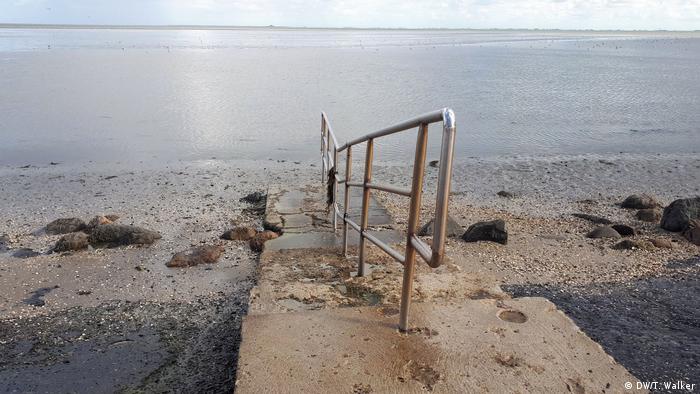
A railing and steps lead down to a calm sea (DW/T. Walker)
When the sea is calm, so is the sense of living alongside it.
For Thomas Langmaack of the northern state of Schleswig-Holstein's agency for coastal defense, national parks and marine conservation (LKN), that's a cause for concern.


Too close yet too comfortable

It is also his job to foster an understanding among communities inhabiting the 3,900 square kilometers (1,505 square miles) of lowland — some of which was originally sea snared over time through the construction of dikes — of the capricious and sometimes ferocious nature of the waters that swirl around them.

"People have largely become careless," Langmaack said. "They've suppressed it, because there hasn't been a devastating storm surge for several decades."

And because the several hundred kilometers of complex dikes form a wall between them and the sea, they are safer than ever before.

predicted sea level rise
Dikes are constantly being repaired and renewed

Dikes are constantly being repaired and renewed to enable the people to continue to live in the flatlands in relative safety
"But even they can fail," LKN spokesman Hendrik Brunkhorst said. "We have to make people aware of the dangers."

The sea rose only 28 centimeters (11 inches) between 1940 and 2007, which is in keeping with recordings from the previous century. But there is a sense of urgency about the need to prepare local communities for the worst, in part stirred by cyclone Xaver, which hit the region in 2013, but also because both sea and storm water levels are predicted to rise within the coming decades.

Planning for the unknown

Besides alerting the population, the agency for coastal defense has been strengthening its fortifications with so-called "climate dikes."

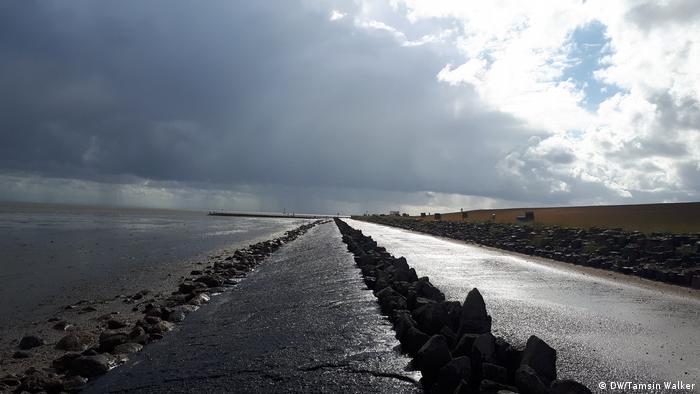
A far cry from the early hand-built clay incarnations that began appearing on the flat northern German landscape around a millennium ago, these precision-engineered giant green slopes are designed to keep the waves at bay in such a way that it would be easy to add a new layer on top if water levels were to suddenly rise much faster than current forecasts suggest.

"We have to look to the future," Langmaack said. "What we have is rising temperatures, and that means rising sea levels, but nobody can tell us how the curve is going to develop, and that makes it very difficult."

"We're genuinely planning for the next 100 years," he continued."

.......................

"As a conservationist, Fröhlich doesn't generally sanction the idea of tampering with nature, but climate change  induced sea level rise could, he says, be grounds enough for an exception.

"I think we underestimate what's around the corner," he said. "I'm worried that large parts of this area will be lost. I really am."

And if that happens, if the Wadden Sea starts to swallow itself, there's a very good chance the sense of calm it instills in those who live with and from it, will sink as well."

Go to the original, complete, 2018 DW article

Ref: Sea Level Rise and Implications for Low-Lying Islands, Coasts and Communities: IPCC

Related:  Related: East Antarctic Melting Hotspot Identified by Japanese Expedition – Ice Melting at Surprisingly Fast Rate: SciTechDaily

Saturday, 5 September 2020

Choosing A Place To Retire? Factor In Climate Change (excerpt): Forbes


The hazards of wildfires and extreme heat are also intensifying due to climate change.
Hurricane damage
(Pics added by this blog)

"When Bill and Annemarie Kachur retired in early 2016, they saw no reason to go anywhere. The gray shingled bungalow in Myrtle Beach, S.C. had been their home for more than 15 years.

“I’ve been here so long, it’s a sense of roots now for me,” says Bill, 65, who spent his early career hopping around the country, working on-air at various radio stations. 

Plus, they were already in a haven for retirees. “I like the fact that there isn’t a winter,” says Annemarie, who’ll be 65 in September.
But in recent years, their idyllic spot about 2 ½ miles from the Atlantic Ocean has revealed an ominous side: hurricane season. “I just noticed that the last four or five years, we keep getting hammered,” recalls Bill.

Two Hurricane Evacuations Since 2016

Since 2016, the Kachurs have ridden out four hurricanes, including two evacuations to safer ground.

“Ten months out of the year, it’s great,” says Bill. “And then there’s a couple months out of the year when you’re walking on eggshells and you’re a little bit concerned about what’s blowin’ in the wind, so to speak.” 

Warm, beachy spots on the Atlantic, Pacific and Gulf Coasts have been retirement magnets for decades. But, as Hurricane Laura just underscored, they’re also squarely in the crosshairs of the changing climate, effects of which are already evident in many of the nation’s most popular retirement destinations.

The hazards of wildfires and extreme heat are also intensifying due to climate change.
Planned retreat from rising seas


Climate Change and Retirement Location Decisions

“Current climate and future climate is absolutely something that people should be thinking about when deciding where to live, where to retire,” advises Radley Horton, a climate scientist at Columbia University’s Earth Institute, who has focused on climate adaptation strategies. “Those are absolutely critical concerns when you think about impacts directly on the home, but also livability outdoors — things like critical infrastructure, too,” says Horton.

The hazards of wildfires and extreme heat are also intensifying due to climate change.
Californian Wildfires
Rising seas are threatening things we tend to take for granted in many areas, like major freeways, airports and sewage treatment plants. The hazards of wildfires and extreme heat are also intensifying due to climate change."

Where then to retire to? : Read complete Forbes article: By Craig Miller, Science Journalist

Related: Port Macquarie after a 7m sea level rise. Insurance risks affect property values now.

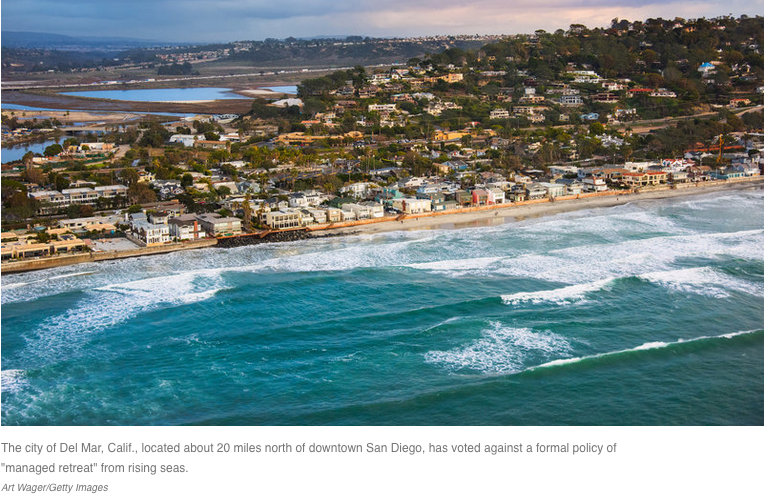
Related: 'Retreat' Is Not An Option As A California Beach Town Plans For Rising Seas: NPR

hurricanes, #searise, #bushfires, property values, insurance, #America, #Australia, #Houston, #wildfire,  

Thursday, 3 September 2020

Young people’s burden: requirement of negative CO2 emissions: Hansen et al

Abstract. 

The rapidity of ice sheet and sea level response to global temperature is difficult to predict
Melting ice sheets
Global temperature is a fundamental climate metric highly correlated with sea level, which implies that keeping shorelines near their present location requires keeping global temperature within or close to its preindustrial Holocene range. 

However, global temperature excluding short-term variability now exceeds +1C relative to the 1880–1920 mean and annual 2016 global temperature was almost +1.3C. 

We show that global temperature has risen well out of the Holocene range and Earth is now as warm as it was during the prior (Eemian) interglacial period, when sea level reached 6–9 m higher than today. 

Further, Earth is out of energy balance with present atmospheric composition, implying that more warming is in the pipeline, and we show that the growth rate of greenhouse gas climate forcing has accelerated markedly in the past decade.  

The rapidity of ice sheet and sea level response to global temperature is difficult to predict, but is dependent on the magnitude of warming. 

Targets for limiting global warming thus, at minimum, should aim to avoid leaving global temperature at Eemian or higher levels for centuries. 

Such targets now require “negative emissions”, i.e., extraction of CO2from the air. 

If phase down of fossil fuel emissions begins soon, improved agricultural and forestry practices,including reforestation and steps to improve soil fertility and increase its carbon content, may provide much of the necessary CO2 extraction. 

In that case, the magnitude and duration of global temperature excursion above the natural range of the current inter glacial (Holocene) could be limited and irreversible climate impacts could be minimized. 

In contrast, continued high fossil fuel emissions today place a burden on young people to undertake massive technological CO2 extraction if they are to limit climate change and its consequences. 

Proposed methods of extraction such as bio energy with carbon capture and storage (BECCS) or air capture of CO2 have minimal estimated costs of USD 89–535 trillion this century and also have large risks and uncertain feasibility.    

Continued high fossil fuel emissions unarguably sentences young people to either a massive, implausible cleanup or growing deleterious climate impacts or both.

James Hansen et al  
Published by Copernicus Publications on behalf of the European Geosciences Union. 

Correspondence to:James Hansen (jeh1@columbia.edu) 
Received: 22 September 2016 – Discussion started: 4 October 2016 Revised: 29 May 2017 – Accepted: 8 June 2017 – Published: 18 July 2017


Go to research article  

 
targets now require “negative emissions”, i.e., extraction of CO2from the air.
Newcastle with a 0.7m sea rise by 2100, below the 2010 official government planning estimate of 0.9m.


Related: 

Port Macquarie after a 7m sea level rise. Insurance risks affect property values now.

Related: 'Retreat' Is Not An Option As A California Beach Town Plans For Rising Seas: NPR 


Tuesday, 1 September 2020

Sea level rise from ice sheets track worst-case climate change scenario: Phys.org

Credit: CC0 Public Domain 
Ice sheets in Greenland and Antarctica whose melting rates are rapidly increasing have raised the global sea level by 1.8cm since the 1990s, and are matching the Intergovernmental Panel on Climate Change's worst-case climate warming scenarios.
According to a new study from the University of Leeds and the Danish Meteorological Institute, if these rates continue, the ice sheets are expected to raise sea levels by a further 17cm and expose an additional 16 million people to annual coastal flooding by the end of the century.

Since the ice sheets were first monitored by satellite in the 1990s, melting from Antarctica has pushed global sea levels up by 7.2mm, while Greenland has contributed 10.6mm. And the latest measurements show that the world's oceans are now rising by 4mm each year.

"Although we anticipated the ice sheets would lose increasing amounts of ice in response to the warming of the oceans and atmosphere, the rate at which they are melting has accelerated faster than we could have imagined," said Dr. Tom Slater, lead author of the study and climate researcher at the Centre for Polar Observation and Modelling at the University of Leeds.

"The melting is overtaking the we use to guide us, and we are in danger of being unprepared for the risks posed by rise."

East Antarctic Melting Hotspot Identified by Japanese Expedition – Ice Melting at Surprisingly Fast Rate: SciTechDaily

"Ice is melting at a surprisingly fast rate underneath Shirase Glacier Tongue in East Antarctica due to the continuing influx of warm seawater into the Lützow-Holm Bay.

Hokkaido University scientists have identified an atypical hotspot of sub-glacier melting in East Antarctica. Their findings, published in the journal Nature Communications, could further understandings and predictions of sea level rise caused by mass loss of ice sheets from the southernmost continent.

The 58th Japanese Antarctic Research Expedition had a very rare
opportunity to conduct ship-based observations near the tip of East Antarctic Shirase Glacier when large areas of heavy sea ice broke up, giving them access to the frozen Lützow-Holm Bay into which the glacier protrudes.

“Our data suggests that the ice directly beneath the Shirase Glacier Tongue is melting at a rate of 7–16 meters per year,” says Assistant Professor Daisuke Hirano of Hokkaido University’s Institute of Low Temperature Science. “This is equal to or perhaps even surpasses the melting rate underneath the Totten Ice Shelf, which was thought to be experiencing the highest melting rate in East Antarctica, at a rate of 10–11 meters per year.”'

"The Antarctic ice sheet, most of which is in East Antarctica, is Earth’s largest freshwater reservoir. If it all melts, it could lead to a 60-meter rise in global sea levels. Current predictions estimate global sea levels will rise one meter by 2100 and more than 15 meters by 2500. Thus, it is very important for scientists to have a clear understanding of how Antarctic continental ice is melting, and to more accurately predict sea level fluctuations.


Monday, 24 August 2020

Polar bears, climate crisis, and oil and gas drilling in the Arctic National Wildlife Refuge: WWF site (excerpt)


Identify areas where  cute polar bear cubs can live on solid Arctic sea ice
Polar bear cubs at risk from climate change
"Sea levels are rising and oceans are becoming warmer. Longer, more intense droughts threaten crops, wildlife and freshwater supplies. From polar bears in the Arctic to marine turtles off the coast of Africa, our planet’s diversity of life is at risk from the changing climate."

"Climate change poses a fundamental threat to the places, species and people’s livelihoods WWF works to protect. To adequately address this crisis we must urgently reduce carbon pollution and prepare for the consequences of global warming, which we are already experiencing. WWF works to:
  • advance policies to fight climate change
  • engage with businesses to reduce carbon emissions
  • help people and nature adapt to a changing climate"


"Humans and wild animals face new challenges for survival because of climate change. More frequent and intense drought, storms, heat waves, rising sea levels, melting glaciers and warming oceans can directly harm animals, destroy the places they live, and wreak havoc on people’s livelihoods and communities."


Humans and wild animals face new challenges for survival because of climate change

Polar bears, climate crisis, and oil and gas drilling in the Arctic National Wildlife Refuge


"To adequately address the climate crisis we must urgently reduce carbon pollution and prepare for the consequences of global warming, which the world is already experiencing. Combining global outreach with local expertise, WWF:
  • helps people and nature adapt to a changing climate
  • advances policies to fight climate change
  • combats deforestation
  • engages with businesses to reduce carbon emissions
  • challenges U.S. cities to prepare for more extreme weather"


"Adapting to Climate Change


To avoid the worst effects of climate change, we need to dramatically reduce global carbon emissions. But we must also prepare for the significant and unavoidable consequences of carbon
Identify areas where polar bears can live on solid Arctic sea ice for decades to come
polar bear cubs
emissions such as increasing temperatures, shifting precipitaton patterns, ocean acidification, sea level rise and the increasing intensity and frequency of extreme weather events. WWF works with local communities, governments and others around the world to help nature and people prepare for the many impacts of a changing climate. To do this we:

  • Increase resilience of communities in Nepal by promoting new farming techniques, community weather monitoring and creating seed banks
  • Restore beach vegetation to shade marine turtle nests in the Caribbean
  • Secure access to fresh water for elephants in Thailand during periods of drought
  • Identify areas where polar bears can live on solid Arctic sea ice for decades to come"
 Go to WWF site
 Related: Brazil slashes budget to fight climate change as deforestation spikes: Reuters

Wednesday, 19 August 2020

Sea level rise is so much more than melting ice: Verge Science video


While researching climate change, we heard something confusing: the sea level in New York City is rising about one and a half times faster than the global average. We couldn’t figure out what that meant. Isn’t the sea level...flat? So we called up an expert, Dr. Andrea Dutton, and went down the rabbit hole. And, we did our best to visualize her truly bizarre answers with animations, dioramas, and a lot of melting ice.

Subscribe: http://bit.ly/2FqJZMl

Related:Greenland's melting ice sheet has passed the point of no return, scientists say (excerpt): USA Today


sea level rise, #searise, #climatechange, #cambio-climatico, #icemelting, #jailclimatecriminals,  

This is what sea level rise will do to coastal cities: Video


Searise is already redrawing coastlines around the world. What happens when the coast retreats through a major city? 

We look at how the world map will change in the year 2100, and what coastal cities can do to defend themselves. Correction: An early version of this video suggested that researchers expect to see four feet of sea level rise by the end of the century. While researchers do expect to see at least that level of sea level rise in the future, the exact timing is difficult to project. We regret the error. 

Read more here: http://bit.ly/2ZwP5Se 

Related: Sea Level Rise Effect on Mumbai of 1.5m rise

#searise, #cambio-climatico, #climateaction, #climatechange, #climateemergency, #jailclimatecriminals, 

Greenland's melting ice sheet has passed the point of no return, scientists say (excerpt): USA Today

STORY HIGHLIGHTS

• Greenland's ice sheet dumps more than 280 billion metric tons
Even if global warming were to stop today, the ice sheet would continue shrinking.
of melting ice into the ocean each year.

 
•  Even if global warming were to stop today, the ice sheet would continue shrinking.
• Scientists analyzed 40 years of satellite data from more than 200 large glaciers draining into the ocean.

Greenland's melting ice sheet has passed the point of no return. 
In fact, glaciers on the island have shrunk so much that even if global warming were to stop today, the ice sheet would continue shrinking, a new study suggests.

"Glacier retreat has knocked the dynamics of the whole ice sheet into a constant state of loss," study co-author Ian Howat, an earth scientist from Ohio State University, said in a statement. "Even if the climate were to stay the same or even get a little colder, the ice sheet would still be losing mass."

This "tipping point" means the snowfall that replenishes the ice sheet each year cannot keep up with the ice that is flowing into the ocean from melting glaciers.