Wednesday, 14 November 2018

GREENS WELCOME INVESTMENT IN NSW ENERGY TRANSMISSION INFRASTRUCTURE AS OPPORTUNITY FOR SUPPORTING NEW RENEWABLES

A fortnight after the Greens released their plan for eight renewable energy zones and upgrades to transmission projects in NSW, the State Government has today released its NSW Transmission Infrastructure Strategy.

The Greens have welcomed the four priority transmission projects identified in the strategy, including upgrades to the interconnectors with Queensland and Victoria, and a new interconnector with South Australia to enable renewable energy projects to connect to the grid and increase the resilience of the power network.

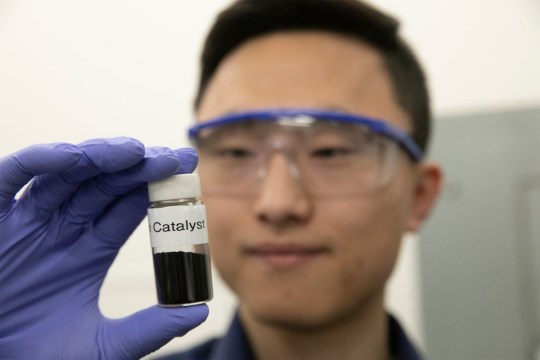
scifigeneration: New system opens the door to transforming CO2 into industrial fuels

Imagine a day when – rather than being spewed into the atmosphere – the gases coming from power plants and heavy industry are instead captured and fed into catalytic reactors that chemically transform greenhouse gases like carbon dioxide into industrial fuels or chemicals and that emit only oxygen.

It’s a future that Haotian Wang says may be closer than many realize.

A Fellow at the Rowland Institute at Harvard, Wang and colleagues have developed an improved system to use renewable electricity to reduce carbon dioxide into carbon monoxide – a key commodity used in a number of industrial processes. The system is described in a November 8 paper published in Joule, a newly launched sister journal of Cell Press.

November 13 2018

Monday, 12 November 2018

The Real News: Michael Mann: We Are Even Closer To Climate Disaster Than IPCC Predicts


TheRealNews Published on Oct 9, 2018 

A new report from the world's leading body on climate change says we could see catastrophic global warming by 2030, and climate scientist Michael Mann says their predictions are too conservative

Everything to Know About Coal (in Under 3 Minutes)


Published on Jan 4, 2018

Coal has helped power the United States for decades—but thanks to automation and natural gas, it’s now on the way out. Given the many benefits of renewables, that’s not such a bad thing. Take action here: http://www.ucsusa.org/coal

NY Times: U.S. Report Says Humans Cause Climate Change, Contradicting Top Trump Officials

"WASHINGTON — Directly contradicting much of the Trump administration’s position on climate change, 13 federal agencies unveiled an exhaustive scientific report on Friday that says humans are the dominant cause of the global temperature rise that has created the warmest period in the history of civilization.

Over the past 115 years global average temperatures have increased 1.8 degrees Fahrenheit, leading to record-breaking weather events and temperature extremes, the report says. The global, long-term warming trend is “unambiguous,” it says, and there is “no convincing alternative explanation” that anything other than humans — the cars we drive, the power plants we operate, the forests we destroy — are to blame."

Nov, 2017

Rolling Stone: What’s Another Way to Say ‘We’re F-cked’? One of the leading climate scientists of our time is warning of the horrifying possibility of 15-to-20 feet of sea-level rise

"If that sounds alarmist, watch this short video. In it, you’ll see a scientist named Richard Alley in a Skype discussion with students at Bard College, as well as with Eban Goodstein, director of the Graduate Programs in Sustainability at Bard. It would be just another nerdy Skype chat except Alley is talking frankly about something that few scientists have the courage to say in public: As bad as you think climate change might be in the coming decades, reality could be far worse. Within the lifetime of the students he’s talking with, Alley says, there’s some risk — small but not as small as you might hope — that the seas could rise as much as 15-to-20 feet."

Read original Rolling Stone article


Rolling Stone: Welcome to the Age of Climate Migration

"In 2017, a string of climate disasters – six big hurricanes in the Atlantic, wildfires in the West, horrific mudslides, high-temperature records breaking all over the country – caused $306 billion in damage, killing more than 300 people. After Hurricane Maria, 300,000 Puerto Ricans fled to Florida, and disaster experts estimate that climate and weather events displaced more than 1 million Americans from their homes last year.