Showing posts with label hurricanes. Show all posts

Monday, 28 February 2022

Will predicted sea rise inundation and flooding affect property values in Coffs Harbour NSW?

#inundation  #sea rise  #searise  #climatecrisis  #climatechange  #ice  #melting ice
Coffs Harbour 7m rise. Click to enlarge.
As many homes in Coffs Harbour  are flooded because of an intense rain depression we need also to examine the affect of sea rise. 
 
We also must stop building in flood affected areas. Councils must stop approving development in flood affected areas. It is ridiculous to see new buildings flooded to their roofs. Insurance companies may pay for a while but not without future higher payment rates. In the end every taxpayer pays.
 
• We are looking more and more unlikely to prevent severe global heating.

• Scientists are predicting the melting of the ice covering Greenland with a subsequent sea level rise of 7m.

• This rise does not factor in sea rise from the melting of Antarctica and other ice.

• Already many properties are likely to flood when a high tide is combined with high local rainfall. What were a hundred year rainfall events are now ten year events.

• The frequency of high rainfall events will increase with global heating and more and more severe hurricanes are predicted because of warmer seas.

• Low coastal areas will be subjected to severe storm surges.

• Would you buy a property likely to be inundated in twenty years, fifty years, a hundred years? Many wouldn't. Even the perception of possible inundation will greatly affect property values.

• When certain properties are in less demand their value falls.

• Would you buy a property with a value likely to fall?

•  The view of Coffs Harbour above shows areas likely to be inundated by a 7m sea level rise.

• Property above a 10m rise will become highly sought after and will greatly rise in value.

Learn more about how sea rise inundation will affect Australian property.

Click here to go to Coastal Risk Australia site

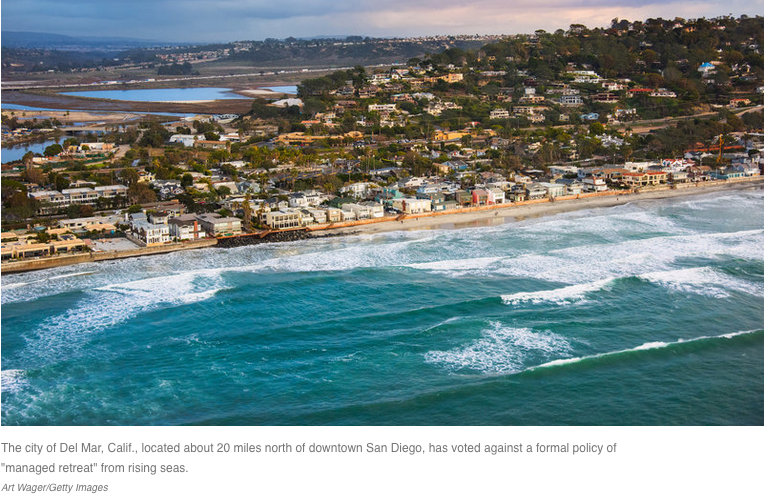
'Retreat' Is Not An Option As A California Beach Town Plans For Rising Seas: NPR 


#inundation  #sea rise  #searise  #climatecrisis  #climatechange  #ice  #melting ice 

Wednesday, 11 November 2020

A record hurricane season (excerpt): New York Times


Satellite image of the Atlantic on November 10th, 2020.
Image: NOAA
"Subtropical Storm Theta, which formed in the open waters of the Atlantic this week, became the 29th named storm of this year’s hurricane season, surpassing the total count from 2005. Scientists can’t say for sure whether global warming is causing more hurricanes, but they are confident that it’s changing the way storms behave.
Here’s how.
Higher winds. There’s a solid scientific consensus that hurricanes are becoming more powerful. Hurricanes are complex, but one of the key factors that determines how strong a given storm ultimately becomes is ocean surface temperature, because warmer water provides more of the energy that fuels storms.
More rain. Warming also increases the amount of water vapor that the atmosphere can hold. In fact, every degree Celsius of warming allows the air to hold about 7 percent more water. That means we can expect future storms to unleash larger amounts of rainfall.
Slower storms. Researchers do not yet know why storms are moving more slowly, but they are. Slower, wetter storms worsen flooding.
Wider-ranging storms. Because warmer water helps fuel hurricanes, climate change is enlarging the zone where hurricanes can form. That could mean more storms making landfall in higher latitudes, like in the United States or Japan.

More volatility. As the climate warms, researchers also say they expect storms to intensify more rapidly. Researchers are still unsure why it’s happening, but the trend appears to be clear."

Go to New York Times

Related: Polling Shows Growing Climate Concern Among Americans. But Outsized Influence of Deniers Remains a Roadblock (excerpt): DeSmog

Thursday, 22 October 2020

Boiling Point: Climate change is wreaking havoc on the power grid in ways you never knew (excerpts): LA Times

 Pics from this blog

"There’s been a lot of debate about the extent to which climate change is actually to blame. Officials pointed out that four of California’s five hottest August days in the last 35 years came this past August; others have noted that the state experienced hotter days and higher overall peak electricity demand during a July 2006 heat storm that did not lead to rolling blackouts.

Here’s what’s not in dispute: As the planet gets hotter, largely because of the burning of fossil fuels, the number of blackouts caused by extreme weather is on the rise, in California and across the country.

The nonprofit research organization Climate Central analyzed federal data and released a report last month finding that hurricanes, wildfires, heat storms and other extreme weather events caused 67% more power outages in the United States during the decade ending in 2019 than they did during the previous decade"

........

"Climate change isn’t the only reason blackouts are on the rise. Roshi Nateghi, an industrial engineering professor at Purdue University, told me rapid urbanization — more people moving to cities — has put greater strains on aging infrastructure. And the data used by Climate Central may overstate the increase in weather-driven outages, since reporting requirements for utilities have gotten more stringent over time.

But there’s no question climate change is playing a role, and the effects will only get worse, Nateghi said.

“A big part of it is that our grid is vulnerable to severe weather and climate events,” she said. “And we have been seeing an increase in intensity and frequency of extreme events.”


Why is extreme weather such a problem for the electric grid? Powerful winds can knock down utility poles. Intense rains can flood substations. Ice can accumulate on wires during winter storms. Wildfires can knock out power lines — or utility companies can be forced to shut down lines to avoid igniting fires. High temperatures can cause fossil-fueled power plants to produce less electricity, which actually happened with California’s natural gas fleet in August."

Go to LA Times story 


Related:  I’m an American Climate Emigrant (excerpts): Sierra

Friday, 16 October 2020

Florida Sees Signals of a Climate-Driven Housing Crisis (excerpt): NYT

"Home sales in areas most vulnerable to sea-level rise began falling around 2013, researchers found. Now, prices are following a similar downward path."

In Florida, home sales in areas at high risk from sea-level rise

have fallen compared to areas at low risk.


"The idea that climate change will eventually ruin the value of coastal homes is neither new nor particularly controversial. In 2016, the then-chief economist for the federal mortgage giant Freddie Mac warned that rising seas “appear likely to destroy billions of dollars in property and to displace millions of people.” By 2045, more than 300,000 existing coastal homes will be at risk of flooding regularly, the Union of Concerned Scientists concluded in 2018.

The question that has occupied researchers is how soon, and how quickly, people will respond to that risk by demanding price discounts or fleeing the market. Previous research has begun to tackle that question, showing that climate change, far from being a distant threat, is already starting to hurt real estate values."


Credit...Rose Marie Cromwell for The New York Times

"Then, starting in 2013, something started to change. While sales in safer areas kept climbing, sales in vulnerable ones began to fall. By 2018, the last year for which Dr. Keys and Mr. Mulder obtained data, sales in vulnerable areas trailed safer areas by 16 percent to 20 percent.

A few things happened around that time that might have made prospective home buyers more worried about climate risk, Dr. Keys said. An international report the previous year highlighted the risks of extreme weather events. After that report came out, Google searches in Florida for “sea level rise” spiked.

And people from the Northeast, who account for a significant portion of Florida home buyers, had just lived through Hurricane Sandy, which damaged some 650,000 homes and caused 8.5 million people to lose power, some for months."


Go to NYT original full length story 


Related: I’m an American Climate Emigrant (excerpts): Sierra


Friday, 18 September 2020

A season of climate-fueled disasters (excerpt): NYT

Wildfires are still scorching the West as a hurricane hits the South

"It’s pretty scary out there these days. There are wildfires in the West and a hurricane causing 

More severe climate fires

 “catastrophic” flooding in the South. And the destructiveness of those disasters is being aggravated by climate change.

All of that is keeping those of us on The Times climate team very busy.

For decades, climate journalists focused on the science of climate change, which proves the planet is warming and forecasts the consequences. That goes back at least to 1988, when The Times published a front-page article about the NASA scientist James Hansen, who testified in the Senate and warned in an interview that “It is time to stop waffling so much and say that the evidence is pretty strong that the greenhouse effect is here.”

The government, as we all know, continued to waffle. And here we are. Now, to an ever increasing degree, being a climate reporter is all about catastrophes, reported in real time.

And so, we do what we do. We cover the news.

More severe hurricanes

In the West, more than 5 million acres have now burned, and fire season still has months to go. Our coverage has focused heavily on the links between wildfires and climate change.

.........................."


By John Schwartz    (Images from this blog)


Read complete NYT article

 Related: How Climate Migration Will Reshape America Millions will be displaced. Where will they go? (excerpt) : NYT Magazine

 Related: The exhausted Raccoons of the Resistance are running an Antifarsonist self care workshop

#climatefires,#climatechange,#climateaction,#climate crisis,hurricanes,floods,science,

Saturday, 12 September 2020

The Climate Disasters We Ignore Today Will Eventually Come for Us (excerpt): Gizmodo


Even if the world does act, some climate disasters may be inevitable
Vehicles ply on waterlogged Delhi-Gurgaon Expressway
 near Narsingpur after heavy rains, in Gurugram
..... "In a just world, this would be major news, even in the faraway U.S. Perhaps stories about the local covid-19 crises we’re seeing across the country would get more attention, but surely, the displacement of millions deserves a spot on the front page. And yet.


If you didn’t know these floods were happening, I’m not here to scold you. Tragedies take place around the world every day, from bombings to hunger. Plus, here in the U.S., things are pretty awful for lots of people, too. It’s difficult if not impossible to keep up with every bad thing happening in all places. It’s also, frankly, easier for many of us in the Global North to ignore crises that are happening to poor people far away. When these crises do surface in news reports, many of us are taught to treat them as inevitable — things are simply more difficult for people “over there.”


This can all lead us to feel insulated from these horrors. We need to
Even if the world does act, some climate disasters may be inevitable
Local residents look at a submerged bus in a waterlogged road 
underpass after monsoon rainfalls in New Delhi
 (Photo: Prakash Singh, Getty Images)
fight that impulse. Caring about our fellow human beings is the right thing to do, sure. But even if empathy isn’t your thing, there’s also an uncomfortable reality: Climate disasters will eventually come for us all if we don’t act now. 


The deafening silence about climate change-fuelled weather in the Global South isn’t limited to the recent floods in South Asia. People have died in deluges in India and Bangladesh in previous years, too — hundreds last year, 1,000 in 2018, over 1,200 in 2017. Hurricane Dorian, one of the most intense hurricanes to ever form in the Atlantic Ocean, absolutely ravaged the Bahamas just last year. Yet it has all but faded from popular memory in the U.S. aside from the saga of Sharpiegate. And nearly three years after Hurricane Maria hit Puerto Rico, thousands are still without homes and the power grid recently crashed again in the face of a moderate tropical storm yet these stories of widespread suffering are rarely found on front pages. 


Even if the world does act, some climate disasters may be inevitable
World leaders plan for climate change
All of this devastation was not inevitable. World leaders could have taken steps to move us away from fossil fuels decades ago. They also could have poured far more resources into helping vulnerable people adapt before emergencies strike, and rebuild after they do. But they’ve made clear they won’t do much of that of their own accord — they claim it’s too expensive, too difficult, too impractical. We need a mass movement that shows them we won’t take no for an answer, and part of that is recognising the toll the crisis is already taking and acting with urgency and compassion.
World leaders already have blood on their hands. Every life these actions could have saved is important. Each of the hundreds of Indian and Bangladeshi people killed by the ongoing monsoons in India deserved better. And we all deserve better than to see this continue.


That’s not just because it’s the right thing to do. It’s also our only option. Eventually, ecological horror will come for all of us. It might be in a month, a year, or 20 years, but eventually, a storm, heat wave, or tornado will come banging down your door. The time to change course is now, starting with, at a minimum, acknowledging the impacts the climate crisis on the poorest among us. 


Even if the world does act, some climate disasters may be inevitable
We want climate action now
Even if the world does act, some climate disasters may be inevitable since we’ve already overheated the planet and left people vulnerable. We won’t be able to stop every flood or heat wave from taking place. But what’s not inevitable is our treatment of some people as disposable. If we prioritise taking steps to help people adapt and prepare, countless lives could be saved. Stopping deforestation of catchment areas and restoring wetlands, for instance, could go a long way to better shielding communities in India and Bangladesh from rising waters. So could national policies to provide more resilient housing to all people, and international policies to prioritise aid to the struggling countries that are hit hardest......"

Go to complete Gizmodo story by Dharna Noor, August 21, 2020

Related:  Climate Change Poses Serious Threats to India's Food Security (excerpt): The Wire


Wednesday, 9 September 2020

News outlets continue to ignore climate change in articles about California's record-breaking weather (excerpt): Heated

"Nothing to see here, folks

This long weekend was literal hell for millions in the American West. California, Nevada, Arizona, Oregon, and Washington are suffering from dangerous heat, wildfire and smoke unlike anything they’ve ever seen. 

Three major newspaper stories. Zero climate mentions.
Californian Wildfires, 2019


Scientists attribute the unprecedented intensity of these events to human-caused climate change. Greenhouse gas emissions have made the atmosphere in these areas much hotter and drier than it used to be. “We’re living in a fundamentally climate-altered world,” MIT Technology Review noted last month, citing a multitude of peer-reviewed research about how climate change exacerbates extreme heat and wildfire. These so-called “compound climate events” are only predicted to get worse if greenhouse gas emissions continue unabated. 

Every American should be aware of these basic scientific facts when reading about the devastation of this weekend’s record-breaking extreme weather. But most of the major newspaper stories about the Labor Day Weekend from Hell don’t contain any climate-related information. Why?


Three major newspaper stories. Zero climate mentions.
Melting Siberian permafrost


Three major newspaper stories. Zero climate mentions.


Section A, page 12 of today’s New York Times contains a big story about the unprecedented weather pummeling California. Titled Extreme Heat Turns State Into a Furnace,” the piece contains more than 1,700 words of devastating detail about how heat, fire, and toxic air are affecting people in the state. But none of those details were about why things are getting so bad. None of those words were “climate change.”

The Associated Press’s article today is similar. Titled “Scorched earth: Record 2 million acres burned in California,” it contains 1,100 words about the weather’s unprecedented nature. It lists several different record-breaking data points, and quotes state officials saying how “unnerving” it is to have broken these records so early in the wildfire season. And yet this article—which will be re-published this morning in newspapers across the country—also does not mention the reason why these records might be happening.

The Washington Post also has an article about unprecedented
climate change-fueled extreme weather on its front page this
Three major newspaper stories. Zero climate mentions.
News coverage of Hurricane Laura analysed
morning, but it doesn’t mention climate change’s role. It’s about how 50 hikers are trapped inside a shelter within a rapidly-growing 130,000 acre wildfire, unable to be rescued. 

“This is one of the largest and most dangerous fires in the history of Fresno County,” the local fire chief said. “I don’t think everyone understands that.”

Newspapers often ignore basic climate science in extreme weather stories 


News outlets like the Times, the Post, and the AP have climate reporting teams. These teams all publish important stories about how the climate crisis fuels extreme weather across the country. The Times in particular has increased its climate coverage substantially in the last few years, according to data from the University of Colorado Boulder."


 Related: Trump and Biden: Little room for climate change in US election (excerpt): DW
 
role of media, journalists, #California, #wildfire, #bushfires, permafrost, hurricanes, cyclones, #jailclimatecriminals,


Sunday, 6 September 2020

Donald Trump is hampering fight against climate change, WEF warns (excerpt) : The Guardian (2 years ago)

Donald Trump’s go-it-alone approach to tackling climate change
Trump digs coal
Two years after 2018 the situation is even worse.

"World Economic Forum outlines huge increase in all five eco risks since the US president assumed office


The World Economic Forum delivered a strong warning about Donald Trump’s go-it-alone approach to tackling climate change as it highlighted the growing threat of environmental collapse in its annual assessment of the risks facing the international community."

............." the WEF avoided mentioning Trump by name but said “nation-state unilateralism” would make it harder to tackle global warming and ecological damage.

The WEF’s global risks perception survey showed Trump’s arrival in the White House in 2017 had coincided with a marked increase in concern about the environment among experts polled by the Swiss-based organisation.

It said all five environmental risks covered by the survey – extreme weather events, natural disasters, failure of climate-change mitigation and adaptation, biodiversity loss and ecosystem collapse, and human-made natural disasters – had become more prominent.

“This follows a year characterised by high-impact hurricanes, extreme temperatures and the first rise in CO2 emissions for four years. We have been pushing our planet to the brink and the damage is becoming increasingly clear. 

“Biodiversity is being lost at mass-extinction rates, agricultural systems are under strain, and pollution of the air and sea has become an increasingly pressing threat to human health.”


Trump has threatened to withdraw the US from the 2015 Paris agreement under which nations agreed to take steps to limit the increase in global temperature. He has said the commitments made by his predecessor, Barack Obama, would damage the American economy.

Other states have said they will keep to the pledges made in Paris, an approach supported by the WEF."


ALSO

Trump suggests the climate may actually be 'fabulous' after an ominous UN report on looming disaster

failure of climate-change mitigation and adaptationTrump digs coal

  
   • President Donald Trump on Tuesday sought to cast doubt on a UN report on climate change that had dire warnings about how little time we have to stop a global catastrophe.
 
   • Trump suggested that the world’s climate might actually be “fabulous” and that he’d seen reports expressing that position.
 
   • The UN report outlines the effects of global warming of 1.5 degrees Celsius above pre-industrial levels.
 
   • Trump has previously called climate change a “hoax,” and last year he announced he would pull the US out of the Paris climate accord.
Trump, WEF, Paris Agreement, #climate crisis, #jailclimatecriminals, #criminales-climáticos-de-la-cárcel, #criminalesclimáticosdelacárcel, #extremeheat, #icemelting, hurricanes,  climatechangedenial

Saturday, 5 September 2020

Choosing A Place To Retire? Factor In Climate Change (excerpt): Forbes


The hazards of wildfires and extreme heat are also intensifying due to climate change.
Hurricane damage
(Pics added by this blog)

"When Bill and Annemarie Kachur retired in early 2016, they saw no reason to go anywhere. The gray shingled bungalow in Myrtle Beach, S.C. had been their home for more than 15 years.

“I’ve been here so long, it’s a sense of roots now for me,” says Bill, 65, who spent his early career hopping around the country, working on-air at various radio stations. 

Plus, they were already in a haven for retirees. “I like the fact that there isn’t a winter,” says Annemarie, who’ll be 65 in September.
But in recent years, their idyllic spot about 2 ½ miles from the Atlantic Ocean has revealed an ominous side: hurricane season. “I just noticed that the last four or five years, we keep getting hammered,” recalls Bill.

Two Hurricane Evacuations Since 2016

Since 2016, the Kachurs have ridden out four hurricanes, including two evacuations to safer ground.

“Ten months out of the year, it’s great,” says Bill. “And then there’s a couple months out of the year when you’re walking on eggshells and you’re a little bit concerned about what’s blowin’ in the wind, so to speak.” 

Warm, beachy spots on the Atlantic, Pacific and Gulf Coasts have been retirement magnets for decades. But, as Hurricane Laura just underscored, they’re also squarely in the crosshairs of the changing climate, effects of which are already evident in many of the nation’s most popular retirement destinations.

The hazards of wildfires and extreme heat are also intensifying due to climate change.
Planned retreat from rising seas


Climate Change and Retirement Location Decisions

“Current climate and future climate is absolutely something that people should be thinking about when deciding where to live, where to retire,” advises Radley Horton, a climate scientist at Columbia University’s Earth Institute, who has focused on climate adaptation strategies. “Those are absolutely critical concerns when you think about impacts directly on the home, but also livability outdoors — things like critical infrastructure, too,” says Horton.

The hazards of wildfires and extreme heat are also intensifying due to climate change.
Californian Wildfires
Rising seas are threatening things we tend to take for granted in many areas, like major freeways, airports and sewage treatment plants. The hazards of wildfires and extreme heat are also intensifying due to climate change."

Where then to retire to? : Read complete Forbes article: By Craig Miller, Science Journalist

Related: Port Macquarie after a 7m sea level rise. Insurance risks affect property values now.

Related: 'Retreat' Is Not An Option As A California Beach Town Plans For Rising Seas: NPR

hurricanes, #searise, #bushfires, property values, insurance, #America, #Australia, #Houston, #wildfire,  

Thursday, 20 August 2020

Lessons From the Frontlines of Global Warming (excerpt): New Republic

"What interviews with flood, wildfire, and drought survivors can teach us about how to live amid the threat of climate change

 
What would you do if your house burned down or your neighborhood washed away in a flood?
Extreme heat kills

Ronnie Scott lost his wife when she tried to to rescue their dog and cat from floodwaters in West Virginia in 2016. Carole Duncan almost lost her 83-year-old father during Australia’s massive 2019 bushfires, the firefighters finding him just in time. 

KerryAnn Laufer returned home days after the 2019 Kincade Fire in California to find only her fireplace still standing, while Dave Mackey saw nearly every house in his neighborhood on Grand Bahama island washed away, pummeled by raging waters and 200-mile-per-hour winds from Hurricane Dorian.


What would you do if your house burned down or your neighborhood washed away in a flood?
Storms, wildfires, and other such disasters are getting more common and intense as climate change accelerates. Scott, Duncan, Laufer, and Mackey, who survived these extreme weather events, are among the lucky ones. But each of them found themselves changed by the experience.


What would you do if your house burned down or your neighborhood washed away in a flood? How would you respond if a cataclysmic weather event killed someone you love or forced you to abandon, perhaps forever, the place you call home? And how would it change the way you think about the world?


These questions are at the heart of a new “Voices from the Future”
What would you do if your house burned down or your neighborhood washed away in a flood?
Green new deal is cheap actually
interview series a small group of journalist, researchers, and I have developed at the Julie Ann Wrigley Global Futures Laboratory at Arizona State University. We have collected the stories and insights of nearly three dozen survivors on five continents, eight of which will be published in these pages over the next few weeks."


Original story 

Steven Beschloss is a professor of practice at the Walter Cronkite School of Journalism and Mass Communication and directs the Narrative Storytelling Initiative at Arizona State University. He has written for The New Yorker and The Washington Post, among other publications.


#California, #firestorms, #wildfire, Australia, cyclones, floods, Green New Deal, hurricanes, 


Friday, 14 August 2020

Sea Level Rise Effect on Mumbai of 1.5m rise

Mumbai, land at risk from 1.5m sea rise
 • We are looking more and more unlikely to prevent global heating.

• Scientists are predicting the melting of the ice covering Greenland with a subsequent sea level rise of 7m.

• This rise does not factor in sea rise from the melting of Antarctica and other ice.

• Already many properties are likely to flood when a high tide is combined with high local rainfall. 
 

What were a hundred year rainfall events are now ten year events.


Mumbai, land at risk with 1.0m sea rise
 
• The frequency of high rainfall events will increase with global heating and more and more severe hurricanes are predicted because of warmer seas.


• Low coastal areas will be subjected to severe storm surges.

• Would you buy a property likely to be inundated in twenty years, fifty years, a hundred years? Many wouldn't. Even the perception of possible inundation will greatly affect property values. Some properties will become more expensive to insure or become impossible to insure

• When certain properties are in less demand their value falls.

• Would you buy a property with a value that is likely to fall?

•  The view of Mumbai above shows areas likely to be inundated by a 1.5m and a 1.0m sea level rise.

• Property above a 10m rise will become highly sought after and will greatly increase in value.

Learn more about how sea rise inundation will affect India's property, indeed any property, at climatecentral.org


Related:

Greenland shed ice at unprecedented rate in 2019; Antarctica continues to lose mass: EurekAlert


Melbourne: predicted flooding with a conservative sea level rise of only 1.5m


#sea level rise, #Greenland ice melt, #sea ice, #climateaction, #climatechange, #jailclimatecriminals, #cambio-climatico,