Showing posts with label climate refugees. Show all posts

Wednesday, 14 October 2020

I’m an American Climate Emigrant (excerpts): Sierra

 "My family moved northward for many reasons—climate chaos was among them

We were only a few hours’ drive north of the California-Oregon border when I began to feel the pangs of survivor’s guilt. It was mid-August, and the news from back home was no good. We had busted out of the San Francisco Bay Area just as the heat wave began to sizzle California, and as we drove north through wine country, the temperature gauge in our car said it was 108 degrees outside. Days later, a freak electric storm swung across the state, sparking hundreds of fires. Some of our favorite places were burning: the forested mountains around Santa Cruz and the oak woodlands west of Davis, where we had spent many summer afternoons lounging on the banks of Putah Creek. Smoke was already beginning to choke our friends and former neighbors. “You got out just in time,” a buddy texted. “California is imploding.”

The Oregon coast felt, at that time, like a whole new world. As we threaded our way up Highway 1, the sky was cool and gray, and by evening a thick fog had turned into a spitting rain. The smoke and fires might as well have been on another planet. The rain was a relief, but I couldn’t shake a certain shame. I felt bad about our good fortune, about leaving our community behind to suffer.
I had lived in California for more than 20 years, and my family’s long-planned departure was supposed to be an adventure of sorts, an opportunity to start a new life for ourselves in the Pacific Northwest. For months, we had been looking forward to the move with a mix of trepidation and excitement, the swirl of emotions common to any emigrant: nostalgia for the life we had built, spiked with the thrill of surprising horizons. But now, as grim news piled up in our newsfeeds, the move had taken on a sour taste.

We weren’t merely heading toward a new home in another state. With a disaster unfolding behind us, we were fleeing."

Go to the Sierra article 


climate change refugees,climate refugees,#California,#USA,climate fires,floods,tidal flooding,

Monday, 14 September 2020

'Australia in January, California in August': Aussies watch on in horror as wildfires ravage US west coast (excerpt): SBS

Washington governor blames climate change for fires
Australia and Oregon


Former NSW fire chief Greg Mullins says the wildfires ravaging the US are a 'direct reflection' of what happened in Australia last summer, and serve as another 'wake up call' to pay attention to climate change.

With up to 100 wildfires burning across multiple states on the US west coast, the situation is is eerily reminiscent of Australia’s deadly bushfire event of 2019-20.

Ross Bradstock is from the Centre for Environmental Risk Management of Bushfires at the University of Wollongong. He says what Australia went through last summer "is repeating itself in places like California". 

“We’re seeing something similar play out over there as to what played out in our last season in terms of unprecedented fires, unprecedented area burnt, unprecedented drought and heat,” he told SBS News.


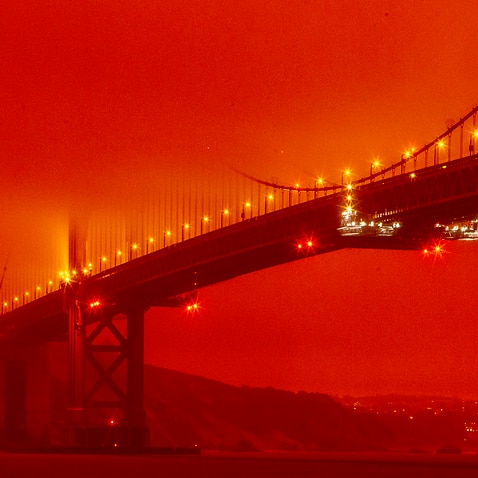
In this photo provided by Frederic Larson, the Golden Gate Bridge is seen at 11 a.m. PT amid a smoky, orange hue caused by the ongoing wildfires, Wednesday, Sept. 9, 2020, in San Francisco. (Frederic Larson via AP)
San Francisco, Pic from SBS story


Former NSW Fire and Rescue Commissioner Greg Mullins has helped to fight fires in California several times since the 1990s. 

He agrees the current wildfires are "a direct reflection" of what Australia faced.

"It's unprecedented," Mr Mullins told SBS News.

"The temperatures they're getting - you know, 49.4 (degrees) in the eastern suburbs of Los Angeles - nothing has ever come close." .................


Go to complete article By Rashida Yosufzai, Jodie Stephens

Related: Washington governor blames climate change for fires (excerpt): abc news


Washington governor blames climate change for fires
 Fires near Sydney, Pic from this blog

Sunday, 4 August 2019

Fleeing climate change - the real environmental disaster | DW Documentary


DW Documentary

Published on May 2, 2019

How many millions of people will be forced to leave their homes by 2050? This documentary looks at the so-called hotspots of climate change in the Sahel zone, Indonesia and the Russian Tundra. Lake Chad in the Sahel zone has already shrunk by 90 percent since the 1960s due to the increasing heat. About 40 million people will be forced to migrate to places where there is enough rainfall. Migration has always existed as a strategy to adapt to a changing environment. But the number of those forced to migrate solely because of climate change has increased dramatically since the 1990s. It is a double injustice: after becoming rich at the expense of the rest of the world, the industrialized countries are now polluting the atmosphere with their emissions and bringing a second misfortune to the inhabitants of the poorer regions. One of them is Mohammed Ibrahim: as Lake Chad got hotter and drier, he decided to go where the temperatures were less extreme and there was still a little water, trekking with his wife, children and 70 camels from Niger to Chad and then further south. The journey lasted several years and many members of his herd died of thirst. Now he and his family are living in a refugee camp: they only have seven camels left. Mohammed is one of many who have left their homelands in the Sahel - not because of conflict and crises, but because of the high temperatures. He's a real climate refugee.

Tuesday, 30 July 2019

'People are dying': how the climate crisis has sparked an exodus to the US : The Guardian

"As part of the Running Dry series, the Guardian looks at how drought and famine are forcing Guatemalan families to choose between starvation and migration
by in Camotán

At sunrise, the misty fields around the village of Guior are already dotted with men, women and children sowing maize after an overnight rainstorm.

After several years of drought, the downpour brought some hope of relief to the subsistence farmers in this part of eastern Guatemala.

But as Esteban Gutiérrez, 30, takes a break from his work, he explains why he is still willing to incur crippling debts – and risk his life – to migrate to the United States.

“My children have gone to bed hungry for the past three years. Our crops failed and the coffee farms have cut wages to $4 a day,” he says, playing nervously with the white maize kernels in a plastic trough strapped to his waist."

Read The Guardian article

Related:  

Heatwave: think it’s hot in Europe? The human body is already close to thermal limits elsewhere :The Conversation

Wednesday, 22 May 2019

The heat is on over the climate crisis. Only radical measures will work : The Guardian

Experts agree that global heating of 4C by 2100 is a real possibility. The effects of such a rise will be extreme and require a drastic shift in the way we live


Drowned cities; stagnant seas; intolerable heatwaves; entire nations uninhabitable… and more than 11 billion humans. A four-degree-warmer world is the stuff of nightmares and yet that’s where we’re heading in just decades.


While governments mull various carbon targets aimed at keeping human-induced global heating within safe levels – including new ambitions to reach net-zero emissions by 2050 – it’s worth looking ahead pragmatically at what happens if we fail. After all, many scientists think it’s highly unlikely that we will stay below 2C (above pre-industrial levels) by the end of the century, let alone 1.5C. Most countries are not making anywhere near enough progress to meet these internationally agreed targets.

Read The Guardian Article 

See also:

A Postmortem for Survival: on science, failure and action on climate change


Thursday, 9 May 2019

Video: Kiribati - A Climate Change Reality


Boobu Tioram, a resident of the Pacific island of Kirabati, took time out from reinforcing a seawall in front of his newly built house to speak with UNDP about what climate change has meant to his way of life. 

Thursday, 21 March 2019

Earth at 2° hotter will be horrific. Now here’s what 4° will look like. | David Wallace-Wells


Big Think

This is what the world will be like if we do not act on climate change.

 - The best-case scenario of climate change is that world gets just 2°C hotter, which scientists call the "threshold of catastrophe". - Why is that the good news? Because if humans don't change course now, the planet is on a trajectory to reach 4°C at the end of this century, which would bring $600 trillion in global climate damages, double the warfare, and a refugee crisis 100x worse than the Syrian exodus. - 

David Wallace-Wells explains what would happen at an 8°C and even 13°C increase. These predictions are horrifying, but should not scare us into complacency. "It should make us focus on them more intently," he says. David Wallace-Wells is a national fellow at the New America foundation and a columnist and deputy editor at New York magazine. He was previously the deputy editor of The Paris Review. He lives in New York City. His latest book is The Uninhabitable Earth: Life After Warming (https://goo.gl/ih35YX

Read more at BigThink.com: https://bigthink.com/videos/earth-at-...
Follow Big Think here:
YouTube: http://goo.gl/CPTsV5
Facebook: https://www.facebook.com/BigThinkdotcom
Twitter: https://twitter.com/bigthink 

#sea level rise, #2.0 degrees, #4.0 degrees, #ice, #albino effect, polar ice melt, #climate catastrophe, #climate refugees,  #wewantclimateactionnow
Published on Mar 14, 2019
This is what the world will be like if we do not act on climate change. - The best-case scenario of climate change is that world gets just 2°C hotter, which scientists call the "threshold of catastrophe". - Why is that the good news? Because if humans don't change course now, the planet is on a trajectory to reach 4°C at the end of this century, which would bring $600 trillion in global climate damages, double the warfare, and a refugee crisis 100x worse than the Syrian exodus. - David Wallace-Wells explains what would happen at an 8°C and even 13°C increase. These predictions are horrifying, but should not scare us into complacency. "It should make us focus on them more intently," he says. David Wallace-Wells is a national fellow at the New America foundation and a columnist and deputy editor at New York magazine. He was previously the deputy editor of The Paris Review. He lives in New York City. His latest book is The Uninhabitable Earth: Life After Warming (https://goo.gl/ih35YX) Read more at BigThink.com: https://bigthink.com/videos/earth-at-... Follow Big Think here: YouTube: http://goo.gl/CPTsV5 Facebook: https://www.facebook.com/BigThinkdotcom Twitter: https://twitter.com/bigthink

Thursday, 31 January 2019

Climate Change Leads to More Wars and Refugees: Bloomberg

Aleppo Photo by Aladdin Hammami
Aleppo,  Photo by aladdin hammami on Unsplash

Pentagon Fears Confirmed: Climate Change Leads to More Wars and Refugees

The conclusions published Wednesday in a scientific journal underscore the rising levels of anxiety that global warming has among leaders. Attendees at this year’s World Economic Forum in Davos, Switzerland, said the inability to adapt to higher temperatures is the biggest global risk. A Pentagon report published on Tuesday in Washington warned that rising seas and more frequent wild fires threaten U.S. security.


The peer-reviewed study, “Climate, conflict and forced migration,” published in Elsevier Ltd.’s Global Environmental Change, analyzed sprawling data sets covering drought, battle deaths, ethnicity and political systems. Those were then combined with geographic information about refugee flows. The researchers discovered that deteriorating climate conditions played a “a statistically significant role” in the recent waves of migrants fleeing Middle East conflict.

 Read the Bloomberg article


#war  #climate migration  #climate change  # Syria  # Davos  #sea rise  #wildfire 

Monday, 12 November 2018

Rolling Stone: Welcome to the Age of Climate Migration

"In 2017, a string of climate disasters – six big hurricanes in the Atlantic, wildfires in the West, horrific mudslides, high-temperature records breaking all over the country – caused $306 billion in damage, killing more than 300 people. After Hurricane Maria, 300,000 Puerto Ricans fled to Florida, and disaster experts estimate that climate and weather events displaced more than 1 million Americans from their homes last year.