Dr Will Steffen from the Australian National University discusses 'Climate Change: The Magnitude of the Challenge' at Festival of Ambitious Ideas, May 2016.
Sunday, 5 July 2020
The Magnitude of the Challenge - Dr Will Steffen, Australian National University: Youtube 2016 and 2020
Dr Will Steffen from the Australian National University discusses 'Climate Change: The Magnitude of the Challenge' at Festival of Ambitious Ideas, May 2016.

Friday, 3 July 2020
Greenhouse Gas Removal: The Royal Society of Engineers 2018 Report
 |
Cover image Visualisation
of global atmospheric carbon
dioxide
surface concentration by Cameron
Beccario,
earth.nullschool.net,
using GEOS-5 data provided by the
Global Modeling and Assimilation Office
(GMAO) at NASA Goddard Space Flight Center.
|
"Recommendations
Greenhouse gas removal (GGR) from the atmosphere will be required to fulfil the aims of the Paris agreement on climate change. This report recommends the following international action to achieve this GGR:
RECOMMENDATION 1
Continue and increase global efforts to reduce emissions of greenhouse gases. Large-scale GGR is challenging and expensive and not a replacement for reducing emissions.
RECOMMENDATION 2
Implement a global suite of GGR methods now to meet the goals of the Paris Agreement. This suite should include existing land-based approaches, but these are unlikely to provide sufficient GGR capacity so other technologies must be actively explored.
RECOMMENDATION 3
Build CCS infrastructure. Scenario building indicates that substantial permanent storage, presently only demonstrated in

RECOMMENDATION 4
Incentivise demonstrators and early stage deployment to enable development of GGR methods. This allows the assessment of the real GGR potential and of the wider social and environmental impacts of each method. It would also enable the process of cost discovery and reduction.
RECOMMENDATION 5
Incentivise removal of atmospheric greenhouse gases through carbon pricing or other mechanisms. GGR has financial cost at scale and so will require incentives to drive technological development and deployment of a suite of methods.
RECOMMENDATION 6
Establish a framework to govern sustainability of GGR deployment. Undertake rigorous life cycle assessments and environmental monitoring of individual methods and of their use together.

Build GGR into regulatory frameworks and carbon trading systems. In the UK, as an example, active support for GGR implementation (soil carbon sequestration, forestation, habitat restoration) should be built into new UK agricultural or land management subsidies.
RECOMMENDATION 8
Establish international science-based standards for monitoring, reporting and verification for GGR approaches, both of carbon sequestration and of environmental impacts. Standards currently exist for biomass and CCS, but not for GGR methods at large.RECOMMENDATION 5Incentivise removal of atmospheric greenhouse gases through carbon pricing or other mechanisms. GGR has financial cost at scale and so will require incentives to drive technological development and deployment of a suite of methods."
Online Report: https://royalsociety.org/-/media/policy/projects/greenhouse-gas-removal/royal-society-greenhouse-gas-removal-report-2018.pdf
Read the complete report

#jailclimatecriminals #cambio-climatico, #climatecrisis, #climateemergency, #jailclimatecriminals, #criminalesclimáticosdelacárcel, #greenhousegas
Wednesday, 1 July 2020
Video: Coastal Wetlands Powerful Ecosystem: PEW
"Did you know that coastal wetlands, like mangroves, seagrasses, and salt marshes, can absorb carbon and store it for hundreds of years? Mangrove forests alone are able to store 3-5 times more carbon per acre than other tropical forests. Woah.
Not only do they play an important role in carbon sequestration, but they buffer communities and shorelines by acting as a natural barrier to floods, storm surges, and rising seas.
Despite their power and potential, they are also some of the most threatened ecosystems in the world. In the last century, we’ve destroyed at least half of our coastal wetlands.
Now countries around the world have the opportunity to both protect these valuable ecosystems and, at the same time, help fulfill their Nationally Determined Contributions (NDCs) under the Paris Agreement.
Full Transcript Below:
In the boundary between land and sea, rooted in the shallow waters, lie powerful ecosystems that sustain people and the planet. Coastal Wetlands, like mangroves, salt marshes, and sea grasses, are some of the most biologically diverse ecosystems on earth.
They are shelters for sharks, turtles, and birds.
Feeding and spawning grounds for a variety of fish species, making them integral to food production.
They are powerful places that safeguard shorelines and combat climate change. Which is why we must choose to protect them.
Coastal wetlands have an extraordinary capacity to absorb carbon and store it for centuries, helping mitigate emissions. Mangroves alone can store three to five times more carbon per acre than other tropical rainforests.
Coastal wetlands can also help us adapt to the impacts of climate change.
By buffering coastlines, they reduce the risk of floods caused by storm surge and rising seas for millions of people. But these wetlands are in grave danger of disappearing altogether.
In the last century, we’ve destroyed half of our coastal wetlands, accelerating biodiversity loss and releasing stored carbon back into the atmosphere.
This not only contributes to climate change, but leaves us more vulnerable to its effects. But there is a path forward to protect these vital ecosystems.
In 2015, 197 parties adopted the Paris Agreement, committing their countries to reduce emissions and build resilience against the effects of climate change through Nationally Determined Contributions, or NDCs. Protecting and restoring coastal wetlands is one effective way for governments to meet these commitments.
It is also a critical nature-based solution to help us both mitigate and adapt to climate change.
In the face of historic threats, we need to take historic action. It’s time to protect our coastal wetlands."
FROM: https://www.youtube.com/watch?v=-mCR0pKInsM
https://www.pewtrusts.org
Saturday, 27 June 2020
Earth at 2° hotter will be horrific. Now here’s what 4° will look like. | David Wallace-Wells
Earth at 2° hotter will be horrific. Now here’s what 4° will look like. Watch the newest video from Big Think: https://bigth.ink/NewVideo Join Big Think Edge for exclusive videos: https://bigth.ink/Edge
---------------------------------------------------------------------------------- The best-case scenario of climate change is that world gets just 2°C hotter, which scientists call the "threshold of catastrophe". Why is that the good news? Because if humans don't change course now, the planet is on a trajectory to reach 4°C at the end of this century, which would bring $600 trillion in global climate damages, double the warfare, and a refugee crisis 100x worse than the Syrian exodus. David Wallace-Wells explains what would happen at an 8°C and even 13°C increase. These predictions are horrifying, but should not scare us into complacency. "It should make us focus on them more intently," he says.
--------------------------------------------------------------------------------- DAVID WALLACE-WELLS: David Wallace-Wells is a national fellow at the New America foundation and a columnist and deputy editor at New York magazine. He was previously the deputy editor of The Paris Review. He lives in New York City.
Six ways nature can protect us from climate change: CAA
This month, the United Nations Environment Programme (UNEP) released a
brand-new animation to explain the increasingly popular concept of
ecosystem-based adaptation (EbA).
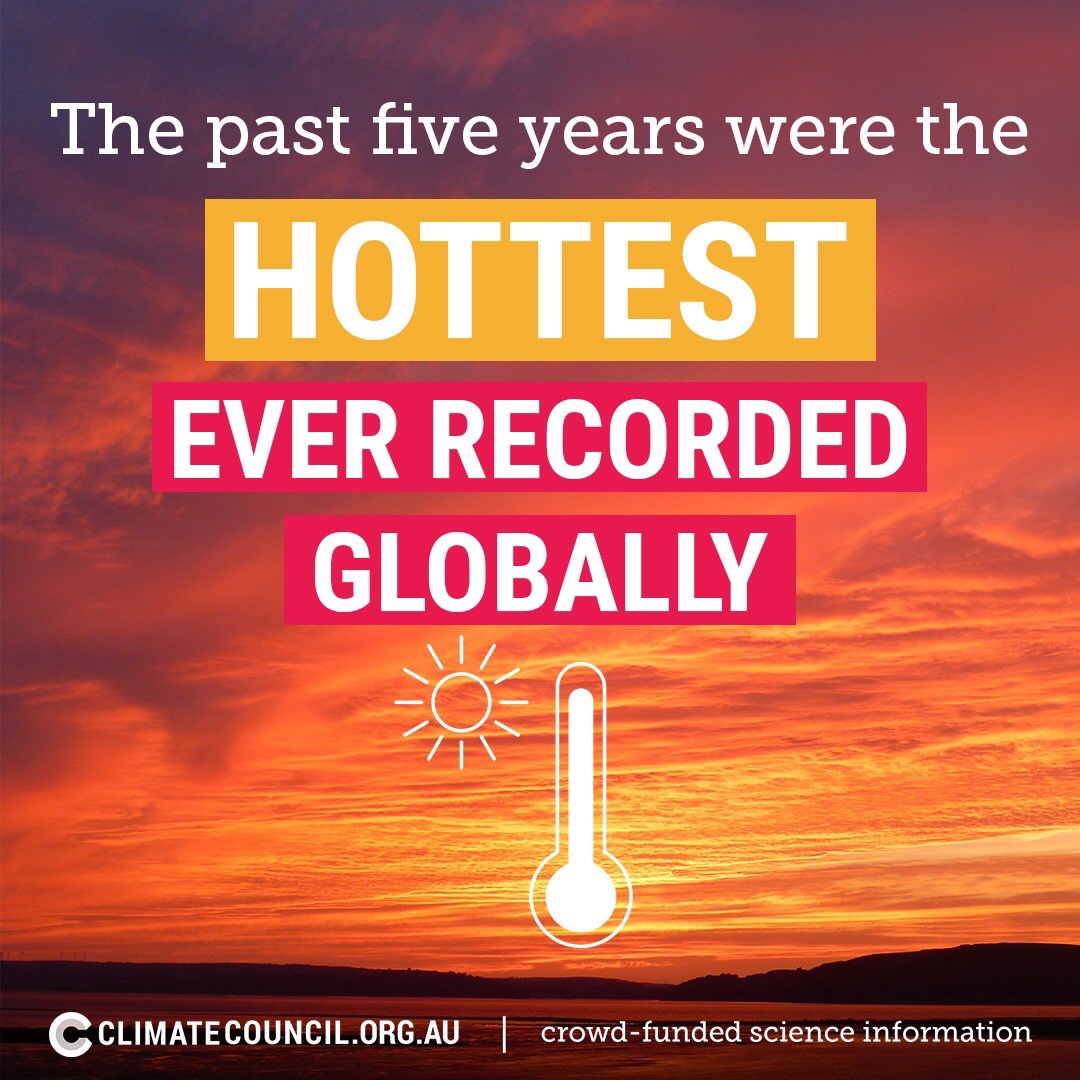 |
| Hottest Years |
Restoring
and protecting nature is one of the greatest strategies for tackling
climate change, but not just for the obvious reason that it sucks carbon
out the air. Forests, wetlands, and other ecosystems act as buffers
against extreme weather, protecting houses, crops, water supplies and
vital infrastructure.
The strategy of using nature as a defence against climate impacts is called called ecosystem-based adaptation (EbA) – in essence, look after nature and it will look after you.
Here are six ways that nature can defend us from climate change impacts:
Monday, 22 June 2020
Government's COVID Commission manufacturing plan calls for huge public gas subsidies: ABC NEWS
State bans on coal seam gas development would be
scrapped and the Federal Government would underwrite gas prices and
massively subsidise costs and investment for gas companies, under
confidential plans for a "gas-led manufacturing recovery" post-COVID-19.
methane gas industry calls for sunsidies
Key points:
- Leaked documents reveal a draft plan calling for massive gas subsidies and public investment
- The interim report also calls for reduced 'green and red tape' and an end to all fracking moratoriums in NSW and Victoria
- The National COVID Coordination Commission has several members with deep links to the gas industry
The draft plans, obtained by the ABC, call for the scrapping of "green and red tape" on gas development, including a relaxation of Australian standards for equipment used in gas infrastructure and a loosening of environmental regulations and approval processes.
They are set out in an interim report from the manufacturing taskforce of the National COVID Coordination Commission (NCCC).
The NCCC is a hand-picked team of business leaders and former bureaucrats set up by the Prime Minister's Office to shape the economic recovery from the virus and lockdown, and includes several members with strong links to the gas sector.
The manufacturing taskforce includes business representatives as well as union leaders from that sector.
Its draft report advocates "underwriting new [gas] supply with government balance sheets" to allow gas producers "to invest with confidence and new pipelines to be built to get the gas to markets".
Sunday, 21 June 2020
Subscribe to:
Posts (Atom)