Showing posts with label #renewables. Show all posts

Thursday, 26 November 2020

Big batteries are getting bigger and smarter, and doing things fossil fuels can’t do (excerpt): RenewEconomy

 "South Australia and Victoria seem to be engaged in a competition for bragging rights over who has the biggest big battery in the country.

Right now it is South Australia, with the newly expanded Hornsdale Power Reserve (150MW/194MWh), but the mantle late next year will go to Victoria, where Hornsdale owner Neoen has committed to building a 300MW/450MWh big battery at Geelong, before the crown possibly returns to South Australia with AGL’s proposed “gigawatt hour” battery next to the Torrens Island gas generator.

What we can be sure of is that big batteries will get even bigger. AGL has talked of a 500MW battery at Liddell with as yet unspecified hours of storage, Neoen is talking of a 900MW/1800MWh big battery at the massive Goyder South wind and solar hybrid plant in South Australia, while Sun Cable may trump them all with a 20 gigawatt hour battery in the Northern Territory if its bold plan to supply Singapore with the world’s biggest solar farm becomes a reality.

Big might be beautiful, and able to steal the headlines, but the real significance of the most recent announcements – Neoen’s in Victoria and AGL’s in South Australia, as well as this week’s new AGL big battery proposal for the Loy Yang A brown coal generator in Victoria – is not just their size, but what they are able to do."

Read complete RenewEconomy article 


Related:   NO FUTURE IN GAS - video

Sunday, 1 November 2020

The Trump administration is burying dozens of studies detailing the promise of renewable energy, impeding a transition away from fossil fuels (excerpt): Grist

 ‘It just goes into a black hole’ 

Vote for my future climate

The Trump administration is burying dozens of studies detailing the promise of renewable energy, impeding a transition away from fossil fuels

on Oct 26, 2020

"But what went unsaid at the grip-and-grin was that one of those high-ranking officials, Dan Simmons of the U.S. Department of Energy doesn’t appear to fully support renewables. In fact, he has presided over his agency’s systematic squelching of dozens of government studies detailing its promise.

One pivotal research project, for example, quantifies hydropower’s unique potential to enhance solar and wind energy, storing up power in the form of water held back behind dams for moments when the wind isn’t blowing and the sun isn’t shining. By the time of the Hoover Dam ceremony, Simmons’ office at the Energy Department had been sitting on that particular study for more than a year.


In all, the department has blocked reports for more than 40 clean energy studies. The department has replaced them with mere presentations, buried them in scientific journals that are not accessible to the public, or left them paralyzed within the agency, according to emails and documents obtained by InvestigateWest, as well as interviews with more than a dozen current and former employees at the Department of Energy, or DOE, and its national labs.

Bottling up and slow-walking studies is already harming efforts to fight climate change, according to clean energy experts and others, because Energy Department reports drive investment decisions. Entrepreneurs worry that the agency’s practices under the current White House will ultimately hurt growth prospects for U.S.-developed technology."

Go to complete Grist story


 Related: Polling Shows Growing Climate Concern Among Americans. But Outsized Influence of Deniers Remains a Roadblock (excerpt): DeSmog


Saturday, 3 October 2020

China's zero emissions target puts Australia on notice (excerpts): The Age


Flag: Peoples Republic of China
"Australia's former top climate diplomat has warned China's net-zero emissions target will leave Australia behind, threatening future trade deals and its influence in the Pacific as the Morrison government becomes wedged between the US and China on climate action.

Howard Bamsey, who was Australia's special envoy on climate change during the Rudd government, said the announcement from President Xi Jinping last week had turned the politics of emissions reduction into a sharp economic and diplomatic issue.


Renewables consumption by region

Exajoules


*Commonwealth of Independent States

Source: BP Statistical Review of World Energy 2020


Professor Bamsey, who was also Australia's ambassador for the environment under the Howard government, said the new policy "pulls the rug out from under the argument" that Australia's domestic climate goals do not need to accelerate because China was yet to increase its ambitions.

"It's clear now China is accepting a leadership role," he said. "Xi made the announcement. That carries all the weight of the state and party.".."

..............

".. Professor Bamsey said the UK, European Union and a potential Biden presidency will pressure Australia to match their climate goals ahead of Glasgow.

"We are an internationally connected economy and we will have to adopt the policies of our trading partners, including our main partner in China," he said. "We won't be able to continue to provide goods and services and ignore the climate dimension.".."

.....................

".. The director of the European Union's Centre of Excellence at RMIT, Bruce Wilson, said China's pledge would increase pressure on Australia as it attempts to negotiate free trade deals with the EU and Britain.

"If anyone is trying to do a trade deal with the EU, the Paris deal is non-negotiable," he said.

Professor Wilson said it was still not clear if the EU would accept Australia's use of Kyoto carryover credits to meet its obligations and said a "carbon border tax" was on the agenda for countries not compliant with the EU's environmental standards.

"If you are exporting an emissions heavy product into Europe there will be a tax on that," he said.

"Chief negotiators from the EU and Australia were expected to brief stakeholders about progress on the trade deal on Wednesday afternoon. ..."

Go to The Age article  


 Related: Class action to stop planned coal mine extension filed by climate action-focused Australian teenagers (excerpt): ABC


carbon tariffs,European Union,China,impose trade tariffs on carbon offenders,coal,#renewables,#Australia,#climatechange,


Monday, 21 September 2020

Pandemic lands 'worst body blow' in modern history on fossil fuel companies (excerpt): Yale Climate Connections


 "......“Serious stress, serious stress.”

“An industry in its last days.”

“Steady decline [in growth, demand] for the past decade.”

“Cratering.”

Those are a few of the characterizations of today’s oil, natural gas, and coal industries put forward by several independent journalists, writers, and analysts in the new edition of the “This is Not Cool” video series.

… And then, along came the coronavirus and the COVID-19 challenges, providing one more blow to the energy industry.

Even pre-pandemic, the conventional energy sector “already had plans to cancel major infrastructure projects like pipelines,” independent journalist Keith Schneider told Yale Climate Connections. And with the pandemic, oil and gas experienced “the worst body blow in its modern contemporary history,” he said.

Journalist and writer Antonia Juhasz agrees, pointing to “an industry in its last days, it’s just getting hit from too many sides.”

“Most of the new electricity generation coming online today is coming from wind and solar,” says Houston Chronicle reporter Chris Tomlinson. And professor Dan Kammen of the University of California Berkeley says solar and wind have been the cheapest energy options worldwide for at least the past three consecutive years.

Kammen also says that he believes solar and wind energy initiatives can advance two to three times as many job opportunities as traditional fossil fuel projects: That would be critical to help long-time coal and other fossil fuel industry employees whose decades of work has been critical to economic development … and who society cannot simply leave stranded as momentum turns toward a clean economy. Tending to the plight of those workers whose jobs are lost will have to be part of the energy-options puzzle, interviewees say."..."

Watch the video

Go Yale Climate Connections


Related: Scottish green hydrogen scheme gears up to fuel ferries, buses and trains (excerpt): The Guardian

Saturday, 19 September 2020

More natural gas isn’t a “middle ground” — it’s a climate disaster (excerpt): Vox

To tackle climate change, natural gas has got to go.

 
Methane gas energy has to go. Leave gas in the ground.

"Methane leakage may make natural gas as bad as coal, but it’s not the reason gas has no future

The paper leads with a quick note on methane leakage in natural gas production. Methane is a fast-acting greenhouse gas with enormous short-term impacts on climate. It leaks at every stage of the natural gas production and transportation process.

While gas itself is less carbon-intensive than coal, if enough methane leaks during its production, its greenhouse gas advantages are wiped out.

Gas wells destroy farmland.
Does that much methane leak? Some studies have suggested that, yes, methane leakage is bad enough to make natural gas the greenhouse equivalent of coal. Other studies have suggested that gas still has an advantage (and proponents note that leakage could be reduced).

For our purposes here, it doesn’t matter. None of the five arguments against natural gas rely on any particular estimate of leakage. All of them would apply even if natural gas achieved zero leakage (which is impossible). The same is true regarding the local environmental impacts of natural gas production (air pollution, habitat loss, earthquakes) — they are dreadful, but even if they were eliminated, the following arguments would still apply.


1) Gas breaks the carbon budget

Honestly, this one is enough to rule out gas on its own. .......... "

Read the complete Vox article by

  Revealed: how the gas industry is waging war against climate action (excerpt) : The Guardian


Fact check on PM Morrison's gas plan.


 #methanegas,methane gas,greenhouse gas pollution,carbon dioxide,#economy,#stranded assets,#renewables,#jailclimatecriminals,


Friday, 18 September 2020

Scottish green hydrogen scheme gears up to fuel ferries, buses and trains (excerpt): The Guardian

"Scottish Power’s wind and solar farms will soon help produce green hydrogen to run buses, ferries and even trains as part of a pioneering strategic partnership to develop the UK’s nascent hydrogen economy.

Wind and solar farms will produce the gas alongside Scottish Power,

The renewable energy company, owned by Spain’s Iberdrola, will work alongside companies that specialise in producing and distributing the zero-carbon gas. Hydrogen is expected to play a major role in helping the UK to meet its climate targets.

Scottish Power will use the clean electricity generated by a major new solar farm planned for a site near Glasgow to run an electrolyser, owned by its project partner ITM Power, which will split water into hydrogen and oxygen molecules."..............

Go to complete The Guardian article

Related: HYDROGEN The once and future fuel? Opinion

  hydrogen,clean energy,energy,#renewables,

Tuesday, 8 September 2020

The Federal Government’s plan to use clean money to fund dirty projects - Video: The Climate Council

The Federal Government wants to use Australia’s clean energy bank to fund dirty fossil fuel projects. 

Yes, you read that correctly. Australia doesn’t need any new polluting fossil fuels. Coal and gas are expensive, polluting and a bad public investment. Our Clean Jobs Plan shows we can create 76,000 jobs in the short term, while setting Australia up for the future and tackling long-term problems like climate change (which seems like a much better idea). 

Learn more: https://climc.nl/3hCA9uI


Related:  Trump will roll back more environmental regulations if reelected, says EPA chief: CNBC

Climate Council, #Australia, jobs, #renewables, PM Morrison, coal, #methanegas, #climatechange, 
South Africa's Climate Action Rating by the 'Climate Action Tracker' (Excerpt)

At the Climate Action Tracker site countries are evaluated according to the sufficiency of climate action.
Check out your country at the site.

(Excerpt- Pics by this blog)

"At 2 Dec 2019     Rating: Highly Insufficient"

"The South African government finally approved its Integrated

Resource Plan (IRP2019) in October 2019, confirming the trend change in power sector planning indicated in the draft for comment from August 2018. The plan reduces the role of coal compared to previous planning and increases the adoption of renewables and gas. Unlike earlier drafts, the IRP2019 proposes extending the operational lifetime of South Africa’s sole nuclear power plant by 20 years, up to 2044.

The final plan marks a major shift in energy policy, which is remarkable for a coal-dominated country like South Africa. It aims to decommission over 35 GW (of 42 GW currently operating) of coal-fired power capacity from state-owned coal and utility giant Eskom by 2050.

remarkable for a coal-dominated country like South Africa.
Coal in South Africa - Wikipedia
However, it would still see South Africa complete nearly 6 GW of costly coal capacity currently under construction and commission another 1.5 GW of new coal capacity by 2030. IRP2019 includes a detailed phase-out plan for coal-fired power plants, which, despite improvements to earlier plans, still shows that substantial amounts of coal capacity will run beyond the year 2050. For Paris-compatibility, coal must be phased out globally, at the very latest by 2040.

The plan also proposes a significant increase in renewables-based generation from wind and solar as well as gas-based generation capacity by 2030 (an additional 15.8 GW for wind, 7.4 GW for solar and 2.5 GW for gas by 2030), with no further new nuclear capacity being procured.

Implementing the IRP2019 will enable South Africa to achieve its 2030 NDC target. However, we rate South Africa’s NDC target as “Highly Insufficient” based on the upper end of the NDC range. In this context, South Africa should consider revising its target downward for 2030 to be resubmitted to the UNFCCC as part of the Paris Agreement’s ambition raising cycle of 2020.

To be in line with the Paris Agreement goals, South Africa would need to adopt more ambitious actions by 2050 beyond the IRP2019, such as even further increasing renewable energy capacity by 2030 and beyond, fully phasing out coal-fired power generation by latest 2040, and substantially limiting natural gas use.

Although South Africa is one of the few countries that has put forward absolute emissions targets in their NDC, we still rate this target “Highly Insufficient”.  ..........................


Go to Climate Action Tracker for more detail.

Related: This is what sea level rise will do to coastal cities: Video


...and in Australia: "While the federal government continues to repeatedly state that Australia is on track to meet its 2030 target “in a canter”, the Climate Action Tracker is not aware of any scientific basis, published by any analyst or government agency, that would support this. The OECD has warned the Australian Government that it will not achieve its target without intensified mitigation efforts. It describes current climate policy as a “piecemeal approach”." Climate Action Tracker

#climateaction, coal mining, South Africa, Paris Agreement, Paris Targets, #renewables,

Thursday, 3 September 2020

'A shot in the arm:' Victoria backs clean energy in bid to fuel COVID-19 recovery: SMH

(Pics by this blog)

"Clean energy projects will receive a Victorian government funding boost in the hope of driving the state's battered economy out of the coronavirus downturn and avoiding a slump in wind and solar investment.

Victorian Energy Minister Lily D'Ambrosio is preparing to brief 


300 investors on Wednesday about the launch of a formal process to test interest in building 600 megawatts of renewable energy capacity statewide, which she said would drive down prices and create new jobs at a critical time."

.......................................

"Climate advocates say the unprecedented upheaval of COVID-19 presents a once-in-a-generation opportunity to accelerate the energy transition. Mr Thornton said there was now a "massive consensus" in Australia and around the world about the potential for renewable energy to play a leading role in the economic recovery from COVID-19."

By Nick Toscano and Miki Perkins

Go to the complete SMH article 


Related: 

Young people’s burden: requirement of negative CO2 emissions: Hansen et al


Monday, 24 August 2020

The Two Sides to Canada’s Post Pandemic Recovery: by Rolly Montpellier @Below2C

There are two sides to Canada’s post pandemic recovery. On the bright side there’s massive public support for a recovery that puts people before profits and tackles both the climate crisis and the coronavirus crisis simultaneously. Hundreds of organizations all across the land have endorsed these Just Recovery Principles. But there is also a dark side.

The Two Sides to Canada's Post Pandemic Recovery, Below2C
Canada's commitment to different energy types since beginning od Covid 19 pandemic


1. The Dark Side

“The last time we had a financial meltdown (the 2008-09 recession) it was followed by a record surge in fossil fuel burning,” wrote Barry Saxifrage and Chris Hatch recently in the National Observer
 “At the time there was hope that governments would use their huge, future-shaping stimulus to transition to a climate-safe economy.”

Fossil Fuel Burning Annual Totals


Well, that didn’t happen. Instead, the burning of fossils soared in 2010 and continued its upward trajectory every single year since. That is, until the pandemic as the Global Fossil Fuel Burning chart illustrates. The blue dotted line on the chart shows the projection for an 8% decline in CO² for 2020.

Saturday, 22 August 2020

Transparent Solar Panels: Energy Formula

Let's hope this technology develops further.

"A team of researchers from Michigan State University managed to develop fully transparent solar panels – a breakthrough that could lead to countless applications in architecture, as well as other fields such as mobile electronics or the automotive industry. Previous attempts to create such a device have been made, but results were never satisfying enough, with low efficiency and poor material quality.


A transparent luminescent solar concentrator waveguide is shown with colorful traditional luminescent solar concentrators in the background. The new LSC can create solar energy but is not visible on windows or other clear surfaces – Courtesy of Michigan State University, Photography: G.L. Kohuth

“We can tune these materials to pick up just the ultraviolet and the near infrared wavelengths that then ‘glow’ at another wavelength in the infrared” – Richard Lunt, assistant professor of chemical engineering and materials science at MSU’s College of Engineering. The captured light is transported to the contour of the panel, where it is converted to electricity with the help of thin strips of photovoltaic solar cells.

Solar panels are great, particularly when you are looking at making your home a lot more energy efficient. Here at Energy Formula, we’re looking forward at helping you reach your goal.  If you’ve been looking at the idea of solar panels but you just can’t get behind their functionality as far aster aesthetic appeal, you aren’t alone. There are many people whose sole reason for not going solar is due to the appearance of the panel itself.  No you have a new way to consider looking at solar power: through transparent solar panels!

How do transparent solar panels work?
These are exactly as simple as they sound. They’re panes of glass that are coated in a solar concentrator top layer that acts as the solar panel itself. Invisible to the eye, this super lightweight coating can be applied to any clear surface and give it maximum solar potential while still keeping the window itself perfectly clear.  This is essentially an invisible solar panel!
These unique transparent solar panels work by using molecules to absorb the light that hits the glass and then transporting it to the actual contour of the panel and converting it into energy through the photovoltaic cells that you know about already.  
This development would make the most out of the buildings’ facades, since the vertical footprint is often larger than the rooftop one – especially for glass towers. Solar harvesting of Transparent Solar Panels would, thus, become more efficient and aesthetically, without altering the architectural design. Moreover, this technology could be easily integrated in old buildings.

The process of their power is exactly as you would expect, but it’s so special and unique to think that it happens entirely invisible to the naked eye in the form of a film that can be spread over any clear surface.  Truly, it’s the stuff of legends, but it is very much  real life.

Perks of transparent solar panels

There are no end of perks to consider for transparent solar panels, but her are some of the leading options to know about for our world as we know it. 
  • It allows for skyscrapers to engage with renewable energy: We already know that there are all sorts of skyscrapers and such kinds of buildings that are filled to the brim with glass.  This means that there are floors and floors, and panes and panes of glass already there ready to be used for solar power.  We just have to use it. 
  • It’s simple to apply and easy to benefit from: This film must be applied correctly, but it is easy to do so by professionals, and it will be as simple as “peel and stick” as far as the benefits . No complicated software, no upkeep. It’s just a covering for windows of any size and maximum solar power. 
  • It can be an after-market solution: Buildings new and old can benefit from the use of transparent solar panels as it is intended as an after-market treatment to consider for glass in both commercial and residential buildings. 
  •  
While transparent solar panels have only 1% energy efficiency right now compared to the blue and black ones that you’ve seen before, there’s a lot of hope that this will continue to build and grow as more people get interested in solar power and the technologies that can be used to put it into effect a bit more realistically for commercial buildings. " 

from Energy Formula


Sunday, 9 August 2020

Video - Impact of climate change on Australian industries: CNBC


Sadly, at the federal government level in Australia, there is a lack of political will and action when it comes to climate change, Martin Rice, acting CEO at the Climate Council told CNBC

Subscribe to CNBC Life: http://cnb.cx/2wAkfMv 

Subscribe to CNBC International: http://cnb.cx/2gft82z

Related:

Australia's Climate Council- Worth Checking Out the Website


video, Great Barrier Reef, jobs, tourism, #drought, #renewables, energy storage, electricity, carbon, Climate Council, #stranded assets


Monday, 27 July 2020

FirstEnergy Scandal is Latest Example of Utility Corruption, Deceit / DeSmog

By Matt Kasper, originally published at Energy and Policy Institute

 Federal agents arrested Ohio Speaker of the House Larry Householder, along with several lobbyists, on July 21 on charges that the group used $60 million of funds provided by the monopoly utility FirstEnergy Corp. in exchange for passing a law that bailed out that company’s nuclear and coal plants. 

The scandal is the latest example of monopoly utility companies deceiving lawmakers, regulators, and the public to enrich executives and shareholders, and occasionally being criminally investigated or prosecuted for their actions. Many instances of utility corruption center around attempts to change policies or regulations in ways that would increase electric bills – often to cover costs at expensive power plants, win approval to construct controversial power plants, or restrict the growth of rooftop solar power.

Read the full DeSmog article listing various allegations involving various lawmakers and energy companies. 

Related: Prepare for Economic Chaos

#jailclimatecriminals, #USA, #fossilfuelcompanies, #lawmakers, #climateaction, #economy, #renewables, 

Sunday, 19 July 2020

HYDROGEN The once and future fuel? Opinion


"London, 19 June: Desperate policy makers trying to reach Net Zero targets that are unaffordable and infeasible are rushing into the premature adoption of hydrogen as a last ditch attempt to save the current agenda.

Hydrogen gas may contribute to greenhouse gases
Hydrogen Gas


Dr John Constable, author of the study, said: 

“Hydrogen has genuine long term potential as a universal energy carrier to supplement electricity, but current methods of production are hugely expensive and will stress fresh water supplies. Target-driven haste is already resulting in accidents. Counterproductive and naive policies are compromising the hydrogen future.” "

"Faced with the task of eliminating carbon dioxide emissions while sustaining economic growth, the UK government, like others around the world, is promoting hydrogen as an energy carrier for sectors of the economy such as heavy transport and peak winter heating that are extremely difficult to decarbonize.

The wisdom of this policy, with a special focus on the United Kingdom, is addressed in a new historical and technical study published today by the GWPF.

The study concludes that current enthusiasm is a desperate measure that will jeopardise the long-term promise of hydrogen for the sake of short-term political optics.

Because of the accelerated timetable required by arbitrary targets, it is necessary to manufacture hydrogen via two expensive and energetically inefficient commodity production processes, the electrolysis of water, and the reforming of natural gas.

Electrolysis is extremely expensive, and the reforming of methane emits carbon dioxide and so requires Carbon Capture and Sequestration, which is not only costly but unproven at the required scale. Both these commodity processes imply high levels of fresh water consumption.

The prudent approach, obvious since the 1970s and still the official long-range policy of the government of Japan, is to aim for hydrogen production by the thermal decomposition of sea water employing advanced nuclear reactors, which alone might conceivably make hydrogen cheap. This is, however, very difficult chemical and nuclear engineering, and its realisation lies well into the future."


Hydrogen Gas
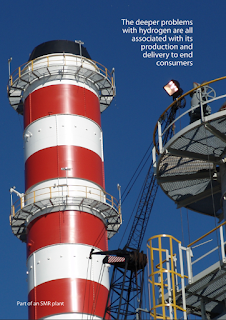
Part of an SMR plant
The paper also notes that hasty introduction will not give enough time for safe societal adjustment to the inherent dangers of a fugitive and readily ignited gas that has a strong tendency to technical detonation (combustion with a supersonic combustion frontier). The learning experience could be needlessly painful and deadly.


Ref Climate Change Institute comment on Hydrogen: The Once And Future Fuel (pdf)


Related:

'Terrifying': Scientists dig deep for missing piece of climate puzzle: SMH

 #cambio-climatico


Sunday, 5 July 2020

Names and Locations of the Top 100 People Killing the Planet: The Decolonial Atlas

Names and Locations
Names and Location of the Top 100 People Killing the Planet, 2019 – by Jordan Engel
“The earth is not dying, it is being killed, and those who are killing it have names and addresses.” – Utah Phillips

Just 100 companies are responsible for more than 70% of the world’s greenhouse gas emissions since 1988. The guys who run those companies – and they are mostly guys – have gotten rich on the backs of literally all life on Earth. Their business model relies on the destruction of the only home humanity has ever known. 

Meanwhile, we misdirect our outrage at our neighbors, friends, and family for using plastic straws or not recycling. If there is anyone who deserves the outrage of all 7.5 billion of us, it’s these 100 people right here. Combined, they control the majority of the world’s mineral rights – the “right” to exploit the remaining unextracted oil, gas, and coal. They need to know that we won’t leave them alone until they agree to Keep It In The Ground. Not just their companies, but them. Now it’s personal.

Houston tops this list as home to 7 of the 100 top ecocidal planet killers, followed by Jakarta, Calgary, Moscow, and Beijing. The richest person on the list is Russian oil magnate Vagit Alekperov, who is currently worth $20.7 billion.

The map is in the form of a cartogram which represents the size of countries by their cumulative carbon dioxide emissions since industrialization.

This map is a response to the pervasive myth that we can stop climate change if we just modify our personal behavior and buy more green products. Whether or not we separate our recycling, these corporations will go on trashing the planet unless we stop them. The key decision-makers at these companies have the privilege of relative anonymity, and with this map, we’re trying to pull back that veil and call them out. These guys should feel the same personal responsibility for saving the planet that we all feel.

Names and Locations North America.png  


Closeup of the top 32 North Americans killing the planet.

 Names and Locations Europe.png 

Closeup of the top 18 Europeans killing the planet.

Update, September 2019:
Writer Adam Weymouth contacted every person on this list asking for an interview to discuss their thoughts on climate change. In the course of his research, he found a few CEOs have now changed. 
They are:

Suncor – CEO Mark Little;
 
Kiewit – CEO Bruce Grewcock;
 
NACCO – CEO J C Butler Jr;
 
Console Energy – CEO James A Brock;
 
Alpha Natural Resources no longer exists. Bought by Contura Energy. CEO Kevin S Crutchfield;
 
Polska Grupa  Górnicza – CEO Tomasz Rogala;
 
OKD – CEO Michal Heřman;
 
EGPC – CEO Abed Ezz El-Regal;
 
Nigerian National Petroleum – CEO Mele Kyari;
 
DTEK – CEO Maxim Timchenko (Rinat Akhmetov is the owner);
 
CNOOC – CEO Yuan Guangyu;
 
INPEX – CEO Takayuki Ueda;
 
Berau Coal Energy – CEO Iskak Indra Wahyudi;
 
Indika Energy – CEO Agus Lasmono
 
“Names and Location of the Top 100 People Killing the Planet, 2019” was made by Jordan Engel. It can be reused under the Decolonial Media License 0.1.

Saturday, 27 June 2020

Earth at 2° hotter will be horrific. Now here’s what 4° will look like. | David Wallace-Wells


Earth at 2° hotter will be horrific. Now here’s what 4° will look like. Watch the newest video from Big Think: https://bigth.ink/NewVideo Join Big Think Edge for exclusive videos: https://bigth.ink/Edge
  ---------------------------------------------------------------------------------- The best-case scenario of climate change is that world gets just 2°C hotter, which scientists call the "threshold of catastrophe". Why is that the good news? Because if humans don't change course now, the planet is on a trajectory to reach 4°C at the end of this century, which would bring $600 trillion in global climate damages, double the warfare, and a refugee crisis 100x worse than the Syrian exodus. David Wallace-Wells explains what would happen at an 8°C and even 13°C increase. These predictions are horrifying, but should not scare us into complacency. "It should make us focus on them more intently," he says. 

--------------------------------------------------------------------------------- DAVID WALLACE-WELLS: David Wallace-Wells is a national fellow at the New America foundation and a columnist and deputy editor at New York magazine. He was previously the deputy editor of The Paris Review. He lives in New York City.

Tuesday, 9 June 2020

As Protests Rage Over George Floyd’s Death, Climate Activists Embrace Racial Justice: Insideclimatenews


climate change is real
#climatejustice
When New York Communities for Change helped lead a demonstration of 500 on Monday in Brooklyn to protest George Floyd's killing in Minneapolis, the grassroots group's activism spoke to a long-standing link between police violence against African Americans and environmental justice.

Elizabeth Yeampierre, executive director of UPROSE, Brooklyn's oldest Latino community-based organization, said she considers showing up to fight police brutality and racial violence integral to her climate change activism. 

Bronx Climate Justice North, another grassroots group, says on its website: "Without a focus on correcting injustice, work on climate change addresses only symptoms, and not root causes."


Read the Inside Climate News article

Monday, 8 June 2020

Banking on gas will leave us stranded: SMH

#climatecrisis   #jailclimatecriminals
Covid-19 pandemic
"When I, and others, proposed gas as a transition fuel some 30 years ago, the price of solar was multiples of its current price, so gas was a quicker and more cost-effective means of achieving a reduction in emissions of some 40 to 60 per cent relative to coal.

However, as Chief Scientist Alan Finkel admitted in his recent address to the National Press Club, “the cost of producing electricity from wind and solar is now around $A50 per megawatt hour and [even with effective storage] the price … is lower than existing gas-fired electricity generation and similar to new-build, coal-fired electricity generation … and is set to drop even further”.

And with solar and wind technology proven, in the sense that financiers accept the risk without premium, why wouldn’t the government seek the development of grid-scale storage to achieve 100 per cent renewables? Clearly Morrison and his team have sold out to the likes of the Minerals Council and the fossil fuel lobby, whose influence is now conspicuous in the focus of the COVID recovery commission."


Read the complete SMH article 


Chief Scientist Dr Alan Finkel says gas fired hydrogen could reduce the risk associated with total reliance on renewable energy.

The suggestion of a pipeline linking large the gas fields off