The Climate 21 Project taps the expertise of more than 150 experts with high-level government
experience, including nine former cabinet appointees, to deliver actionable advice for a
rapid-start, whole-of-government climate response coordinated by the White House and accountable
to the President.
The memos below contain the Climate 21 Project’s recommendations for 11 White House offices,
federal departments, and federal agencies, as well as cross-cutting recommendations on personnel
and hiring.
Importantly, the Climate 21 Project is not offering a policy agenda. Rather, the memos below
contain
recommendations that can help the President hit the ground running
and build the capacity of
his administration to tackle the climate crisis quickly with the existing tools at hand.
The recommendations are focused in scope on areas where the contributors have the most expertise.
An all-of-government mobilization on climate change will require important work by additional federal
departments and agencies that were not examined by the Climate 21 Project.
"A team of former Obama administration officials and experts have created a 300-page blueprint laying
out a holistic approach to the climate while avoiding some of the
pitfalls that hampered President Barack Obama, who shared some of the
same goals but was unable to enact all of them. Dubbed the Climate 21
Project, it took a year and a half to develop and was delivered recently
to Biden’s transition team. The document outlines how the incoming
administration could restructure aspects of the government to move
faster on global warming." Washington Post
" ....... I wanted to know if this was beginning to change. Might Americans
finally be waking up to how climate is about to transform their lives?
And if so — if a great domestic relocation might be in the offing — was
it possible to project where we might go? To answer these questions, I
interviewed more than four dozen experts: economists and demographers,
climate scientists and insurance executives, architects and urban
planners, and I mapped out the danger zones that will close in on
Americans over the next 30 years. The maps for the first time combined
exclusive climate data from the Rhodium Group, an independent
data-analytics firm; wildfire projections modeled by United States
Forest Service researchers and others; and data about America’s shifting
climate niches, an evolution of work first published by The Proceedings of the National Academy of Sciences last spring. (See a detailed analysis of the maps.) "
Sea rise and no planned retreat
"What I found was a nation on the cusp of a great transformation. Across
the United States, some 162 million
people — nearly one in two — will
most likely experience a decline in the quality of their environment,
namely more heat and less water. For 93 million of them, the changes
could be
particularly severe, and by 2070, our analysis suggests, if
carbon emissions rise at extreme levels, at least four million Americans
could find themselves living at the fringe, in places decidedly outside
the ideal niche for human life. The cost of resisting the new climate
reality is mounting. Florida officials have already acknowledged that
defending some roadways against the sea will be unaffordable. And the
nation’s federal flood-insurance program is for the first time requiring
that some of its payouts be used to retreat from climate threats across
the country. It will soon prove too expensive to maintain the status
quo. "
........................
Some predicted sea rise may be too conservative
"Let’s start with some basics.
Across the country, it’s going to get hot. Buffalo may feel in a few
decades like Tempe, Ariz., does today, and Tempe itself will sustain
100-degree average summer temperatures by the end of the century.
Extreme humidity from New Orleans to northern Wisconsin will make
summers increasingly unbearable, turning otherwise seemingly survivable
heat waves into debilitating health threats. Fresh water will also be in
short supply, not only in the West but also in places like Florida,
Georgia and Alabama, where droughts now regularly wither cotton fields.
By 2040, according to federal government projections, extreme water
shortages will be nearly ubiquitous west of Missouri. The Memphis Sands
Aquifer, a crucial water supply for Mississippi, Tennessee, Arkansas and
Louisiana, is already overdrawn by hundreds of millions of gallons a
day. Much of the Ogallala Aquifer — which supplies nearly a third of the
nation’s irrigation groundwater — could be gone by the end of the
century."
Vehicles ply on waterlogged Delhi-Gurgaon Expressway near Narsingpur after heavy rains, in Gurugram
..... "In a just world, this would be major news, even in the faraway U.S.
Perhaps stories about the local covid-19 crises we’re seeing across the
country would get more attention, but surely, the displacement of
millions deserves a spot on the front page. And yet.
If you didn’t
know these floods were happening, I’m not here to scold you. Tragedies
take place around the world every day, from bombings to hunger. Plus, here in the U.S., things are pretty awful
for lots of people, too. It’s difficult if not impossible to keep up
with every bad thing happening in all places. It’s also, frankly, easier
for many of us in the Global North to ignore crises that are happening
to poor people far away. When these crises do surface in news reports,
many of us are taught to treat them as inevitable — things are simply
more difficult for people “over there.”
This can all lead us to feel insulated from these horrors. We need to
Local residents look at a submerged bus in a waterlogged road
underpass after monsoon rainfalls in New Delhi
(Photo: Prakash Singh,
Getty Images)
fight that impulse. Caring about our fellow human beings is the right
thing to do, sure. But even if empathy isn’t your thing, there’s also an
uncomfortable reality: Climate disasters will eventually come for us
all if we don’t act now.
The deafening silence about climate
change-fuelled weather in the Global South isn’t limited to the recent
floods in South Asia. People have died in deluges in India and
Bangladesh in previous years, too — hundreds last year, 1,000 in 2018, over 1,200 in 2017. Hurricane Dorian, one of the most intense hurricanes to ever form in the Atlantic Ocean, absolutely ravaged the Bahamas just last year. Yet it has all but faded from popular memory in the U.S. aside from the saga of Sharpiegate. And nearly three years after Hurricane Maria hit Puerto Rico, thousands are still without homes and the power grid recently crashed again in the face of a moderate tropical storm yet these stories of widespread suffering are rarely found on front pages.
World leaders plan for climate change
All of this devastation was not inevitable. World leaders could have
taken steps to move us away from fossil fuels decades ago. They also
could have poured far more resources into helping vulnerable people
adapt before emergencies strike, and rebuild after they do. But they’ve
made clear they won’t do much of that of their own accord — they claim
it’s too expensive, too difficult, too impractical. We need a mass
movement that shows them we won’t take no for an answer, and part of
that is recognising the toll the crisis is already taking and acting
with urgency and compassion. World leaders already have blood on
their hands. Every life these actions could have saved is important.
Each of the hundreds of Indian and Bangladeshi people killed by the
ongoing monsoons in India deserved better. And we all deserve better
than to see this continue.
That’s not just because it’s the right
thing to do. It’s also our only option. Eventually, ecological horror
will come for all of us. It might be in a month, a year, or 20 years,
but eventually, a storm, heat wave, or tornado will come banging down
your door. The time to change course is now, starting with, at a
minimum, acknowledging the impacts the climate crisis on the poorest
among us.
We want climate action now
Even if the world does act, some climate disasters may
be inevitable since we’ve already overheated the planet and left people
vulnerable. We won’t be able to stop every flood or heat wave from
taking place. But what’s not inevitable is our treatment of some people
as disposable. If we prioritise taking steps to help people adapt and
prepare, countless lives could be saved. Stopping deforestation of
catchment areas and restoring wetlands, for instance, could go a long
way to better shielding communities in India and Bangladesh from rising
waters. So could national policies to provide more resilient housing to
all people, and international policies to prioritise aid to the
struggling countries that are hit hardest......" Go to complete Gizmodo story by Dharna Noor, August 21, 2020
"Peak medical groups representing about 75 per cent of Australia’s
90,000 doctors have written to the prime minister to ask him to make a
response to climate change central to the government’s post-coronavirus
economic stimulus plans.
The groups, which include bodies such as
the Australian Medical Association and the College of Intensive Care
Medicine of Australia and New Zealand, have called on the government to
redirect funds from fossil fuel subsidies in stimulus efforts to
renewable energy projects and infrastructure to promote walking, cycling
and public transport.
The
letter comes after a similar appeal sent on Monday by finance and
industry heavyweights, including the big four banks and major
corporations, also urging the government to make “sustainable
investments” in areas such as health, education, clean energy and urban
infrastructure as it helps rebuild the economy."
South Beach, Miami on May 3, 2007. Photo by Flickr user James WIlliamor, via a Creative Commons license.
"Sea level since 1880
The global mean water level in the ocean rose by 0.14 inches (3.6
millimeters) per year from 2006–2015, which was 2.5 times the average
rate of 0.06 inches (1.4 millimeters) per year throughout most of the
twentieth century. By the end of the century, global mean sea level is
likely to rise at least one foot (0.3 meters) above 2000 levels, even if
greenhouse gas emissions follow a relatively low pathway in coming
decades.
In some ocean basins, sea level rise has been as much as 6-8 inches
(15-20 centimeters) since the start of the satellite record. Regional
differences exist because of natural variability in the strength of
winds and ocean currents, which influence how much and where the deeper
layers of the ocean store heat."
..........................
ADMIN: The above figures are now seen by some scientists as an underestimation of sea level rise. See article below.
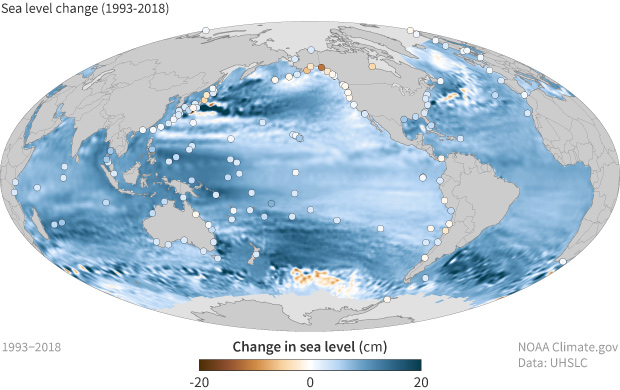
Between 1993 and 2018, mean sea level has risen across most of the
world ocean (blue colors). In some ocean basins, sea level has risen 6-8
inches (15-20 centimeters). Rates of local sea level (dots) can be
amplified by geological processes like ground settling or offset by
processes like the centuries-long rebound of land masses from the loss
of ice age glaciers. NOAA Climate.gov map, based on data provided by
Philip Thompson, University of Hawaii.
Past and future sea level rise at specific locations on
land may be more or less than the global average due to local factors:
ground settling, upstream flood control, erosion, regional ocean
currents, and whether the land is still rebounding from the compressive
weight of Ice Age glaciers. In the United States, the fastest rates of
sea level rise are occurring in the Gulf of Mexico from the mouth of the
Mississippi westward, followed by the mid-Atlantic. Only in Alaska and a
few places in the Pacific Northwest are sea levels falling, though that
trend will reverse under high greenhouse gas emission pathways.
In some ocean basins, sea level rise
has been as much as 6-8 inches (15-20 centimeters) since the start of
the satellite record in 1993.
Why sea level matters
In the United States, almost 40 percent
of the population lives in relatively high population-density coastal
areas, where sea level plays a role in flooding, shoreline erosion, and
hazards from storms. Globally, 8 of the world’s 10 largest cities are
near a coast, according to the U.N. Atlas of the Oceans.
In urban settings along coastlines around the world, rising seas
threaten infrastructure necessary for local jobs and regional
industries. Roads, bridges, subways, water supplies, oil and gas wells,
power plants, sewage treatment plants, landfills—the list is practically
endless—are all at risk from sea level rise.
Higher background water levels mean that deadly and destructive storm
surges, such as those associated with Hurricane Katrina, “Superstorm”
Sandy, and Hurricane Michael—push farther inland than they once did.
Higher sea level also means more frequent high-tide flooding, sometimes
called “nuisance flooding”
because it isn't generally deadly or dangerous, but it can be
disruptive and expensive. (Explore past and future frequency of
high-tide flooding at U.S. locations with the Climate Explorer, part of the U.S. Climate Resilience Toolkit.)
Nuisance
flooding in Annapolis in 2012. Around the U.S., nuisance flooding has
increased dramatically in the past 50 years. Photo by Amy McGovern.
In the natural world, rising sea level creates stress
on coastal ecosystems that provide recreation, protection from storms,
and habitat for fish and wildlife, including commercially valuable
fisheries. As seas rise, saltwater is also contaminating freshwater aquifers, many of which sustain municipal and agricultural water supplies and natural ecosystems.
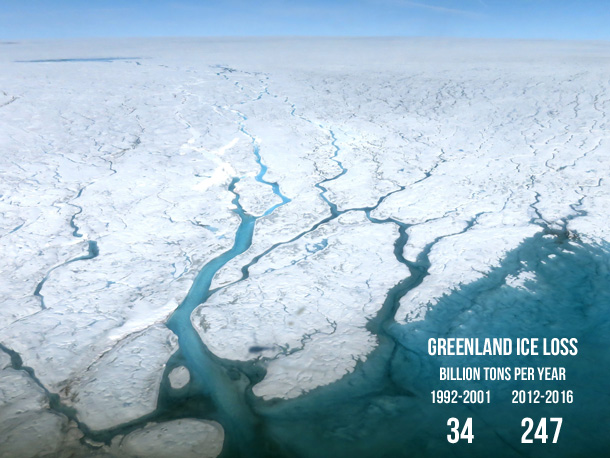
Melt streams on the Greenland Ice Sheet on July 19, 2015. Ice loss
from the Greenland and Antarctic Ice Sheets as well as alpine glaciers
has accelerated in recent decades. NASA photo by Maria-José Viñas.
' "It
is very likely that the current climate models overestimate the
meltwater retention capacity of the ice sheet and underestimate the
projected sea level rise coming from Greenland ... by a factor of two or
three," he said. ' ICNews
Climate litigation is not going away any time soon.
Lawsuits demanding accountability and action on the existential
threat of climate change continue to take hold across the world with
some significant new developments and new cases emerging over the past
year, according to a new report on trends in global climate change litigation.
That report,
published July 3 by the London School of Economics’ Grantham Research
Institute on Climate Change and the Environment, provides an overview of
climate change lawsuits around the world including key developments
between May 2019 and May 2020. Grantham Research Institute maintains a database of global climate change lawsuits and in recent years has issued annual reports on trends in climate litigation.
Over the past three decades climate change lawsuits have spread
across six continents with over 1,500 cases identified in 37 countries,
according to the latest report. Most of these cases are in the U.S.,
though increasingly cases are emerging outside the U.S.
including 26 new cases in the last year alone. The Global South (Asia,
Africa and Latin America) has seen 37 cases of climate litigation
to date.
While a majority of climate-related lawsuits are routine cases such
as regulatory proceedings or challenges to fossil fuel permitting, cases
are also being brought more strategically as a way to hold governments
and companies accountable for damaging climate impacts. This kind of
litigation against national governments and against fossil fuel
companies has taken off in recent years.
New study out today on climate litigation across the world – shows humans rights are increasingly being used to support cases & that plaintiffs are using new strategies to bring lawsuits against major fossil fuel companies https://t.co/1tD7dVKlJ6pic.twitter.com/7FO7DK4DiC
Climate change fell out of the public eye as COVID-19 took over the
world. But this year is likely to be the most pivotal yet in the fight
against climate change.
From
our vantage point today, 2020 looks like the year when an unknown virus
spun out of control, killed hundreds of thousands and altered the way
we live day to day. In the future, we may look back at 2020 as the year
we decided to keep driving off the climate cliff–or to take the last
exit. Taking the threat seriously would mean using the opportunity
presented by this crisis to spend on solar panels and wind farms, push
companies being bailed out to cut emissions and foster greener forms of
transport in cities. If we instead choose to fund new coal-fired power
plants and oil wells and thoughtlessly fire up factories to urge growth,
we will lock in a pathway toward climate catastrophe. There’s a divide
about which way to go.
In
early April, as COVID-19 spread across the U.S. and doctors urgently
warned that New York City might soon run out of ventilators and hospital
beds, President Donald Trump gathered CEOs from some of the country’s
biggest oil and gas companies for a closed-door meeting in the White
House Cabinet Room. The industry faced its biggest disruption in
decades, and Trump wanted to help the companies secure their place at
the center of the 21st century American economy.
Everything
was on the table, from a tariff on imports to the U.S. government
itself purchasing excess oil. “We’ll work this out, and we’ll get our
energy business back,” Trump told the CEOs. “I’m with you 1,000%.” A few
days later, he announced he had brokered a deal with Russian President
Vladimir Putin and Saudi Crown Prince Mohammed bin Salman to cut oil
production and rescue the industry.
Art by Jill Pelto for TIME
Later
in April, Ursula von der Leyen, the president of the European
Commission, in a video message from across the Atlantic, offered a
different approach for the continent’s economic future. A European Green
Deal, she said, would be the E.U.’s “motor for the recovery.”
“We
can turn the crisis of this pandemic into an opportunity to rebuild our
economies differently,” she said. On May 27, she pledged more than $800
billion to the initiative, promising totransform the way Europeans live.
For
the past three years, the world outside the U.S. has largely tried to
ignore Trump’s retrograde position on climate, hoping 2020 would usher
in a new President with a new position, re-enabling the cooperation
between nations needed to prevent the worst ravages of climate change.
But there’s no more time to wait.
We’re
standing at a climate crossroads: the world has already warmed 1.1°C
since the Industrial Revolution. If we pass 2°C, we risk hitting one or
more major tipping points, where the effects of climate change go from
advancing gradually to changing dramatically overnight, reshaping the
planet. To ensure that we don’t pass that threshold, we need to cut
emissions in half by 2030. Climate change has understandably fallen out
of the public eye this year as the coronavirus pandemic rages.
Nevertheless, this year, or perhaps this year and next, is likely to be
the most pivotal yet in the fight against climate change. “We’ve run out
of time to build new things in old ways,” says Rob Jackson, an earth
system science professor at Stanford University and the chair of the
Global Carbon Project. What we do now will define the fate of the
planet–and human life on it–for decades.
Earth at 2° hotter will be horrific. Now here’s what 4° will look like.
Watch the newest video from Big Think: https://bigth.ink/NewVideo
Join Big Think Edge for exclusive videos: https://bigth.ink/Edge
----------------------------------------------------------------------------------
The best-case scenario of climate change is that world gets just 2°C hotter, which scientists call the "threshold of catastrophe".
Why is that the good news? Because if humans don't change course now, the planet is on a trajectory to reach 4°C at the end of this century, which would bring $600 trillion in global climate damages, double the warfare, and a refugee crisis 100x worse than the Syrian exodus.
David Wallace-Wells explains what would happen at an 8°C and even 13°C increase. These predictions are horrifying, but should not scare us into complacency. "It should make us focus on them more intently," he says.
---------------------------------------------------------------------------------
DAVID WALLACE-WELLS:
David Wallace-Wells is a national fellow at the New America foundation and a columnist and deputy editor at New York magazine. He was previously the deputy editor of The Paris Review. He lives in New York City.