Wednesday, 18 November 2020

Faith Institutions Announce Largest-Ever Joint Divestment From Fossil Fuels (excerpt): 350

"Commitments highlight need for governments to increase ambition
on climate action.


WASHINGTON - Today, 47 faith institutions announce their divestment from fossil fuels, making the largest-ever joint announcement of divestment among religious leaders. These include Catholic, Protestant, and Jewish institutions from 21 countries.

Participating institutions include the Commission of the Bishops’ Conferences of the European Union, American Jewish World Service, and Anglican and Methodist churches across the United Kingdom. The full list of participating institutions is here.

The announcement coincides with the fifth anniversary of the Paris agreement on climate change. Faith leaders’ action puts pressure on government leaders, and their commitment to clean energy stands in stark contrast with many governments’ failure to deliver ambitious energy strategies. "

Go to complete 350.0rg article


Related:
Politicians Try to Rally Support for Coal Despite Economics and Biden Presidential Win (excerpt): DeSmog


divestment, 350, fossil fuel industry, Paris Agreement, faith institutions, jail climate criminals

Sunday, 15 November 2020

Politicians Try to Rally Support for Coal Despite Economics and Biden Presidential Win (excerpt): DeSmog

Sen. Mitt Romney

"The election results are a stark reminder of just how divided the country remains on many issues. However, in the days since the results were announced November 7, two senators from both parties are finding common ground in a familiar space: opposition to the Green New Deal and support for a dying coal industry.

Both Sen. Mitt Romney (R-UT) and Sen. Joe Manchin (D-WV) immediately took to CNN and Fox News in the days after the election was called to try and rally support for the fossil fuel industry in the wake of Joe Biden's election as president a success which brings with it the promise of strong climate action.

But their comments also come on the heels of yet another coal plant closure in the U.S. and as the world's largest coal producer, Peabody Energy, warns of going bankrupt for the second time in five years.

Romney told CNN on November 8 that “I want to make sure that we conservatives keep on fighting to make sure we don't have a Green New Deal, we don't get rid of gas and coal.”


Pic from this blog

Meanwhile, Manchin went on Fox News on November 9 to alsocriticize the Green New Deal, saying, “That’s not who we are as a Democratic Party.” 

We’re going to use fossil in its cleanest fashion,” he added. Manchin's unwavering support for the coal industry is well documented and unsurprising as he ran a coal company prior to being elected to the Senate.

Manchin in his comments also echoed Romney’s call to not get rid of gas and coal, telling Fox News, “You have to have energy independence in this country. You can’t eliminate certain things.”


Read complete Politicians Try to Rally Support for Coal Despite Economics and Biden Presidential Win

in DeSmog by Justin Mikulka • Thursday, November 12, 2020. Read time: 10 mins


Related:  What is the Climate 21 Project?


Saturday, 14 November 2020

What is the Climate 21 Project?


The Climate 21 Project taps the expertise of more than 150 experts with high-level government experience, including nine former cabinet appointees, to deliver actionable advice for a rapid-start, whole-of-government climate response coordinated by the White House and accountable to the President.

The memos below contain the Climate 21 Project’s recommendations for 11 White House offices, federal departments, and federal agencies, as well as cross-cutting recommendations on personnel and hiring.

Importantly, the Climate 21 Project is not offering a policy agenda. Rather, the memos below contain

 recommendations that can help the President hit the ground running

 and build the capacity of his administration to tackle the climate crisis quickly with the existing tools at hand.

The recommendations are focused in scope on areas where the contributors have the most expertise. An all-of-government mobilization on climate change will require important work by additional federal departments and agencies that were not examined by the Climate 21 Project.

Go to https://climate21.org/

"A team of former Obama administration officials and experts have created a 300-page blueprint laying out a holistic approach to the climate while avoiding some of the pitfalls that hampered President Barack Obama, who shared some of the same goals but was unable to enact all of them. Dubbed the Climate 21 Project, it took a year and a half to develop and was delivered recently to Biden’s transition team. The document outlines how the incoming administration could restructure aspects of the government to move faster on global warming." Washington Post

Related: The 40 Things Biden Should Do First on Climate Change (excerpt): Bloomberg Green

Friday, 13 November 2020

The 40 Things Biden Should Do First on Climate Change (excerpt): Bloomberg Green


Randolph Bell
Randolph Bell, Director for Global Energy Security, Atlantic Council

Take care of fugitive methane emissions.

“Failing to fully address methane leakage is increasingly a risk for the climate and for the U.S. economy. Methane makes up at least 10 percent of U.S. greenhouse gas emissions—recent analysis suggests far more—and is at least 25% more potent at trapping heat than carbon dioxide. With natural gas projected to play an important role in the global energy system even under aggressive decarbonization scenarios by providing low-carbon power in the developing world and feedstock for hydrogen production (with carbon capture and storage), addressing methane is crucial for meeting climate goals.”

“The U.S.’s methane problem has the attention of major oil & gas producers, who decried the Trump Administration’s August reversal of an Obama-era rule on methane. Engie’s decision last month, under pressure from the French government, to delay its $7 billion deal with U.S. LNG company NextDecade because of U.S. methane emissions underscores the risks to the U.S. economy.”

“President-elect Biden can immediately direct the EPA to initiate a new rulemaking process to ensure that industry monitors and addresses leaks in new equipment, as Obama’s rule did. Biden can also be more ambitious and address leaks in older equipment, an effort that was not completed under Obama.” —As told to Akshat Rathi


Wednesday, 11 November 2020

A record hurricane season (excerpt): New York Times


Satellite image of the Atlantic on November 10th, 2020.
Image: NOAA
"Subtropical Storm Theta, which formed in the open waters of the Atlantic this week, became the 29th named storm of this year’s hurricane season, surpassing the total count from 2005. Scientists can’t say for sure whether global warming is causing more hurricanes, but they are confident that it’s changing the way storms behave.
Here’s how.
Higher winds. There’s a solid scientific consensus that hurricanes are becoming more powerful. Hurricanes are complex, but one of the key factors that determines how strong a given storm ultimately becomes is ocean surface temperature, because warmer water provides more of the energy that fuels storms.
More rain. Warming also increases the amount of water vapor that the atmosphere can hold. In fact, every degree Celsius of warming allows the air to hold about 7 percent more water. That means we can expect future storms to unleash larger amounts of rainfall.
Slower storms. Researchers do not yet know why storms are moving more slowly, but they are. Slower, wetter storms worsen flooding.
Wider-ranging storms. Because warmer water helps fuel hurricanes, climate change is enlarging the zone where hurricanes can form. That could mean more storms making landfall in higher latitudes, like in the United States or Japan.

More volatility. As the climate warms, researchers also say they expect storms to intensify more rapidly. Researchers are still unsure why it’s happening, but the trend appears to be clear."

Go to New York Times

Related: Polling Shows Growing Climate Concern Among Americans. But Outsized Influence of Deniers Remains a Roadblock (excerpt): DeSmog

Tuesday, 10 November 2020

Climate Change: How Do We Know? (excerpt): NASA


"This graph, based on the comparison of atmospheric samples contained in ice cores and more recent direct measurements, provides evidence that atmospheric CO2 has increased since the Industrial Revolution. (Credit: Luthi, D., et al.. 2008; Etheridge, D.M., et al. 2010; Vostok ice core data/J.R. Petit et al.; NOAA Mauna Loa CO2 record.) Find out more about ice cores (external site)."


"Earth's climate has changed throughout history. Just in the last 650,000 years there have been seven cycles of glacial advance and retreat, with the abrupt end of the last ice age about 11,700 years ago marking the beginning of the modern climate era — and of human civilization. Most of these climate changes are attributed to very small variations in Earth’s orbit that change the amount of solar energy our planet receives.

Scientific evidence for warming of the climate system is unequivocal.
- Intergovernmental Panel on Climate Change

The current warming trend is of particular significance because most of it is extremely likely (greater than 95% probability) to be the result of human activity since the mid-20th century and proceeding at a rate that is unprecedented over decades to millennia.1

Earth-orbiting satellites and other technological advances have enabled scientists to see the big picture, collecting many different types of information about our planet and its climate on a global scale. This body of data, collected over many years, reveals the signals of a changing climate.

The heat-trapping nature of carbon dioxide and other gases was demonstrated in the mid-19th century.2 Their ability to affect the transfer of infrared energy through the atmosphere is the scientific basis of many instruments flown by NASA. There is no question that increased levels of greenhouse gases must cause Earth to warm in response.

Ice cores drawn from Greenland, Antarctica, and tropical mountain glaciers show that Earth’s climate responds to changes in greenhouse gas levels. Ancient evidence can also be found in tree rings, ocean sediments, coral reefs, and layers of sedimentary rocks. This ancient, or paleoclimate, evidence reveals that current warming is occurring roughly ten times faster than the average rate of ice-age-recovery warming. Carbon dioxide from human activity is increasing more than 250 times faster than it did from natural sources after the last Ice Age.3

The evidence for rapid climate change is compelling: ....."

Sunday, 8 November 2020

Preparing for climate refugees


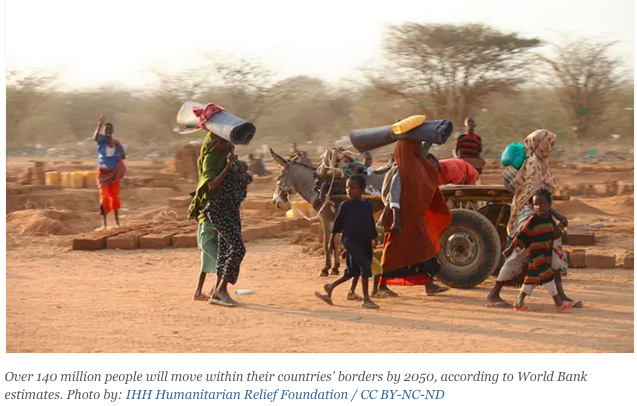
It is not just war that creates refugees. South and Central American and African droughts are forcing farmers off their lands. Hurricanes, storms and the resulting flooding is making much of the world’s lower coastal areas unlivable. Sea level rise...
As droughts impact and water becomes scarce wars are fought over resources. 


It is not just war that creates refugees. South and Central American and African droughts are forcing farmers off their lands. 

Sea rise destroying Fijian village


Hurricanes, storms and the resulting flooding is making much of the world’s lower coastal  areas unlivable. 


Sea level rise is poisoning or drowning farm lands or swamping island homes. 

You Tube: Climate Change Will Make MILLIONS Homeless. Where Will They Go? 


Heat is forcing indigenous peoples from their traditional lands. 


It is not just war that creates refugees. South and Central American and African droughts are forcing farmers off their lands. Hurricanes, storms and the resulting flooding is making much of the world’s lower coastal areas unlivable. Sea level rise...
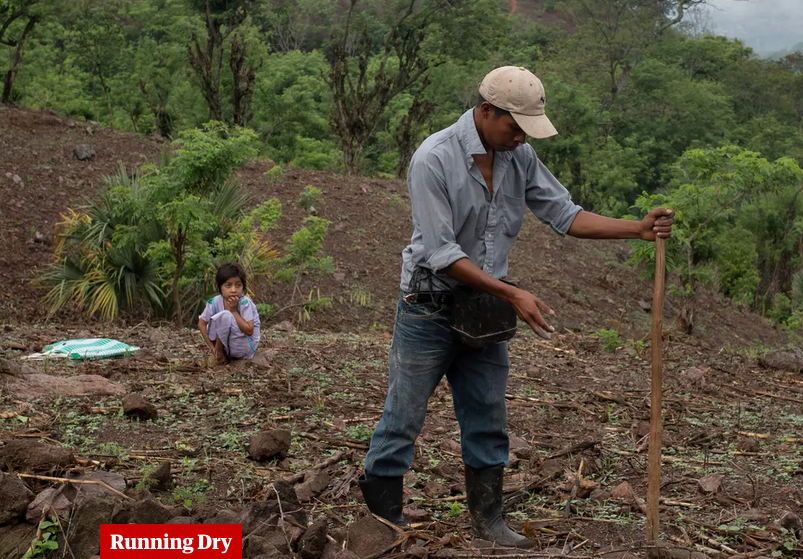
Central and South American farmers are forced off their lands by droughts. Many travel north.   


It is not just war that creates refugees. South and Central American and African droughts are forcing farmers off their lands. Hurricanes, storms and the resulting flooding is making much of the world’s lower coastal areas unlivable. Sea level rise...

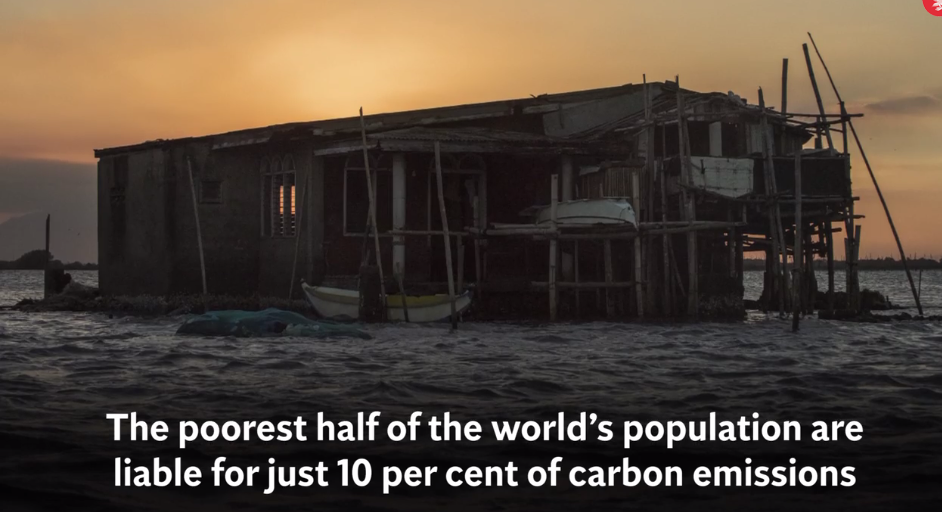
Yet the poorest have hardly contributed to climate change. 


You Tube: Climate Change, Disasters and Refugees - Talking Points

From a purely economic view the indefinite holding of refugees in detention camps is massively expensive. Huge, long-term camps of refugees require a more compassionate response by wealthier nations especially those contributing to wars or climate change.

Governments require a humane and compassionate response to refugees.

The United Nations needs to make 'climate change' a legal reason for refugees to seek asylum.

• Planning how refugees can be assimilated and contribute to less climate affected nations is essential.

Latest News:
Experts say judgment is ‘tipping point’ that opens the door to climate crisis claims for protection

 Wealthy nations must contribute more to the poorer nations so they can better manage their own climate refugees and the effects of climate change. 

See also:   Preparing for Killing Air Pollution