Showing posts with label ocean heating. Show all posts

Wednesday, 11 November 2020

A record hurricane season (excerpt): New York Times


Satellite image of the Atlantic on November 10th, 2020.
Image: NOAA
"Subtropical Storm Theta, which formed in the open waters of the Atlantic this week, became the 29th named storm of this year’s hurricane season, surpassing the total count from 2005. Scientists can’t say for sure whether global warming is causing more hurricanes, but they are confident that it’s changing the way storms behave.
Here’s how.
Higher winds. There’s a solid scientific consensus that hurricanes are becoming more powerful. Hurricanes are complex, but one of the key factors that determines how strong a given storm ultimately becomes is ocean surface temperature, because warmer water provides more of the energy that fuels storms.
More rain. Warming also increases the amount of water vapor that the atmosphere can hold. In fact, every degree Celsius of warming allows the air to hold about 7 percent more water. That means we can expect future storms to unleash larger amounts of rainfall.
Slower storms. Researchers do not yet know why storms are moving more slowly, but they are. Slower, wetter storms worsen flooding.
Wider-ranging storms. Because warmer water helps fuel hurricanes, climate change is enlarging the zone where hurricanes can form. That could mean more storms making landfall in higher latitudes, like in the United States or Japan.

More volatility. As the climate warms, researchers also say they expect storms to intensify more rapidly. Researchers are still unsure why it’s happening, but the trend appears to be clear."

Go to New York Times

Related: Polling Shows Growing Climate Concern Among Americans. But Outsized Influence of Deniers Remains a Roadblock (excerpt): DeSmog

Sunday, 10 May 2020

On land, Australia’s rising heat is ‘apocalyptic.’ In the ocean, it’s worse.: Washington Post

"The Washington Post’s examination of accelerated warming in the waters off Tasmania marks this year’s final installment of its global series “2C: Beyond the Limit,” which identified hot spots around the world. The investigation has shown that disastrous impacts from climate change aren’t a problem lurking in the distant future: They are here now. 

Nearly a tenth of the planet has already warmed 2 degrees Celsius since the late 19th century, and the abrupt rise in temperature related to human activity has transformed parts of the Earth in radical ways. 

In the United States, New Jersey is among the fastest-warming states, and its average winter has grown so warm that lakes no longer freeze as they once did. Canadian islands are crumbling into the sea because a blanket of sea ice no longer protects them from crashing waves. Fisheries from Japan to Angola to Uruguay are collapsing as their waters warm. Arctic tundra is melting away in Siberia and Alaska, exposing the remains of woolly mammoths buried for thousands of years and flooding the gravesites of indigenous people who have lived in an icy world for centuries. 

Australia is a poster child for climate change. Wildfires are currently raging on the outskirts of its most iconic city and drought is choking a significant portion of the country."

Sunday, 22 March 2020

The Frontline: experts answer your questions on the impacts of the climate emergency – as it happened: Ther Guardian

To mark the end of The Frontline series a panel of experts answer your questions about the climate crisis and how it is affecting Australia.
Ask Prof Lesley Hughes, Greg Mullins, Prof Michael Mann and Assoc Prof Donna Green your questions, and see the answers on our live blog. Email frontline.live@theguardian.com or tweet #frontlinelive

Monday, 8 July 2019

Climate change: what to expect and are there really two sides? | Ask Bob: Video


Published on Nov 4, 2017

Many view climate change as the most pressing issue of our time. But how, specifically, is it going to affect us and our planet? Is there still time to make a difference? And what does it mean to believe "both sides" of climate change science? CBC's Bob McDonald weighs-in.

Related:

How high will sea levels rise- ABC Science

Friday, 5 April 2019

Australia’s 2018 environmental scorecard: a dreadful year that demands action: The Conversation


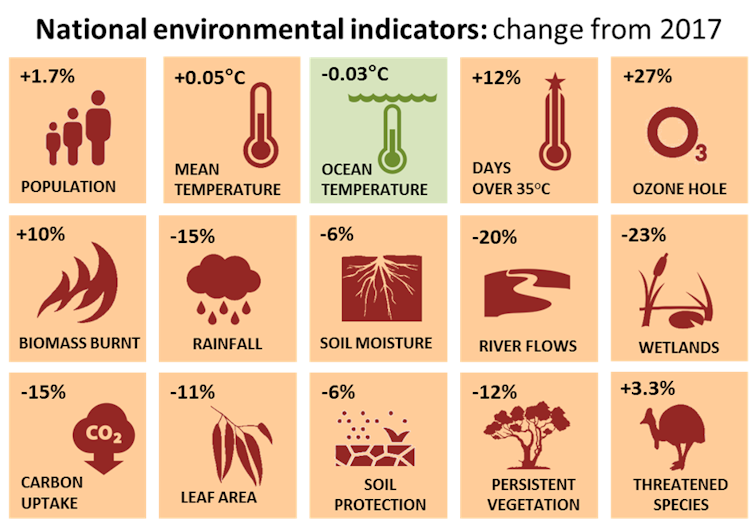
"Temperatures went up again, rainfall declined further, and the destruction of vegetation and ecosystems by drought, fire and land clearing continued. Soil moisture, rivers and wetlands all declined, and vegetation growth was poor.
In short, our environment took a beating in 2018, and that was even before the oppressive heatwaves, bushfires and Darling River fish kills of January 2019."

Dar
Indicators of Australia’s environment in 2018 compared with the previous year. Similar to national economic indicators, they provide a summary but also hide regional variations, complex interactions and long-term context. source: http://www.ausenv.online/2018


"Globally, the increase of greenhouse gases in the atmosphere accelerated again after slowing down in 2017. Global air and ocean temperatures remained high, sea levels increased further, and even the ozone hole grew again, after shrinking during the previous two years."

Read the article 

See also:

Australian Coalition government signs off with a budget tailored for climate denial: Renew Economy


Sunday, 11 November 2018

Devdiscourse: Climate change effecting blue economy of India say scientists

Image Credit: Twitter

"There would be a drop in productivity of marine species as there was a gradual damage being caused to the ecosystem and biodiversity, the Vice-Chancellor said.

Warming of the Indian Ocean at a fast pace owing to climate change poses a threat to the multi-million dollar blue economy of India, scientists said here Thursday. Climate change is affecting fisheries through change in stock productivity and its distribution, they said during the opening session of a 'Winter School on Climate Change in Marine Fisheries' being organised by the Central Marine Fisheries Research Institute here.

Friday, 2 November 2018

Science News article: Earth's oceans have absorbed 60 percent more heat than previously thought

Date:
October 31, 2018
Source:
Princeton University
Summary:
Since 1991, the world's oceans have absorbed an amount of heat energy each year that is 150 times the energy humans produce as electricity annually, according to a new study. The strong ocean warming the researchers found suggests that Earth is more sensitive to fossil-fuel emissions than previously thought.
Excerpts: 

"Climate sensitivity is used to evaluate allowable emissions for mitigation strategies. Most climate scientists have agreed in the past decade that if global average temperatures exceed pre-industrial levels by 2? (3.6?), it is all but certain that society will face widespread and dangerous consequences of climate change.

The researchers' findings suggest that if society is to prevent temperatures from rising above that mark, emissions of carbon dioxide, the chief greenhouse gas produced by human activities, must be reduced by 25 percent compared to what was previously estimated, Resplandy said.

Read the full original Science News article