In these times of unprecedented uncertainty, my to-do list helps me stay sane.
It doesn’t matter that I have no places to go or people to see. With
COVID-19 tossing normal life down the drain the world over, the shred of
normalcy helps me stave off apathy, paralysis, and my sudden aversion
to wearing proper pants.
I’m not the only one desperate for a little structure in my life in
the age of social distancing and sheltering in place. Many of us who are
fortunate enough to stay home during this crisis have been busy
establishing work-life boundaries, maintaining an exercise routine, and
staying in touch with loved ones. While these are all great ways to
break up the monotony of sheltering in place, it’s also possible to
pencil climate action into your newfound daily routine. To get started, Grist put together a to-do list of daily
climate-related activities that are compatible with social distancing
for two weeks straight.
Day 1: Stock up — thoughtfully. Before you speed out
to the store and panic-buy everything in sight, stop and take
inventory. Check out everything you already own, notice what should be
consumed soon, and write down what you really need. Bulk beans, lentils,
and grains are solid options: They’ll stay good for ages, are healthy
and versatile, and are climate-friendly foods. And having a
consolidated, well-planned list and an organized fridge will prevent
food waste — a major contributor to climate change
— and save you unnecessary trips to the store. You can even take a
first step towards growing some of your own food by buying an herb to
grow on your windowsill — mint, sage, oregano, parsley, and rosemary are
all pretty hard to kill. (Before you finalize your shopping list, check
out the action items for Days 2, 5, and 10.)
Day 2: Power strips to the rescue. Now that you’re
working from home (alongside a partner, perhaps, or kids home from
school), consolidate your outlets and save electricity by plugging your
chargers into power strips that can be switched off when you don’t need
them. Ditto if you have a toaster, coffee machine, and electric kettle
all plugged in on the kitchen counter. If you don’t own power strips,
add them to your list for Day 1 — lots of essential stores sell them.
It’s easy to forget about all the appliances we leave plugged in to suck up power like vampires, but now that you aren’t rushing off to work, it’s easy to stop wasting power.
Day 3: Junk mail begone! By your third day indoors,
it’s probably become apparent just how much junk mail piles up when left
to its own devices. Why companies still send snail mail advertisements
addressed to “Current Resident” is beyond me, but asking to be taken off
their lists will save paper, energy, and your time. The website Catalog Choice
makes it easy to get off the mailing lists of businesses that just
won’t leave you alone. Now’s also a good time to switch all your monthly
bills and medical statements to online only if you haven’t already.
' “I think the main issue is that people focus way, way too much on
people’s personal footprints, and whether they fly or not, without
really dealing with the structural things that really cause carbon
dioxide levels to go up,” said Gavin Schmidt, a climatologist and the
director of the NASA Goddard Institute for Space Studies in New York
City.
Transportation makes up a little over 20 percent of global carbon dioxide emissions, according to the International Energy Agency. (In the United States, it makes up around 28 percent.)
That’s a significant chunk, but it also means that even if all travel
were completely carbon-free (imagine a renewable-powered, electrified
train system, combined with personal EVs and battery-powered airplanes),
there’d still be another 80 percent of fossil fuel emissions billowing
into the skies.
So where are all those emissions coming from? For one thing,
utilities are still generating roughly the same amount of electricity —
even if more of it’s going to houses instead of workplaces. Electricity
and heating combined account for over 40 percent of global emissions.
Many people around the world rely on wood, coal, and natural gas to keep
their homes warm and cook their food — and in most places, electricity
isn’t so green either." '
Michael Moore is a dude known for provocation. Every documentary he
drops is designed to paint a world of sharp contrasts with clear bad
guys. They’re designed to get a reaction and get people talking, so in
some ways, him dropping a documentary he executive produced trashing
renewable energy on Earth Day makes total sense.
Planet of the Humans is directed and narrated by Jeff Gibbs,
a self-proclaimed “photographer, campaigner, adventurer, and
storyteller” who has co-produced some of Moore’s films. The documentary
came out on Earth Day, positioning itself up as some tough, real talk
not just about renewable energy but environmental groups.
And by real
talk, I mean it cast renewables as no better than fossil fuels and
environmental groups as sleek corporate outfits in bed with billionaires
helping kill the planet. As Emily Atkin put it in her HEATED newsletter
on Thursday, “[e]ntertaining good-faith arguments about how to stop
climate change is my job, and I have no reason at present to believe
Moore and director Jeff Gibbs argued in bad faith.” Indeed. So I decided
to listen to what they had to say.
I’ll leave the film criticism to those wiser than me (though I will
say I feel like I didn’t watch three acts but three separate movies),
but I will say this: The movie—which is available for free on YouTube
and is currently on the service’s trending list with 1 million views in
24 hours—is deeply flawed in both its premise, proposed solutions, and
who gets to voice them.
The movie’s central thesis is that we are on the brink of extinction
and have been sold a damaged bill of goods about all forms of renewable
energy by environmental groups motivated by profit. Essentially, the
argument is we’re all dirty and the stain will never come out no matter
how hard we try.
There are a few issues at play. One is that much of the issues the
film takes with solar and wind are based on anachronistic viewpoints. PV
Magazine, a solar trade publication,notes
that it’s “difficult to take the film seriously on any topic when it
botches the solar portion so thoroughly. Although the film was released
in 2020, the solar industry it examines, whether through incompetence or
venality, is from somewhere back in 2009.”
The film also goes through great lengths to throw solar and wind in
the same boat as burning biomass for power. The latter relies on serious
carbon accounting bullshittery
to be carbon neutral. A critique of biomass is fair and something I
would honestly have watched a whole film about. And ditto for the film’s
critique of large environmental organisations, which rely on large
funders that may provide money with strings attached (though Bill
McKibben, one of the film’s targets and founder of 350.org, came out strongly critiquing how he and the organisation were portrayed).
The film, for example, highlights the Sierra Club’s Beyond Coal campaign,
which has helped shutter more than 300 coal plants around the U.S. The
program’s biggest donor is Mike Bloomberg, who sees natural gas—which
has replaced much of that coal capacity—as a bridge fuel (which it is decidedly not).
And this is where the narrative Gibbs tells and the one we need to be
telling diverges. Gibbs is happy to trash the unholy alliance between
big green groups and big dollar funders who have, in some cases, made
their fortunes on extractive industries and the system that relies on
their existence. That can lead to conflicts—real or perceived—about how
green groups spend their time. And frankly, I’m there with him.
Gibbs’ uses this situation to take the leap to population control as
the only solution. Yes, renewables are bad and so are billionaires and
the corporate-philanthropic industrial complex so, Gibbs concludes, we
should probably get rid of some humans ASAP. Over the course of the
movie, he interviews a cast of mostly white experts who are mostly men
to make that case. It’s got a bit more than a whiff of eugenics and
ecofascism, which is a completely bonkers takeaway from everything
presented. If renewables are so bad, then what does a few million less
people on the planet going to do? Oh, and who are we going to knock off
or control for? Who decides? How does population control even solve the
problem of corporate influence on nonprofits and politics?
Those questions lead to a dark place. We’ve already had a glimpse of
what that ideology looks like in the hands of individuals. The alleged manifesto
penned by last year’s El Paso shooting suspect sounds an awful lot like
Gibbs’ movie, arguing that extractive companies “are heading the
destruction of our environment by shamelessly overharvesting resources”
and that we to “get rid of enough people” to get things back in balance.
Which is a whole lot of nope.
I don’t mean to say Gibbs is therefor an ecofascist. But to see an
ostensibly serious environmental movie backed by an influential
filmmaker peddle these ideas is genuinely disturbing, especially at a
time when we’re seeing it pop up elsewhere in response to the coronavirus.
Also side note that it’s also incredibly myopic that Gibbs goes after
environmental nonprofits for taking corporate money while ignoring the
Sierra Club’s and other early conservation group’s history of support for racist ideas about population control he nods to as a solution (it should be noted some groups are trying to make up for past misdeeds today).
What’s most frustrating about Gibbs’ film is he walks right up to
some serious issues and ignores clear solutions. The critique of the
compromised corporate philanthropy model is legit. We should absolutely
hold nonprofits to account when they don’t live up to their missions.
But the solution isn’t to take the leap to population control. It’s to
tax the rich so they can’t use philanthropic funding as cover for their
misdeeds while simultaneously filling government coffers to implement
democratic solutions.
There’s a reason that Breitbart and otherconservativevoices
aligned with climate denial and fossil fuel companies have taken a
shine to the film. It’s because it ignores the solution of holding power
to account and sounds like a racist dog whistle.
We also should absolutely interrogate the systems and supply chains of renewable energy. The lithium industry’s violent toll
on land and people in Latin American countries with vast reserves is
real. Letting corporations run the show promises to lead to future
violence, regardless of how many people live on Earth. The film doesn’t
interview any of the new wave of environmental leaders who see the fight
against these injustices and the climate crisis as intrinsically linked. It’s too bad since that’s a message Gibbs—and the rest of the world—need to hear now more than ever.
But prominent environmentalist Bill McKibben, who was criticized in the film, issued this response to the movie:
I am used to ceaseless harassment and attack from the
fossil fuel industry, and I’ve done my best to ignore a lifetime of
death threats from right-wing extremists. It does hurt more to be
attacked by others who think of themselves as environmentalists.
Josh Fox, the director of Gasland, led a campaign to have the film taken down and for Michael Moore to issue an apology:
I just had the unfortunate displeasure of watching PLANET OF THE HUMANS the #Earthday freebie irresponsibly put out by Michael Moore @MMFlint.
The film is an unsubstantiated, unscientific, poorly made piece of
yellow journalism which attacks proven renewable energy and science..
— Josh Fox EndFossilFuels (@joshfoxfilm) April 22, 2020
Two days later, Fox said that the film’s distributor agreed to take
it down. But the direct-to-YouTube video remains online, now clocking
more than 1.5 million views.
1) I just received notice that the distributor of Michael Moore's #PlanetoftheHumans is taking the film down due to misinformation in the film.
The
full economic impact of the Covid-19 is still yet unknown, but it is
clear that world’s governments face a choice in their response: Do they
look to protect industries in terminal decline, or do they look to the
long-term, supporting new green industries to flourish in a
post-Covid-19 future?
A growing number of experts and global
leaders have joined calls for the response to Covid-19 to be a ‘green
response’, including the implementation of a ‘Green New Deal’ for a
sustainable economy popularised by US Democrats.
The Green New
Deal provides a vision for a sustainable future economy, and integrates
proposals for ambitious climate action, investment in clean energy, a
circular economy and includes a boost to direct public sector investment
in sustainable infrastructure, including electric vehicles and public
transport systems.
Unfortunately for Australia it is becoming
increasingly clear that the Morrison government is steadfast in giving
life support to the fossil fuel industry, clearly indication its
preference for short-term opportunities
for fossil fuel interests, and its ministers have been clearly working
reinforce the position of the oil, gas and coal sectors.
Resources minister Keith Pitt has gone in to bat for the gas and coal
sectors, while energy minister Angus Taylor is working to prop up
demand for oil and relaxing already weak regulations on the oil sector,
including fuel standards.
This includes the Morrison government gifting almost $100 million to the United States to purchase oil that will remain stored in the United State’s Strategic Petroleum Reserve.
On
Wednesday, Taylor announced that the government would also be looking
to soften fuel standards to allow the industry to redeploy stockpiled
aviation fuels for use in other parts of the transport sector. Australia
already has weak fuel standards by most international standards, and a
further weakening of the standards will likely lead to worse
environmental and health outcomes.
Pitt made the government’s
priorities even clearer, welcoming the expansion of Australia’s gas
sector with Arrow Energy’s commitment to a new gas project in
Queensland. “Notwithstanding COVID-19, our energy and resources will be
important in getting not just our economy back on its feet, but vital in
assisting our important trading partners to kickstart their economies,”
Pitt said.
“The Australian Government is committed to working
with the oil and gas industry in order to provide support and
flexibility given the changing circumstances at this time.
At the same time, Taylor – who doubles as emissions reduction minister – has praised the electricity and gas sectors for overseeing significant falls in domestic prices. But he studiously
avoided any mention of the ongoing significant cuts in greenhouse gas
emissions in the grid, or the prominent role played in that by
investment in wind and solar.
Despite Covid-19, the threat of climate change has not subsided and
the need to transition the global energy system to one with
significantly less greenhouse gas emissions will remain a pressing
global issue during and after the world has dealt with the pandemic. And
studies show that acting on climate change will deliver substantial
economic benefits for those who embrace it.
The International
Renewable Energy Agency this week published new analysis that shows
ambitious investment in the clean energy sector would provide
substantial benefits to the global community, boosting global economic
output by as much as A$160 trillion by 2050 above a ‘business as usual’ scenario.
This
included the potential to create almost 250,000 new jobs in Oceania’s
renewable energy sector by 2050, with growth more than compensating for
inevitable job losses in the fossil fuel sector. A global poll
conducted by Ipsos in April found that 71 per cent of adults globally
still view climate change as serious a long-term crisis as Covid-19. The
figure was lower in Australia, with 59 per cent agreeing with the
proposition locally.
“Despite the environment taking a back seat
compared with other current issues, it’s still important to people.
There is strong support among the public for a green economic recovery
from the COVID-19 crisis,” Ipsos Australia public affairs director,
Jennifer Brook, said.
While it still sees a majority of
Australians ranking the climate change response as equal importance with
Covid-19, the Morrison government will likely see the weaker response
as an opportunity to put climate action event further on the backburner.
Bruce Robertson from the Institute for Energy Economics and Financial
Analysis told RenewEconomy that moves to prop up ailing parts of the
fossil fuel sector were a mistake.
“While governments say they are
not supposed to be picking winners, they are certainly not supposed to
be picking losers,” Robertson said.
“Globally since the
coronavirus pandemic, there’s been a permanent shift down in demand –
and the world is swimming in gas and oil. How will this investment get
us out of the hole? It is not a governments role to pick winners. It is
definitely not a governments role to pick proven losing industries to
shower tax payer dollars on.”
“The government is making big
decisions about our future right now. We need a new normal, not going
back to the old ways of a reliance on emissions-intensive gas, which is
both a fossil fuel and a loss-making industry. Gas is not the industry
of the future. We have the choice now. We can do things differently
going forward,” Robertson added.
With a long-term view, strategic
investments in the green infrastructure required for the long term
offers the best possible economic response to the Covid-19 crisis.
The
government can do this by heeding the calls of the clean energy sector
to include investment and support for new zero-emissions generation and
energy efficiency in stimulus measures.
Doing so will not only
provide a powerful form of short-term economic stimulus, but will also
leave Australia better placed in the long-term, well after the crisis of
Covid-19 as been resolved.
RenewEconomy and its sister sites One Step Off The Grid and The Driven
will continue to publish throughout the Covid-19 crisis, posting good
news about technology and project development, and holding government,
regulators and business to account. But as the conference market
evaporates, and some advertisers pull in their budgets, readers can help
by making a voluntary donation here
to help ensure we can continue to offer the service free of charge and
to as wide an audience as possible. Thankyou for your support.
Michael
Mazengarb is a journalist with RenewEconomy, based in Sydney. Before
joining RenewEconomy, Michael worked in the renewable energy sector for
more than a decade.
New
Zealand climate minister says governments must not just return to the
way things were, and instead plot a new course to ease climate change
James Shaw
James Shaw, New Zealand’s climate change minister, has asked the
country’s independent climate change commission to check whether its
emissions targets under the Paris agreement are enough to limit global
heating to 1.5C. He explains why he’s prioritising the issue during a
strict national lockdown to stop the spread of Covid-19, which could
send New Zealand’s unemployment rate soaring.
To say that we find ourselves in an unprecedented moment is so
obvious and has been so often repeated it’s almost become white noise.
What is less obvious, however, is where we go from here.
In any significant crisis, let alone one as catastrophic as the
Covid-19 pandemic, it is an entirely understandable human reflex to want
things to “return to normal”, to “go back to the way they were before”.
And, when faced with economic headwinds – in recent decades, the
Asian financial crisis, the global financial crisis and, in our own
case, the Christchurch earthquakes) successive governments the world
over have directed their efforts to meeting public expectation and
getting back to business as usual.
Unfortunately, one of the features of business as usual was a highly
polluting and ecologically unsustainable economy on a pathway that was
locking in catastrophic climate change.
Successive responses to economic crises have seen climate change and
the natural environment we depend on for life on Earth as a
nice-to-have, something to think about once we’ve got the economy back
on track and there’s a bit more money to go round.
Seoul is to set a 2050 net zero emissions goal and end coal financing,
after the Democratic Party’s landslide victory in one of the world’s
first Covid-19 elections
South
Korean President Moon Jae-in's landslide victory in the country's
parliamentary election gives his party a clear mandate to implement its
Green New Deal
(Photo: Republic of Korea/Jeon Han/Flickr)
South Korea
is on track to set a 2050 carbon neutrality goal and end coal financing
after its ruling Democratic Party won an absolute majority in the
country’s parliamentary elections on Wednesday.
President Moon Jae-in’s party won a landslide 180 seats in the
300-member National Assembly, up from 120 previously, in a huge show of
faith in his handling of the coronavirus pandemic.
The Democratic Party’s decisive victory will enable President Moon to
press ahead with its newly adopted Green New Deal agenda during the
last two years of his mandate.
Under the plan, South Korea has become the first country in East Asia to pledge to reach net zero emissions by 2050.
As part of the Paris Agreement, countries have agreed to submit
updated climate plans to 2030 and long-term decarbonisation strategies
to the UN before the end of the year.
In its climate manifesto
published last month, the Democratic Party promised to pass a “Green
New Deal” law that would steer the country’s transformation into a
low-carbon economy.
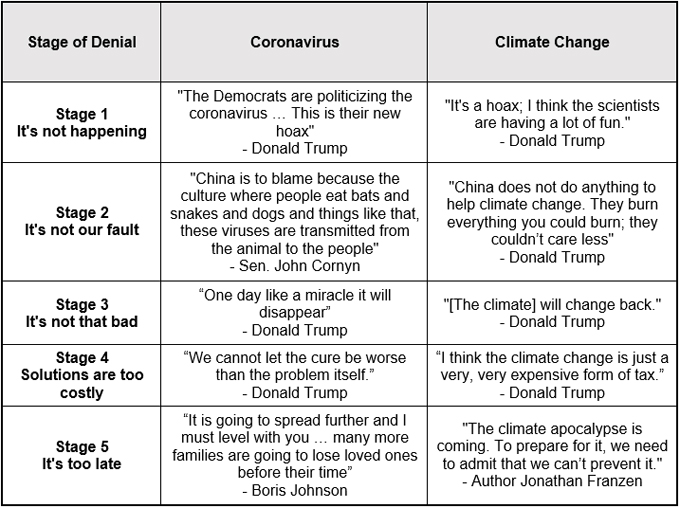
Whether denying coronavirus or climate change, many deploy the same unfounded strategies and messages.
For the climate community, observing U.S. national political leaders’ responses to the coronavirus pandemic has been like watching the climate crisis unfold
on fast-forward. Many – particularly on the political right – have
progressed through the same five stages of science denial in the face of
both threats.
For climate change, the denial process began decades ago. NASA climate scientist James Hansen testified to Congress in 1988 about the dangers posed by global warming; the fossil fuel industry formed the Global Climate Coalition
the very next year to launch a campaign casting doubt on mainstream
climate science. In November 1989, President George H.W. Bush’s chief of
staff, climate denier John Sununu, sabotaged efforts to develop the
first international climate change treaty. Exxon in particular spent the
following decades and tens of millions of dollars funding a network of
think tanks to propagate climate science denial. In a memo leaked in
2003, Republican strategist Frank Luntz advised G.O.P. politicians, “You
need to continue to make the lack of scientific certainty a primary
issue in the debate.”
Analysis
The same denial process has unfolded with coronavirus, but over a far
more compressed time frame. In both crises, early warnings from
scientific experts went unheeded and were often discouraged or suppressed.
As a result, the American government began responding only after each
threat’s impacts had become widespread and undeniable. At that point,
due to the missed opportunity to prevent the outbreak of impacts, much
of the response came in the form of damage control. America’s efforts to
“flatten the curve” of coronavirus cases, like its efforts to bend the
carbon emissions curve, were deployed too slowly.
The five stages of denial
In 2013, as the fifth Intergovernmental Panel on Climate Change report was due to be released, the five stages of climate denial
were on display in many conservative media outlets. Watching the
reactions to the unfolding coronavirus crisis in early 2020 created a
sense of déjà vu, as many leaders exhibited the same stages of
denial. In fact, many of the same actors who deny the climate crisis
also were (or still are) denying coronavirus threats. Some observers have remarked that the Venn diagram of coronavirus and climate deniers is nearly a circle.
Stage 1: Deny the problem exists. This is denial at
its most basic, as there is no need to solve a problem that doesn’t
exist. If the issue is a hoax, as the president repeatedly has asserted
about both global warming and coronavirus,
the status quo can be maintained. But denying a problem doesn’t change
its physical or epidemiological properties, so in the face of real
scientifically quantified threats, Stage 1 denial cannot last very long.
Stage 2: Deny responsibility. Upon accepting the
threat posed by coronavirus outbreaks, numerous conservative politicians
and pundits have tried to shift the blame to China, with many including the president labeling it “the Chinese virus,” echoed over 100 times on Fox News.
Similarly, after accepting that climate change is happening, many have
tried to blame it on natural cycles, or, if they accept humanity’s
responsibility, to likewise blame it on China. But here again denial falls short; shifting blame does not slow a physical or viral crisis.
Stage 3: Downplay the threat. President Trump spent weeks downplaying the threat of coronavirus, early maintaining
that it had only infected one person in America, that “one day like a
miracle it will disappear,” that “within a couple of days [the number of
infected Americans] is going to be down to close to zero,” and so on.
Fox News and other conservative media outlets followed his lead
in downplaying the risks. Similarly, Trump has said the climate “will
change back,” and conservative media outlets have spent decades arguing
that climate change is no big deal. Yet, as the devastation of
coronavirus and climate change impacts has become a reality, doubters
have been increasingly forced to move beyond Stage 3 denial. Stage 4: Attack the solutions as too costly. Trump
has claimed that coronavirus curve-flattening measures recommended by
experts – like long-term social distancing – are too costly. He instead
suggested preemptively loosening social distancing measures to reopen
the national economy “sooner rather than later” (an approach Fox News has also championed), as well as various unproven drug treatments, with Fox News again following suit. A number of ideologues have argued
that older Americans would rather die than cause the economic
disruption associated with extended social distancing. Some partisan
policymakers and pundits similarly oppose virtually all large-scale
climate solutions as too expensive, instead proposing worthwhile but
inadequate steps like simply planting trees or capturing carbon from
power plants to inexplicably use for extracting yet more fossil fuels.
Stage 5: It’s too late. Some have proposed, once it
became obvious that the coronavirus outbreak had become widespread, that
governments should just maintain the status quo, try to build herd immunity,
and cope with the consequences (such as overwhelmed health care systems
that could result in millions of deaths). Climate justice essayist Mary
Heglar coined the term “de-nihilist”
to describe those who have similarly succumbed to the fear that it’s
too late to stop climate change. Such attitudes only hamper efforts to
constructively address both problems.
Coronavirus is a learning opportunity for climate change
Because American leadership proceeded through these stages of denial, it wasted valuable months
that could have been spent preparing for and curbing the spread of
coronavirus. For comparison, South Korea diagnosed its first case of
COVID-19 on January 20 – the same day as the U.S. – but almost
immediately launched an aggressive program of testing, tracing, and quarantining.
By March, South Korea was conducting over 10,000 coronavirus tests
per day, and its new cases fell below 150 per day by mid-March. Despite a
population six times larger, the U.S. had reached the threshold of
10,000 new tests per day only on March 16,
and has consistently lagged in testing on a per capita basis. As
testing in the U.S. finally began to catch up to the viral spread, the
number of new coronavirus cases in America accelerated past 10,000 per
day by March 23, reaching 580,000, by April 14 compared to 10,564 South Korean cases (222 deaths) as of that date.
After this late start, Trump has regularly argued that the U.S.
“cannot let the cure be worse than the problem itself.” Those who oppose
climate solutions similarly argue that making investments to bend the
carbon emissions curve would be worse than the consequences of climate
change – consequences that include increased food insecurity;
intensified hurricanes, wildfires, heatwaves, droughts, and floods; and
more species extinctions, violent conflicts, and death.
Both arguments run counter to expert advice, misunderstand the
problem, and present a false choice. In reality, failing to make the
necessary early investments to head off each threat will result in
economy-crippling consequences, whether in the form of overwhelmed
health care systems in the case of coronavirus or more deadly extreme
weather events in the case of climate change. Experts agree that to protect both the economy and public health,
government responses must focus on flattening the coronavirus curve and
making investments to rapidly curb carbon pollution. In fact, a new study
on the 1918 flu pandemic found that measures like social distancing
“not only lower mortality, they also mitigate the adverse economic
consequences of a pandemic.” Nipping the problem quickly and
aggressively yields the best outcome for both the economy and public
health. Put simply, suffering and death are costly.
Observing the damage resulting from denial of both the coronavirus
and climate crises raises the question, how did humans evolve this
apparent psychological flaw? Physician-scientist Ajit Varki has hypothesized
that comprehending one’s own mortality is a psychological evolutionary
barrier for most species, because this realization would amplify the
fear of death and thus “would have then reduced the reproductive fitness
of such isolated individuals.” Varki posits that humans may have
overcome this barrier by developing denial as a coping mechanism, but
that “If this theory turns out to be the correct explanation for the
origin of the species, it might ironically also be now sowing the seeds
of our demise,” since denial now obstructs efforts to address threats
like climate change and coronavirus.
As climate activist and author Bill McKibben put it,
“You can’t negotiate with physics and chemistry, you can’t compromise
with them or spin them away … coronavirus is teaching us precisely this
lesson about biology as well. Reality is real and sometimes it bites
pretty hard.” Or, as Republican pollster Neil Newhouse said more bluntly, “Denial is not likely to be a successful strategy for survival.”
But because of its compressed time frame, coronavirus has provided
humanity an opportunity to learn this lesson and apply it to curbing the
worst of the climate crisis. Contrary to Stage 5 denial, it’s not yet
too late to avoid the most severe climate change impacts.