 |
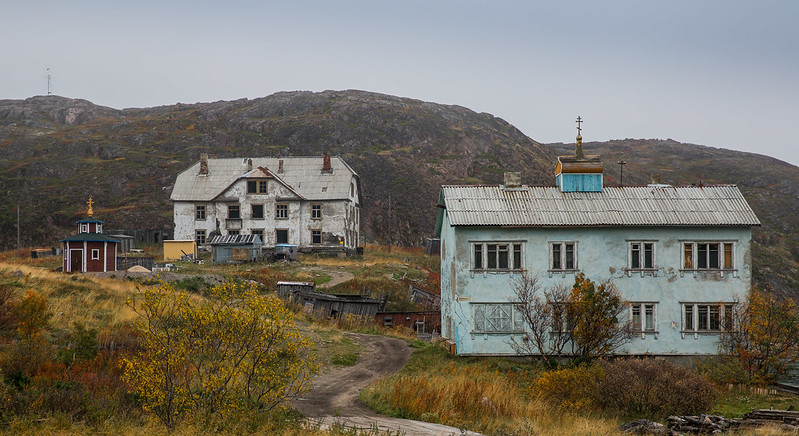
Teriberka, a village in the Russian Arctic (Pic: Ninara/Flickr)
|
Record permafrost temperatures are transforming the Arctic, especially
for indigenous peoples, whose hunting livelihoods are at risk as ground
melts
Frozen ground in the Arctic is thawing, harming indigenous people’s hunting livelihoods and destabilising buildings and roads across the rapidly warming region.
Air temperatures hit 38C in Russia on 20 June in the Russian town of Verkhoyansk in Siberia, claimed as a heat record in the Arctic, which is warming twice as fast as the global average.
The previous day, the land surface temperature hit an extraordinary 45C at several locations in the Arctic Circle, according to European satellite data.
Often overlooked compared to air temperature records, temperatures in the ground are trending ever higher across the Arctic, according to the UN panel of climate scientists.
Permafrost, permanently frozen ground often just below the surface which melts to mud in summer, covers about a quarter of the land in the northern hemisphere. And shrinking permafrost is causing wrenching long-term changes to nature.
“As one of our elders says: ‘Nature doesn’t trust us any more’,” said Vyacheslav Shadrin, chair of the Yukaghir Council of Elders, of the Republic of Sakha-Yakutia in the Russian far east, about 600 km from Verkhoyansk. The Yukaghir total about 1,500 people.
“We can’t predict what will happen tomorrow. This is maybe the main challenge. All our lives are based on traditional knowledge. We used to know that tomorrow we catch fish or have our reindeer. Now we can’t say,” he told Climate Home News. Rivers that were reliable roads for months in winter can now be treacherous.
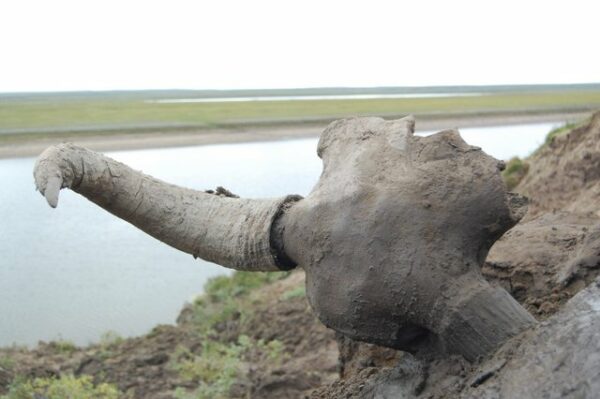
A bison horn revealed by melting permafrost in Siberia (Pic: Johanna Anjar)
Until a few decades ago, he said that many Yukaghir did not dig up ancient mammoth bones or tusks, fearing that disturbing bones entombed in the frozen soil could release malevolent spirits from an underworld below.
Today, however, the thaw of permafrost means such finds are more common – and valuable to collectors – and many Yukaghir have abandoned the belief.
“Traditionally the most forbidden things are connected to the mammoth, the spirit of the underworld. Now we use mammoth bones as a profit,” he said.
Climate news in your inbox? Sign up hereAround the Arctic, the loss of white snow and ice that reflects sunlight back to space reveals darker soil and water, that absorb ever more heat and accelerates the thaw.
At the time of publication, the extent of sea ice in the Arctic Ocean was tracking close to 2012 levels, the minimum on records dating back to 1979, NSIDC data show. On land, snow and ice cover is also among the lowest for the time of year, according to Rutgers University, and Greenland’s melt so far this year is also rapid, adding to sea level rise.
The World Meteorological Organization said it is checking last month’s heat record in Siberia. Daily records can be natural freaks – Fort Yukon on the Arctic circle in Alaska hit 37.7C as long ago as 1915, before climate change was a worry.
The temperature spike in Siberia was “an iconic threshold that indicates the warming we’re seeing over the long term” both in the air and the soil, said Walt Meier, senior research scientist at the US National Snow and Ice Data Center.
“The Arctic is warming about twice as fast as the rest of the globe and the Siberian region, even in the Arctic, is warming rapidly,” he told CHN. “We’re seeing buildings cracking, roads buckling around the Arctic.”
Greenpeace takes Arctic oil lawsuit to Norway’s supreme courtThe thaw of permafrost may have caused the collapse of a fuel tank that spilled 21,000 tonnes of diesel into rivers and subsoil near the city of Norilsk on May 29. Elsewhere, loss of permafrost has been blamed for causing more frequent avalanches.
Read the complete Climate Home News article
#jailclimatecriminals #climatecrisis #cambio-climatico
permafrost, Russia, Arctic, #cambio-climatico, #climateaction, #climatecriminals, #jailclimatecriminals, #climateemergency, #climatecrisis,