Showing posts with label Arctic. Show all posts

Sunday, 25 October 2020

The Arctic is in a death spiral. How much longer will it exist? (excerpt): The Guardian


 "The region is unravelling faster than anyone could once have predicted. But there may still be time to act."


At the end of July, 40% of the 4,000-year-old Milne Ice Shelf, located on the north-western edge of Ellesmere Island, calved into the sea. Canada’s last fully intact ice shelf was no more.

On the other side of the island, the most northerly in Canada, the St Patrick’s Bay ice caps completely disappeared.

Two weeks later, scientists concluded that the Greenland Ice Sheet may have already passed the point of no return. Annual snowfall is no longer enough to replenish the snow and ice loss during summer melting of the territory’s 234 glaciers. Last year, the ice sheet lost a record amount of ice, equivalent to 1 million metric tons every minute.

The Arctic is unravelling. And it’s happening faster than anyone could have imagined just a few decades ago. Northern Siberia and the Canadian Arctic are now warming three times faster than the rest of the world. In the past decade, Arctic temperatures have increased by nearly 1C. If greenhouse gas emissions stay on the same trajectory, we can expect the north to have warmed by 4C year-round by the middle of the century."

Go to Guardian article and photo essay


Related:  Vigorous action needed, and soon, on climate change (excerpt): Yale Climate Connections


Arctic,Antarctica,Greenland ice melt,#icemelting,sea level rise,#climate crisis,

Monday, 24 August 2020

Polar bears, climate crisis, and oil and gas drilling in the Arctic National Wildlife Refuge: WWF site (excerpt)


Identify areas where  cute polar bear cubs can live on solid Arctic sea ice
Polar bear cubs at risk from climate change
"Sea levels are rising and oceans are becoming warmer. Longer, more intense droughts threaten crops, wildlife and freshwater supplies. From polar bears in the Arctic to marine turtles off the coast of Africa, our planet’s diversity of life is at risk from the changing climate."

"Climate change poses a fundamental threat to the places, species and people’s livelihoods WWF works to protect. To adequately address this crisis we must urgently reduce carbon pollution and prepare for the consequences of global warming, which we are already experiencing. WWF works to:
  • advance policies to fight climate change
  • engage with businesses to reduce carbon emissions
  • help people and nature adapt to a changing climate"


"Humans and wild animals face new challenges for survival because of climate change. More frequent and intense drought, storms, heat waves, rising sea levels, melting glaciers and warming oceans can directly harm animals, destroy the places they live, and wreak havoc on people’s livelihoods and communities."


Humans and wild animals face new challenges for survival because of climate change

Polar bears, climate crisis, and oil and gas drilling in the Arctic National Wildlife Refuge


"To adequately address the climate crisis we must urgently reduce carbon pollution and prepare for the consequences of global warming, which the world is already experiencing. Combining global outreach with local expertise, WWF:
  • helps people and nature adapt to a changing climate
  • advances policies to fight climate change
  • combats deforestation
  • engages with businesses to reduce carbon emissions
  • challenges U.S. cities to prepare for more extreme weather"


"Adapting to Climate Change


To avoid the worst effects of climate change, we need to dramatically reduce global carbon emissions. But we must also prepare for the significant and unavoidable consequences of carbon
Identify areas where polar bears can live on solid Arctic sea ice for decades to come
polar bear cubs
emissions such as increasing temperatures, shifting precipitaton patterns, ocean acidification, sea level rise and the increasing intensity and frequency of extreme weather events. WWF works with local communities, governments and others around the world to help nature and people prepare for the many impacts of a changing climate. To do this we:

  • Increase resilience of communities in Nepal by promoting new farming techniques, community weather monitoring and creating seed banks
  • Restore beach vegetation to shade marine turtle nests in the Caribbean
  • Secure access to fresh water for elephants in Thailand during periods of drought
  • Identify areas where polar bears can live on solid Arctic sea ice for decades to come"
 Go to WWF site
 Related: Brazil slashes budget to fight climate change as deforestation spikes: Reuters

Friday, 14 August 2020

Melting arctic ice fuels climate change and extreme weather events | DW News

Global climate change is perhaps most clearly visible at the cold top and bottom of the globe.


The arctic has been warming up for years - and now, the warnings of experts and scientists are clear for everyone to see - the poles are melting. As the differences in temperature between the poles and the equator reduce, the jetstream winds, which move weather around the globe - are slowing down. The result - extreme weather. High- and low pressure systems remain at the same spot for longer, creating floods and droughts.

Für Videos in deutscher Sprache besuchen Sie: https://www.youtube.com/channel/deuts... #ClimateChange #Arctic #GlobalWarming 


Wednesday, 15 July 2020

Climate Explained: What the World Was Like the Last Time Carbon Dioxide Levels Were at 400ppm: EW

a hotter planet
climate change
What was the climate and sea level like at times in Earth’s history when carbon dioxide in the atmosphere was at 400ppm? 


The last time global carbon dioxide levels were consistently at or above 400 parts per million (ppm) was around four million years ago during a geological period known as the Pliocene Era (between 5.3 million and 2.6 million years ago). The world was about 3℃ warmer and sea levels were higher than today.


We know how much carbon dioxide the atmosphere contained in the past by studying ice cores from Greenland and Antarctica. As compacted snow gradually changes to ice, it traps air in bubbles that contain samples of the atmosphere at the time. We can sample ice cores to reconstruct past concentrations of carbon dioxide, but this record only takes us back about a million years.


Beyond a million years, we don't have any direct measurements of the composition of ancient atmospheres, but we can use several methods to estimate past levels of carbon dioxide. One method uses the relationship between plant pores, known as stomata, that regulate gas exchange in and out of the plant. The density of these stomata is related to atmospheric carbon dioxide, and fossil plants are a good indicator of concentrations in the past.


Another technique is to examine sediment cores from the ocean floor. The sediments build up year after year as the bodies and shells of dead plankton and other organisms rain down on the seafloor. We can use isotopes (chemically identical atoms that differ only in atomic weight) of boron taken from the shells of the dead plankton to reconstruct changes in the acidity of seawater. From this we can work out the level of carbon dioxide in the ocean.
The data from four-million-year-old sediments suggest that carbon dioxide was at 400ppm back then.

Sea Levels and Changes in Antarctica 


During colder periods in Earth's history, ice caps and glaciers grow and sea levels drop. In the recent geological past, during the most recent ice age about 20,000 years ago, sea levels were at least 120 meters lower than they are today.


Sea-level changes are calculated from changes in isotopes of oxygen in the shells of marine organisms. For the Pliocene Era, research shows the sea-level change between cooler and warmer periods was around 30-40 meters and sea level was higher than today. Also during the Pliocene, we know the West Antarctic Ice Sheet was significantly smaller and global average temperatures were about 3℃ warmer than today. Summer temperatures in high northern latitudes were up to 14℃ warmer.


This may seem like a lot but modern observations show strong polar amplification of warming: a 1℃ increase at the equator may raise temperatures at the poles by 6-7℃. It is one of the reasons why Arctic sea ice is disappearing.

Impacts in New Zealand and Australia  


Read the complete EW article

Monday, 13 July 2020

‘Nature doesn’t trust us any more’: Arctic heatwave stokes permafrost thaw: Climate Home News


we need climate action now
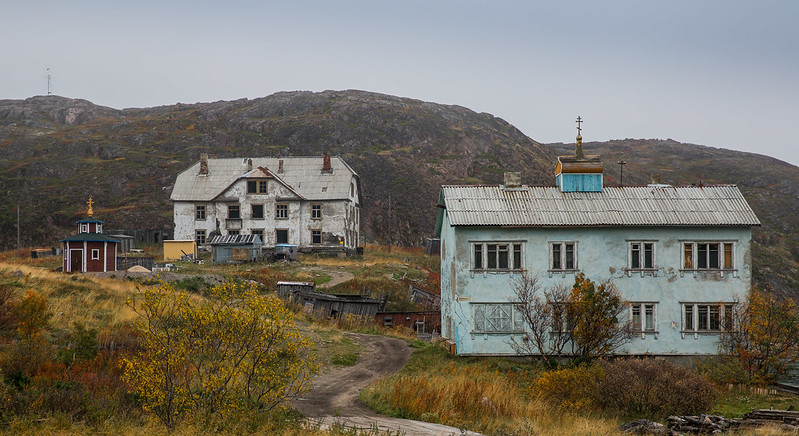
Teriberka, a village in the Russian Arctic (Pic: Ninara/Flickr)
Record permafrost temperatures are transforming the Arctic, especially for indigenous peoples, whose hunting livelihoods are at risk as ground melts 


Frozen ground in the Arctic is thawing, harming indigenous people’s hunting livelihoods and destabilising buildings and roads across the rapidly warming region.

Air temperatures hit 38C in Russia on 20 June in the Russian town of Verkhoyansk in Siberia, claimed as a heat record in the Arctic, which is warming twice as fast as the global average.

The previous day, the land surface temperature hit an extraordinary 45C at several locations in the Arctic Circle, according to European satellite data.

Often overlooked compared to air temperature records, temperatures in the ground are trending ever higher across the Arctic, according to the UN panel of climate scientists.

Permafrost, permanently frozen ground often just below the surface which melts to mud in summer, covers about a quarter of the land in the northern hemisphere. And shrinking permafrost is causing wrenching long-term changes to nature.

“As one of our elders says: ‘Nature doesn’t trust us any more’,” said Vyacheslav Shadrin, chair of the Yukaghir Council of Elders, of the Republic of Sakha-Yakutia in the Russian far east, about 600 km from Verkhoyansk. The Yukaghir total about 1,500 people.

“We can’t predict what will happen tomorrow. This is maybe the main challenge. All our lives are based on traditional knowledge. We used to know that tomorrow we catch fish or have our reindeer. Now we can’t say,” he told Climate Home News. Rivers that were reliable roads for months in winter can now be treacherous.
we need climate action now
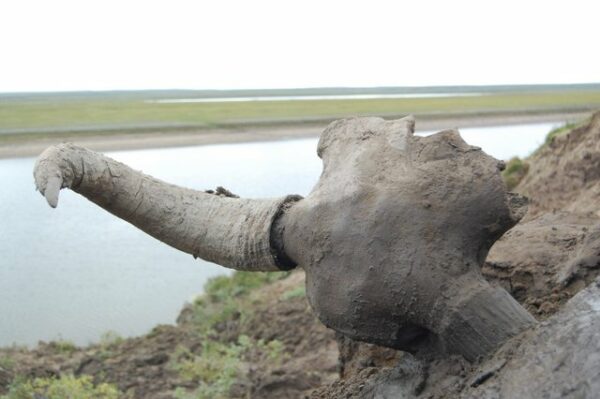
A bison horn revealed by melting permafrost in Siberia (Pic: Johanna Anjar)

Until a few decades ago, he said that many Yukaghir did not dig up ancient mammoth bones or tusks, fearing that disturbing bones entombed in the frozen soil could release malevolent spirits from an underworld below.

Today, however, the thaw of permafrost means such finds are more common – and valuable to collectors – and many Yukaghir have abandoned the belief.

“Traditionally the most forbidden things are connected to the mammoth, the spirit of the underworld. Now we use mammoth bones as a profit,” he said.
Climate news in your inbox? Sign up here
Around the Arctic, the loss of white snow and ice that reflects sunlight back to space reveals darker soil and water, that absorb ever more heat and accelerates the thaw.

At the time of publication, the extent of sea ice in the Arctic Ocean was tracking close to 2012 levels, the minimum on records dating back to 1979, NSIDC data show. On land, snow and ice cover is also among the lowest for the time of year, according to Rutgers University, and Greenland’s melt so far this year is also rapid, adding to sea level rise.

The World Meteorological Organization said it is checking last month’s heat record in Siberia. Daily records can be natural freaks – Fort Yukon on the Arctic circle in Alaska hit 37.7C as long ago as 1915, before climate change was a worry.

The temperature spike in Siberia was “an iconic threshold that indicates the warming we’re seeing over the long term” both in the air and the soil, said Walt Meier, senior research scientist at the US National Snow and Ice Data Center.

“The Arctic is warming about twice as fast as the rest of the globe and the Siberian region, even in the Arctic, is warming rapidly,” he told CHN. “We’re seeing buildings cracking, roads buckling around the Arctic.”
Greenpeace takes Arctic oil lawsuit to Norway’s supreme court
The thaw of permafrost may have caused the collapse of a fuel tank that spilled 21,000 tonnes of diesel into rivers and subsoil near the city of Norilsk on May 29. Elsewhere, loss of permafrost has been blamed for causing more frequent avalanches.

Read the complete Climate Home News article 

#jailclimatecriminals  #climatecrisis  #cambio-climatico

permafrost, Russia, Arctic, #cambio-climatico, #climateaction, #climatecriminals, #jailclimatecriminals, #climateemergency, #climatecrisis,