Showing posts with label permafrost. Show all posts

Wednesday, 9 September 2020

News outlets continue to ignore climate change in articles about California's record-breaking weather (excerpt): Heated

"Nothing to see here, folks

This long weekend was literal hell for millions in the American West. California, Nevada, Arizona, Oregon, and Washington are suffering from dangerous heat, wildfire and smoke unlike anything they’ve ever seen. 

Three major newspaper stories. Zero climate mentions.
Californian Wildfires, 2019


Scientists attribute the unprecedented intensity of these events to human-caused climate change. Greenhouse gas emissions have made the atmosphere in these areas much hotter and drier than it used to be. “We’re living in a fundamentally climate-altered world,” MIT Technology Review noted last month, citing a multitude of peer-reviewed research about how climate change exacerbates extreme heat and wildfire. These so-called “compound climate events” are only predicted to get worse if greenhouse gas emissions continue unabated. 

Every American should be aware of these basic scientific facts when reading about the devastation of this weekend’s record-breaking extreme weather. But most of the major newspaper stories about the Labor Day Weekend from Hell don’t contain any climate-related information. Why?


Three major newspaper stories. Zero climate mentions.
Melting Siberian permafrost


Three major newspaper stories. Zero climate mentions.


Section A, page 12 of today’s New York Times contains a big story about the unprecedented weather pummeling California. Titled Extreme Heat Turns State Into a Furnace,” the piece contains more than 1,700 words of devastating detail about how heat, fire, and toxic air are affecting people in the state. But none of those details were about why things are getting so bad. None of those words were “climate change.”

The Associated Press’s article today is similar. Titled “Scorched earth: Record 2 million acres burned in California,” it contains 1,100 words about the weather’s unprecedented nature. It lists several different record-breaking data points, and quotes state officials saying how “unnerving” it is to have broken these records so early in the wildfire season. And yet this article—which will be re-published this morning in newspapers across the country—also does not mention the reason why these records might be happening.

The Washington Post also has an article about unprecedented
climate change-fueled extreme weather on its front page this
Three major newspaper stories. Zero climate mentions.
News coverage of Hurricane Laura analysed
morning, but it doesn’t mention climate change’s role. It’s about how 50 hikers are trapped inside a shelter within a rapidly-growing 130,000 acre wildfire, unable to be rescued. 

“This is one of the largest and most dangerous fires in the history of Fresno County,” the local fire chief said. “I don’t think everyone understands that.”

Newspapers often ignore basic climate science in extreme weather stories 


News outlets like the Times, the Post, and the AP have climate reporting teams. These teams all publish important stories about how the climate crisis fuels extreme weather across the country. The Times in particular has increased its climate coverage substantially in the last few years, according to data from the University of Colorado Boulder."


 Related: Trump and Biden: Little room for climate change in US election (excerpt): DW
 
role of media, journalists, #California, #wildfire, #bushfires, permafrost, hurricanes, cyclones, #jailclimatecriminals,


Saturday, 5 September 2020

How climate change feeds off itself and gets even worse: Axios

(Pics by this blog)
It takes global cooperation to address climate change,
We want climate action now.

Climate change is like a snowball effect, except, well, hot. 

Why it matters: Like a snowball begins small and grows larger by building upon itself, numerous feedback loops embedded in our atmosphere and society are exacerbating climate change.

Driving the news: Scientists are well acquainted with feedback loops, but the often wonky topic doesn’t break through into the mainstream despite its importance to how much the world warms and how much we respond to that warming.
  • As we soak up the last of these hot summer days, and extreme weather hits parts of the country, today seems a fitting time to break this down for those of us without a Ph.D.
Here are seven feedback loops in science and beyond.
Air conditioning
How it works: Climate change is making our summers hotter, so we use more air conditioners, which emit greenhouse gases, which heats up our planet more, so we use even more AC, which heats up our planet even more ... You get the cycle.

* This is an easy-to-understand feedback loop, but it’s not going to
It takes global cooperation to address climate change,
Heatwaves will kill.
have a big impact on our emissions, says Zeke Hausfather, a climate scientist at the research group Breakthrough Institute. 


* The bigger impact is likely to be population growth in developing countries in hot parts of the world, like India, getting AC to survive their ever-hotter weather.

Water evaporation
This one’s more technical but far more consequential for Earth’s temperature than the AC example.

How it works: The atmosphere heats up as we emit heat-trapping greenhouse gases.

* This warmer air leads to more water evaporation from water 
 “Those decomposition processes emit greenhouse gases,” Duffy said.

* Scientists estimate that there's twice as much carbon locked up in permafrost as is already in the atmosphere, Duffy says. "The potential to amplify warming is huge.”
It takes global cooperation to address climate change,
Melting Land Icesheets
Albedo feedback
This is similar to permafrost. It’s why you feel hotter in black clothes compared to white clothes.
How it works: Lighter surfaces reflect heat more, so as ice and other cold places get warmer (i.e., the Arctic and other permafrost), their ability to reflect heat diminishes and they soak up more heat.
  • “As the world warms, expect a lot of ice and snow to melt, which uncovers darker surfaces, which will result in more warming,” said Hausfather.
Between the lines: This phenomenon, combined with the permafrost one, helps explain why the planet's poles warm faster than the rest of the world.
Wildfires
How it works: Trees, by definition, embody carbon. So when
It takes global cooperation to address climate change,
Californian Wildfires
wildfires burn them down, carbon dioxide is emitted. 


* As the world warms, temperatures get hotter and places get drier, creating tinderboxes for when wildfires do start.
* The hotter the world gets, the bigger wildfires will be (in some places like California), the more CO2 emitted into the atmosphere, which heats up the world more, which will exacerbate wildfires more ...
Policy and economic paralysis
Unlike most policy challenges, climate change gets worse the longer we take to address it.

How it works: The longer we wait to address climate change with major government action, the bigger the policy needed and the bigger economic impact that policy will have.
  • But the bigger the policy and economic hit get, the harder the politics get.
  • So we wait longer still, making the required policy and economic impact ever bigger, which makes the politics even more difficult.
Yes, but: Plausible future scenarios also exist where the impacts of a warming world grow so intense and/or clean-energy technologies become so cheap that eventually these aforementioned feedback loops are broken.
Geopolitics
It takes global cooperation to address climate change,
Carbon tariffs require geopolitical agreements.
How it works: It takes global cooperation to address climate change, given its global nature. But climate change impacts different countries differently, so they're more likely to act on their own, and in their own self-interest.
  • But if there's no global cooperation, climate change continues to get worse — prolonging the adverse impacts on different countries, and giving them even less incentive to cooperate with other countries and more incentive to act on their own.
The bottom line:
“The possible scenario that is a real nightmare is if we don’t control human emissions, nature takes over and we lose control of the warming, because of these emissions from natural systems.”
— Philip Duffy, climate scientist


Go to Axios

Related: East Antarctic Melting Hotspot Identified by Japanese Expedition – Ice Melting at Surprisingly Fast Rate: SciTechDaily


airconditioning, carbon tariffs, feedback loops, tipping points, permafrost, polar ice melt, #jailclimatecriminals, 

Monday, 13 July 2020

‘Nature doesn’t trust us any more’: Arctic heatwave stokes permafrost thaw: Climate Home News


we need climate action now
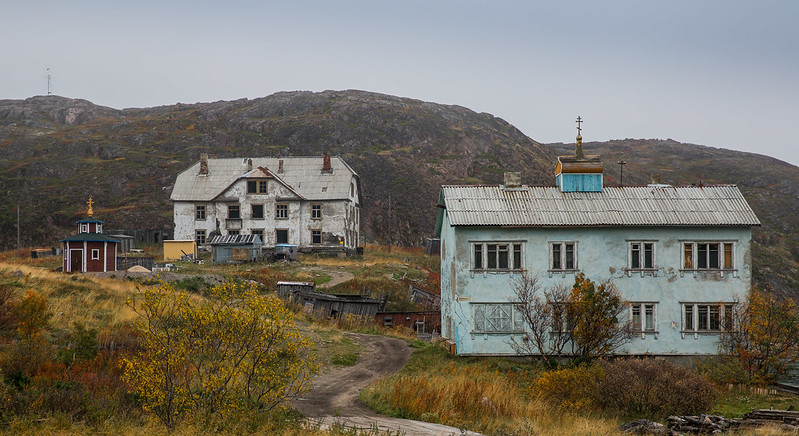
Teriberka, a village in the Russian Arctic (Pic: Ninara/Flickr)
Record permafrost temperatures are transforming the Arctic, especially for indigenous peoples, whose hunting livelihoods are at risk as ground melts 


Frozen ground in the Arctic is thawing, harming indigenous people’s hunting livelihoods and destabilising buildings and roads across the rapidly warming region.

Air temperatures hit 38C in Russia on 20 June in the Russian town of Verkhoyansk in Siberia, claimed as a heat record in the Arctic, which is warming twice as fast as the global average.

The previous day, the land surface temperature hit an extraordinary 45C at several locations in the Arctic Circle, according to European satellite data.

Often overlooked compared to air temperature records, temperatures in the ground are trending ever higher across the Arctic, according to the UN panel of climate scientists.

Permafrost, permanently frozen ground often just below the surface which melts to mud in summer, covers about a quarter of the land in the northern hemisphere. And shrinking permafrost is causing wrenching long-term changes to nature.

“As one of our elders says: ‘Nature doesn’t trust us any more’,” said Vyacheslav Shadrin, chair of the Yukaghir Council of Elders, of the Republic of Sakha-Yakutia in the Russian far east, about 600 km from Verkhoyansk. The Yukaghir total about 1,500 people.

“We can’t predict what will happen tomorrow. This is maybe the main challenge. All our lives are based on traditional knowledge. We used to know that tomorrow we catch fish or have our reindeer. Now we can’t say,” he told Climate Home News. Rivers that were reliable roads for months in winter can now be treacherous.
we need climate action now
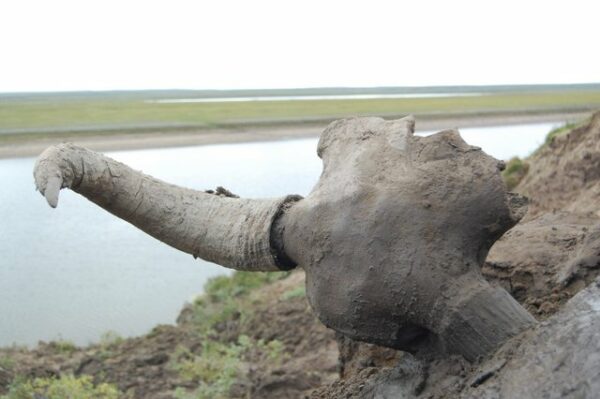
A bison horn revealed by melting permafrost in Siberia (Pic: Johanna Anjar)

Until a few decades ago, he said that many Yukaghir did not dig up ancient mammoth bones or tusks, fearing that disturbing bones entombed in the frozen soil could release malevolent spirits from an underworld below.

Today, however, the thaw of permafrost means such finds are more common – and valuable to collectors – and many Yukaghir have abandoned the belief.

“Traditionally the most forbidden things are connected to the mammoth, the spirit of the underworld. Now we use mammoth bones as a profit,” he said.
Climate news in your inbox? Sign up here
Around the Arctic, the loss of white snow and ice that reflects sunlight back to space reveals darker soil and water, that absorb ever more heat and accelerates the thaw.

At the time of publication, the extent of sea ice in the Arctic Ocean was tracking close to 2012 levels, the minimum on records dating back to 1979, NSIDC data show. On land, snow and ice cover is also among the lowest for the time of year, according to Rutgers University, and Greenland’s melt so far this year is also rapid, adding to sea level rise.

The World Meteorological Organization said it is checking last month’s heat record in Siberia. Daily records can be natural freaks – Fort Yukon on the Arctic circle in Alaska hit 37.7C as long ago as 1915, before climate change was a worry.

The temperature spike in Siberia was “an iconic threshold that indicates the warming we’re seeing over the long term” both in the air and the soil, said Walt Meier, senior research scientist at the US National Snow and Ice Data Center.

“The Arctic is warming about twice as fast as the rest of the globe and the Siberian region, even in the Arctic, is warming rapidly,” he told CHN. “We’re seeing buildings cracking, roads buckling around the Arctic.”
Greenpeace takes Arctic oil lawsuit to Norway’s supreme court
The thaw of permafrost may have caused the collapse of a fuel tank that spilled 21,000 tonnes of diesel into rivers and subsoil near the city of Norilsk on May 29. Elsewhere, loss of permafrost has been blamed for causing more frequent avalanches.

Read the complete Climate Home News article 

#jailclimatecriminals  #climatecrisis  #cambio-climatico

permafrost, Russia, Arctic, #cambio-climatico, #climateaction, #climatecriminals, #jailclimatecriminals, #climateemergency, #climatecrisis, 

Friday, 12 June 2020

Unexpected future boost of methane possible from Arctic permafrost : NASA

climate permafrost melt
melting permafrost
By Ellen Gray,
NASA's Earth Science News Team

New NASA-funded research has discovered that Arctic permafrost’s expected gradual thawing and the associated release of greenhouse gases to the atmosphere may actually be sped up by instances of a relatively little known process called abrupt thawing. Abrupt thawing takes place under a certain type of Arctic lake, known as a thermokarst lake that forms as permafrost thaws.

The impact on the climate may mean an influx of permafrost-derived methane into the atmosphere in the mid-21st century, which is not currently accounted for in climate projections.

The Arctic landscape stores one of the largest natural reservoirs of organic carbon in the world in its frozen soils. But once thawed, soil microbes in the permafrost can turn that carbon into the greenhouse gases carbon dioxide and methane, which then enter into the atmosphere and contribute to climate warming.


Read the article

Tuesday, 10 September 2019

Honest Government Ad | We're F**ked: YouTube


 The Government made an ad about climate change as we head into the third decade of the 21st century, and it’s surprisingly honest and informative. 
 - Global Climate Strike Sept 20-27: https://globalclimatestrike.net 
- Worldwide Rebellion Oct 7-18: https://rebellion.global 
- FridaysForFuture Sept 20/27: https://www.fridaysforfuture.org/even... 
Ways you can support us to keep making videos: 
 -- Become a Patron: https://www.patreon.com/TheJuiceMedia 
 -- Tip us on PayPal: https://www.paypal.me/thejuicemedia 
 -- Tip us in Bitcoin: https://www.thejuicemedia.com/support -*- 
CREDITS -- Produced by Patrons of The Juice Media -- Written by Giordano for The Juice Media -- Performed by Zoe x Voice by Lucy -- Animations by Brent Cataldo -- Thanks to Scott, Adso, Damian, Matt and Dbot for feedback on the script -- Footage courtesy of Extinction Rebellion: https://www.youtube.com/channel/UCYTh... -- Music by PMWA: https://audiojungle.net/item/timelaps...

See also:

Leaked IPCC report warns of the future of oceans in climate change: Global Landscapes Forum

Saturday, 4 May 2019

Rapid permafrost thaw unrecognized threat to landscape, global warming researcher warns: PHYSORG

A "sleeping giant" hidden in permafrost soils in Canada and other northern regions worldwide will have important consequences for global warming, says a new report led by University of Guelph scientist Merritt Turetsky. 


Scientists have long studied how gradual permafrost occurring over decades in centimetres of surface soils will influence to the atmosphere. But Turetsky and an international team of researchers are looking at something very different: rapid collapse of permafrost that can transform the landscape in mere months through subsidence, flooding and landslides.


"We are watching this sleeping giant wake up right in front of our eyes," said Turetsky, who holds the Canada Research Chair in Integrative Ecology.

Read the PHYSORG article