Showing posts with label forests. Show all posts

Wednesday, 9 September 2020

Water wars: How conflicts over resources are set to rise amid climate change: World Economic Forum

global warming is increasing competition for water around the world
Water shortages for one in four children in areas of extreme water shortage by 2040

   • From erratic rainfall to severe droughts, global warming is increasing competition for water around the world, with water-related conflicts on the rise.
 
  • According to the WRI, more than two billion people live in countries experiencing "high" water stress.
 
  • Conserving forests, wetlands and watersheds, including those around cities, can help absorb rainfall, helping stem crop losses from flooding and drought.

From Yemen to India, and parts of Central America to the African Sahel, about a quarter of the world's people face extreme water shortages that are fueling conflict, social unrest and migration, water experts said on Wednesday.
With the world's population rising and climate change bringing more erratic rainfall, including severe droughts, competition for scarcer water is growing, they said, with serious consequences.
"If there is no water, people will start to move. If there is no water, politicians are going to try and get their hands on it and they might start to fight over it," warned Kitty van der Heijden, head of international cooperation at the Netherlands' foreign ministry.


global warming is increasing competition for water around the world
Map of baseline water stress for countries

One in four children worldwide will be living in areas of extremely high water stress by 2040, researchers estimated.

"It's threats like these that keep me up at night," the diplomat told a webinar hosted by the World Resources Institute (WRI), a U.S.-based research group.
global warming is increasing competition for water around the world
African boy gathering muddy water


 According to the WRI, 17 countries face "extremely high" levels of water stress, while more than two billion people live in countries experiencing "high" water stress.

In terms of water availability, "at some point we are going to hit the wall, and that wall might be different in different places", Heijden said.

Climate change is compounding the challenge, she said, with cities such as India's Chennai and South Africa's Cape Town battling severe water shortages in recent years related in part to erratic rainfall.
Disputes over water have for millenia served as a flashpoint, driving political instability and conflict, the water experts said.
And "the risks of water-related disputes are growing .. in part because of growing scarcity over water", said Peter Gleick, co-founder of the California-based Pacific Institute, which jointly published the report with WRI and The Water, Peace and Security Partnership.
global warming is increasing competition for water around the world
Drought affecting Central American farming
But as water scarcity grows, water systems are also increasingly becoming targets in other types of conflicts, said Gleick, whose institute has compiled a chronology of water conflicts that dates back 5,000 years.
In Yemen, years of fighting has destroyed water infrastructure, leaving millions without safe water to drink or grow crops. Wells and other water facilities also have been targets in Somalia, Iraq, Syria and other countries, he said.
Smarter irrigation
Climate change is compounding the challenge
India is already hot
Recurring droughts in parts of Central America and the African Sahel in recent years have triggered migration as subsistence farmers, whose harvests have been decimated by low rainfall, seek refuge and jobs in other countries.
One key to tackling water scarcity is boosting investment in more sparing use of water in agriculture, an industry that absorbs more than two-thirds of the water used by people each year, the experts said.

Tuesday, 25 August 2020

The End of the Environment: Bob Brown.: The Saturday Paper (excerpt)

.... "The prime minister’s post-Covid-19 plan is to roar ahead with a slate of mega-projects that would be delayed by any
a boon for corporate environmental exploiters
Liberals and nationals Fail Australian Forests
proper consideration of their environmental and Indigenous heritage impacts.
 
 
While the EPBC Act rarely leads to any project being given the thumbs down, it does require environmental impacts to be assessed, and this takes time. The government’s solution? Get rid of the federal assessment.
 
a boon for corporate environmental exploiters
Forests are only proven carbon storage
When parliament resumes next week, Minister for the Environment Sussan Ley will introduce a bill, under the cover of Covid-19, to amend Howard’s EPBC Act and hand the power to the states – which are more vulnerable to the corporate sector – to approve mining, gas fracking, dam building, the rapid expansion of industrial fish farming and the invasion of national parks by private enterprise. She aims to wash her hands of the Commonwealth’s responsibility for environmental assessment and protection.
 
...........................
 
.........................
 
The minister is not waiting for the final report, due in October, of her own inquiry into the EPBC Act, headed by businessman Graeme Samuel. Last month she peremptorily dismissed his interim report’s key recommendation that the Commonwealth set up a policing agency to watch over state management of environmental matters. This was despite Samuel’s finding that “Australia’s natural environment and iconic places are in an overall state of decline and are under increasing threat”.
 
Undoubtedly, the powers to protect Indigenous heritage will be the
a boon for corporate environmental exploiters
Koala after wildfire
next thing shunted to the states. Ley knew the Juukan Gorge caves were to be blown up by Rio Tinto before the event and yet she did nothing. Next, she rejected national heritage protection for the ancient Djab Wurrung eucalypts in Victoria. Handing her powers to the states will spare her from such complicit embarrassment in the future.
 
a boon for corporate environmental exploiters
Australia's climate action record
With the Greens opposed, it will be up to Labor and the crossbenchers in the senate to take on Scott Morrison’s game plan to relegate environmental powers to weaker state governments while concentrating economic might in Canberra: a boon for corporate environmental exploiters and their lobbyists in both cases.
 
This is a watershed moment for Australia’s environment. It has taken more than two decades to see any success in our fight to chip away at Howard’s RFAs. And now we face another era wherein policy is being devised to ignore the certainty of environmental devastation for the promise of a quick profit.
 
In Earth’s sixth great age of extinction, there is a rising tide of opposition to the foolishness, if not criminality, of destroying wildlife habitats – from the deep seas to coral reefs and coastlines to what little is left of woodlands, grasslands and forests.
 
a boon for corporate environmental exploiters
Koala and destroyed forest
The phenomenon of Extinction Rebellion, temporarily quietened by Covid-19, is just a hint of the public unrest to come unless the needless exploitation of nature and our finest human heritage ends. Earth’s ecosystem is at breaking point. Our human herd is already using nearly twice the living produce this planet is capable of sustaining and yet, everywhere, the clamour is for “growth”.
If the forests continue to fall, everything else will follow. As with whaling in 1978, the time for logging Australia’s wildlife-filled and carbon-rich native forests is up.
 

Saturday, 22 August 2020

Legal challenge to native forest logging in Tasmania might succeed


"BIG NEWS ! This court case could be a watershed moment in
ending the taxpayer-subsidised destruction of Tasmania’s precious native forests and the best chance in a generation to properly protect our old growth wilderness, their critters and critical carbon sinks.


the Tasmanian Government failed again to get FSC certification for its destructive native forest logging operations
Australian political parties support logging native forests
For more than two decades, too many Tasmanian politicians have hidden behind these dodgy Regional Forest Agreements and promoted the interests of a few profiteers at the expense of our environment and taxpayers.
We have long known these Regional Forest Agreements were used 
Recently the Tasmanian Government failed again to get FSC certification for its destructive native forest logging operations
Native forests are already at risk from fires.
as cover to abandon the endangered wildlife they were set up to protect, simply to grease the wheels for a marginal industry that has wielded significant political clout. 
Recently the Tasmanian Government failed again to get FSC certification for its destructive native forest logging operations. 
This is no surprise when, for decades, it has not had a robust legal framework holding the industry to account especially around the protection of endangered species such as the Tasmanian devil, wedge-tailed eagle and swift parrot, and also for the logging of old growth forests." Senator Whish-Wilson on Facebook

..............................

"Bob Brown launches legal challenge to native forest logging in Tasmania

State-sanctioned felling is ‘based on a monumental lie’, former Greens leader says

'The former Greens leader Bob Brown has launched a legal challenge to native forest logging in Tasmania, claiming it is inconsistent with federal environment law.

The case by the Bob Brown Foundation, lodged in the federal court on Thursday, challenges what has been seen as an effective exemption from environment laws granted to state-sanctioned logging under regional forest agreements between Canberra and the states.

it lacks a legally enforceable requirement that the state must protect threatened species.
Australia ranks second worse on climate protection
It argues the Tasmanian regional forest agreement is not valid as it lacks a legally enforceable requirement that the state must protect threatened species.

The foundation says if the case were successful it would consider similar action against federal-state forest agreements in Victoria, New South Wales and Western Australia. It said the current rules “essentially allows the state government to make up the rules as it suits, and gives no guaranteed protection for our wildlife and environment”.

Brown said the foundation had been buoyed by a landmark federal court judgment in May that found logging in Victoria’s central highlands by the state-owned agency VicForests was in breach of a regional forest agreement.

the flattening and burning of native forests and wildlife is not ecologically sustainable,”
Logging in NSW leaves Koala stranded.
“This is a huge undertaking for us but everyone knows that the flattening and burning of native forests and wildlife is not ecologically sustainable,” Brown said. “The industry is based on a monumental lie and this challenge puts that lie to the test.”

Read complete The Guardian story, August 21, 2020

  Related: Both the major parties in Australia support new gas projects

Sunday, 22 March 2020

State MPs dismayed at NSW Forestry logging unburnt habitat after bushfires: The Guardian

Endangered species have lost up to 82% of their habitat but Environment Protection Authority says logging of unburnt forest is legal

Saturday, 5 October 2019

Greta Thunberg and George Monbiot make short film on the climate crisis


Environmental activists Greta Thunberg and George Monbiot have helped produce a short film highlighting the need to protect, restore and use nature to tackle the climate crisis. Living ecosystems like forests, mangroves, swamps and seabeds can pull enormous quantities of carbon from the air and store them safely, but natural climate solutions currently receive only 2% of the funding spent on cutting emissions.

 The film’s director, Tom Mustill of Gripping Films, said: 'We tried to make the film have the tiniest environmental impact possible. We took trains to Sweden to interview Greta, charged our hybrid car at George’s house, used green energy to power the edit and recycled archive footage rather than shooting new.'

Subscribe to Guardian News on YouTube ► http://bit.ly/guardianwiressub Support the Guardian ► https://support.theguardian.com/contr... #naturenow #climatecrisis #gretathunberg CREDITS Narrators: Greta Thunberg & George Monbiot Director: Tom Mustill Producer: Triangle Monday DoP & Editor: Fergus Dingle Sound: Shaman Media GFX: Paraic Mcgloughlin Online: Bram De Jonghe Picture Post: Special Treats Productions Mix: Mcasso Music Audio Post: Tom Martin NCS Guidance: Charlie Lat Music: Rone / InFiné Music The Independent film by Gripping Films(Tom Mustill) was supported by: Conservation International Food and Land Use Coalition Gower St With guidance from Nature4Climate Natural Climate Solutions www.grippingfilms.com FIND OUT MORE: #naturenow www.naturalclimate.solutions Today in Focus podcast ► https://www.theguardian.com/news/seri... The Guardian YouTube network: The Guardian ► http://www.youtube.com/theguardian Owen Jones talks ► http://bit.ly/subsowenjones Guardian Football ► http://is.gd/guardianfootball Guardian Sport ► http://bit.ly/GDNsport Guardian Culture ► http://is.gd/guardianculture

Wednesday, 11 September 2019

Time to rethink Australia's fire fighting resources.


📷: Bindi Cox
Our wildfires are taking lives, destroying homes and infrastructure and stressing our rural communities. 

Our firefighters in Australia, both paid and volunteer, are out there risking injury and putting their lives on the line, or at the very least sacrificing their work. Employers, often small business employers, are supporting them. Are our firefighters sufficient in number?


"There are still 50 fires burning across New South Wales, with 21 fires uncontained. A total of 630 firefighters have been deployed across the state. A fire in Bees Nest, north-west of Dorrigo in the Armidale area, is currently over 66,500 hectares and out of control." September 10


What are we losing in these fires?

📷 Photo Credit: Darren, Jimboomba Police
 • Of course we are losing homes and infrastructure. Communities are being traumatised. We are now wondering whether drought stricken communities will have the required water to fight the inevitable fires that climate change is increasing. 

• We now have a new fire category, 'extreme'.

• We are also losing precious forests and biodiversity. This week the Gondwana World Heritage Area has been severely damaged.

"The Gondwana Rainforests of Australia, World Heritage Area, contains the most extensive areas of subtropical rainforest in the world, large areas of warm temperate rainforest, and the majority of the world's Antarctic beech cool temperature rainforest. These extraordinary areas still contain ancient and primitive plants and animals from which life on Earth evolved." NSW National Parks

The same fire began in the Guy Fawkes River National Park and by September10,  had burned 66,500 hectares and was 'out of control'.
 
"The park is a significant conservation site with amazing biodiversity. There are 24 threatened animal species you might encounter here, including the brush-tailed rock-wallabies that can often be seen in the park’s rocky areas." National Parks


There has been a world wide reaction to careless burning of the Amazon forests. Other countries are busily planting trees to protect soils and store carbon, yet Australia is busy clearing trees and fighting forest fires with limited resources. 


It is time to review our fire fighting resources.

We know some extra resources have been ordered or already purchased.

"New South Wales has signed a contract with United States-based Coulson Aviation to purchase three aircraft for firebombing duties, including a modified Boeing 737 large air tanker.

  
NSW buys Boeing 737 large air tanker for firefighting ...


https://australianaviation.com.au › 2019/05 › nsw-buys-boeing-737-large-..."

As we face an increasing number of fierce fires in an extended fire season, it is time to ask:

Are we allowing our rural communities to suffer unnecessarily?

Why are we allowing our world heritage forests with unique biodiversity to burn?

Do we have sufficient resources to fight fires and to extinguish them quickly?

Why are we still reliant on volunteers? Why are we putting volunteers at risk?

Do we have enough air support?

Is a budget surplus a priority over expanding our firefighting resources and better protecting our communities? 

Related:

What if we stopped pretending Climate Change could be prevented.

Monday, 9 September 2019

What if we stopped pretending Climate Change could be prevented.

"All-out war on climate change made sense only as long as it was winnable. Once you accept that we’ve lost it, other kinds of action take on greater meaning. 

Preparing for fires and floods and refugees is a directly pertinent example. But the impending catastrophe heightens the urgency of almost any world-improving action. In times of increasing chaos, people seek protection in tribalism and armed force, rather than in the rule of law, and our best defense against this kind of dystopia is to maintain functioning democracies, functioning legal systems, functioning communities. In this respect, any movement toward a more just and civil society can now be considered a meaningful climate action. Securing fair elections is a climate action.
 Combatting extreme wealth inequality is a climate action. Shutting down the hate machines on social media is a climate action. Instituting humane immigration policy, advocating for racial and gender equality, promoting respect for laws and their enforcement, supporting a free and independent press, ridding the country of assault weapons—these are all meaningful climate actions. To survive rising temperatures, every system, whether of the natural world or of the human world, will need to be as strong and healthy as we can make it."

"In Santa Cruz, where I live, there’s an organization called the Homeless Garden Project. On a small working farm at the west end of town, it offers employment, training, support, and a sense of community to members of the city’s homeless population. It can’t “solve” the problem of homelessness, but it’s been changing lives, one at a time, for nearly thirty years. Supporting itself in part by selling organic produce, it contributes more broadly to a revolution in how we think about people in need, the land we depend on, and the natural world around us. In the summer, as a member of its C.S.A. program, I enjoy its kale and strawberries, and in the fall, because the soil is alive and uncontaminated, small migratory birds find sustenance in its furrows.

There may come a time, sooner than any of us likes to think, when the systems of industrial agriculture and global trade break down and homeless people outnumber people with homes. At that point, traditional local farming and strong communities will no longer just be liberal buzzwords. Kindness to neighbors and respect for the land—nurturing healthy soil, wisely managing water, caring for pollinators—will be essential in a crisis and in whatever society survives it. A project like the Homeless Garden offers me the hope that the future, while undoubtedly worse than the present, might also, in some ways, be better. Most of all, though, it gives me hope for today."

Read the excellent NYT article

See also:

Leaked IPCC report warns of the future of oceans in climate change: Global Landscapes Forum


For Pope Francis, a Perfect Moment for an Unsettling Warning on the Environment: NYT

"Pope Francis used his first full day in Madagascar to hammer the same point home.

“Your lovely island of Madagascar is rich in plant and animal biodiversity, yet this treasure is especially threatened by excessive deforestation, from which some profit,” Francis said Saturday in Madagascar’s capital, Antananarivo, about an hour’s drive from the lemur reserve. “The last forests are menaced by forest fires, poaching, the unrestricted cutting down of valuable woodlands.”
Francis has been making a similar case since his election in 2013, when he put environmental protection and global warming at the top of his agenda. He championed the Paris climate accord and, in 2015, became the first pope to dedicate an encyclical to protecting the earth."


Saturday, 31 August 2019

Video - Kalang: protecting this NSW forest

Conservation of our existing forests is essential to combat climate catastrophe. Whether the tree is in The Amazon or in NSW it is essential as carbon storage.


This short documentary depicts the beauty and unique ecosystem of the Kalang area and the forests of north-eastern New South Wales, while exposing the unsustainability of past and future logging operations and the destruction of endangered wildlife habitats.

What can you do to help protect this amazing biodiverse region and its inhabitants? - Support the proposed Great Koala National Park: http://www.koalapark.org.au - Sign the petition to protect this ancient native forest and its headwaters from logging on Change.org: https://www.change.org/p/premier-of-n...

- Spread the word and share this video !

Related:

Leaked IPCC report warns of the future of oceans in climate change: Global Landscapes Forum

Tuesday, 20 August 2019

New climate change report underscores the need to manage land for the short and long term: SciFiGeneration

In its latest report, the Intergovernmental Panel on Climate Change describes how agriculture, deforestation, and other human activities have altered 70% of the land on Earth’s surface. 

These changes are significantly adding to climate-warming emissions. They are also making forests and other natural systems, which can store key greenhouse gases, less able to do so.
Many calls to limit emissions focus on those from energy and transportation. But as the IPCC report points out, agriculture and land use are also major greenhouse gas sources. In the past decade, land use was responsible for 22% of global greenhouse gas emissions, compared to 35% for energy and 14% for transportation.

For the past 20 years, I have been working to understand how severe climate change will be in the coming century. Scientists know that Earth’s climate responds to both changes in greenhouse gas levels in the atmosphere and changes in land use. This report makes clear that solving the climate crisis will require serious choices about how humans interact with the land systems that provide our societies with food, water and shelter.

The story is not all doom and gloom. There are strategies that can reduce greenhouse gas emissions from land use, food production and agriculture, and also generate economic and social benefits. Acting on these recommendations would be a big step toward addressing climate change in a meaningful way. 

Read the complete SciFiGeneration article

Wednesday, 14 August 2019

Forests, logging and climate change: IA

Logging has a serious effect on climate change, writes Frances Pike.

THE INTERGOVERNMENTAL PANEL for Climate Change (IPCC) recommends that "natural solutions" are employed to deal with climate change emergency. The immediate protection and restoration of natural systems for carbon dioxide removal (CDR) are preferred to geo-engineering and B.E.C.C.S — burning biomass as a fossil fuel substitute while using some sort of carbon capture and storage.

It is clear that the resilience of natural systems must be enhanced to withstand climate change impact, lest they falter and collapse, inhibiting their capacity for CDR.

The fairytale that burning wood instead of coal is carbon neutral continues to wreak havoc on the world’s extant forests. But that fairytale could soon end, taking with it the myth that the industrial logging of the world’s native forests has been and is now "sustainable".

For a long time, the falsity of carbon emission accounting for forest bioenergy has been apparently invisible to many policymakers. A Weekend Australian commentator said, in relation to UK power station Drax which has converted to wood: “The CO2 it emitted as a coal station was causing climate change; the increased CO2 now emitted from burning wood is defined by the EC bureaucrats as not existing”.

Read the complete article 

Related: Want to beat climate change? Protect our natural forests: The Conversation

Wednesday, 7 August 2019

Want to beat climate change? Protect our natural forests: The Conversation


Tomorrow a special report on how land use affects climate change will be released by the Intergovernmental Panel on Climate Change. 

Land degradation, deforestation, and the expansion of our deserts, along with agriculture and the other ways people shape land, are all major contributors to global climate change.

Conversely, trees remove carbon dioxide and store it safely in their trunks, roots and branches. 

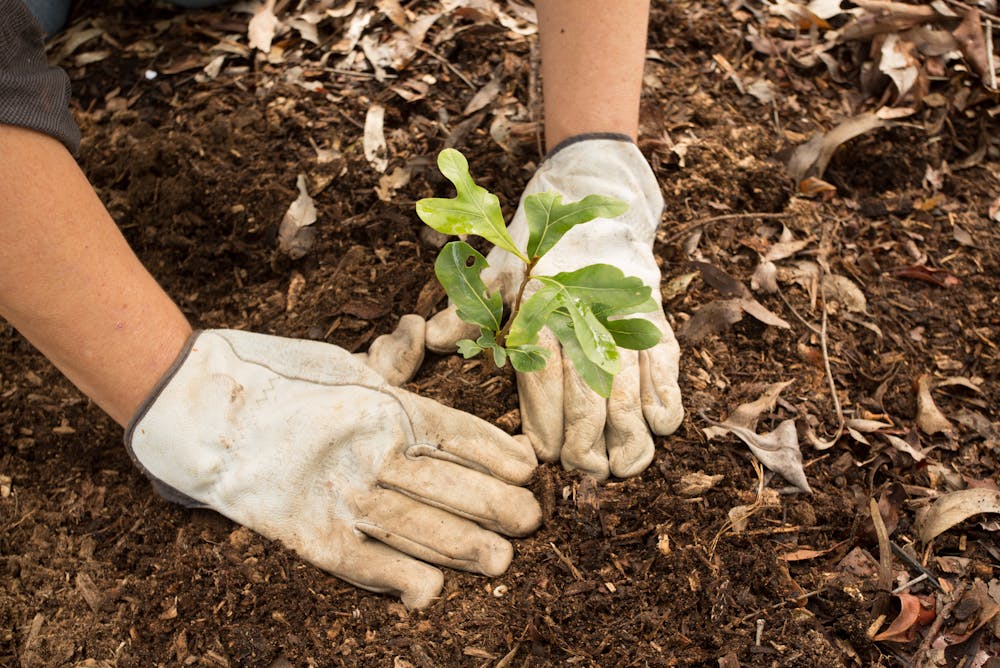
Research published in July estimated that planting a trillion trees could be a powerful tool against climate change.

Read more: Our cities need more trees, but some commonly planted ones won't survive climate change


However, planting new trees as a climate action pales in comparison to protecting existing forests. Restoring degraded forests and expanding them by 350 million hectares will store a comparable amount of carbon as 900 million hectares of new trees.

Natural climate solutions

Using ecological mechanisms for reducing and storing carbon is a growing field of study. Broadly known as “natural climate solutions”, carbon can be stored in wetlands, grasslands, natural forests and agriculture. 

This is called “sequestration”, and the more diverse and longer-lived the ecosystem, the more it helps mitigate the effect of climate change.
Allowing trees to regenerate naturally is a more effective, immediate and low-cost method of removing and storing atmospheric carbon than planting new trees. Shutterstock
Research has estimated these natural carbon sinks can provide 37% of the CO₂ reduction needed to keep the rise in global temperatures below 2℃.
But this research can be wrongly interpreted to imply that the priority is to plant young trees. In fact, the major climate solution is the protection and recovery of carbon-rich and long-lived ecosystems, especially natural forests.

Read more: Extreme weather caused by climate change has damaged 45% of Australia's coastal habitat

With the imminent release of the new IPCC report, now is a good time to prioritise the protection and recovery of existing ecosystems over planting trees.
Forest ecosystems (including the soil) store more carbon than the atmosphere. Their loss would trigger emissions that would exceed the remaining carbon budget for limiting global warming to less than the 2℃ above pre-industrial levels, let alone 1.5℃, threshold.

Read more: 40 years ago, scientists predicted climate change. And hey, they were right

Natural forest systems, with their rich and complex biodiversity, the product of ecological and evolutionary processes, are stable, resilient, far better at adapting to changing conditions and store more carbon than young, degraded or plantation forests.

Protect existing trees

Forest degradation is caused by selective logging, temporary clearing, and other human land use. In some areas, emissions from degradation can exceed those of deforestation. Once damaged, natural ecosystems are more vulnerable to drought, fires and climate change.
Recently published research found helping natural forest regrow can have a globally significant effect on carbon dioxide levels. This approach – called proforestation – is a more effective, immediate and low-cost method for removing and storing atmospheric carbon in the long-term than tree planting. And it can be used across many different kinds of forests around the world.

 
Avoiding further loss and degradation of primary forests and intact forest landscapes, and allowing degraded forests to naturally regrow, would reduce global carbon emissions. Shutterstock
Avoiding further loss and degradation of primary forests and intact forest landscapes, and allowing degraded forests to naturally regrow, would reduce global carbon emissions annually by about 1 gigatonnes (Gt), and reduce another 2-4 Gt of carbon emissions just through natural regrowth.

Read more: Not everyone cares about climate change, but reproach won't change their minds

Research has predicted that protecting primary forests while allowing degraded forests to recover, along with limited expansion of natural forests, would remove 153 billion tonnes of carbon from the atmosphere between now and 2150.
Every country with forests can contribute to this effort. In fact, research shows that community land management is the best way to improve natural forests and help trees recover from degradation.

Read The Conversation article

Saturday, 20 July 2019

Can planting trees save our climate?

In recent weeks, a new study by researchers at ETH Zurich has hit the headlines worldwide (Bastin et al. 2019). It is about trees. The researchers asked themselves the question: how much carbon could we store if we planted trees everywhere in the world where the land is not already used for agriculture or cities? Since the leaves of trees extract carbon in the form of carbon dioxide – CO2 – from the air and then release the oxygen – O2 – again, this is a great climate protection measure. The researchers estimated 200 billion tons of carbon could be stored in this way – provided we plant over a trillion trees.

The media impact of the new study was mainly based on the statement in the ETH press release that planting trees could offset two thirds of the man-made CO2 increase in the atmosphere to date. To be able to largely compensate for the consequences of more than two centuries of industrial development with such a simple and hardly controversial measure – that sounds like a dream! And it was immediately welcomed by those who still dream of climate mitigation that doesn’t hurt anyone.

Unfortunately, it’s also too good to be true. 

Read the RealClimate article

Friday, 12 July 2019

How to erase 100 years of carbon emissions? Plant trees—lots of them.

Increasing the Earth’s forests by an area the size of the United States would cut atmospheric carbon dioxide 25 percent.

 PUBLISHED


An area the size of the United States could be restored as forests with the potential of erasing nearly 100 years of carbon emissions, according to the first ever study to determine how many trees the Earth could support.
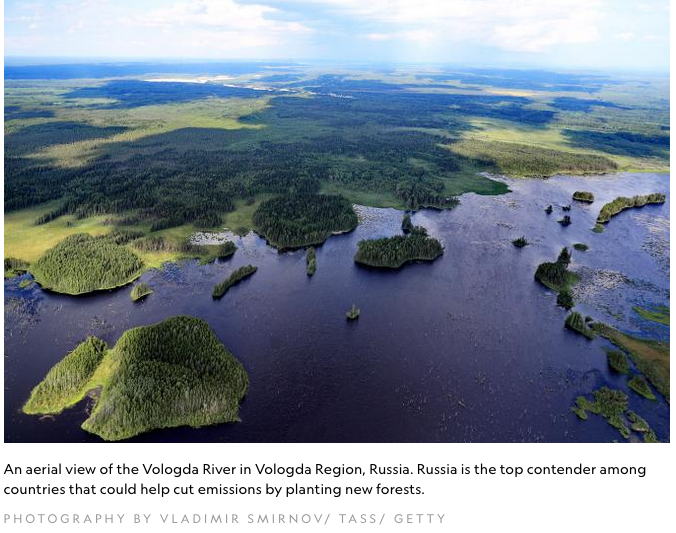
Published today in Science, "The global tree restoration potential” report found that there is enough suitable land to increase the world’s forest cover by one-third without affecting existing cities or agriculture. However, the amount of suitable land area diminishes as global temperatures rise. Even if global warming is limited to 1.5 degrees Celsius, the area available for forest restoration could be reduced by a fifth by 2050 because it would be too warm for some tropical forests.
“Our study shows clearly that forest restoration is the best climate change solution available today,” said Tom Crowther, a researcher at ETH Zürich, and senior author of the study.