Showing posts with label India. Show all posts

Wednesday, 9 September 2020

Water wars: How conflicts over resources are set to rise amid climate change: World Economic Forum

global warming is increasing competition for water around the world
Water shortages for one in four children in areas of extreme water shortage by 2040

   • From erratic rainfall to severe droughts, global warming is increasing competition for water around the world, with water-related conflicts on the rise.
 
  • According to the WRI, more than two billion people live in countries experiencing "high" water stress.
 
  • Conserving forests, wetlands and watersheds, including those around cities, can help absorb rainfall, helping stem crop losses from flooding and drought.

From Yemen to India, and parts of Central America to the African Sahel, about a quarter of the world's people face extreme water shortages that are fueling conflict, social unrest and migration, water experts said on Wednesday.
With the world's population rising and climate change bringing more erratic rainfall, including severe droughts, competition for scarcer water is growing, they said, with serious consequences.
"If there is no water, people will start to move. If there is no water, politicians are going to try and get their hands on it and they might start to fight over it," warned Kitty van der Heijden, head of international cooperation at the Netherlands' foreign ministry.


global warming is increasing competition for water around the world
Map of baseline water stress for countries

One in four children worldwide will be living in areas of extremely high water stress by 2040, researchers estimated.

"It's threats like these that keep me up at night," the diplomat told a webinar hosted by the World Resources Institute (WRI), a U.S.-based research group.
global warming is increasing competition for water around the world
African boy gathering muddy water


 According to the WRI, 17 countries face "extremely high" levels of water stress, while more than two billion people live in countries experiencing "high" water stress.

In terms of water availability, "at some point we are going to hit the wall, and that wall might be different in different places", Heijden said.

Climate change is compounding the challenge, she said, with cities such as India's Chennai and South Africa's Cape Town battling severe water shortages in recent years related in part to erratic rainfall.
Disputes over water have for millenia served as a flashpoint, driving political instability and conflict, the water experts said.
And "the risks of water-related disputes are growing .. in part because of growing scarcity over water", said Peter Gleick, co-founder of the California-based Pacific Institute, which jointly published the report with WRI and The Water, Peace and Security Partnership.
global warming is increasing competition for water around the world
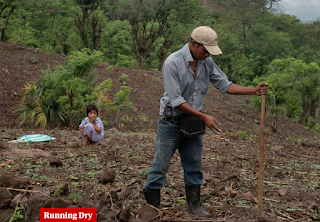
Drought affecting Central American farming
But as water scarcity grows, water systems are also increasingly becoming targets in other types of conflicts, said Gleick, whose institute has compiled a chronology of water conflicts that dates back 5,000 years.
In Yemen, years of fighting has destroyed water infrastructure, leaving millions without safe water to drink or grow crops. Wells and other water facilities also have been targets in Somalia, Iraq, Syria and other countries, he said.
Smarter irrigation
Climate change is compounding the challenge
India is already hot
Recurring droughts in parts of Central America and the African Sahel in recent years have triggered migration as subsistence farmers, whose harvests have been decimated by low rainfall, seek refuge and jobs in other countries.
One key to tackling water scarcity is boosting investment in more sparing use of water in agriculture, an industry that absorbs more than two-thirds of the water used by people each year, the experts said.

Monday, 7 September 2020

Climate Change Poses Serious Threats to India's Food Security (excerpt): The Wire

Climatic factors like increased temperatures and extreme rainfall will affect productivity by causing physiological changes. Photo: Reuters
"Planning for the long-term impacts of climate change on agriculture appears to be rather low on the government's priority list.

Issues including the security clampdown in the Valley and slowdown in major sectors of the economy are dominating headlines. The agriculture ministry too would be occupied with formulating interventions to spur the economy of the erstwhile state of Jammu and Kashmir.


Climate change is no longer a distant threat. According to the Indian Meteorological Department, the annual mean temperature in the country has increased by 0.6 degrees Celsius between 1901 and 2018, when compared to pre-industrial levels. Eleven of the 15 warmest years have so far all been within the last 15 years with 2018 being the sixth warmest year in India’s recorded history.

The extent and degree of warming are going to get more severe. As carbon emissions continue and those which are built into the climate system take effect, temperatures across the world are expected to increase between 3-5 degree Celsius by 2100. India is among the countries which are likely to bear the worst of a warming planet due to its tropical location and relatively lower levels of income.

Agriculture and food production are likely to be significantly affected by climate change. According to one estimate, yields of major crops could decline by up to 25%. A recent IPCC report also warned that in the years to come, food security will stand threatened due to climate change coupled with increasing demands of the rising population.

The global population is expected to increase from 7.7 billion in 2019 to 8.5 billion by 2030 and 9.7 billion by 2050. According to the United Nation’s World Population Prospects (June 2019), the Indian population is projected to increase from 1.36 billion in 2019 to 1.5 billion by 2030 and 1.64 billion by 2050.

Crops, animal husbandry, as well as fisheries,
 are likely to be impacted. Photo: Reuters

Providing food and nutritional security to an entire population needs some serious planning and effective implementation. And we need to start now. 

Climatic factors like increased temperatures and extreme rainfall will affect productivity by causing physiological changes. In addition, they will affect soil fertility, the incidence of pest infestation and the availability of water. This will impact crops, animal husbandry as well as fisheries."................................

From The Wire 
by Siraj Hussain
19/Sep/2019

Friday, 14 August 2020

Sea Level Rise Effect on Mumbai of 1.5m rise

Mumbai, land at risk from 1.5m sea rise
 • We are looking more and more unlikely to prevent global heating.

• Scientists are predicting the melting of the ice covering Greenland with a subsequent sea level rise of 7m.

• This rise does not factor in sea rise from the melting of Antarctica and other ice.

• Already many properties are likely to flood when a high tide is combined with high local rainfall. 
 

What were a hundred year rainfall events are now ten year events.


Mumbai, land at risk with 1.0m sea rise
 
• The frequency of high rainfall events will increase with global heating and more and more severe hurricanes are predicted because of warmer seas.


• Low coastal areas will be subjected to severe storm surges.

• Would you buy a property likely to be inundated in twenty years, fifty years, a hundred years? Many wouldn't. Even the perception of possible inundation will greatly affect property values. Some properties will become more expensive to insure or become impossible to insure

• When certain properties are in less demand their value falls.

• Would you buy a property with a value that is likely to fall?

•  The view of Mumbai above shows areas likely to be inundated by a 1.5m and a 1.0m sea level rise.

• Property above a 10m rise will become highly sought after and will greatly increase in value.

Learn more about how sea rise inundation will affect India's property, indeed any property, at climatecentral.org


Related:

Greenland shed ice at unprecedented rate in 2019; Antarctica continues to lose mass: EurekAlert


Melbourne: predicted flooding with a conservative sea level rise of only 1.5m


#sea level rise, #Greenland ice melt, #sea ice, #climateaction, #climatechange, #jailclimatecriminals, #cambio-climatico,  

Friday, 7 August 2020

This Is Inequity at the Boiling Point: The Conversation (excerpt)


https://www.nytimes.com/interactive/2020/08/06/climate/climate-change-inequality-heat.html?campaign_id=3&emc=edit_MBAU_p_20200806&instance_id=21045&nl=morning-briefing&regi_id=94643053&section=backStory&segment_id=35452&te=1&user_id=8e8e563fc4e5a5c16b6b437d6b7137af
Heatwaves

"This Is Inequity at the Boiling Point


It was a record 125 degrees Fahrenheit in Baghdad in July, and 100 degrees above the Arctic Circle this June. Australia shattered its summer heat records as wildfires, fueled by prolonged drought, turned the sky fever red. 


For 150 years of industrialization, the combustion of coal, oil and gas has steadily released heat-trapping gases into the atmosphere, driving up average global temperatures and setting heat records. Nearly everywhere around the world, heat waves are more frequent and longer lasting than they were 70 years ago. 

But a hotter planet does not hurt equally. If you’re poor and
https://www.nytimes.com/interactive/2020/08/06/climate/climate-change-inequality-heat.html?campaign_id=3&emc=edit_MBAU_p_20200806&instance_id=21045&nl=morning-briefing&regi_id=94643053&section=backStory&segment_id=35452&te=1&user_id=8e8e563fc4e5a5c16b6b437d6b7137af
Heatwaves
marginalized, you’re likely to be much more vulnerable to extreme heat. You might be unable to afford an air-conditioner, and you might not even have electricity when you need it. You may have no choice but to work outdoors under a sun so blistering that first your knees feel weak and then delirium sets in. Or the heat might bring a drought so punishing that, no matter how hard you work under the sun, your corn withers and your children turn to you in hunger.
It’s not like you can just pack up and leave. So you plant your corn higher up the mountain. You bathe several times a day if you can afford the water. You powder your baby to prevent heat rash. You sleep outdoors when the power goes out, slapping mosquitoes. You sit in front of a fan by yourself, cursed by the twin dangers of isolation and heat. 

Extreme heat is not a future risk. It’s now. It endangers human health, food production and the fate of entire economies. And it’s worst for those at the bottom of the economic ladder in their societies. See what it’s like to live with one of the most dangerous and stealthiest hazards of the modern era. 

Photographs by Myrto Papadopoulos in Athens, Ilana Panich-Linsman in Houston, KC Nwakalor in the Niger Delta, Nigeria, Daniele Volpe in Jocotán, Guatemala, Saumya Khandelwal in Lucknow, India, and Juan Arredondo in New York City."


‘Nature doesn’t trust us any more’: Arctic heatwave stokes permafrost thaw: Climate Home News


Tuesday, 24 September 2019

Greta Thunberg condemns world leaders in emotional speech at UN : The Guardian

  • Thunberg, 16, says governments have betrayed young people
  • ‘You are not mature enough to tell it like it is. You are failing us’


“The summit was designed to accelerate countries’ ambition to address the climate crisis amid increasingly urgent warnings by scientists. A new UN analysis has found that commitments to cut planet-warming gases must be at least tripled and increased by up to fivefold if the world is to meet the goals of the 2015 Paris agreement of holding the temperature rise to at least 2C above the pre-industrial era.“

Read complete The Guardian story

Tuesday, 14 May 2019

Climate change: Where we are in seven charts and what you can do to help: BBC

Average Warming projected by 2100
"The UN has warned that the goal of limiting global warming to "well below 2C above pre-industrial levels" is in danger because major economies, including the US and the EU, are falling short of their pledges.


But scientists at the Intergovernmental Panel on Climate Change (IPCC) - the leading international body on global warming - argue the 2C pledge in the 2015 Paris accord didn't go far enough. The global average temperature rise actually needs to be kept below 1.5C, they say.


So how warm has the world got and what can we do about it?"

Read the article

Sunday, 18 November 2018

Nature Communications: Warming assessment of the bottom-up Paris Agreement emissions pledges


"Tightening the warming goal of each country’s effort-sharing approach to aspirational levels of 1.1 °C and 1.3 °C could achieve the 1.5 °C and well-below 2 °C-thresholds, respectively. 

This new hybrid allocation reconciles the bottom-up nature of the Paris Agreement with its top-down warming thresholds and provides a temperature metric to assess NDCs. When taken as benchmark by other countries, the NDCs of India, the EU, the USA and China lead to 2.6 °C, 3.2 °C, 4 °C and over 5.1 °C warmings, respectively."

Read the full Nature Communications article

Sunday, 11 November 2018

Devdiscourse: Climate change effecting blue economy of India say scientists

Image Credit: Twitter

"There would be a drop in productivity of marine species as there was a gradual damage being caused to the ecosystem and biodiversity, the Vice-Chancellor said.

Warming of the Indian Ocean at a fast pace owing to climate change poses a threat to the multi-million dollar blue economy of India, scientists said here Thursday. Climate change is affecting fisheries through change in stock productivity and its distribution, they said during the opening session of a 'Winter School on Climate Change in Marine Fisheries' being organised by the Central Marine Fisheries Research Institute here.