Showing posts with label climate science. Show all posts

Sunday, 1 November 2020

The Trump administration is burying dozens of studies detailing the promise of renewable energy, impeding a transition away from fossil fuels (excerpt): Grist

 ‘It just goes into a black hole’ 

Vote for my future climate

The Trump administration is burying dozens of studies detailing the promise of renewable energy, impeding a transition away from fossil fuels

on Oct 26, 2020

"But what went unsaid at the grip-and-grin was that one of those high-ranking officials, Dan Simmons of the U.S. Department of Energy doesn’t appear to fully support renewables. In fact, he has presided over his agency’s systematic squelching of dozens of government studies detailing its promise.

One pivotal research project, for example, quantifies hydropower’s unique potential to enhance solar and wind energy, storing up power in the form of water held back behind dams for moments when the wind isn’t blowing and the sun isn’t shining. By the time of the Hoover Dam ceremony, Simmons’ office at the Energy Department had been sitting on that particular study for more than a year.


In all, the department has blocked reports for more than 40 clean energy studies. The department has replaced them with mere presentations, buried them in scientific journals that are not accessible to the public, or left them paralyzed within the agency, according to emails and documents obtained by InvestigateWest, as well as interviews with more than a dozen current and former employees at the Department of Energy, or DOE, and its national labs.

Bottling up and slow-walking studies is already harming efforts to fight climate change, according to clean energy experts and others, because Energy Department reports drive investment decisions. Entrepreneurs worry that the agency’s practices under the current White House will ultimately hurt growth prospects for U.S.-developed technology."

Go to complete Grist story


 Related: Polling Shows Growing Climate Concern Among Americans. But Outsized Influence of Deniers Remains a Roadblock (excerpt): DeSmog


Monday, 19 October 2020

Amy Coney Barrett says she’s “not a scientist” and has no “firm views” on the topic of climate change: (excerpts) LAT and NYT

Wikipedia pic from 2018 Amy Coney Barrett
Amy Coney Barrett, the president’s Supreme Court nominee, was asked about climate change during Senate confirmation hearings. She responded that she’s “not a scientist” and has no “firm views” on the topic. The Supreme Court could play a big role in determining whether the federal government is able to mount a serious response to the climate crisis; as Marianne Lavelle wrote recently for InsideClimate News, activists are worried the court’s landmark 2007 climate ruling could be in danger.


Go to LA Times story

"But with Senator Kamala Harris of California, the Democratic

Photo from Alliance for Justice

candidate for vice president, Judge Barrett, the daughter of an oil executive, went further. She described the settled science of climate change as still in dispute, compared to Ms. Harris’s other examples, including whether smoking causes cancer and the coronavirus is infectious.

“Do you believe that climate change is happening and threatening the air we breathe and the water that we drink?” Ms. Harris asked.

Judge Barrett responded, “You asked me uncontroversial questions, like Covid-19 being infectious or if smoking causes cancer” to solicit “an opinion from me on a very contentious matter of public debate,” climate change.

“I will not do that,” Judge Barrett concluded. “I will not express a view on a matter of public policy, especially one that is politically controversial.”

Go to New York Times story 


Related:  Anxiety Mounts Abroad About Climate Leadership and the Volatile U.S. Election (excerpts): InsideClimate News


Tuesday, 22 September 2020

Revealed: Most Popular Climate Story on Social Media Told Half a Million People the Science Was a Hoax (excerpts): DeSmog

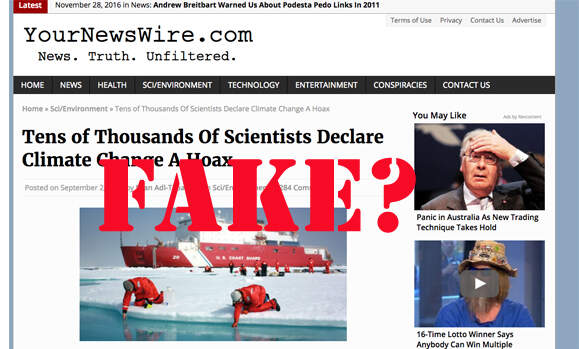
 "The most popular climate change story across social media in the past six months used a debunked survey from the late 1990s to claim that “tens of thousands of scientists” had declared global warming a “hoax”, a DeSmog analysis has found.


Fake News example

Published on YourNewsWire, the story was shared, clicked or “liked” 557,000 times on social media, with 555,000 of those engagements from Facebook. The story's author worked for many years with UK conspiracy theorist David Icke.

DeSmog used the social media analytics tool BuzzSumo to find the most popular climate stories globally over the last six months, using the search term “climate change”.

The YourNewsWire story appears on a site mixed with stories about aliens, conspiracy theories, and anti-Clinton rhetoric together with some serious news. The story was shared on Facebook three times as much as the second most popular article, published by the LA Times.

The LA Times article, from November, reported the comments of California Governor Jerry Brown, who warned President-elect Donald Trump his state would not walk away from its climate change commitments."

Pic from a Change.org petition about Fake News
...................


"Debunked Oregon Petition

The YourNewsWire story ran under the headline: “Tens of Thousands Of Scientists Declare Climate Change A Hoax” and is a mish-mash of old debunked talking points together with content from other websites also claiming climate change is a hoax.

The intro to the story reads: “A staggering 30,000 scientists have come forward confirming that man-made climate change is a hoax perpetuated by the elite in order to make money.”

The story only briefly references the source for the “30,000 scientists” claim which is, in fact, a survey released 18 years ago known as the Oregon Petition.

An analysis of the petition has found only 39 of the 31,000 signatories actually had a relevant climate science qualification.

Much of the content of the YourNewsWire story was cut and pasted from an article published three days earlier on the website Natural News.

That story, shared more than 80,000 times, ran with the headline: “Over 30,000 scientists say 'Catastrophic Man-Made Global Warming' is a complete hoax and science lie.”

 Go to the complete DeSmog article


Related: European Thinktanks Repeating ‘Well-worn’ US Climate Denial Tropes (excerpt): DeSmog


 #fakenews,fake news,climate change deniers,Facebook page,climatescience,#fossilfuelcompanies,climate change disinformation,


Monday, 21 September 2020

"Only 16% of Americans realize that the consensus is above 90%." (excerpt): Skeptical Science

 "Expert consensus is a powerful thing. People know we don’t have the time or capacity to learn about everything, and so we frequently defer to the conclusions of experts. It’s why we visit doctors when we’re ill. The same is true of climate change: most people defer to the expert consensus of climate scientists. Crucially, as we note in our paper:

Public perception of the scientific consensus has been found to be a gateway belief, affecting other climate beliefs and attitudes including policy support.

That’s why those who oppose taking action to curb climate change have engaged in a misinformation campaign to deny the existence of the expert consensus. They’ve been largely successful, as the public badly underestimate the expert consensus, in what we call the “consensus gap.” Only 16% of Americans realize that the consensus is above 90%."


 Lead author John Cook explaining the team’s 2016 consensus paper.


Go to skepticalscience.com

Sunday, 13 September 2020

Scientists say they're being silenced by the government: from ABC Radio

"On RN Breakfast with Fran Kelly
scientists employed by government and industry had work "unduly modified
science or fiction


As the Morrison Government rushes to amend national environmental protection laws, scientists warn a growing number of their colleagues are being silenced.

A study by the Ecological Society of Australia claims a third of ecologists and conservation scientists employed by government and industry had work "unduly modified" and almost half of those working for government were blocked from releasing their findings.

Their treatment has renewed calls for the creation of an independent environmental agency, something the Coalition has ruled out.

scientists employed by government and industry had work "unduly modified
The scientific conspiracy!
Featured:
Don Driscoll, Professor in Terrestrial Ecology, Deakin University

Producer: Cathy Van Extel

Duration: 8min 57sec

Sunday, 30 August 2020

IPCC: the dirty tricks climate scientists faced in three decades since first report (excerpt): The Conversation

(Pics added by this blog)

As the evidence became ever more compelling, the attacks on scientists escalated.
Wildfire
..... "The path to the summit
The accumulation of carbon dioxide in the atmosphere, caused primarily by the burning of fossil fuels, had been worrying scientists since the 1970s. The discovery of the “ozone hole” above Antarctica had given atmospheric scientists enormous credibility and clout among the public, and an international treaty banning chlorofluorocarbons, the chemicals causing the problem, was swiftly signed. 

Greenhouse gases
The Reagan White House worried that a treaty on CO₂ might happen as quickly, and set about ensuring the official scientific advice guiding leaders at the negotiations was under at least partial control. So emerged the intergovernmental – rather than international – panel on climate change, in 1988.

Already before Sundsvall, in 1989, figures in the automotive and fossil fuel industries of the US had set up the Global Climate Coalition to argue against rapid action and to cast doubt on the evidence. Alongside thinktanks, such as the George Marshall Institute, and trade bodies, such as the Western Fuels Association, it kept up a steady stream of publishing in the media – including a movie – to discredit the science.

But their efforts to discourage political commitment were only partially successful. The scientists held firm, and a climate treaty was agreed in 1992. And so attention turned to the scientists themselves.

The Serengeti strategy

In 1996, there were sustained attacks on climate scientist Ben Santer, who had been responsible for synthesising text in the IPCC’s second assessment report. He was accused of having “tampered with” wording and somehow “twisting” the intent of IPCC authors by Fred Seitz of the Global Climate Coalition.

Wildfire
In the late 1990s, Michael Mann, whose famous “hockey stick” diagram of global temperatures was a key part of the third assessment report, came under fire from right-wing thinktanks and even the Attorney General of Virginia. Mann called this attempt to pick on scientists perceived to be vulnerable to pressure “the Serengeti strategy”.

As Mann himself wrote

Vote for your children's future
By singling out a sole scientist, it is possible for the forces of “anti-science” to bring many more resources to bear on one individual, exerting enormous pressure from multiple directions at once, making defence difficult. It is similar to what happens when a group of lions on the Serengeti seek out a vulnerable individual zebra at the edge of a herd."

Go to complete The Conversation article
by

Research Associate in Social Movements, Keele University

Related:  2020 is a Warning That Our Civilization is Beginning to Fall Apart (excerpt): Medium

#bigbusiness, #bushfires, #carbonstorage, #climatecriminals, #criminalesclimáticosdelacárcel, #climateemergency, #jailclimatecriminals, #jail the climate criminals, anti-science, climate science,

Saturday, 25 July 2020

Climate change talk has been around for 30 years. Where's the action? / ABC Radio National Excerpt


 "Since 2015, the world has seen its five hottest years on record. Much of the eastern part of the country has been gripped by drought.

A few summers ago, fires burnt parts of alpine Tasmania that hadn't burnt in a thousand years. Last year was the hottest year in Australia since records began — and we had the biggest bushfires in history."

Scientists have repeatedly warned that the effects of climate change would include more extreme weather.(Supplied: Gena Dray)
cambioclimatico, #criminalesclimáticosdelacárcel
Scientists have warned us about the dangers of 2 degrees of warming — at the moment, we're heading for more than that.(ABC News: Jordan Hayne)

'Scientists have spelt out this out repeatedly for 30 years, and environmental groups have championed the cause. But both made mistakes.

 For too long, scientists believed that the facts spoke for themselves, that all they had to do was get them out there. And the NGOs had a tendency come across as self-righteous, or guilt-trippy.

I was already on board — with me they were preaching to the choir — but I don't think they pulled in enough other people.

I want you to panic   Greta Thunberg
Climate Action Now
But here we are. After years of drought at home, and increasingly extreme weather all over the world, polling shows that most of us get it enough to think climate change is a problem and that we should do something about it.


And yet we've done very little. I want to know why. That's why I've made this series.

And yes, part of it turns out to be the fossil fuel industry. Part of it turns out to be that change is hard, and that it's been easier for politicians to do little, especially when they are themselves divided.

But part of it turns out to be you and me — our own psychology, the stuff that makes us human, means acting on climate change is hard to do.

Not that it can't be done — and there is hope. We'll get to that too. I hope you'll join me for Hot Mess."'

 By Richard Aedy for Hot Mess 
Richard Aedy has been a journalist for more than 30 years. He's been concerned about climate change for most of that time. He's been at Radio National since 1998. 


#drought, #wildfire, droughts, bushfire, science, climate science, Australia, #Australia, fossil fuel subsidies,  #climatejustice

Monday, 18 May 2020

Australia’s most senior former public servants and scientists reveal their anger about climate policy failure: ABC

"For more than 30 years, Australian politics has been grappling with climate change and the nation's most senior public servants have been there through it all.   

Usually they keep their thoughts private, rarely making a foray into public debate, even in retirement.   

Now, after the devastating "black summer" fire season, the former heads of the Office of Prime Minister and Cabinet and the Department of the Treasury, along with former chief scientists, have decided they can no longer stay silent. 

They believe there has been a colossal failure by politicians of all stripes to comprehensively tackle climate change.

These senior policy makers and scientific minds describe climate policy as perhaps the greatest public policy disappointment of their generation, and a story of power and personal ambition triumphing over the national interest.

Martin Parkinson, who served as secretary of the Department of Climate Change between 2007 and 2011, described politicians as "incapable of grappling with this".

"I don't know how many reports have been put in front of them," he said.

Monday, 30 December 2019

Stanford Researchers Have an Exciting Plan to Tackle The Climate Emergency Worldwide: Science Alert

Things are pretty dire right now. Giant swaths of my country are burning as I write this, at a scale unlike anything we've ever seen. Countless animals, including koalas, are perishing along with our life-supporting greenery. People are losing homes and loved ones.
These catastrophes are being replicated around the globe ever more frequently, and we know exactly what is exacerbating them. We know we need to rapidly make some drastic changes - and Stanford researchers have come up with a plan

Using the latest data available, they have outlined how 143 countries around the world can switch to 100 percent clean energy by the year 2050. 

This plan could not only contribute towards stabilising our dangerously increasing global temperatures, but also reduce the 7 million deaths caused by pollution every year and create millions more jobs than keeping our current systems.

The plan would require a hefty investment of around US$73 trillion. But the researchers' calculations show the jobs and savings it would earn would pay this back in as little as seven years.
"Based on previous calculations we have performed, we believe this will avoid 1.5 degree global warming," environmental engineer and lead author Mark Jacobson told ScienceAlert.

"The timeline is more aggressive than any IPCC scenario - we concluded in 2009 that a 100 percent transition by 2030 was technically and economically possible - but for social and political reasons, a 2050 date is more practical."

Here's how it would work. The plan involves transitioning all our energy sectors, including electricity, transport, industry, agriculture, fishing, forestry and the military to work entirely with renewable energy.

Jacobson believes we have 95 percent of the technology we need already, with only solutions for long distance and ocean travel still to be commercialised.

"By electrifying everything with clean, renewable energy, we reduce power demand by about 57 percent," Jacobson explained.
He and colleagues show it is possible to meet demand and maintain stable electricity grids using only wind, water, solar and storage, across all 143 countries.

These technologies are already available, reliable and respond much faster than natural gas, so they are already cheaper. There's also no need for nuclear which takes 10-19 years between planning and operation, biofuels that cause more air pollution, or the invention of new technologies.

"'Clean coal' just doesn't exist and never will," Jacobson says, "because the technology does not work and only increases mining and emissions of air pollutants while reducing little carbon, and their is no guarantee at all the carbon that is captured will stay captured."

The team found that electrifying all energy sectors makes the demand for energy more flexible and the combination of renewable energy and storage is better suited to meet this flexibility than our current system. 
This plan "creates 28.6 million more full-time jobs in the long term than business as usual and only needs approximately 0.17 percent and approximately 0.48 percent land for new footprint and distance respectively," the researchers write in their report.

Building the infrastructure necessary for this transition would, of course, create CO2 emissions. The researchers calculated that the necessary steel and concrete would require about 0.914 percent of current CO2 emissions. But switching to renewables to produce the concrete would reduce this.

With plans this big there are plenty of uncertainties, and some inconsistencies between databases. The team takes these into account by modelling several scenarios with different levels of costs and climate damage.

"You're probably not going to predict exactly what's going to happen," said Jacobson. "But there are many solutions and many scenarios that could work."

Technology writer Michael Barnard believes the study's estimates are quite conservative - skewing towards the more expensive technologies and scenarios.
"Storage is a solved problem," he writes for CleanTechnica. "Even the most expensive and conservative projections as used by Jacobson are much, much cheaper than business as usual, and there are many more solutions in play."

The authors of the report stress that while implementing such an energy transition, it is also crucial that we simultaneously tackle emissions coming from other sources like fertilisers and deforestation.

This proposal could earn push-back from industries and politicians that have the most to lose, especially those with a track record of throwing massive resources at delaying our progress towards a more sustainable future. Criticisms of the team's previous work have already been linked back to these exact groups

But "the costs of transitioning have dropped so low, transitions are occurring even in places without policies," said Jacobson. "For example, in the US, 9 out of the 10 states with the most wind power installed are Republican-voting states with few or no policies promoting wind power."

Over 60 countries have already passed laws to transition to 100 percent renewable electricity by between 2020 and 2050. This guide can give them and other countries an example of how this can practically be done.

"There's really no downside to making this transition," Jacobson explained to Bloomberg. "Most people are afraid it will be too expensive. Hopefully this will allay some of those fears."

At least 11 independent research groups agree this type of transition is possible, including energy researchers Mark Diesendorf and Ben Elliston from University of New South Wales, Australia.

They reviewed major criticisms of 100 percent renewable energy transition plans and concluded "the principal barriers to [100 percent renewable electricity systems] are neither technological nor economic, but instead are primarily political, institutional and cultural."

So, multiple lines of evidence insist we have the technology, resources and knowledge to make this possible. The only question is, can enough of us put aside our fears and ideologies to make it happen?

"The biggest risk is that the plans are not implemented quickly enough," Jacobson said. "I hope people will take these plans to their policymakers in their country to help solve these problems."
The report has been published in the journal One Earth; more details for individual countries can be found here.

TESSA KOUMOUNDOUROS
27 DEC 2019


#jailclimate criminals 

See also:

Sick of compromises and wary of those who suggest compromise

Thursday, 26 December 2019

If the Climate Change Crisis were World War II, it’s 1939: Medium

"The question is really, as Superchunk observed, “how fast?” Can we make this transition in time to prevent clathrate collapse or the popping of Yellowstone park? How many billions will die from famine, disease, water-shortages and toxic air pollution before we clean up the place? How many need to die before head-in-the-sand deniers get out of the way of those of us trying to make a difference?

To me a “climate emergency” means a war footing; and that means waging war against the deniers first, as they are the real obstacle. I’d be very happy to see a lot of our current senior political and corporate leaders hauled up in The Hague and charged with crimes against humanity, and I’d regard that as entirely appropriate. But that’s a fantasy and is, alas, unlikely to happen.

In various countries citizens are resorting to the courts to force their governments into action, and that’s certainly a pathway to progress in places where laws are designed to enforce the rights of ordinary people, rather than simply there to block action against climate change.

The sad truth is that almost no-one really believes that global warming, and the myriad other issues that stem from humanity’s abuse of the planet, are truly anything to get too worried about.

Most people I know, even those who completely accept that climate change is real and happening, continue to act as if they believe, deep-down, despite what they say, that the risks are overstated and, if impacts are going to be felt, they’ll be felt by other people and way in the distant, to them, future.

People may say that they accept the science, but they act as if they
don’t. A lot of people subscribe to a kind of magical thinking, wherein some hitherto undreamed of technological fix will just make the whole problem go away, so we can just continue polluting.

The emergency is upon us. We must urgently and radically change the way we generate power, fuel, and food, while putting in place adaptation measures to deal with the global warming already locked into the planetary system. If we do hit the runaway global warming tipping point, then no amount of adaptation will be possible. But simply explaining the facts clearly is usually written off as being alarmist. And that’s the core of the climate crisis."


See also

Climate change is a health emergency, RACGP declares: News GP

How Scientists Got Climate Change So Wrong: NYT


For decades, most scientists saw climate change as a distant prospect. We now know that thinking was wrong. This summer, for instance, a heat wave in Europe penetrated the Arctic, pushing temperatures into the 80s across much of the Far North and, according to the Belgian climate scientist Xavier Fettweis, melting some 40 billion tons of Greenland’s ice sheet.

Tuesday, 12 November 2019

Thousands Of Scientists Declare A Climate Emergency

It's only Tuesday, but more than 11,000 scientists around the world have come together to declare a climate emergency. Their paper, published Tuesday in the journal Bioscience, lays out the science behind this emergency and solutions for how we can deal with it.

Scientists aren’t the first people to make this declaration. A tribal nation in the Canadian Yukon, the U.K., and parts of Australia have all come to the same grim conclusion. 

In the U.S., members of Congress have pushed the government to do the same, but y’know, they got Donald Trump. Ain’t shit happening with that fool in office. Anyway, this proclamation from scientists is significant because they’re not doing it out of a political agenda or as an emotional outcry. They’re declaring a climate emergency because the science supports it.

Read the article 

 Related:

Just 20 Companies Are Responsible for 35% of All Greenhouse Gas Emissions: Medium


#criminales climáticos de la cárcel

#criminalesclimáticosdelacárcel

#jailclimatecriminals

#gaolclimatecriminals

Thursday, 10 October 2019

There are three types of climate change denier, and most of us are at least one: ABC

"Last week, amid the cacophony of reactions to Greta Thunberg's appearance before the United Nations Climate Action Summit, a group of self-proclaimed "prominent scientists" sent a registered letter to UN Secretary-General Antonio Guterres. 

The letter, headed "There is no climate emergency", urged Guterres to follow:
"…a climate policy based on sound science, realistic economics and genuine concern for those harmed by costly but unnecessary attempts at mitigation."
The group, supported by 75 Australian business and industry figures, along with others around the world, obviously rejects the scientific consensus on climate change. 

But this missive displays remarkably different tactics to those
previously used to stymie climate action.

The language of climate change denial and inaction has transformed. 

Outright science denial has been replaced by efforts to reframe climate change as natural, and climate action as unwarranted.

However, this is just another way of rejecting the facts, and their implications for us. Denial can take many forms."

Read the complete ABC NEWS article 

See also:

How the Climate Kids Are Short-Circuiting Right-Wing Media: NYT

Thursday, 16 May 2019

A Postmortem for Survival: on science, failure and action on climate change


CO2 Reading April 21, 2019
Failing to learn from past mistakes is the only truly unforgivable mistake in science. And on climate change, the scientific community (by and large) has been criminally negligent when it comes to observing — and especially learning from — its own track record. This blog post is a postmortem in 4 acts: an anatomy of failure, so that we can hopefully learn, act and change. Fast.

Act 1: Science as success

Let’s get one thing out of the way, shall we? The physical science of climate change has been a resounding, phenomenal, triumphant success. As a colleague from the University of Leeds recently put it, “We’ve been right for decades.” This makes the Intergovernmental Panel on Climate Change first Working Group (on the physical science) assessment reports an absolute dawdle to write up: “Still right!” [That’s a joke, by the way. There are always absolute stacks of new science to report on: just the large lines of it have not budged at all.] So there is not much to learn from there in terms of failure. Well done, physical scientists, you’ve observed & modeled external reality. You aced the case.


S
 Related:

DESMOG: Renewables Offset 35 Times More CO2 Every Year Than All Carbon Capture Projects Ever, New Analysis Finds


Climate Change perceptions


Friday, 22 March 2019

Rolling Stone: Journey to Antarctica: What Scientists Think of Trump’s Latest Climate Tweet “You like carbon dioxide so much?” one researcher mused. “Try putting a plastic bag over your head and see how that works out.”

Pic from NY Post

"To scientists in Antarctica, President Trump is weirder than a sea pig. On Tuesday, Trump tweeted a quote from Patrick Moore, a well-known climate denier who claims to have been a co-founder of Greenpeace. (He wasn’t, and Greenpeace has disavowed him as a “paid lobbyist.”) “The whole climate crisis is not only Fake News, it’s Fake Science,” Trump quoted Moore as saying on an episode of Fox & Friends."
 
"I showed Trump’s tweet to Larter on my iPhone. As he read it, he smiled slightly and shook his head. “It’s crazy talk,” said Larter, who is British. “Do any Americans really believe that stuff?”"

Read the Rolling Stone Article


Tuesday, 5 March 2019

The worst-case scenario

#global warming  #climate change  climatechange  globalwarming  sealevelrise
Vote for my future climate

"Stephen Schneider explores what a world with 1,000 parts per million of CO 2 in its atmosphere might look like."

.... "Fairness must also be taken into account, given that some people would be at much greater risk than others: poor people in hot countries with little adaptive capacity, for instance, indigenous peoples and those exposed to hurricanes or wildfires, or living in low-lying areas. The elderly and children with asthma or other lung ailments would be particularly affected by urban air pollution or wildfire smoke plumes exacerbated by the extreme warming.


The economic outlook is no better. With warming of just 1–3 °C, projections show a mixture of benefit and loss. More than a few degrees of warming, however, and aggregate monetary impacts become negative virtually everywhere; and in a 1,000 p.p.m. scenario current literature suggests the outcomes would be almost universally negative and could amount to a substantial loss of gross domestic product. Millions of people at risk from flooding and
water supply problems would provide further economic challenges." ...
.