An
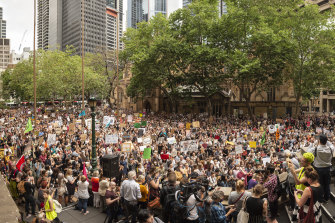
estimated 20,000 protesters marched from Town Hall to Hyde Park on
Wednesday evening, taking over George Street to demand stronger climate
action as bushfires continue to rage across the state.
The event,
titled "NSW is Burning, Sydney is Choking - Climate Emergency Rally!",
was swiftly set up on Facebook last week by Extinction Rebellion, Uni
Students for Climate Justice, and Greens MP David Shoebridge, in response to horrendous air conditions and ongoing bushfires across the state.
Thousands of protesters gathered at Town Hall on Wednesday.Credit:Wolter Peeters
Buses
were diverted away from Elizabeth Street and Park Street because of the
march, with some buses delayed by up to 30 minutes and more than 60 routes affected.
After
a series of speeches, the crowd began marching down York Street at
6.40pm, before turning onto Park Street and heading east towards
Elizabeth Street and Hyde Park.
NSW Police Inspector Gary Coffey said "it’s a very big crowd", and later told the Herald there were an estimated 20,000 people in attendance.
Chloe Rafferty, one of the organisers, said she was angry about the lack of climate action from all levels of government.
"The
state is angry, Sydney is angry," she said. "I have hope that people
will see the need to take action into their own hands and disrupt
business as usual, we can't let the biggest city in Australia having
hazardous air quality become the new normal."
High school student
Amy Lamont addressed the thousands of protesters wearing P2 face masks
and said: "The reality is these fires will be around all summer."
"The
rage we all rightly feel right now needs to grow if we have any chance
of actually challenging that destruction of the status quo that is
burning around us," she said.
"Only we, the majority, have the ability to hold the rich and political elites in this country accountable.
"Students shouldn't have to worry when going to school that they might come back to a burnt home."
David Whitson has been attending protests dressed as a koala since October.
"When you talk about silent Australians, I don’t think of anything more silent than our beloved flora and fauna," he said.
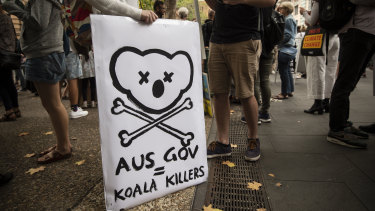
The loss of wildlife, especially Koala Bears, were the focal point for this protest sign.Credit:Wolter PeetersHe
said he thought bushfires would occur early next year, but "it’s caught
everyone by surprise how early and severe the fires are".
Fire
Brigade Employees Union state secretary Leighton Drury has been a
firefighter for 20 years and said the fires ravaging NSW are the "worst
we’ve had in decades".
"I was in Switzerland recently and discovered that they
haven’t had any landfill since the early 2000s, because all of their
waste is either recycled or incinerated to produce electricity. How
“green” is it to incinerate waste in order to produce electricity? Is it
something New Zealand should consider, so that 1) we have no more
landfill, and 2) we can replace our fossil-fuel power stations with
power stations that incinerate waste?
Burning rubbish to generate electricity or heat sounds great: you get
rid of all your waste and also get seemingly “sustainable” energy. What
could be better?
Many developed countries already have significant “waste-to-energy”
incineration plants and therefore less material going to landfill
(although the ash has to be landfilled). These plants often have
recycling industries attached to them, so that only non-recyclables end
up in the furnace. If it is this good, why the opposition?
Here are seven reasons why caution is needed when considering waste-to-energy incineration plants.
Waste-to-energy plants require a high-volume, guaranteed waste stream
for about 25 years to make them economically viable. If waste-to-energy
companies divert large amounts of waste away from landfills, they need
to somehow get more waste to maintain their expensive plants. For
example, Sweden imports its waste from the UK to feed its “beasts”.
The waste materials that are easiest to source and have buyers
for recycling - like paper and plastic - also produce most energy when
burned.
Waste-to-energy destroys innovation
in the waste sector. As a result of China not accepting our mixed
plastics, people are now combining plastics with asphalt to make roads
last longer and are making fence posts that could be replacing treated
pine posts (which emit copper, chrome and arsenic into the ground). If a
convenient waste-to-energy plant had been available, none of this would
have happened.
Waste-to-energy reduces jobs.
Every job created in the incineration industry removes six jobs in
landfill, 36 jobs in recycling and 296 jobs in the reuse industry.
Waste-to-energy works against a circular economy, which tries to
keep goods in circulation. Instead, it perpetuates our current
make-use-dispose mentality.
Waste-to-energy only makes marginal sense in economies that
produce coal-fired electricity – and then only as a stop-gap measure
until cleaner energy is available. New Zealand has a green electricity
generation system, with about 86% already coming from renewable sources
and a target of 100% renewable by 2035, so waste-to-energy would make it a less renewable energy economy.
Lastly, burning waste and contaminated plastics creates a greater
environmental impact than burning the equivalent oil they are made
from. These impacts include the release of harmful substances like
dioxins and vinyl chloride as well as mixtures of many other harmful
substances used in making plastics, which are not present in oil.
European countries were driven to waste-to-energy as a result of a 2007 directive that imposed heavy penalties
for countries that did not divert waste from landfills. The easiest way
for those countries to comply was to install waste-to-energy plants,
which meant their landfill waste dropped dramatically. New Zealand does not have these sorts of directives and is in a
better position to work towards reducing, reusing and recycling
end-of-life materials, rather than sending them to an incinerator to
recover some of the energy used to make them.
Is New Zealand significantly worse than Europe in managing waste?
About a decade ago, a delegation from Switzerland visited New Zealand
Ministry for the Environment officials to compare progress in each of
the waste streams. Both parties were surprised to learn that they had
managed to divert roughly the same amount of waste from landfill through
different routes.
This shows that it is important New Zealand doesn’t blindly follow
the route other countries have used and hope for the same results. Such
is the case for waste-to-energy.
There is also an argument to be made for current landfills. Modern,
sanitary landfills seal hazardous materials and waste stored over the
last 50 years presents future possibilities of landfill mining.
Many landfills have higher concentrations of precious metals,
particularly gold, than mines and some are being mined for those
metals. As resources become scarcer and prices increase, our landfills
may become the mines of the future.
Let’s stop calling this the Sixth Great Extinction. Let’s start calling it what it is: the “first great extermination”. A recent essay
by the environmental historian Justin McBrien argues that describing
the current eradication of living systems (including human societies) as
an extinction event makes this catastrophe sound like a passive
accident.
While we are all participants in the first great extermination, our
responsibility is not evenly shared. The impacts of most of the world’s
people are minimal.
Even middle-class people in the rich world, whose effects are
significant, are guided by a system of thought and action that is shaped
in large part by corporations.
The Guardian’s polluters
series reports that just 20 fossil fuel companies, some owned by
states, some by shareholders, have produced 35% of the carbon dioxide
and methane released by human activities since 1965. This was the year
in which the president of the American Petroleum Institute told his
members that the carbon dioxide they produced could cause “marked
changes in climate” by the year 2000. They knew what they were doing. Even as their own scientists warned that the continued
extraction of fossil fuels could cause “catastrophic” consequences, the
oil companies pumped billions of dollars into thwarting government action. They funded thinktanks and paid retired scientists and fake grassroots organisations to pour doubt and scorn on climate science.
They sponsored politicians, particularly in the US Congress, to block
international attempts to curtail greenhouse gas emissions. They
invested heavily in greenwashing their public image.
These efforts continue today, with advertisements by Shell and Exxon that create the misleading impression that they’re switching from fossil fuels to renewable energy. In reality, Shell’s annual report
reveals that it invested $25bn in oil and gas last year. But it
provides no figure for its much-trumpeted investments in low-carbon
technologies. Nor was the company able to do so when I challenged it.
Environmental lawyers have made a formal complaint against oil giant BP, claiming its latest advertising campaign is misleading consumers about its commitment to tackling climate change.
The challenge, filed today by legal campaign group ClientEarth, is
the first time a complaint has been made about a fossil fuel company’s
alleged greenwashing under international corporate rules.
ClientEarth has also launched a petition calling for a ban on all fossil fuel advertising unless it comes with a tobacco-style health warning.
The complaint focuses on BP’s ‘Keep Advancing’ and ‘Possibilities Everywhere’ campaigns — its biggest marketing blitz
since before the Deepwater Horizon disaster in 2010. Adverts are
currently being shown across billboards, newspapers and television in
the UK, US and Europe as well as online.
ClientEarth climate lawyer Sophie Marjanac described the campaigns as
a “smokescreen”, echoing criticism earlier this year that labelled BP’s approach as “deceptive and hypocritical”.
"Climate-fuelled
disasters have forced about 20 million people a year to leave their
homes in the past decade, according to a new report from Oxfam.
This
equates to one every two seconds - making the climate the biggest
driver of internal displacement for the period, with the world's poorer
countries at the highest risk, despite their smaller contributions to
global carbon pollution compared to richer nations.
People
are seven times more likely to be internally displaced by floods,
cyclones and wildfires than volcanic eruptions and earthquakes, and
three times more likely than by conflict, according to the report
released today."
"Nobody
has been prepared to talk about money and so that's one of the critical
issues that will be on the table in Madrid," said Gore.
"Ultimately
somebody is going to have to pay the price for these impacts and at the
moment that price is being paid by the poorest communities in the
world."
And while current data shows lower risk in developed nations, projections suggest that is set to change.
"Rich countries are not immune either from the threat of displacement," said Gore.
"Climate change is not going to discriminate."
Bob
Ward, policy director at the Grantham Research Institute on Climate
Change and the Environment, told CNN that increasing numbers of
internally displaced people can be attributed in part to a growing
population living in high-risk areas."
There is a wealth of companies from which to choose
In my article Winning at Climate Change Investing,
I broke down the different technology stages for companies involved in
this business into Evolutionary Applications, Novel Adaptations, and
Revolutionary Developments. I have written about a company
that I believe to be just on the cusp between a Novel Adaptation and a
Revolutionary Development: Carbon Engineering. Today, I wanted to focus
my attention on a few companies in the Evolutionary Application
category.
These are companies that are improving present products or processes to allow current systems to operate more efficiently.
One company at which I have been looking is Shiloh Industries SHLO. This is a small-cap name that focuses on material sciences and design changes to specialize in creating strong, lightweight auto components.
While this may not strike you as a climate change related business, by
decreasing the weight of automobiles, fuel-efficiency is improved for
gas-powered vehicles and range increases for electric ones.
Australia has suffered a devastating early bushfire season with fires
across several states burning through hundreds of thousands of hectares
and destroying hundreds of properties with the loss of six lives.
New South Wales has been the most severely hit, with more than 1.65m
hectares razed, an area significantly larger than suburban Sydney. All
six deaths occurred in there and more than 600 homes were destroyed. At one point firefighters were battling a fire front about 6,000km long, equivalent to a return trip between Sydney and Perth.
In Queensland, 20 homes have been lost and about 180,000ha burned. In
Victoria, where the bushfire season usually starts later, 100km/h winds
fanned more than 60 blazes during an unprecedented heatwave on Thursday.
The most extreme warning, a code red, was issued for the north-western
and central regions. The state’s emergency services minister, Lisa
Neville, compared it to “the worst conditions you’d see in February or
March”.