Tuesday, 4 August 2020

Leadership on climate needed: CSIRO report : Canberra Times (excerpt)


In a technical report about the 2019-20 bushfires commissioned by Prime Minister Scott Morrison, the CSIRO warned climate and disaster risks were growing across Australia. 
The report, tendered to the Royal Commission into National Natural Disaster Arrangements on Monday, described many of the risks as systemic which required "coordinated, system-wide responses beyond emergency and disaster management to address".
"There is growing demand - from society and the financial services
and disaster management sectors in particular - for coordinated action across all economic sectors, government portfolios and levels of decision making to mitigate climate and disaster risks, build resilience and adapt to change," CSIRO said.


#jail climate criminals   #cambioclimatico
Erosion caused by sea level rise
"There are opportunities for a more harmonised, coordinated and collective approach which are hampered by under-developed, fragmented or uncoordinated awareness, understanding, and approaches to 'systemic risk' assessment and management in Australia."


However the high levels of "contestation and disinformation" about climate change meant there were "low levels of public understanding" of the causes and effects of climate and disaster risks. 

Read the complete Canberra Times Aug 4 article by Katie Burgess 


See also:

Names and Locations of the Top 100 People Killing the Planet: The Decolonial Atlas


Sunday, 2 August 2020

There is an answer to post Covid-19 economic chaos.

Before the Covid-19 pandemic, climate change was the significant factor looming to ruin unprepared economies. Now that world economies are in deep depression it is 'green new deals' that can provide jobs in the future.


#cambio-climatico  #climatechange   #economies  #greennewdeal
When investors start to take notice of 'climate change'.


"The Climate Council’s report, ‘Compound Costs: How Climate Change is Damaging Australia’s Economy’, finds there are few forces affecting the Australian economy that can match the scale, persistence and systemic risk associated with climate change."

"As the Deputy Governor of the Reserve Bank of Australia noted, the risks that climate change poses to the Australian economy are “ first order” and have knock-on implications for macroeconomic policy (Debelle 2019)."

https://www.climatecouncil.org.au/resources/compound-costs-how-climate-change-damages-australias-economy/


We have a few years to mitigate the worst effects of climate change.
Climate Change is Real but Time is Running Out


"5. The severe costs of climate change outlined in this report are not inevitable. To avoid the costs of climate change increasing exponentially, greenhouse gas emissions must decline to net zero emissions before 2050. Investments in resilience and adaptation will be essential to reduce or prevent losses in the coming decades.


• Increasing resilience to extreme weather and climate change should become a key component of urban planning, infrastructure design and building standards.

• Buildings and infrastructure must be built to withstand future climate hazards and to facilitate the transition to a net zero emissions economy. 

• A credible national climate policy is needed to safeguard our economy by reducing the direct costs of climate change, and avoiding economic risks associated with a sudden, disruptive or disorderly transition to net zero emissions. "      https://www.climatecouncil.org.au/resources/compound-costs-how-climate-change-damages-australias-economy/


"3. The property market is expected to lose $571 billion in value by 2030 due to climate change and extreme weather, and will continue to lose value in the coming decades if emissions remain high.

• One in every 19 property owners face the prospect of insurance premiums that will be effectively unaffordable by 2030 (costing 1% or more of the property value per year). 

• Some Australians will be acutely and catastrophically affected. Low-lying properties near rivers and coastlines are particularly at risk, with flood risks increasing progressively and coastal inundation risks emerging as a major threat around 2050.

• Certain events which are likely to become more common because of climate change are not covered by commercial insurance, including coastal inundation and erosion. 
• More than $226 billion in commercial, industrial, road, rail, and residential assets will be at risk from sea level rise alone by 2100, if greenhouse gas emissions continue at high levels. "   
     https://www.climatecouncil.org.au/resources/compound-costs-how-climate-change-damages-australias-economy


"Extreme events like droughts, heatwaves, cyclones and floods have an impact on agriculture and food production; this is already affecting Australia’s economy and will cost us much more in the future."

https://www.climatecouncil.org.au/resources/compound-costs-how-climate-change-damages-australias-economy


“We will pay for climate breakdown one way or another, so it makes sense to spend the money now to reduce emissions rather than wait until later to pay a lot more for the consequences… It’s a cliché, but it’s true: An ounce of prevention is worth a pound of cure.” 
Nobel Prize-winning economist Joseph Stiglitz, a professor at Columbia University


#jailclimatecriminals  #criminalesclimáticosdelacárcel
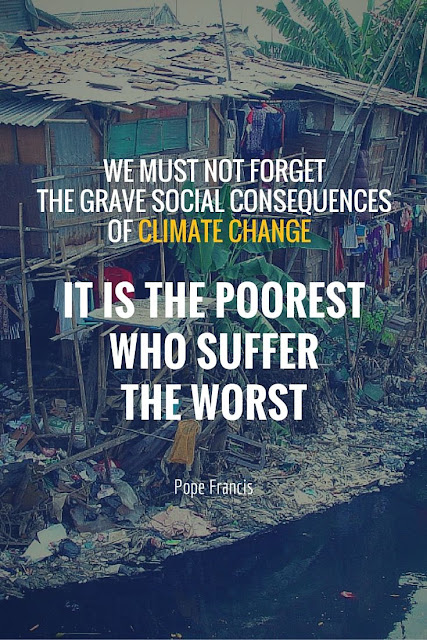
Climate Change will affect the poor the most.


Rewiring America says: "This real–world experience (WW3) illustrates the employment potential of a rapid transition to a clean energy economy. Probably the only viable project of the scale necessary to reignite economic growth and return to full employment is decarbonizing America’s energy system.This is equally true in many other countries in the world.Rewiring America

"Increasing employment under the transition to a zero–carbon is driven by the requirement for more labor in manufacturing, installation, and maintenance of renewables than their counterpart fossil fuel technologies. 

It takes more people to install and keep a wind farm running than it does to drill a well and keep it pumping for the same amount of energy overtime. Renewables get their fuels for free, whereas fossil fuels cost money. It takes more labor and maintenance to access those free renewable fuels. This is a very desirable trade off in an economy with massive unemployment." 
Rewiring America
 

The Guardian


Related: Seizing the moment: how Australia can build a green economy from the Covid-19 wreckage : The Guardian (excerpt)


Related: Is your local government body climate change ready?


#jailclimatecriminals   #gaolclimatecriminals   #climatescience   #economy  

#Australia, #cambio-climatico, #climateaction, #economy, #criminalesclimáticosdelacárcel, #fossilfuelcompanies, #greennewdeal, 


Saturday, 1 August 2020

Seizing the moment: how Australia can build a green economy from the Covid-19 wreckage : The Guardian (excerpt)

Solar farm in Darling Downs, Queensland. The idea of helping jumpstart the economy by also tackling the climate crisis is gaining currency across the political spectrum. Photograph: AAP


"Detailed research by the Grattan Institute suggests an Australian green steel industry could create 25,000 jobs in regional areas that now rely on coalmining, offering a potential path ahead for workers likely to be hardest hit by international steps to cut emissions. 

Among the report’s conclusions: “Australian governments need to be honest with carbon workers: their attempts to protect carbon jobs from global forces will ultimately fail.”
In one of the most challenging areas to address, the faltering aluminium industry, Simon Holmes à Court, a senior adviser to the Climate and Energy College at the University of Melbourne, is looking at how to give four large smelters, which use up to 15% of electricity from the national grid, a viable future in a renewable energy world. He says technology originally developed in Australia could give them the ability to rapidly dial up or down the amount of energy they consume, turning them into a “virtual battery” that helps stabilise the grid and provides an extra income stream to owners.

Garnaut says the economic crash only strengthens the case that he laid out late last year in his book Superpower – that Australia could have an affordable clean electricity system running at more than three times its existing capacity powering a transformed economy, including new minerals industries.

The former government climate adviser, now a professorial fellow at the University of Melbourne, says entrenched low interest rates should increase the pace at which renewable energy replaces coal, as capital costs are down and the fuel used in clean power generation costs nothing. Among Garnaut’s messages is that governments should not fear taking on greater debt to fuel a low-carbon recovery that could include new or expanded clean industries in hydrogen, aluminium, steel, silicon and ammonia.
Wilder says there is cause to be optimistic. “Ironically, this crisis has pushed climate change to the fore in discussions of the economy around the globe,” he says.


There is now significant acceptance that climate change is a threat to the economy. And there is an opportunity to rebuild in a way that makes the economy more resilient, if we choose to take it.' "

Go to The Guardian article 

Related:

Gas lobby seizes Covid moment, and declares war on Australia’s future: RenewEconomy

#cambio-climatico, #Australia, #climatechange, #greennewdeal, #greenrecovery, #jailclimatecriminals, steel industry, 

Friday, 31 July 2020

New gas-fired power not needed as renewable energy expands, grid operator says : The Guardian

#jailclimatecriminals  #climatechange
A day in 2014: Renewable Energy
 A roadmap for an optimal electricity market suggests gas prices will need to stay low to compete with alternatives on renewable grid.


New gas-fired power is not essential for a grid increasingly based on renewable energy, and gas prices will need to stay low if it is to compete with alternatives, according to the government agency responsible for the electricity system.

a range of “dispatchable” power sources that can be turned on and off when needed.
Solar Power is cheaper
The Australian Energy Market Operator (Aemo) has released a roadmap detailing what an optimal national electricity market would look like to 2040 if it was designed with a focus on security, reliability and the lowest cost for consumers.

Its integrated system plan, the result of 18 months consultation and analysis, describes a diverse system built on large and small-scale renewable energy supported by a range of “dispatchable” power sources that can be turned on and off when needed.

Read the complete The Guardian article

Related:

Australian Government sued by 23-year-old Melbourne student over financial risks of climate change: ABC NEWS


methane gas, greenhouse gases, energy plan, energy storage, 

#jailclimatecriminals, #Australia, #cambio-climatico, #climatechange, #economy, 


Thursday, 30 July 2020

The verdict from bushfire experts: there's no sidestepping climate: SMH

A week before Christmas last year, five of my fellow veteran fire and emergency chiefs and I held a press conference as fires ravaged Australia’s east coast. Appalled by the utter lack of leadership from Canberra in supporting bushfire response efforts, we took matters into our own hands.

We announced that 33 retired fire and emergency chiefs would convene a National Bushfire and Climate Summit to do what the federal government should have done: bring together everyone with a role to play in an effective bushfire response, and develop solutions to help protect Australians against the growing bushfire threat, fuelled by climate change.

Much has changed since then. The COVID-19 pandemic has turned life as we know it on its head, forcing us to take our summit online, but it did not change our commitment to finding solutions to improve Australia’s bushfire response, readiness, and recovery.
Our sense of urgency was fuelled by a simple truth that was echoed time and again in every session: climate change has pushed Australia into a new era of unprecedented bushfire risk, and our governments have underestimated the threat. This puts communities in danger.

The concern we felt was mirrored in the discussions at the summit, which brought together almost 200 experts including firefighters, bushfire survivors, economists, doctors, farmers, Indigenous cultural burning experts, economists, and many more.

In every session, there was a shared, palpable level of fear. Fear that the death and destruction of our Black Summer is now the benchmark for our periodic worst fire seasons. Fear that no matter what we do to fight such fires, fire seasons like our last will overwhelm every effort at control. Fear that some communities are now located in places that cannot be defended on the worst days. Fear that old approaches to fuel management are no match for fires that now burn so fast and intensely that they create their own dry thunderstorms and weather systems.

The biggest fear expressed, however, was that our national government will continue to ignore the urgent need to reduce greenhouse gas emissions and act on climate change, while supporting the opening of new fossil fuel projects that will worsen global warming.

The truth is abundantly clear: we need a fundamental rethink of how we plan, prepare for, respond to and recover from bushfires. Our Australian Bushfire and Climate Plan, with 165 practical recommendations resulting from summit discussions, is a good start.
But first, if we are to have any hope of coping with the increasing bushfire threat, we must deal with the underlying driver – by phasing out fossil fuels, banning new coal, oil, and gas projects, and reaching net zero emissions as fast as possible.

The remaining recommendations outline how we can better use the support capabilities of our defence forces, better resource our fire, emergency and land management agencies, increase fuel reduction, resource Indigenous cultural burning capabilities and improve insurance access. We also need a national strategy to deal with the health consequences of worsening bushfires.

We recommend new rapid fire-detection technology, new types of water-bombing aircraft and more remote-area fire teams to stop small fires becoming big ones.

There is also considerable emphasis on community support, and community-led solutions. This includes boosting mental health support for afflicted communities and firefighters, and community resilience hubs in every vulnerable local government area.
It is an ambitious plan, for a big problem, but who will pay for it? The summit concluded that fossil fuel companies, which drive the emissions-causing global warming and extreme weather, should pay a levy so Australia can build resilience to, and recover from, worsening climate disasters.

Monday, 27 July 2020

FirstEnergy Scandal is Latest Example of Utility Corruption, Deceit / DeSmog

By Matt Kasper, originally published at Energy and Policy Institute

 Federal agents arrested Ohio Speaker of the House Larry Householder, along with several lobbyists, on July 21 on charges that the group used $60 million of funds provided by the monopoly utility FirstEnergy Corp. in exchange for passing a law that bailed out that company’s nuclear and coal plants. 

The scandal is the latest example of monopoly utility companies deceiving lawmakers, regulators, and the public to enrich executives and shareholders, and occasionally being criminally investigated or prosecuted for their actions. Many instances of utility corruption center around attempts to change policies or regulations in ways that would increase electric bills – often to cover costs at expensive power plants, win approval to construct controversial power plants, or restrict the growth of rooftop solar power.

Read the full DeSmog article listing various allegations involving various lawmakers and energy companies. 

Related: Prepare for Economic Chaos

#jailclimatecriminals, #USA, #fossilfuelcompanies, #lawmakers, #climateaction, #economy, #renewables, 

Saturday, 25 July 2020

9 Ways to assist Australia's farmers with climate change

"Global warming affects agriculture in a number of ways, including through changes in average temperatures, rainfall, and climate extremes (e.g., heat waves); changes in pests and diseases; changes in atmospheric carbon dioxide and ground-level ozone concentrations; changes in the nutritional quality of some foods; and ..."

Climate change and agriculture - Wikipedia


.....................................


Climaste Council meme
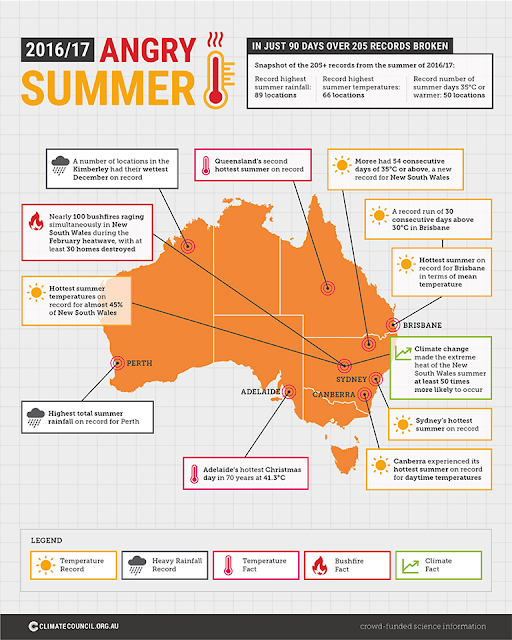
Angry Summer by The Climate Council


It is obvious that many farmers are going to be displaced because of climate change. As their usual crops become unviable and broad scale farming becomes uneconomical because of costs, it is impossible to continue to subsidise farmers that continue to farm or to graze unsuitable animals in an unsustainable fashion. Yet farmers need government support and Australia requires food production.

#jailclimatecriminals, #farmingpractices, #climatecrisis
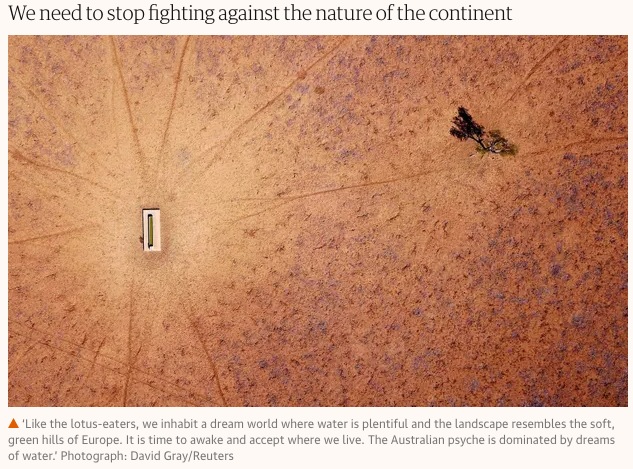
Australia must learn to manage with less surface water. Artesian water resources must be husbanded.

Suggested Actions

1. “What we still don’t have in the year 2019 is a national (Australian) strategy on climate change in agriculture. There’s still no actual framework to help farmers manage these risks and implement solutions,” she said. Verity Morgan-Schmidt, the chief executive of Farmers for Climate Action

2. Revitalise, with extra funding, our agricultural support services that have provided excellent research and development in the past, new crops and animal husbandry practices can be developed.

3. Provide education for farmers that demonstrate alternative farming practices, for example move from cattle to goats.

4. Only subsidise farmers that change their practice to accommodate a changing climate and protect our soils but retrain farmers unable to accommodate change.

5. Encourage small farming practices such as permaculture, greenhouse production, urban farms.

Note: Intensive farming practices have been shown to be as productive as industrial broad scale farming.

6.  Stop selling water off or subsidising in any way corporations that persist in growing water hungry crops such as cotton and almonds in water scarce areas.

7.  Protect our surface and artesian water from destructive and unsustainable industries.

8.  Support farmers to plan moves from floodplains or cope with more flooding. 


#jailclimatecriminals, #cambioclimatico
Droughts will occur more often. Soils will erode. Desertification will occur.


9.  Encourage farmers to 'get a yield' with new products.

" 'Agritourism, insect farming off waste resources, bush tucker foods — there are options out there, but it's not traditional agriculture in that sense.'

" 'We need support structures, new ideas, people helping us transition to these other production industries. ' "

She (Anika) believes the first step needs to come from the energy sector to buy more time for other industries to develop response strategies.

'The easiest way to put the brakes on what we are experiencing is to transition away from dirty fossil fuel energy to clean, renewable energy; that then takes the pressure off other industries.' "


An article by Preparations for Climate Change

See also:  Preparing for a Climate Change Health Crisis