Showing posts with label #Houston. Show all posts

Saturday, 5 September 2020

Choosing A Place To Retire? Factor In Climate Change (excerpt): Forbes


The hazards of wildfires and extreme heat are also intensifying due to climate change.
Hurricane damage
(Pics added by this blog)

"When Bill and Annemarie Kachur retired in early 2016, they saw no reason to go anywhere. The gray shingled bungalow in Myrtle Beach, S.C. had been their home for more than 15 years.

“I’ve been here so long, it’s a sense of roots now for me,” says Bill, 65, who spent his early career hopping around the country, working on-air at various radio stations. 

Plus, they were already in a haven for retirees. “I like the fact that there isn’t a winter,” says Annemarie, who’ll be 65 in September.
But in recent years, their idyllic spot about 2 ½ miles from the Atlantic Ocean has revealed an ominous side: hurricane season. “I just noticed that the last four or five years, we keep getting hammered,” recalls Bill.

Two Hurricane Evacuations Since 2016

Since 2016, the Kachurs have ridden out four hurricanes, including two evacuations to safer ground.

“Ten months out of the year, it’s great,” says Bill. “And then there’s a couple months out of the year when you’re walking on eggshells and you’re a little bit concerned about what’s blowin’ in the wind, so to speak.” 

Warm, beachy spots on the Atlantic, Pacific and Gulf Coasts have been retirement magnets for decades. But, as Hurricane Laura just underscored, they’re also squarely in the crosshairs of the changing climate, effects of which are already evident in many of the nation’s most popular retirement destinations.
The hazards of wildfires and extreme heat are also intensifying due to climate change.
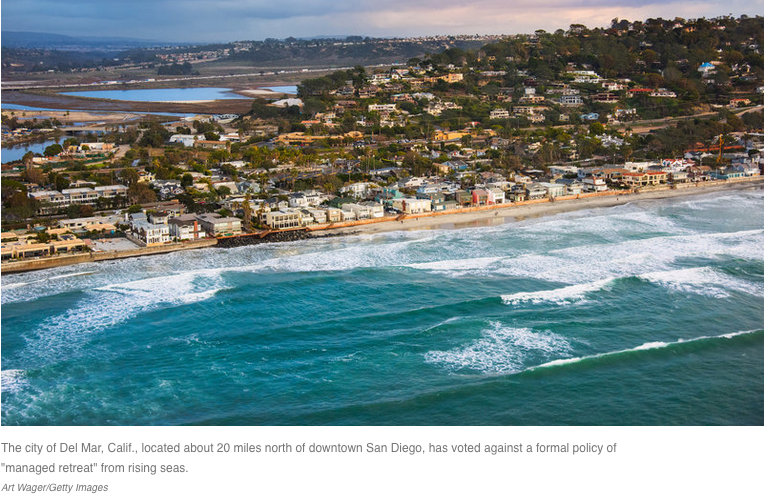
Planned retreat from rising seas


Climate Change and Retirement Location Decisions

“Current climate and future climate is absolutely something that people should be thinking about when deciding where to live, where to retire,” advises Radley Horton, a climate scientist at Columbia University’s Earth Institute, who has focused on climate adaptation strategies. “Those are absolutely critical concerns when you think about impacts directly on the home, but also livability outdoors — things like critical infrastructure, too,” says Horton.

The hazards of wildfires and extreme heat are also intensifying due to climate change.
Californian Wildfires
Rising seas are threatening things we tend to take for granted in many areas, like major freeways, airports and sewage treatment plants. The hazards of wildfires and extreme heat are also intensifying due to climate change."

Where then to retire to? : Read complete Forbes article: By Craig Miller, Science Journalist

Related: Port Macquarie after a 7m sea level rise. Insurance risks affect property values now.

Related: 'Retreat' Is Not An Option As A California Beach Town Plans For Rising Seas: NPR

hurricanes, #searise, #bushfires, property values, insurance, #America, #Australia, #Houston, #wildfire,  

Friday, 7 August 2020

This Is Inequity at the Boiling Point: The Conversation (excerpt)


https://www.nytimes.com/interactive/2020/08/06/climate/climate-change-inequality-heat.html?campaign_id=3&emc=edit_MBAU_p_20200806&instance_id=21045&nl=morning-briefing&regi_id=94643053&section=backStory&segment_id=35452&te=1&user_id=8e8e563fc4e5a5c16b6b437d6b7137af
Heatwaves

"This Is Inequity at the Boiling Point


It was a record 125 degrees Fahrenheit in Baghdad in July, and 100 degrees above the Arctic Circle this June. Australia shattered its summer heat records as wildfires, fueled by prolonged drought, turned the sky fever red. 


For 150 years of industrialization, the combustion of coal, oil and gas has steadily released heat-trapping gases into the atmosphere, driving up average global temperatures and setting heat records. Nearly everywhere around the world, heat waves are more frequent and longer lasting than they were 70 years ago. 

But a hotter planet does not hurt equally. If you’re poor and
https://www.nytimes.com/interactive/2020/08/06/climate/climate-change-inequality-heat.html?campaign_id=3&emc=edit_MBAU_p_20200806&instance_id=21045&nl=morning-briefing&regi_id=94643053&section=backStory&segment_id=35452&te=1&user_id=8e8e563fc4e5a5c16b6b437d6b7137af
Heatwaves
marginalized, you’re likely to be much more vulnerable to extreme heat. You might be unable to afford an air-conditioner, and you might not even have electricity when you need it. You may have no choice but to work outdoors under a sun so blistering that first your knees feel weak and then delirium sets in. Or the heat might bring a drought so punishing that, no matter how hard you work under the sun, your corn withers and your children turn to you in hunger.
It’s not like you can just pack up and leave. So you plant your corn higher up the mountain. You bathe several times a day if you can afford the water. You powder your baby to prevent heat rash. You sleep outdoors when the power goes out, slapping mosquitoes. You sit in front of a fan by yourself, cursed by the twin dangers of isolation and heat. 

Extreme heat is not a future risk. It’s now. It endangers human health, food production and the fate of entire economies. And it’s worst for those at the bottom of the economic ladder in their societies. See what it’s like to live with one of the most dangerous and stealthiest hazards of the modern era. 

Photographs by Myrto Papadopoulos in Athens, Ilana Panich-Linsman in Houston, KC Nwakalor in the Niger Delta, Nigeria, Daniele Volpe in Jocotán, Guatemala, Saumya Khandelwal in Lucknow, India, and Juan Arredondo in New York City."


‘Nature doesn’t trust us any more’: Arctic heatwave stokes permafrost thaw: Climate Home News