"There’s been a lot of debate about the extent to which climate change
is actually to blame. Officials pointed out that four of California’s
five hottest August days in the last 35 years came this past August;
others have noted that the state experienced hotter days and higher
overall peak electricity demand during a July 2006 heat storm that did not lead to rolling blackouts.
Here’s
what’s not in dispute: As the planet gets hotter, largely because of
the burning of fossil fuels, the number of blackouts caused by extreme
weather is on the rise, in California and across the country.
The nonprofit research organization Climate Central analyzed federal data and released a report last month finding that hurricanes, wildfires, heat storms and other
extreme weather events caused 67% more power outages in the United
States during the decade ending in 2019 than they did during the
previous decade"
........
"Climate change isn’t the only reason blackouts are on the rise. Roshi
Nateghi, an industrial engineering professor at Purdue University, told
me rapid urbanization — more people moving to cities — has put greater
strains on aging infrastructure. And the data used by Climate Central
may overstate the increase in weather-driven outages, since reporting
requirements for utilities have gotten more stringent over time.
But there’s no question climate change is playing a role, and the effects will only get worse, Nateghi said.
“A
big part of it is that our grid is vulnerable to severe weather and
climate events,” she said. “And we have been seeing an increase in
intensity and frequency of extreme events.”
Why is extreme
weather such a problem for the electric grid? Powerful winds can knock
down utility poles. Intense rains can flood substations. Ice can
accumulate on wires during winter storms. Wildfires can knock out power
lines — or utility companies can be forced to shut down lines to avoid igniting fires. High temperatures can cause fossil-fueled power plants to produce less electricity, which actually happened with California’s natural gas fleet in August."
"True stories of loss and courage from people at the frontlines of Australia's worst climate-fuelled disasters - bushfire, heatwaves, flash-floods, disease outbreaks and now the latest in a new age of pandemics.
What are the health risks of climate change, why weren't we warned and what are Australian governments doing about it?"
"Suddenly, when the country caught fire, people realised what the government has not: that climate change is killing us.
But climate deaths didn’t start in 2019. Medical officers have been warning of a health emergency as temperatures rise for years, and for at least a decade Australians have been dying from the plagues of climate change – from heat, flood, disease, smoke. And now, pandemic.
In this detailed, considered, compassionate book, Paddy Manning paints us the big picture. He revisits some headline events which might have faded in our memory – the Brisbane Floods of 2011; Melbourne’s thunderstorm asthma fatalities of 2016 – and brings to our attention less well-publicised killers: the soil-borne diseases that amplify after a flood; the fact that heat itself has killed more people than all other catastrophes put together. In each case, he has interviewed scientists to explore the link to climate change and asks how – indeed, whether – we can better prepare ourselves in the future.
Most importantly, Manning has spoken to survivors and the families of victims, creating a monument to those we have already lost. Donna Rice and her 13-year-old son Jordan. Alison Tenner. The Buchanan family. These are stories of humans at their most vulnerable, and also often at their best. In extremis, people often act to save their loved ones above themselves. As Body Count shows, we are now all in extremis, and it is time to act.
Climate Fires in the USA
Respected journalist Paddy Manning tells these stories of tragedy and loss, heroism and resilience, in a book that is both monument and warning.
‘A climate emergency tour de force.' Dr Bob Brown
'True stories of heroism and unimaginable loss...Body Count is a brilliant exposition of why we must deal with the climate problem now.' Ross Garnaut
'Climate change kills. … Through the accounts of people who have lost
so much, Paddy Manning drives home the deeply personal impact of climate
change. Governments continue to ignore the impact on climate change on
human health at OUR peril. The future of our planet and our future
generations depends on everyone playing their part, today.' Professor Kerryn Phelps
'A stunningly powerful call to political leaders everywhere who hear
the warnings of the devastating impacts of climate change on health but
fail to act.' Dr Helen Haines, independent member for Indi
‘Moving stories of heroic courage and tragic loss. A pause to reflect on the lives lost and how urgently we need change.’ David Pocock, former Wallabies captain"
Former NSW fire chief Greg Mullins
says the wildfires ravaging the US are a 'direct reflection' of what
happened in Australia last summer, and serve as another 'wake up call'
to pay attention to climate change.
Fires in Australia (Pic from this blog)
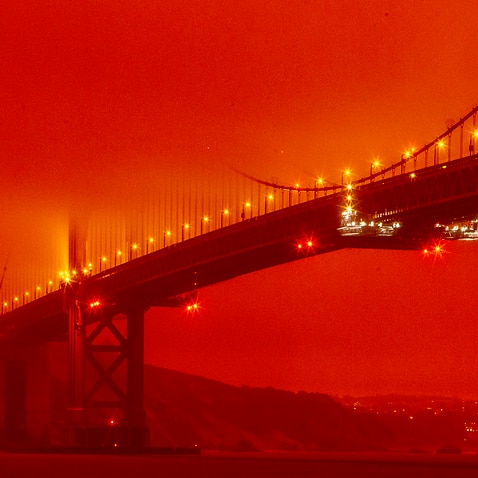
Apocalyptic orange skies, mass evacuations, people fleeing blazes near the water, and fires visible from satellites.
Ross
Bradstock is from the Centre for Environmental Risk Management of
Bushfires at the University of Wollongong. He says what Australia went
through last summer "is repeating itself in places like California".
“We’re
seeing something similar play out over there as to what played out in
our last season in terms of unprecedented fires, unprecedented area
burnt, unprecedented drought and heat,” he told SBS News.
San Francisco, Pic from SBS story
Former
NSW Fire and Rescue Commissioner Greg Mullins has helped to fight fires
in California several times since the 1990s.
He agrees the current
wildfires are "a direct reflection" of what Australia faced.
"It's unprecedented," Mr Mullins told SBS News.
"The
temperatures they're getting - you know, 49.4 (degrees) in the eastern
suburbs of Los Angeles - nothing has ever come close." .................
If only the current Australian government would take advice like this. This is from the United Kingdom's Committee on Climate Change to the U.K. government in 2020.
Climate Action Now
"Ministers
must seize the opportunity to turn the COVID-19 crisis into a defining
moment in the fight against climate change, the Committee on Climate
Change (CCC) says today.
In its annual report to Parliament,
the Committee provides comprehensive new advice to the Government on
delivering an economic recovery that accelerates the transition to a
cleaner, net-zero emissions economy and strengthens the country’s
resilience to the impacts of climate change.
Cities might become unbearable.
Important steps have
been taken in the last year, but much remains to be done. For the first
time the Committee sets out its recommendations government department by
government department. These are the urgent steps that must be taken in
the months ahead to initiate a green, resilient COVID-19 recovery.
They
can be delivered through strong coordination across Whitehall. Doing so
will propel the UK towards more rapid climate progress and position the
country as an international climate leader ahead of the pivotal COP26
climate summit in Glasgow next year.
CCC Chairman, Lord Deben, said:
“The UK is facing its biggest economic shock for a generation.
Meanwhile, the global crisis of climate change is accelerating. We have a
once-in-a-lifetime opportunity to address these urgent challenges
together; it’s there for the taking. The steps that the UK takes to
rebuild from the COVID-19 pandemic can accelerate the transition to a
successful and low-carbon economy and improve our climate resilience.
Choices that lock in emissions or climate risks are unacceptable.”
Climate Change is a fact
Chair of the CCC’s Adaptation Committee, Baroness Brown of Cambridge, said:
“COVID-19 has shown that planning for systemic risks is unavoidable. We
have warned repeatedly that the UK is poorly prepared for the very
serious impacts of climate change, including flooding, overheating and
water shortages. Now is the moment to get our house in order, coordinate
national planning, and prepare for the inevitable changes ahead. The
UK’s domestic ambition can be the basis for strong international climate
leadership, but the delivery of effective new policies must accelerate
dramatically if we’re to seize this chance.”
The Committee’s new analysis expands on its May 2020 advice to the Prime Minister in which it set out the principles for building a resilient recovery. In its new report,
the Committee has assessed a wide set of measures and gathered the
latest evidence on the role of climate policies in the economic
recovery. Its report highlights five clear investment priorities in the
months ahead:
1. Low-carbon retrofits and buildings that are fit for the future.
Hydrogen energy still requires research and development
There are vital new employment and reskilling opportunities across the
country if Governments support a national plan to renovate buildings and
construct new housing to the highest standards of energy and water
efficiency, to begin the shift to low-carbon heating systems, and to
protect against overheating. Roll-out of ‘green passports’ for buildings
and local area energy plans can begin immediately.
2. Tree planting, peatland restoration, and green infrastructure.
Investing in nature, including in our towns and cities, offers another
quick route to opportunities for highly-skilled employment, and outcomes
that improve people’s lives. By making substantial changes in our use
of land, which are needed to meet the UK’s Net Zero target, we will
bring significant benefits for the climate, biodiversity, air quality,
and flood prevention.
Land ice is melting
3. Energy networks must be strengthened for
the net-zero energy transformation in order to support electrification
of transport and heating. Government has the regulatory tools to bring
forward private sector investment. New hydrogen and carbon capture and
storage (CCS) infrastructure will provide a route to establishing new
low-carbon British industries. Fast-tracked electric vehicle charging
points will hasten the move towards a full phase out of petrol and
diesel cars and vans by 2032 or earlier.
4. Infrastructure to make it easy for people to walk, cycle, and work remotely. Dedicated
safe spaces for walking and cycling, more bike parking and support for
shared bikes and e-scooters can help the nation get back to work in a
more sustainable way. For home working to be truly a widespread option,
resilient digital technology (5G and fibre broadband) will be needed.
5. Moving towards a circular economy.
Within the next five years, we can not only increase reuse &
recycling rates rapidly but stop sending biodegradable wastes to
landfill. Local authorities need support to invest strategically in
separated waste collections and recycling infrastructure and to create
new regional jobs.
There are also opportunities to support
the transition and the recovery by investing in the UK’s workforce, and
in lower-carbon behaviours and innovation:
1. Reskilling and retraining programmes. The
net-zero economy will require a net-zero workforce, able to install
smart low-carbon heating systems and to make homes comfortable; to
design, manufacture and use low-carbon products and materials; and to
put carbon back, rather than taking carbon out, from under the North
Sea. Now is the time to build that workforce and to equip UK workers
with vital skills for the future.
Our children want answers.
2. Leading a move towards positive behaviours. There
is a window for Government to reinforce the ‘climate-positive’
behaviours that have emerged during the lockdown, including increased
remote working, cycling and walking. The public sector must lead by
example by encouraging remote working. It also needs to innovate in
order that customer service can be provided effectively remotely.
3. Targeted science and innovation funding. Kick-starting
research and innovation now in low-carbon and adaptation technologies
will facilitate the changes needed in the decades ahead and build UK
competitive advantage. The COVID-19 crisis has highlighted the
importance of research if we are to understand fully the threats and
learn how to manage them.
Cities must retreat from the coast.
Achieving the UK’s climate goals
and rebuilding the economy fit naturally together. Each makes the other
possible. Success demands that we do both. The actions recommended by
the CCC will deliver an improved economy, better public health, improved
biodiversity and access to nature, cleaner air, more comfortable homes
and highly productive and rewarding employment."
"Some Ages Have World Wars. Others Have Moonshots. Our Great Challenge is Preventing the Collapse of Civilization.
Let me explain what I mean by “accelerating pulsation of disaster.” Take the example of California’s wildfires. They’re the direct result
of climate change. Hotter temperatures, hotter oceans, bigger storms,
more lightning, drier vegetation — bang! A near certainty of historic
fires igniting."
Wildfire emergency
"So California’s burning…again. Just
like it was last year, and the year before that, and so on. In a few
months, it’ll be Australia’s turn to be hit by megafires, all over
again. They’ll be worse than last year, at least if we average it all
over a decade or so. That’s because, of course, fire is seasonal. And as
we head into the age of catastrophe, “megafire season” will become a
part of our lives. The world will develop Fire Belts, of which
California and Australia are becoming a part."
"Then there are Flood Belts. While the pandemic raged, much of Asia flooded. The West didn’t take much notice — even though China’s largest dam is now at it’s limits.
And yet the megafloods Asia just experienced are just like megafires —
natural phenomena that are getting worse on a seasonal, yearly cycle.
Within a decade or two, these floods will also threaten habitability.
Expect much greater sea level rise as land-ice melts
...................................
"Are
you beginning to get what I mean by “accelerating pulsation of
disaster” yet? As we head into the age of catastrophe, a new range of
calamities will become our dismal new normal. They’ll recur, in cycles.
Only each time the cycle spins, they’ll get worse and worse. Megafires,
megafloods, pandemics, extinctions."
Sea Rise will flood cities
................................................
The accelerating pulsation of disaster. Life
is going to feel scary, strange, dislocating, anxiety-inducing. As soon
as this disaster ebbs — phew, the megafire’s over! — here comes another
one. Now it’s megaflood season. Now it’s Covid season. Christ, now
there’s a new pandemic. What the? You and I were born live at the very
tail end of a golden age of human stability. That age is now over, and
the transition into the age of apocalypse is going to feel deeply
frightening. 2020 was just the beginning. It’s going to get much, much
worse, before — if — it ever gets better.
Melting Land ice on Greenland
As all
those cycles of catastrophe, operating at annual, semiannual, decadal
scales get worse and worse, ultimately, our systems will begin to
buckle, and then break. Faster and harder than we think.
Think of California right about now. A wildfire is bad. A respiratory pandemic is really bad. But megafires during a respiratory pandemic? What now? They have conflicting objectives: quarantine and stay at home, versus evacuate and firefight."
........................
Heatwaves kill
"They then face a stark dilemma. To
fight accelerating waves of natural calamity, fire, flood, drought,
famine, then saps resources that are needed to invest in tomorrow. We
fight that megafire, we try to build a barrier against tomorrow’s mega
flood. There go all those schools, hospitals, universities, libraries,
parks, roads, high-speed trains we wanted to build, expand, renew.
Simply fending off catastrophe will take a larger and large share of our resources. That
leaves less left over to invest in the things which really improve
people’s quality of life, whether healthcare, education, retirement, and
so on.
What happens as a result of that? Well, people’s qualities of life fall. Depression and frustration and unhappiness grow. And the predictable consequence of that is more extremism. Discontented masses tend to turn to demagogues, who blame all of a society’s problems on hated minorities. The age of catastrophe will be a boon to tomorrow’s Trumps.
And yet even all this just takes to about the mid 2030s or so. After that? That’s when the real fireworks begin."
"By about then, the limits of our civilization’s fundamental systems will have been breached.
Insurance and banking systems won’t be able to cover the losses of
burning states and flooded cities. They’ll go bankrupt, and probably
demand huge bailouts. Those bankruptcies will have a devastating
consequence. Not just the lack of credit, but a sharp rise in the cost
of it. Translation, you’re probably living in debt right now — whether
mortgage, credit card debt, car loans, student debt, medical debt, or
all of the above — and the interest rates on all that are going to
skyrocket. Somebody has to pay for the risk and costs of all this sudden
catastrophe. And it’s probably going to be you, in the hidden form of
paying massively more interest on all that debt you already can’t pay off."
Properties will become uninsurable
As
insurance and financial systems go broke, and the costs of accessing
money and credit spike, huge waves of businesses will close. Most small
businesses exist on razor-thin margins, from restaurants and bars to
nail salons and hobby shops. When their rents double and the interest on
their loans triples and they can’t get any more credit — at exactly the
same time as their customer base is falling apart? Bang! They go broke,
too. And all the millions of people they employ — small businesses are still the heart of the economy — are unemployed. The cycle of depression and poverty accelerates."
"This is not a drill, my friends. It’s
time to stop acting like it is, burying our pretty vacant little heads
in Netflix-and-chill and Instagram envy and the latest gender pronoun
and Fakebook friends. That’s all, history will rightly say, garbage for
the human mind and spirit. This is it. We’re not going to get another chance." "
"The Australian Climate Roundtable
(ACR) is a forum that brings together leading organisations from the
business, farming, investment, union, social welfare and environmental
sectors. Since 2014 we have sought and found common ground on responding
to the challenge of climate change." 28 Aug 2020
"What the experts say Climate
change is already having a real and significant impact on the economy
and community. Australian temperatures are increasing, extreme
climate-related events such as heat waves and bushfires are becoming
more intense and frequent, natural systems are suffering irreversible
damage, some communities are in a constant state of recovery from
successive natural disasters, and the economic and financial impacts of
these changes continue to grow.
Sea Level Rise will affect our cities
Even with ambitious global action in line with the objectives of the
Paris Agreement, Australia will experience escalating costs from the
climate change associated with historical emissions. These costs will be
significant and will require a concerted national response to manage
these now unavoidable climate related damages.
Health risks for children because of climate change
The Intergovernmental Panel on Climate Change advises that global
emissions will need to reach net-zero by around 2050 to achieve the
goals of the Paris Agreement. If the world fails to meet the objectives
of the Paris Agreement, and instead continues its current emissions
pathway, climate change would have far-reaching economic, environmental
and social effects on Australia. It is unlikely that Australia and the
world can remain prosperous in this scenario.
Australia requires a risk assessment for climate change.
These effects include but are not limited to:
* Unprecedented economic damage to Australia and our regional trading
partners from acute (e.g. extreme events) and chronic (e.g. sea level
rise) changes in climate. Significant impacts on coastal regions,
agriculture, human productivity and infrastructure. The economy-wide
costs of not achieving the Paris Agreement objectives far outweigh the
costs of a smooth transition to net-zero emissions. * Risks to financial stability and particularly the insurance
industry. The ability of the insurance and reinsurance markets to
support Australian investments and communities would be compromised.
Drought
* Major acute and long-lived human and community social andhealth
impacts. This includes both loss of life and livelihood from extreme
events through to long-term medical conditions such as post-traumatic
stress disorder. Many communities and regions will suffer a constant
cycle of natural disaster and rebuilding or face relocation.
* Irreversible damage to Australian unique natural heritage, including
Australia's iconic and internationally significant ecosystems such as
the Great Barrier Reef and Kakadu National Park.
* Significant threats to agriculture, forestry, nature-based tourism
Destroyed forests
and fisheries. Unconstrained climate change is a risk to Australia's
domestic food security.
The impacts of climate change will also put many governments under
fiscal stress. Tax revenues will fall dramatically and increases in the
frequency and severity of weather events and other natural disasters,
which invoke significant emergency management responses and recovery
expenditures, indicate that pressure on government budgets will be
especially severe.
2020 has reached into its bag of tricks again and tossed out another surprise - this time in the form of a swirling fire.
Or as meteorologists call it, a "firenado" - short for fire tornado.
The rare and fiery tornado was spotted Saturday near a fire in California.
A
huge forest fire that prompted evacuations north of Los Angeles flared
up around noon Saturday, August 15, sending up a cloud of smoke as it
headed toward thick, dry brush in the Angeles National Forest. (AP)
The
National Weather Service Office issued a tornado warning for a
pyrocumulonimbus cloud that formed by the Loyalton Fire, saying it was
"capable of producing a fire-induced tornado and outflow winds in excess
of 97km/h," CNN meteorologist Haley Brink said.
A pyrocumulonimbus cloud forms above intense rising heat, typically from a fire or volcano.
Fire
tornadoes are created when the rising heat from a fire pulls in smoke,
fire and dirt, creating a rotation vortex above the blaze, Ms Brink
said.
Fire tornadoes can be massive and deadly.
#wildfire, #bushfires
When
the National Weather Service surveyed the damage on that firenado, it
determined it was equivalent to an EF-3 tornado with winds in excess of
230km/h.
Officials in California, Oregon and Colorado are battling a series of wildfires
that have collectively torched more than 40,000 hectares - and things
could get worse with intense heat descending on much of the US.
The Loyalton Fire has burned over 8000 hectares and was five per cent contained by early Sunday.

 Here’s
what’s not in dispute: As the planet gets hotter, largely because of
the burning of fossil fuels, the number of blackouts caused by extreme
weather is on the rise, in California and across the country.
Here’s
what’s not in dispute: As the planet gets hotter, largely because of
the burning of fossil fuels, the number of blackouts caused by extreme
weather is on the rise, in California and across the country. Why is extreme
weather such a problem for the electric grid? Powerful winds can knock
down utility poles. Intense rains can flood substations. Ice can
accumulate on wires during winter storms. Wildfires can knock out power
lines — or utility companies can be forced to shut down lines to avoid igniting fires. High temperatures can cause fossil-fueled power plants to produce less electricity, which actually happened with California’s natural gas fleet in August."
Why is extreme
weather such a problem for the electric grid? Powerful winds can knock
down utility poles. Intense rains can flood substations. Ice can
accumulate on wires during winter storms. Wildfires can knock out power
lines — or utility companies can be forced to shut down lines to avoid igniting fires. High temperatures can cause fossil-fueled power plants to produce less electricity, which actually happened with California’s natural gas fleet in August."