Saturday, 20 June 2020

World has six months to avert climate crisis, says energy expert : The Guardian

Climate Change is Real
The world has only six months in which to change the course of the climate crisis and prevent a post-lockdown rebound in greenhouse gas emissions that would overwhelm efforts to stave off climate catastrophe, one of the world’s foremost energy experts has warned.

“This year is the last time we have, if we are not to see a carbon rebound,” said Fatih Birol, executive director of the International Energy Agency.

Governments are planning to spend $9tn (£7.2tn) globally in the next few months on rescuing their economies from the coronavirus crisis, the IEA has calculated. The stimulus packages created this year will determine the shape of the global economy for the next three years, according to Birol, and within that time emissions must start to fall sharply and permanently, or climate targets will be out of reach.

“The next three years will determine the course of the next 30 years and beyond,” Birol told the Guardian. “If we do not [take action] we will surely see a rebound in emissions. If emissions rebound, it is very difficult to see how they will be brought down in future. This is why we are urging governments to have sustainable recovery packages.”

Read The Guardian article

Thursday, 18 June 2020

Climate worst-case scenarios may not go far enough, cloud data shows : The Guardian

Clouds and climate change
Worst-case global heating scenarios may need to be revised upwards in light of a better understanding of the role of clouds, scientists have said.

Recent modelling data suggests the climate is considerably more sensitive to carbon emissions than previously believed, and experts said the projections had the potential to be “incredibly alarming”, though they stressed further research would be needed to validate the new numbers.

Modelling results from more than 20 institutions are being compiled for the sixth assessment by the United Nations Intergovernmental Panel on Climate Change, which is due to be released next year.

Compared with the last assessment in 2014, 25% of them show a sharp upward shift from 3C to 5C in climate sensitivity – the amount of warming projected from a doubling of atmospheric carbon dioxide from the preindustrial level of 280 parts per million. This has shocked many veteran observers, because assumptions about climate sensitivity have been relatively unchanged since the 1980s.

Read the Guardian article

Wednesday, 17 June 2020

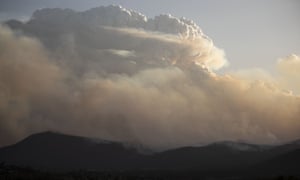
Australia had more supersized bushfires creating their own storms last summer than in previous 30 years : The Guardian

A pyrocumulonimbus cloud generated by the intense Orroral Valley bushfire south of Canberra, 31 January 2020
A pyrocumulonimbus (pyroCB) cloud generated by the Orroral Valley bushfire south of Canberra.
 During the 2019-20 summer there was a record number of these events. Photograph: Brook Mitchell/Getty Images


There was a near doubling of the record of pyrocumulonimbus (pyroCB) storms, royal commission hears

Huge thunderstorm-type clouds called pyrocumulonimbus form over fires in particularly hot, dry and dangerous conditions and are capable of generating their own winds and lightning.

They were once considered “bushfire oddities” but last summer there was a “near doubling of the record of these events, in one event,” Prof David Bowman told the royal commission on Tuesday.

Read The Guardian story


Friday, 12 June 2020

Unexpected future boost of methane possible from Arctic permafrost : NASA

climate permafrost melt
melting permafrost
By Ellen Gray,
NASA's Earth Science News Team

New NASA-funded research has discovered that Arctic permafrost’s expected gradual thawing and the associated release of greenhouse gases to the atmosphere may actually be sped up by instances of a relatively little known process called abrupt thawing. Abrupt thawing takes place under a certain type of Arctic lake, known as a thermokarst lake that forms as permafrost thaws.

The impact on the climate may mean an influx of permafrost-derived methane into the atmosphere in the mid-21st century, which is not currently accounted for in climate projections.

The Arctic landscape stores one of the largest natural reservoirs of organic carbon in the world in its frozen soils. But once thawed, soil microbes in the permafrost can turn that carbon into the greenhouse gases carbon dioxide and methane, which then enter into the atmosphere and contribute to climate warming.


Read the article

Tuesday, 9 June 2020

As Protests Rage Over George Floyd’s Death, Climate Activists Embrace Racial Justice: Insideclimatenews


climate change is real
#climatejustice
When New York Communities for Change helped lead a demonstration of 500 on Monday in Brooklyn to protest George Floyd's killing in Minneapolis, the grassroots group's activism spoke to a long-standing link between police violence against African Americans and environmental justice.

Elizabeth Yeampierre, executive director of UPROSE, Brooklyn's oldest Latino community-based organization, said she considers showing up to fight police brutality and racial violence integral to her climate change activism. 

Bronx Climate Justice North, another grassroots group, says on its website: "Without a focus on correcting injustice, work on climate change addresses only symptoms, and not root causes."


Read the Inside Climate News article

Monday, 8 June 2020

Banking on gas will leave us stranded: SMH

#climatecrisis   #jailclimatecriminals
Covid-19 pandemic
"When I, and others, proposed gas as a transition fuel some 30 years ago, the price of solar was multiples of its current price, so gas was a quicker and more cost-effective means of achieving a reduction in emissions of some 40 to 60 per cent relative to coal.

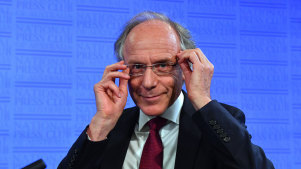
However, as Chief Scientist Alan Finkel admitted in his recent address to the National Press Club, “the cost of producing electricity from wind and solar is now around $A50 per megawatt hour and [even with effective storage] the price … is lower than existing gas-fired electricity generation and similar to new-build, coal-fired electricity generation … and is set to drop even further”.

And with solar and wind technology proven, in the sense that financiers accept the risk without premium, why wouldn’t the government seek the development of grid-scale storage to achieve 100 per cent renewables? Clearly Morrison and his team have sold out to the likes of the Minerals Council and the fossil fuel lobby, whose influence is now conspicuous in the focus of the COVID recovery commission."


Read the complete SMH article 


Chief Scientist Dr Alan Finkel says gas fired hydrogen could reduce the risk associated with total reliance on renewable energy.

The suggestion of a pipeline linking large the gas fields off

Sunday, 7 June 2020

More jobs in renewable-led COVID-19 economic recovery, EY report finds:ABC

Climate action to protect coral reefs and tourism  #jailclimatecriminals
Cooked coral reefs
A renewables-led economic recovery will create almost three times as many jobs as a fossil-fuel-led recovery, according to a report by economic consultancy Ernst and Young (EY).
The newly published report proposed six focus areas, which it said would simultaneously stimulate the economy and move Australia towards net-zero greenhouse gas emissions by 2050, in accordance with the 2015 Paris Agreement.

While the Federal Government has spoken of a "gas-fired" COVID-19 recovery, the EY report, commissioned by conservation group WWF Australia, argues replacing fossil fuels with renewable electricity and hydrogen will be better for the economy. 

"We can rebuild our economy in a way that sets up Australia for prosperity in a world hungry for a low-carbon future," WWF Australia energy transition manager Nicky Ison said.