Showing posts with label Greenland ice melt. Show all posts

Sunday, 25 October 2020

The Arctic is in a death spiral. How much longer will it exist? (excerpt): The Guardian


 "The region is unravelling faster than anyone could once have predicted. But there may still be time to act."


At the end of July, 40% of the 4,000-year-old Milne Ice Shelf, located on the north-western edge of Ellesmere Island, calved into the sea. Canada’s last fully intact ice shelf was no more.

On the other side of the island, the most northerly in Canada, the St Patrick’s Bay ice caps completely disappeared.

Two weeks later, scientists concluded that the Greenland Ice Sheet may have already passed the point of no return. Annual snowfall is no longer enough to replenish the snow and ice loss during summer melting of the territory’s 234 glaciers. Last year, the ice sheet lost a record amount of ice, equivalent to 1 million metric tons every minute.

The Arctic is unravelling. And it’s happening faster than anyone could have imagined just a few decades ago. Northern Siberia and the Canadian Arctic are now warming three times faster than the rest of the world. In the past decade, Arctic temperatures have increased by nearly 1C. If greenhouse gas emissions stay on the same trajectory, we can expect the north to have warmed by 4C year-round by the middle of the century."

Go to Guardian article and photo essay


Related:  Vigorous action needed, and soon, on climate change (excerpt): Yale Climate Connections


Arctic,Antarctica,Greenland ice melt,#icemelting,sea level rise,#climate crisis,

Tuesday, 1 September 2020

East Antarctic Melting Hotspot Identified by Japanese Expedition – Ice Melting at Surprisingly Fast Rate: SciTechDaily

"Ice is melting at a surprisingly fast rate underneath Shirase Glacier Tongue in East Antarctica due to the continuing influx of warm seawater into the Lützow-Holm Bay.

Hokkaido University scientists have identified an atypical hotspot of sub-glacier melting in East Antarctica. Their findings, published in the journal Nature Communications, could further understandings and predictions of sea level rise caused by mass loss of ice sheets from the southernmost continent.

The 58th Japanese Antarctic Research Expedition had a very rare
opportunity to conduct ship-based observations near the tip of East Antarctic Shirase Glacier when large areas of heavy sea ice broke up, giving them access to the frozen Lützow-Holm Bay into which the glacier protrudes.

“Our data suggests that the ice directly beneath the Shirase Glacier Tongue is melting at a rate of 7–16 meters per year,” says Assistant Professor Daisuke Hirano of Hokkaido University’s Institute of Low Temperature Science. “This is equal to or perhaps even surpasses the melting rate underneath the Totten Ice Shelf, which was thought to be experiencing the highest melting rate in East Antarctica, at a rate of 10–11 meters per year.”'

"The Antarctic ice sheet, most of which is in East Antarctica, is Earth’s largest freshwater reservoir. If it all melts, it could lead to a 60-meter rise in global sea levels. Current predictions estimate global sea levels will rise one meter by 2100 and more than 15 meters by 2500. Thus, it is very important for scientists to have a clear understanding of how Antarctic continental ice is melting, and to more accurately predict sea level fluctuations.


Wednesday, 19 August 2020

Greenland's melting ice sheet has passed the point of no return, scientists say (excerpt): USA Today

STORY HIGHLIGHTS

• Greenland's ice sheet dumps more than 280 billion metric tons
Even if global warming were to stop today, the ice sheet would continue shrinking.
of melting ice into the ocean each year.

 
•  Even if global warming were to stop today, the ice sheet would continue shrinking.
• Scientists analyzed 40 years of satellite data from more than 200 large glaciers draining into the ocean.

Greenland's melting ice sheet has passed the point of no return. 
In fact, glaciers on the island have shrunk so much that even if global warming were to stop today, the ice sheet would continue shrinking, a new study suggests.

"Glacier retreat has knocked the dynamics of the whole ice sheet into a constant state of loss," study co-author Ian Howat, an earth scientist from Ohio State University, said in a statement. "Even if the climate were to stay the same or even get a little colder, the ice sheet would still be losing mass."

This "tipping point" means the snowfall that replenishes the ice sheet each year cannot keep up with the ice that is flowing into the ocean from melting glaciers.


Friday, 14 August 2020

Sea Level Rise Effect on Mumbai of 1.5m rise

Mumbai, land at risk from 1.5m sea rise
 • We are looking more and more unlikely to prevent global heating.

• Scientists are predicting the melting of the ice covering Greenland with a subsequent sea level rise of 7m.

• This rise does not factor in sea rise from the melting of Antarctica and other ice.

• Already many properties are likely to flood when a high tide is combined with high local rainfall. 
 

What were a hundred year rainfall events are now ten year events.


Mumbai, land at risk with 1.0m sea rise
 
• The frequency of high rainfall events will increase with global heating and more and more severe hurricanes are predicted because of warmer seas.


• Low coastal areas will be subjected to severe storm surges.

• Would you buy a property likely to be inundated in twenty years, fifty years, a hundred years? Many wouldn't. Even the perception of possible inundation will greatly affect property values. Some properties will become more expensive to insure or become impossible to insure

• When certain properties are in less demand their value falls.

• Would you buy a property with a value that is likely to fall?

•  The view of Mumbai above shows areas likely to be inundated by a 1.5m and a 1.0m sea level rise.

• Property above a 10m rise will become highly sought after and will greatly increase in value.

Learn more about how sea rise inundation will affect India's property, indeed any property, at climatecentral.org


Related:

Greenland shed ice at unprecedented rate in 2019; Antarctica continues to lose mass: EurekAlert


Melbourne: predicted flooding with a conservative sea level rise of only 1.5m


#sea level rise, #Greenland ice melt, #sea ice, #climateaction, #climatechange, #jailclimatecriminals, #cambio-climatico,  

Monday, 20 July 2020

Climate Change: Global Sea Level: NOAA

South Beach, Miami on May 3, 2007. Photo by Flickr user James WIlliamor, via a Creative Commons license.


"Sea level since 1880

The global mean water level in the ocean rose by 0.14 inches (3.6 millimeters) per year from 2006–2015, which was 2.5 times the average rate of 0.06 inches (1.4 millimeters) per year throughout most of the twentieth century. By the end of the century, global mean sea level is likely to rise at least one foot (0.3 meters) above 2000 levels, even if greenhouse gas emissions follow a relatively low pathway in coming decades.

In some ocean basins, sea level rise has been as much as 6-8 inches (15-20 centimeters) since the start of the satellite record. Regional differences exist because of natural variability in the strength of winds and ocean currents, which influence how much and where the deeper layers of the ocean store heat."

..........................

ADMIN: The above figures are now seen by some scientists as an underestimation of sea level rise. See article below.

Greenland shed ice at unprecedented rate in 2019; Antarctica continues to lose mass: EurekAlert


....................................


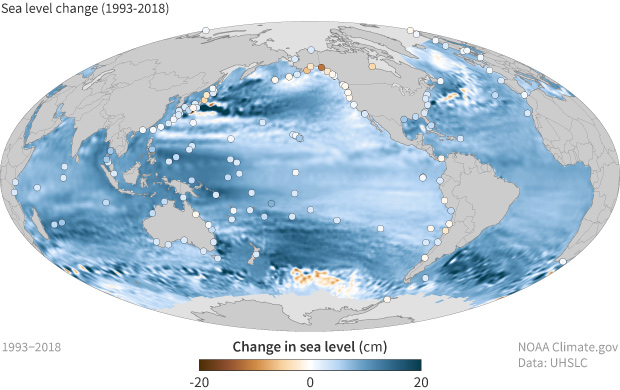
Global map of mean sea level change since 1993 with dots showing local sea level change on land


Between 1993 and 2018, mean sea level has risen across most of the world ocean (blue colors). In some ocean basins, sea level has risen 6-8 inches (15-20 centimeters). Rates of local sea level (dots) can be amplified by geological processes like ground settling or offset by processes like the centuries-long rebound of land masses from the loss of ice age glaciers. NOAA Climate.gov map, based on data provided by Philip Thompson, University of Hawaii. 
Past and future sea level rise at specific locations on land may be more or less than the global average due to local factors: ground settling, upstream flood control, erosion, regional ocean currents, and whether the land is still rebounding from the compressive weight of Ice Age glaciers. In the United States, the fastest rates of sea level rise are occurring in the Gulf of Mexico from the mouth of the Mississippi westward, followed by the mid-Atlantic. Only in Alaska and a few places in the Pacific Northwest are sea levels falling, though that trend will reverse under high greenhouse gas emission pathways.

In some ocean basins, sea level rise has been as much as 6-8 inches (15-20 centimeters) since the start of the satellite record in 1993.

Why sea level matters

In the United States, almost 40 percent of the population lives in relatively high population-density coastal areas, where sea level plays a role in flooding, shoreline erosion, and hazards from storms. Globally, 8 of the world’s 10 largest cities are near a coast, according to the U.N. Atlas of the Oceans.


In urban settings along coastlines around the world, rising seas threaten infrastructure necessary for local jobs and regional industries. Roads, bridges, subways, water supplies, oil and gas wells, power plants, sewage treatment plants, landfills—the list is practically endless—are all at risk from sea level rise. 

Higher background water levels mean that deadly and destructive storm surges, such as those associated with Hurricane Katrina, “Superstorm” Sandy, and Hurricane Michael—push farther inland than they once did. Higher sea level also means more frequent high-tide flooding, sometimes called “nuisance flooding” because it isn't generally deadly or dangerous, but it can be disruptive and expensive. (Explore past and future frequency of high-tide flooding at U.S. locations with the Climate Explorer, part of the U.S. Climate Resilience Toolkit.)


Nuisance flooding in Annapolis in 2012. Around the U.S., nuisance flooding has increased dramatically in the past 50 years. Photo by Amy McGovern.

In the natural world, rising sea level creates stress on coastal ecosystems that provide recreation, protection from storms, and habitat for fish and wildlife, including commercially valuable fisheries. As seas rise, saltwater is also contaminating freshwater aquifers, many of which sustain municipal and agricultural water supplies and natural ecosystems.


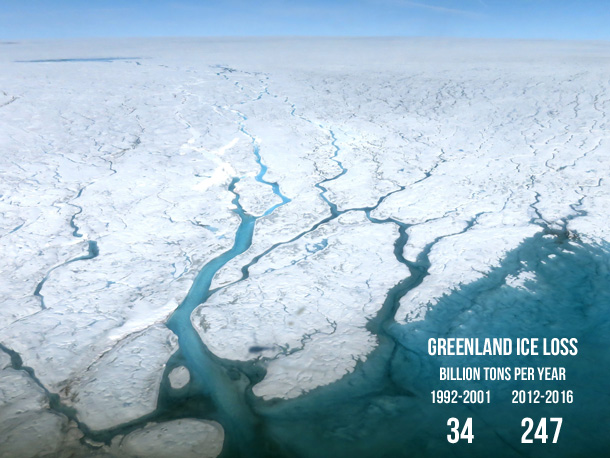
Photo of melt streams on the Greenland Ice Sheet in summer 2015
Melt streams on the Greenland Ice Sheet on July 19, 2015. Ice loss from the Greenland and Antarctic Ice Sheets as well as alpine glaciers has accelerated in recent decades. NASA photo by Maria-José Viñas.

Go to the original NOAA article by

Author: 
November 19, 2019

Other 2019 reports of ice melt predict a higher sea rise. See below.

Greenland shed ice at unprecedented rate in 2019; Antarctica continues to lose mass: EurekAlert

 ' "It is very likely that the current climate models overestimate the meltwater retention capacity of the ice sheet and underestimate the projected sea level rise coming from Greenland ... by a factor of two or three," he said. ' ICNews

Read the complete original Inside Climate News article


Houston: predicted flooding with a conservative sea level rise of only 2ft.


Flooding of Houston with a 2ft sea rise
 • We are looking more and more unlikely to prevent global heating.

• Scientists are predicting the melting of the ice covering Greenland with a subsequent sea level rise of 23ft.

• This rise does not factor in sea rise from the melting of Antarctica and other ice.


• Already many properties are likely to flood when a high tide is combined with high local rainfall. 
 

Flooding of Houston with a  mere 1ft sea level rise


What were a hundred year rainfall events are now ten year events.


• The frequency of high rainfall events will increase with global heating and more and more severe hurricanes are predicted because of warmer seas.


Flooding of Houston with a 10ft sea rise

• Low coastal areas will be subjected to severe storm surges.

• Would you buy a property likely to be inundated in twenty years, fifty years, a hundred years? Many wouldn't. Even the perception of possible inundation will greatly affect property values.

• When certain properties are in less demand their value falls.

• Would you buy a property with a value that is likely to fall?

•  The view of Houston above shows areas likely to be inundated by a 10ft sea level rise.

• Property above a 20ft rise will become highly sought after and will greatly increase in value.

Learn more about how sea rise inundation will affect U.S. property on climate.gov


Related:

Greenland shed ice at unprecedented rate in 2019; Antarctica continues to lose mass: EurekAlert


Melbourne: predicted flooding with a conservative sea level rise of only 1.5m


#sea level rise, #Greenland ice melt, #sea ice, #climateaction, #climatechange, #jailclimatecriminals, #cambio-climatico,  

Tuesday, 7 July 2020

With Greenland's Extreme Melting, a New Risk Grows: Ice Slabs That Worsen Runoff: Inside Climate News


More meltwater is now pouring off these hardened surfaces and toward the ocean, a new study finds. That will have an impact on sea level rise.


Meltwater pools form on Greenland's surface and meltwater rivers funnel it to the ocean. Credit: Dave Walsh/VW Pics/Universal Images Group via Getty Images
Meltwater pools form on Greenland's surface as temperatures rise and feed into rivers that funnel water toward the ocean. New research shows ice slabs are now forming in areas where water used to sink into the snow layer, increasing runoff. Credit: Dave Walsh/VW Pics/Universal Images Group via Getty Images
Scientists have added a new item to the long list of Greenland Ice Sheet woes. Along with snow-darkening algae and increasing rainfall, giant slabs of ice have been thickening and spreading under the Greenland snow at an average rate of two football fields per minute since 2001, new research shows.

The slabs prevent surface meltwater from trickling down and being absorbed by the snow. Instead, more water pours off the surface of the ice sheet and into the ocean.

That's speeding Greenland's contribution to sea level rise, said University of Liege climate researcher Xavier Fettweis, a co-author of a study published Wednesday in the journal Nature. "It is very likely that the current climate models overestimate the meltwater retention capacity of the ice sheet and underestimate the projected sea level rise coming from Greenland ... by a factor of two or three," he said.

Read the complete original Inside Climate News article


#jailclimatecriminals, #cambio-climatico  #climate action
Jan 1 to Sep 2016 2019 Melt Days
 

Wednesday, 27 May 2020

Greenland shed ice at unprecedented rate in 2019; Antarctica continues to lose mass: EurekAlert

Greenland Ice Melt
Irvine, Calif., March 18, 2020 - During the exceptionally warm Arctic summer of 2019, Greenland lost 600 billion tons of ice, enough to raise global sea levels by 2.2 millimeters in two months. On the opposite pole, Antarctica continued to lose mass in the Amundsen Sea Embayment and Antarctic Peninsula but saw some relief in the form of increased snowfall in Queen Maud Land, in the eastern part of the continent.
 
These new findings and others by glaciologists at the University of California, Irvine and NASA's Jet Propulsion Laboratory are the subject of a paper published today in the American Geophysical Union journal Geophysical Research Letters.

"We knew this past summer had been particularly warm in Greenland, melting every corner of the ice sheet, but the numbers are enormous," said lead author Isabella Velicogna, UCI professor of Earth system science and JPL senior scientist.

Between 2002 and 2019, Greenland lost 4,550 billion tons of ice, an average of 268 billion tons annually - less than half what was shed last summer. To put that in perspective, Los Angeles County residents consume 1 billion tons of water per year.

Read the EurekAlert story

Wednesday, 15 January 2020

Sea Level Rise: It’s Probably Worse Than You Think: Medium


As you know, this newsletter is usually fairly inspiring. But this one is not (overall). And that’s because we really need to talk about sea level rise again.
Sorry, but the stakes are insanely high and everyone needs to know about this stuff!
That being said, I do end with an action you can take to help if you so choose! …Or you can just tell your friends about this mind-bending sea level rise predicament. Talking about these things and finding new ways to help together is always good.

Key Takeaways:

  • We’ve locked in about 7.5 ft (2.3 m) of sea level rise already.
  • Sea levels will likely be at least 3.3 ft (1 m) higher by 2100.
  • Last time Earth got this hot, sea levels were way, WAY higher.
  • Ice loss in Greenland and Antarctica is decades ahead of schedule. There’s been significant acceleration.
The fact of the matter is that coastal cities around the world will eventually have to make sci-fi adaptations or retreat…but I’m getting ahead of myself.


Thursday, 26 December 2019

How Scientists Got Climate Change So Wrong: NYT


For decades, most scientists saw climate change as a distant prospect. We now know that thinking was wrong. This summer, for instance, a heat wave in Europe penetrated the Arctic, pushing temperatures into the 80s across much of the Far North and, according to the Belgian climate scientist Xavier Fettweis, melting some 40 billion tons of Greenland’s ice sheet.

Sunday, 8 September 2019

What’s Another Way to Say ‘We’re F-cked’? : Medium

One of the leading climate scientists of our time is warning of the horrifying possibility of 15-to-20 feet of sea-level rise


Richard Alley is not a fringe character in the world of climate change. In fact, he is widely viewed as one of the greatest climate scientists of our time. If there is anyone who understands the full complexity of the risks we face from climate change, it’s Alley. And far from being alarmist, Alley is known for his careful, rigorous science. He has spent most of his adult life deconstructing past Earth climates from the information in ice cores and rocks and ocean sediments. And what he has learned about the past, he has used to better understand the future.

For a scientist of Alley’s stature to say that he can’t rule out 15 or 20 feet of sea-level rise in the coming decades is mind-blowing. And it is one of the clearest statements I’ve ever heard of just how much trouble we are in on our rapidly warming planet (and I’ve heard a lot — I wrote a book about sea-level rise)."

 Related:

Showing sea level 5m rise flooding in Melbourne city

Friday, 6 September 2019

Showing sea level 5m rise flooding in Melbourne city

Melbourne inundation with a 5m sea level rise


• We are looking more and more unlikely to prevent global heating.

• Scientists are predicting the melting of the ice covering Greenland with a subsequent sea level rise of 7m.

• This rise does not factor in sea rise from the melting of Antarctica and other ice.

• Already many properties are likely to flood when a high tide is combined with high local rainfall. What were a hundred year rainfall events are now ten year events.

• The frequency of high rainfall events will increase with global heating and more and more severe hurricanes are predicted because of warmer seas.

• Low coastal areas will be subjected to severe storm surges. 

• Once the ice on Greenland and Antarctica melts the sea level will rise. It is already melting.

• Would you buy a property likely to be inundated in twenty years, fifty years, a hundred years? Many wouldn't. Even the perception of possible inundation will greatly affect property values.

• When certain properties are in less demand their value falls.

• Would you buy a property with a value likely to fall?

•  The view of Melbourne above shows areas likely to be inundated by a 5m sea level rise.

• Property above a 10m rise will become highly sought after and will greatly rise in value.

Learn more about how sea rise inundation will affect Australian property.

Click here to go to Coastal Risk Australia site

'Retreat' Is Not An Option As A California Beach Town Plans For Rising Seas: NPR 


#inundation  #sea rise  #searise  #climatecrisis  #climatechange  #ice  #melting ice

Wednesday, 4 September 2019

Leaked IPCC report warns of the future of oceans in climate change: Global Landscapes Forum

"This topic will be discussed at the Global Landscapes Forum New York 2019. Learn more about how to join here.

The world’s vast oceans, glacial ice sheets and northern permafrost are poised to unleash disaster, including drought, floods, hunger and destruction, unless dramatic action is taken against human-caused carbon pollution and climate change, warns a leaked draft of a major U.N. report.

The Special Report on the Ocean and Cryosphere in a Changing Climate (SROCC) sounds alarm bells over declines in fish stocks, plus “a hundred-fold or more increase in the damages caused by superstorms, and hundreds of millions of people displaced by rising seas,” according to news agency Agence France-Presse (AFP), which obtained a copy of the 900-page draft report."

Read the complete article 

Related:

Great Barrier Reef outlook now 'very poor', Australian government review says: The Guardian


Sunday, 4 August 2019

Video / Climate Scientist Jason Box: “Our Economic System Is Crashing With Reality”: Democracy Now


Published on Aug 2, 2019
 
A heat wave is causing unprecedented melting of the Greenland ice sheet. Meanwhile, the World Meteorological Organization just declared July 2019 the hottest month ever recorded. We speak with Jason Box, professor and ice climatologist at the Geological Survey of Denmark and Greenland, about the intensifying climate crisis. 

He says humanity must move toward living in balance with the environment. “If we don’t reduce greenhouse gas emissions and ultimately stabilize CO2 … there’s no real prospect for a stable society or even a governable society,” Box says. “Perpetual growth on a finite planet is, by definition, impossible.”

Related:  

Heatwave: think it’s hot in Europe? The human body is already close to thermal limits elsewhere :The Conversation

Sunday, 7 July 2019

How high will sea levels rise- ABC Science

This video was made in 2014. We now have evidence the Greenland ice shelf and Antarctic ice shelf is melting more quickly than first thought.


ABC Science

Published on Jul 18, 2014

The rising sea is the sleeping giant of climate change. Although we now know it's happening, how high will it go? In an attempt to predict what impact the rising waters will have on our world, scientists are turning to the distant past.
 

Thursday, 23 May 2019

Sea levels may rise much faster than previously predicted, swamping coastal cities such as Shanghai, study finds: CNN

Sea level rise 1900-2017

Global sea levels could rise more than two meters (6.6 feet) by the end of this century if emissions continue unchecked, swamping major cities such as New York and Shanghai and displacing up to 187 million people, a new study warns.

The study, which was released Monday, says sea levels may rise much faster than previously estimated due to the accelerating melting of ice sheets in both Greenland and Antarctica.
Melting ice: CNN

The international researchers predict that in the worst case scenario under which global temperatures increase by 5 degrees Celsius (9 degrees Fahrenheit) by 2100, sea levels could rise by more than two meters (6.6 feet) in the same period -- double the upper limit outlined by the UN climate science panel's last major report. 
Such a situation would be "catastrophic," the authors of the study warn. 
"It really is pretty grim," lead author Jonathan Bamber, a Professor of Physical Geography at the University of Bristol told CNN. "Two meters is not a good scenario."
He said the mass displacement of people in low-lying coastal areas would likely result in serious social upheaval. It would also pose an "existential threat" to small island nations in the Pacific which would be left pretty much uninhabitable. 

Sunday, 21 April 2019

Bill de Blasio Seeks to Flood-Proof Lower Manhattan by Adding Land: Bloomberg

"New York Mayor Bill de Blasio proposed a $10 billion plan to push out the lower Manhattan coastline as much as 500 feet, or two city blocks, to protect from flooding that’s expected to become more frequent as global temperatures rise.

The project would protect the South Street Seaport and the Financial District, along the eastern edge of lower Manhattan, an area just 8 feet (2.4 meters) above the water line, de Blasio said. Portions of the extended land would be at 20 feet above sea level. The city can’t build flood protection on the existing land because it’s too crowded with utilities, sewers and subway lines, he said.

Read the full Bloomberg article 

Related: 

Corporate America Is Getting Ready to Monetize Climate Change: Bloomberg

Saturday, 20 April 2019

Climate change: Sir David Attenborough warns of 'catastrophe': BBC

"Sir David Attenborough has issued his strongest statement yet on the threat posed to the world by climate change. 

In the BBC programme Climate Change - The Facts, the veteran broadcaster outlined the scale of the crisis facing the planet.

Sir David said we face "irreversible damage to the natural world and the collapse of our societies".

But there is still hope, he said, if dramatic action to limit the effects is taken over the next decade. 


Sir David's new programme laid out the science behind climate change, the impact it is having right now and the steps that can be taken to fight it.

"In the 20 years since I first started talking about the impact of climate change on our world, conditions have changed far faster than I ever imagined," Sir David stated in the film."

Read the full article and see BBC video 

Related: Burning trees as climate mitigation: A resort to the Court: Euractive

Thursday, 11 April 2019

Port Macquarie after a 7m sea level rise. Insurance risks affect property values now.

Port Macquarie after 7m sea level rise. Click to enlarge
Port Macquarie with 7m sea level rise: Click to enlarge.
• We are looking more and more unlikely to prevent global heating.

• Scientists are predicting the melting of the ice covering Greenland  with a subsequent sea level rise of 7m.

• This rise does not factor in sea rise from the melting of Antarctica and other ice.

• Already many properties and infrastructures are likely to flood when a high tide is combined with high local rainfall. What were a hundred year rainfall events are now ten year events.

• The frequency of high rainfall events will increase with global heating and more and more severe hurricanes are predicted because of warmer seas.

• Low coastal areas will also be subjected to severe storm surges.

• Would you buy a property likely to be inundated in twenty years, fifty years, a hundred years? Many wouldn't. Even the perception of possible inundation will greatly affect property values. Insurers are already reluctant to insure many properties that were once only likely to flood every 100 years.

• When certain properties are in less demand their value falls.

• Would you buy a property with a value likely to fall?

•  The view of Port Macquarie above shows areas likely to be inundated by even a 7m sea level rise. Note the flooding of infrastructure and roads. Water supply will be affected. How could levees hold back such an onslaught?

• Property above a 10m rise will become highly sought after and will greatly rise in value. Property able to be accessed by road will increase in value but properties isolated by sea rise will lose value. New, costly road routes above the Hastings River floodplain will be required. Will NSW be able to afford to update all its infrastructure? Of course local government will be raising rates in an attempt to maintain infrastructure.


Isaac Cordal sculpture depicting politicians discussing global warming

Learn more about how sea rise inundation will affect Australian property.

Click here to go to Coastal Risk Australia site

Related: 'Retreat' Is Not An Option As A California Beach Town Plans For Rising Seas: NPR 


#inundation  #sea rise  #searise  #climatecrisis  #climatechange  #ice  #melting ice  #insurancerisk  #floods  #climate catastrophe  #Port Macquarie