Showing posts with label cyclones. Show all posts

Wednesday, 9 September 2020

News outlets continue to ignore climate change in articles about California's record-breaking weather (excerpt): Heated

"Nothing to see here, folks

This long weekend was literal hell for millions in the American West. California, Nevada, Arizona, Oregon, and Washington are suffering from dangerous heat, wildfire and smoke unlike anything they’ve ever seen. 

Three major newspaper stories. Zero climate mentions.
Californian Wildfires, 2019


Scientists attribute the unprecedented intensity of these events to human-caused climate change. Greenhouse gas emissions have made the atmosphere in these areas much hotter and drier than it used to be. “We’re living in a fundamentally climate-altered world,” MIT Technology Review noted last month, citing a multitude of peer-reviewed research about how climate change exacerbates extreme heat and wildfire. These so-called “compound climate events” are only predicted to get worse if greenhouse gas emissions continue unabated. 

Every American should be aware of these basic scientific facts when reading about the devastation of this weekend’s record-breaking extreme weather. But most of the major newspaper stories about the Labor Day Weekend from Hell don’t contain any climate-related information. Why?


Three major newspaper stories. Zero climate mentions.
Melting Siberian permafrost


Three major newspaper stories. Zero climate mentions.


Section A, page 12 of today’s New York Times contains a big story about the unprecedented weather pummeling California. Titled Extreme Heat Turns State Into a Furnace,” the piece contains more than 1,700 words of devastating detail about how heat, fire, and toxic air are affecting people in the state. But none of those details were about why things are getting so bad. None of those words were “climate change.”

The Associated Press’s article today is similar. Titled “Scorched earth: Record 2 million acres burned in California,” it contains 1,100 words about the weather’s unprecedented nature. It lists several different record-breaking data points, and quotes state officials saying how “unnerving” it is to have broken these records so early in the wildfire season. And yet this article—which will be re-published this morning in newspapers across the country—also does not mention the reason why these records might be happening.

The Washington Post also has an article about unprecedented
climate change-fueled extreme weather on its front page this
Three major newspaper stories. Zero climate mentions.
News coverage of Hurricane Laura analysed
morning, but it doesn’t mention climate change’s role. It’s about how 50 hikers are trapped inside a shelter within a rapidly-growing 130,000 acre wildfire, unable to be rescued. 

“This is one of the largest and most dangerous fires in the history of Fresno County,” the local fire chief said. “I don’t think everyone understands that.”

Newspapers often ignore basic climate science in extreme weather stories 


News outlets like the Times, the Post, and the AP have climate reporting teams. These teams all publish important stories about how the climate crisis fuels extreme weather across the country. The Times in particular has increased its climate coverage substantially in the last few years, according to data from the University of Colorado Boulder."


 Related: Trump and Biden: Little room for climate change in US election (excerpt): DW
 
role of media, journalists, #California, #wildfire, #bushfires, permafrost, hurricanes, cyclones, #jailclimatecriminals,


Sunday, 6 September 2020

Germany's coastal lowlands under the shadow of climate change: DW

predicted sea level rise
German mud flats in danger
"Much of Germany's North Sea coast is low enough to put it at risk from the waters at its door. Not least in an era of warming temperatures and predicted sea level rise."

"The wind whips threatening clouds across a dark blue sky above the North Frisian island of Pellworm. Petra Feldkamp casts a glance toward a high green dike in the near distance. Directly behind it, the sea rolls and roars. Out of sight, but not out of mind.

Particularly after a summer in which the realities of our warming global climate have been scorched into the German consciousness.
"I think we all take it seriously. When you live here, you see the situation, you feel it," says Feldkamp, whose family has been on the island for generations. "But this is a place of calm, so it doesn't really scare you."

Though she acknowledges that her sense of calm is in large part due to the protective dikes that were recently raised, and without which the island "would drown," she says she feels "totally safe."

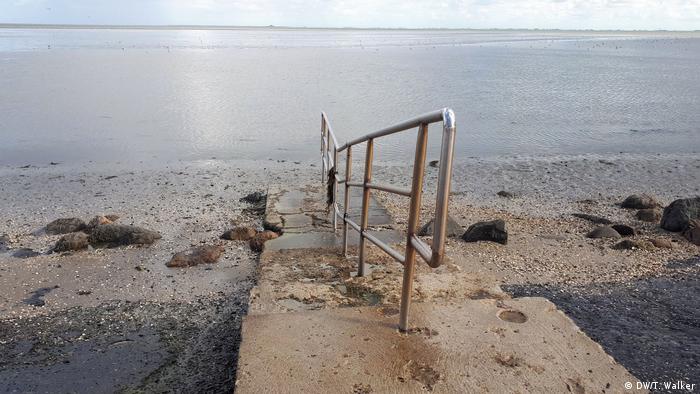
A railing and steps lead down to a calm sea (DW/T. Walker)
When the sea is calm, so is the sense of living alongside it.
For Thomas Langmaack of the northern state of Schleswig-Holstein's agency for coastal defense, national parks and marine conservation (LKN), that's a cause for concern.


Too close yet too comfortable

It is also his job to foster an understanding among communities inhabiting the 3,900 square kilometers (1,505 square miles) of lowland — some of which was originally sea snared over time through the construction of dikes — of the capricious and sometimes ferocious nature of the waters that swirl around them.

"People have largely become careless," Langmaack said. "They've suppressed it, because there hasn't been a devastating storm surge for several decades."

And because the several hundred kilometers of complex dikes form a wall between them and the sea, they are safer than ever before.

predicted sea level rise
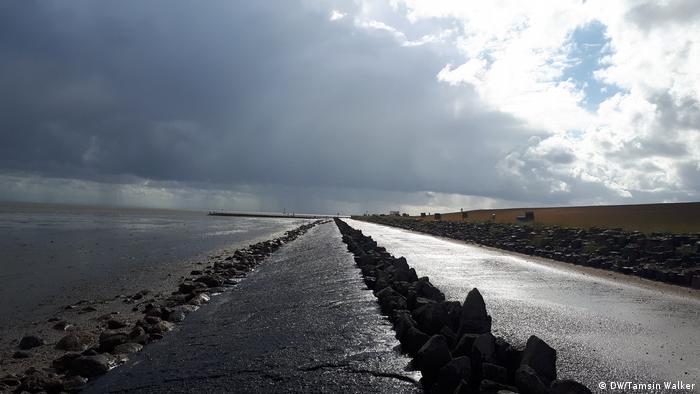
Dikes are constantly being repaired and renewed

Dikes are constantly being repaired and renewed to enable the people to continue to live in the flatlands in relative safety
"But even they can fail," LKN spokesman Hendrik Brunkhorst said. "We have to make people aware of the dangers."

The sea rose only 28 centimeters (11 inches) between 1940 and 2007, which is in keeping with recordings from the previous century. But there is a sense of urgency about the need to prepare local communities for the worst, in part stirred by cyclone Xaver, which hit the region in 2013, but also because both sea and storm water levels are predicted to rise within the coming decades.

Planning for the unknown

Besides alerting the population, the agency for coastal defense has been strengthening its fortifications with so-called "climate dikes."

A far cry from the early hand-built clay incarnations that began appearing on the flat northern German landscape around a millennium ago, these precision-engineered giant green slopes are designed to keep the waves at bay in such a way that it would be easy to add a new layer on top if water levels were to suddenly rise much faster than current forecasts suggest.

"We have to look to the future," Langmaack said. "What we have is rising temperatures, and that means rising sea levels, but nobody can tell us how the curve is going to develop, and that makes it very difficult."

"We're genuinely planning for the next 100 years," he continued."

.......................

"As a conservationist, Fröhlich doesn't generally sanction the idea of tampering with nature, but climate change  induced sea level rise could, he says, be grounds enough for an exception.

"I think we underestimate what's around the corner," he said. "I'm worried that large parts of this area will be lost. I really am."

And if that happens, if the Wadden Sea starts to swallow itself, there's a very good chance the sense of calm it instills in those who live with and from it, will sink as well."

Go to the original, complete, 2018 DW article

Ref: Sea Level Rise and Implications for Low-Lying Islands, Coasts and Communities: IPCC

Related:  Related: East Antarctic Melting Hotspot Identified by Japanese Expedition – Ice Melting at Surprisingly Fast Rate: SciTechDaily

Thursday, 20 August 2020

Lessons From the Frontlines of Global Warming (excerpt): New Republic

"What interviews with flood, wildfire, and drought survivors can teach us about how to live amid the threat of climate change

 
What would you do if your house burned down or your neighborhood washed away in a flood?
Extreme heat kills

Ronnie Scott lost his wife when she tried to to rescue their dog and cat from floodwaters in West Virginia in 2016. Carole Duncan almost lost her 83-year-old father during Australia’s massive 2019 bushfires, the firefighters finding him just in time. 

KerryAnn Laufer returned home days after the 2019 Kincade Fire in California to find only her fireplace still standing, while Dave Mackey saw nearly every house in his neighborhood on Grand Bahama island washed away, pummeled by raging waters and 200-mile-per-hour winds from Hurricane Dorian.


What would you do if your house burned down or your neighborhood washed away in a flood?
Storms, wildfires, and other such disasters are getting more common and intense as climate change accelerates. Scott, Duncan, Laufer, and Mackey, who survived these extreme weather events, are among the lucky ones. But each of them found themselves changed by the experience.


What would you do if your house burned down or your neighborhood washed away in a flood? How would you respond if a cataclysmic weather event killed someone you love or forced you to abandon, perhaps forever, the place you call home? And how would it change the way you think about the world?


These questions are at the heart of a new “Voices from the Future”
What would you do if your house burned down or your neighborhood washed away in a flood?
Green new deal is cheap actually
interview series a small group of journalist, researchers, and I have developed at the Julie Ann Wrigley Global Futures Laboratory at Arizona State University. We have collected the stories and insights of nearly three dozen survivors on five continents, eight of which will be published in these pages over the next few weeks."


Original story 

Steven Beschloss is a professor of practice at the Walter Cronkite School of Journalism and Mass Communication and directs the Narrative Storytelling Initiative at Arizona State University. He has written for The New Yorker and The Washington Post, among other publications.


#California, #firestorms, #wildfire, Australia, cyclones, floods, Green New Deal, hurricanes, 


Friday, 14 August 2020

Sea Level Rise Effect on Mumbai of 1.5m rise

Mumbai, land at risk from 1.5m sea rise
 • We are looking more and more unlikely to prevent global heating.

• Scientists are predicting the melting of the ice covering Greenland with a subsequent sea level rise of 7m.

• This rise does not factor in sea rise from the melting of Antarctica and other ice.

• Already many properties are likely to flood when a high tide is combined with high local rainfall. 
 

What were a hundred year rainfall events are now ten year events.


Mumbai, land at risk with 1.0m sea rise
 
• The frequency of high rainfall events will increase with global heating and more and more severe hurricanes are predicted because of warmer seas.


• Low coastal areas will be subjected to severe storm surges.

• Would you buy a property likely to be inundated in twenty years, fifty years, a hundred years? Many wouldn't. Even the perception of possible inundation will greatly affect property values. Some properties will become more expensive to insure or become impossible to insure

• When certain properties are in less demand their value falls.

• Would you buy a property with a value that is likely to fall?

•  The view of Mumbai above shows areas likely to be inundated by a 1.5m and a 1.0m sea level rise.

• Property above a 10m rise will become highly sought after and will greatly increase in value.

Learn more about how sea rise inundation will affect India's property, indeed any property, at climatecentral.org


Related:

Greenland shed ice at unprecedented rate in 2019; Antarctica continues to lose mass: EurekAlert


Melbourne: predicted flooding with a conservative sea level rise of only 1.5m


#sea level rise, #Greenland ice melt, #sea ice, #climateaction, #climatechange, #jailclimatecriminals, #cambio-climatico,